Key facts
- -(으)ㄹ게요 is a promise, an offer or a decision made at the moment of speaking.
- -(으)ㄹ 거예요 states a plan or a prediction and works with any subject.
What you'll learn
- Say which pattern is a promise or offer and which is a plan or prediction.
- Build both patterns for vowel stems, consonant stems, ㄹ stems and common irregular verbs.
- Choose the right pattern for five sentences and give the reason.
- Avoid the most common mistakes, such as a question with -(으)ㄹ게요 and the spelling -(으)ㄹ께요.
Before you start: you should know the polite ending -아요/어요 and the -(으)ㄹ modifier. The full future tense lesson is on its own page, linked below. Audio plays only when you press a button.
What Is the Difference between -(으)ㄹ게요 and -(으)ㄹ 거예요?

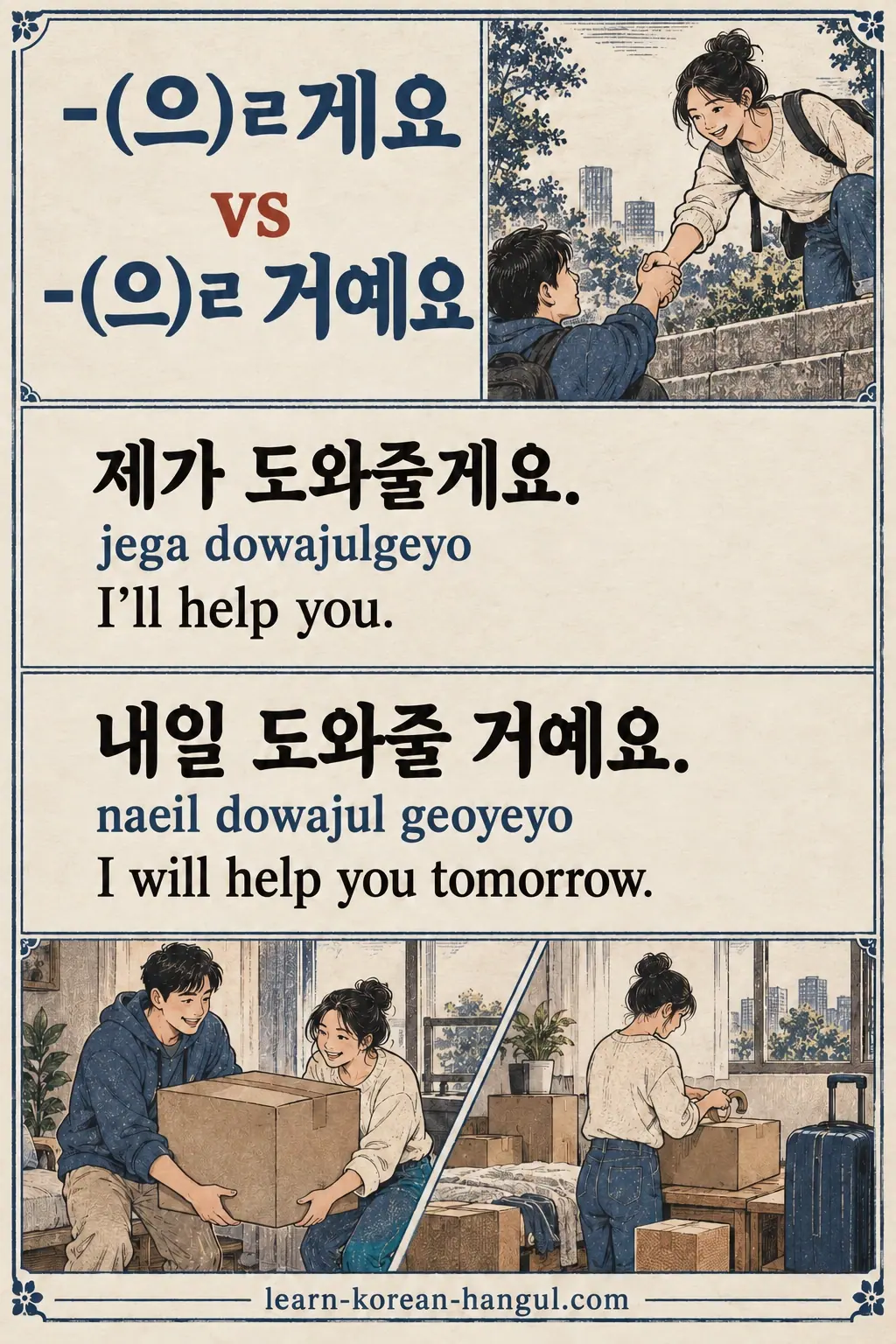
The difference is where the decision comes from. With -(으)ㄹ게요 the speaker decides right now, because of what the listener just said or did. With -(으)ㄹ 거예요 the speaker reports a plan that was already made, or guesses what will happen. English uses "I'll" for the first and "I will" or "I'm going to" for the second.
Here are two sentences about the same help.
제가 도와줄게요. (jega dowajulgeyo) "I'll help you." Pronunciation: [제가 도와줄께요]. Imagine that your friend is struggling with a heavy box. You see it, and you speak. The offer is made for the listener, at this moment.
내일 도와줄 거예요. (naeil dowajul geoyeyo) "I will help you tomorrow." Pronunciation: [내일 도와줄꺼예요]. The sentence reports a plan. It does not respond to anything that has just happened, and it is not an offer on the spot.
The first sentence is a gift to the listener, and the second one is information. The next section lines the two patterns up in a table.
-(으)ㄹ게요 vs -(으)ㄹ 거예요: Side-by-Side Table
The table compares the two patterns on the points that decide the choice.
| Point | -(으)ㄹ게요 | -(으)ㄹ 거예요 |
|---|---|---|
| Core meaning | I'll (a promise, offer or decision) | I will, I'm going to; it will (a plan or prediction) |
| When the decision is made | now, in response to the listener | before now, or not decided by anyone |
| Subject | the speaker (I) | any subject |
| Prediction | no | yes: 비가 올 거예요 |
| Question | no | yes: 뭐 할 거예요? |
| With adjectives | no | yes: 예쁠 거예요 |
| Built from | stem + -(으)ㄹ게요 | stem + -(으)ㄹ + 거예요 |
| Casual form | -(으)ㄹ게 | -(으)ㄹ 거야 |
| Formal counterpart | -겠습니다 | -(으)ㄹ 겁니다 |
| Example | 먼저 갈게요. | 주말에 부산에 갈 거예요. |
Two notes sit behind the table. First, both patterns are pronounced with a tense consonant after the ㄹ: [갈께요] and [갈꺼예요]. The spelling does not change: the ending is written 게요 and 거예요. Second, the formal counterpart of -(으)ㄹ게요 is -겠습니다, as in 열심히 하겠습니다 (yeolsimhi hagetseumnida), "I will do my best". The formal counterpart of -(으)ㄹ 거예요 is -(으)ㄹ 겁니다.
When Do You Use -(으)ㄹ게요?

Use -(으)ㄹ게요 when you promise, offer or decide something in response to the person you are talking to. A vowel stem takes ㄹ게요, a consonant stem takes 을게요, and a ㄹ stem keeps its ㄹ.
| Dictionary form | Meaning | -(으)ㄹ게요 form | Spoken |
|---|---|---|---|
| 가다 | to go | 갈게요 | [갈께요] |
| 전화하다 | to call | 전화할게요 | [전화할께요] |
| 먹다 | to eat | 먹을게요 | [머글께요] |
| 사다 | to buy | 살게요 | [살께요] |
| 듣다 | to listen | 들을게요 | [드를께요] |
| 돕다 | to help | 도울게요 | [도울께요] |
The irregular verbs follow the usual rule, because 을게요 begins with a vowel: 듣다 becomes 들을게요, and 돕다 becomes 도울게요.
Here are four typical uses.
- A promise. 알겠어요, 조심할게요. (algesseoyo, josimhalgeyo.) "Okay, I'll be careful."
- A decision when leaving. 먼저 갈게요. (meonjeo galgeyo) "I'll go first (I'm leaving now)."
- An offer to pay or help. 커피는 제가 살게요. (keopineun jega salgeyo) "I'll buy the coffee." Also 제가 들어 드릴게요 ("I'll carry it for you").
- A quick promise. 이따가 전화할게요. (ittaga jeonhwahalgeyo) "I'll call you later."
Notice three limits. The subject must be the speaker, so 동생이 할게요 is wrong. The verb must be an action, so 예쁠게요 is wrong, but the verb 있다 is allowed when it means "to stay": 여기 있을게요 ("I'll stay here"). And the ending is not used for a normal question. For the full rules, read the lesson on -(으)ㄹ게요.
When Do You Use -(으)ㄹ 거예요?

Use -(으)ㄹ 거예요 when you state a plan, give a forecast or ask about someone's plan. The pattern is the future tense in beginner courses. A vowel stem takes ㄹ 거예요, a consonant stem takes 을 거예요, and a ㄹ stem takes only 거예요.
| Dictionary form | Meaning | -(으)ㄹ 거예요 form | Spoken |
|---|---|---|---|
| 가다 | to go | 갈 거예요 | [갈꺼예요] |
| 일하다 | to work | 일할 거예요 | [일할꺼예요] |
| 먹다 | to eat | 먹을 거예요 | [머글꺼예요] |
| 오다 | to come | 올 거예요 | [올꺼예요] |
| 놀다 | to play | 놀 거예요 | [놀꺼예요] |
Here are four typical uses.
- A plan. 이번 주말에 부산에 갈 거예요. (ibeon jumare busane gal geoyeyo) "I'm going to Busan this weekend." Pronunciation: [이번 주마레 부사네 갈꺼예요].
- A longer-term plan. 저는 내년에 한국에서 일할 거예요. (jeoneun naenyeone hangugeseo ilhal geoyeyo) "I will work in Korea next year." Pronunciation: [저는 내녀네 한구게서 일할꺼예요].
- A prediction. 내일 비가 올 거예요. (naeil biga ol geoyeyo) "It will rain tomorrow."
- A question about someone's plan. 내일 뭐 할 거예요? (naeil mwo hal geoyeyo?) "What are you going to do tomorrow?"
The pattern is flexible, because the subject can be I, you or anyone, and the sentence can be a statement or a question. It can also use adjectives: 내일은 추울 거예요 ("It will be cold tomorrow"). For the full rules, read the lesson on future tense -(으)ㄹ 거예요.
Can You Use Both in the Same Sentence?

Both patterns can sit in the same conversation, and sometimes in the same sentence. They describe two different things: what you promise right now and what you plan for later.
- 오늘은 일찍 갈게요. 내일은 늦게 갈 거예요. "I'll go early today (I promise). Tomorrow I'll go late (that is my plan)."
A conversation shows both patterns at work. Two friends plan lunch.
A: 내일 같이 점심 먹을래요? (naeil gachi jeomsim meogeullaeyo?) "Do you want to have lunch together tomorrow?"
B: 네, 좋아요. 제가 식당을 예약할게요. (ne, joayo. jega sikdangeul yeyakalgeyo.) "Yes, good. I'll book a restaurant."
A: 고마워요. 저는 열두 시에 갈 거예요. (gomawoyo. jeoneun yeoldu sie gal geoyeyo.) "Thank you. I'm going to go at twelve."
Speaker B reacts to A's invitation and offers a service, so -(으)ㄹ게요 fits. Speaker A tells a plan, so -(으)ㄹ 거예요 fits. A single speaker can switch between the two within a minute.
One overlap needs care. When someone asks 누가 할 거예요? ("Who will do it?"), the answers 제가 할게요 and 제가 할 거예요 are both possible. The first volunteers on the spot. The second announces a decision that has already been made and can sound firm or even defensive. In an everyday offer, -(으)ㄹ게요 sounds warmer.
How Do Negatives, Honorifics and the past Work?
The two patterns also differ when you add a negative, an honorific or a past meaning.
| Feature | -(으)ㄹ게요 | -(으)ㄹ 거예요 |
|---|---|---|
| Negative | 안 갈게요 or 가지 않을게요: "I won't go" (a decision) | 안 갈 거예요: "I am not going" (a plan) |
| Honorific for the subject | not used for yourself; to show respect to the listener, pick a polite verb such as 드리다 | 선생님은 내일 오실 거예요: "The teacher will come tomorrow" |
| Past meaning | none | 친구는 벌써 갔을 거예요: "My friend has probably already left" |
The negative with -(으)ㄹ게요 is a decision made on the spot, for example 저는 안 갈게요 ("I won't go, then"). The negative with -(으)ㄹ 거예요 reports that you do not plan to go. The honorific -(으)시- raises the subject, and the subject of -(으)ㄹ게요 is always "I", so the honorific does not appear on it. In the last row, the past marker -았/었 turns -(으)ㄹ 거예요 into a guess about the past. -(으)ㄹ게요 has no past form, because a promise always looks forward.
Which One Should You Pick? a Simple Rule of Thumb
Ask three questions in order.
- Is the subject anyone other than "I"? If yes, use -(으)ㄹ 거예요. Example: 동생이 도와줄 거예요.
- Is the sentence a question, a forecast or about an adjective? If yes, use -(으)ㄹ 거예요. Example: 내일 뭐 할 거예요?
- Are you saying "I will" in answer to the listener, to offer, promise or decide on the spot? If yes, use -(으)ㄹ게요. Example: 제가 들어 드릴게요.
If you say "I will" about something you have planned for a long time, choose -(으)ㄹ 거예요, because nobody is asking you for it right now.
What Mistakes Do Learners Make with These Two?
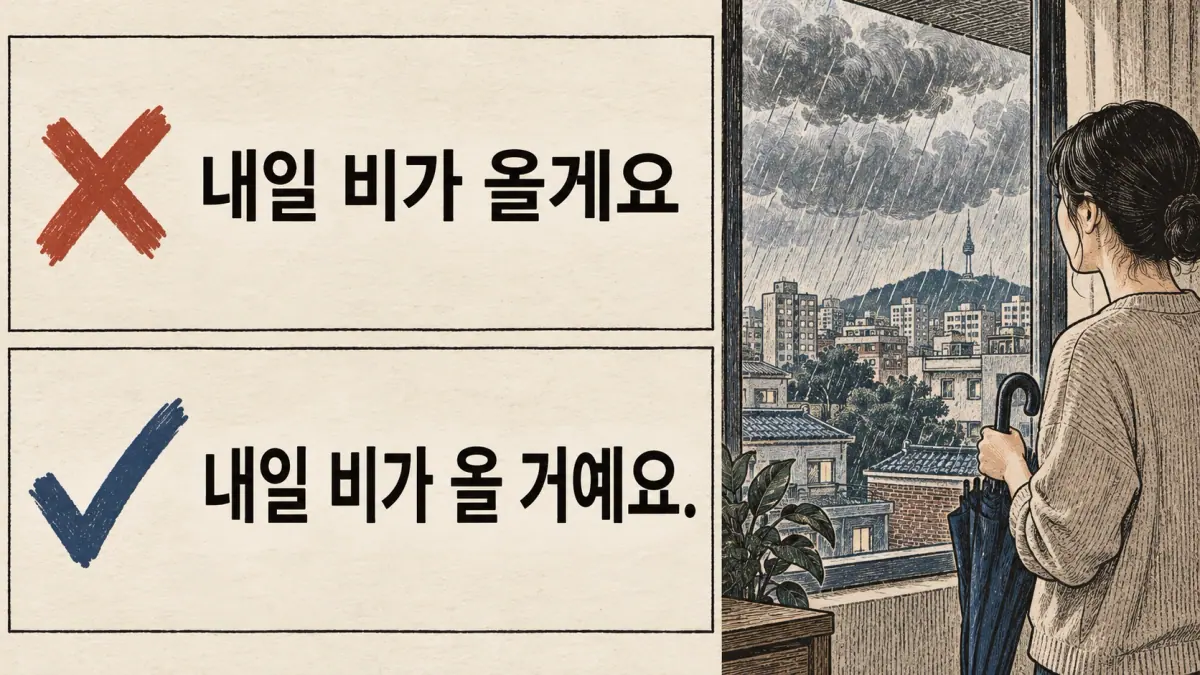
The commonest mistakes break the three limits of -(으)ㄹ게요. Five of them appear again and again.
- Making -(으)ㄹ게요 a question. 뭐 할게요? is not a normal question. Say 뭐 할 거예요? or 뭐 할래요?.
- Using -(으)ㄹ게요 for another person. 친구가 올게요 is wrong. Say 친구가 올 거예요.
- Using -(으)ㄹ게요 for a prediction. 내일 비가 올게요 is wrong. Say 내일 비가 올 거예요.
- Spelling it with 께. The standard spelling is -(으)ㄹ게요, never -(으)ㄹ께요, even though the sound is tense. The same applies to -(으)ㄹ 거예요: it is not written 꺼예요.
- Answering an offer with a stiff plan. When someone asks for help, 제가 할 거예요 can sound as if you are announcing your own business. Say 제가 할게요.
A quick self-check: ask "Am I answering a person right now?" If yes, -(으)ㄹ게요 is the natural choice. If no, -(으)ㄹ 거예요 is.
Practice: Choose the Right Pattern
Try the five questions, then read the answers below.
Practice · 5
Your friend is carrying many bags. Which sentence fits? 제가 ___.
Show answer
들어 드릴게요
An offer made on the spot uses -(으)ㄹ게요.
You want to ask about someone's weekend plan. Which sentence fits? 주말에 뭐 ___?
Show answer
할 거예요
A question about a plan uses -(으)ㄹ 거예요. -(으)ㄹ게요 cannot be a normal question.
Which sentence is a prediction?
Show answer
내일 비가 올 거예요.
A prediction about the weather needs -(으)ㄹ 거예요.
Which spelling is standard?
Show answer
갈게요
The standard spelling is -(으)ㄹ게요, although it is pronounced with a tense ㄱ.
Your friend asks, "Who will pay?" You want to volunteer warmly. Which sentence fits?
Show answer
제가 낼게요.
A warm volunteer offer uses -(으)ㄹ게요. A third-person subject is not allowed with this pattern.
Answer key
- 들어 드릴게요. The sentence is 제가 들어 드릴게요.
- 할 거예요. The sentence is 주말에 뭐 할 거예요?
- 내일 비가 올 거예요.
- 갈게요.
- 제가 낼게요.
Now write your own pair: one offer you could make to a friend today (with -(으)ㄹ게요), and one plan for next weekend (with -(으)ㄹ 거예요).
What Should You Learn Next?
After this comparison, study each pattern on its own lesson page, then look at the other pairs on the list.
- Learn the full rules for -(으)ㄹ게요, including the casual -(으)ㄹ게.
- Learn the full rules for future tense -(으)ㄹ 거예요, including the irregular verbs.
- Read the other common mix-up, -(으)ㄹ게요 vs -(으)ㄹ래요.
- Compare other confusable pairs on Confusing Grammar Compared.
- See where both patterns sit on the Beginner Grammar list.
Frequently Asked Questions
What Is the Difference between -(으)ㄹ게요 and -(으)ㄹ 거예요?
-(으)ㄹ게요 is a promise, an offer or a decision that the speaker makes now, in response to the listener or the situation. -(으)ㄹ 거예요 states a plan that already exists or a prediction. Compare 제가 도와줄게요 (I'll help you) with 내일 도와줄 거예요 (I will help you tomorrow).
Can I Always Replace -(으)ㄹ게요 with -(으)ㄹ 거예요?
No. -(으)ㄹ 거예요 can replace it in some statements about yourself, but the sentence then sounds like an announcement and loses the warmth of an offer. The reverse does not work: -(으)ㄹ게요 cannot express a prediction, take a third-person subject or form a question.
Which One Sounds More Natural in Speech?
-(으)ㄹ게요 is the natural choice for promises and offers in conversation, such as 먼저 갈게요. -(으)ㄹ 거예요 is the natural choice for plans and predictions, such as 주말에 부산에 갈 거예요. Both are common, and the situation decides.
Which One Appears More Often on TOPIK?
This site does not publish exam statistics. Both patterns are taught at the beginner to lower-intermediate stage. For current exam content, check the official TOPIK site (topik.go.kr), which publishes the level descriptions and past papers.
What Is the Quickest Rule to Remember?
Ask whether you are answering the person in front of you. If you are promising, offering or deciding on the spot, use -(으)ㄹ게요. If you are telling a plan or guessing what will happen, use -(으)ㄹ 거예요.