
| Korean | Name | Romanization | Family | Sound |
|---|---|---|---|---|
| ㄱ | 기역 (giyeok) | g / k | plain | g in "go", softer at the start of a word |
| ㄴ | 니은 (nieun) | n / n | other | n in "no" |
| ㄷ | 디귿 (digeut) | d / t | plain | d in "do" |
| ㄹ | 리을 (rieul) | r / l | other | quick tap between r and d |
| ㅁ | 미음 (mieum) | m / m | other | m in "me" |
| ㅂ | 비읍 (bieup) | b / p | plain | b in "boy" |
| ㅅ | 시옷 (siot) | s / t | plain | s in "sun" |
| ㅇ | 이응 (ieung) | none / ng | other | silent |
| ㅈ | 지읒 (jieut) | j / t | plain | j in "jam" |
| ㅊ | 치읓 (chieut) | ch / t | aspirated | ch in "cheese" with a puff |
| ㅋ | 키읔 (kieuk) | k / k | aspirated | k in "kite" with a puff |
| ㅌ | 티읕 (tieut) | t / t | aspirated | t in "top" with a puff |
| ㅍ | 피읖 (pieup) | p / p | aspirated | p in "pin" with a puff |
| ㅎ | 히읗 (hieut) | h / t | other | h in "hat" |
| ㄲ | 쌍기역 (ssanggiyeok) | kk / k | tense | k with a tight throat |
| ㄸ | 쌍디귿 (ssangdigeut) | tt / none | tense | t with a tight throat |
| ㅃ | 쌍비읍 (ssangbieup) | pp / none | tense | p with a tight throat |
| ㅆ | 쌍시옷 (ssangsiot) | ss / t | tense | s said with tension |
| ㅉ | 쌍지읒 (ssangjieut) | jj / none | tense | j with a tight throat |
What Are Korean Consonants?
Korean consonants (자음, jaeum) are the letters that start or close a syllable block in Hangul. Every block has at least one consonant and one vowel: in 한, the consonant ㅎ opens the block and ㄴ closes it, with the vowel ㅏ between them. If a block starts with a vowel sound, it uses the silent consonant ㅇ as a placeholder.
The consonants make up 19 of the 40 letters in the alphabet. Their shapes, names and sounds follow clear patterns, so the 19 are easier to learn than they look. The grid below arranges them by where in the mouth you make the sound (rows) and by series (columns).
| Place in the mouth | Plain | Aspirated | Tense |
|---|---|---|---|
| Back of the tongue | ㄱ | ㅋ | ㄲ |
| Tongue tip | ㄷ | ㅌ | ㄸ |
| Lips | ㅂ | ㅍ | ㅃ |
| Tongue blade (hissing) | ㅅ | none | ㅆ |
| Flat tongue on the palate | ㅈ | ㅊ | ㅉ |
| No three-way pair | ㄴ ㅁ ㅇ ㄹ ㅎ |
How Many Korean Consonants Are There?
Korean has 19 consonant letters. Of these, 14 are basic: ㄱ ㄴ ㄷ ㄹ ㅁ ㅂ ㅅ ㅇ ㅈ ㅊ ㅋ ㅌ ㅍ ㅎ. The other 5 are double consonants made by writing a basic letter twice: ㄲ ㄸ ㅃ ㅆ ㅉ. Be careful with the overlap: the four aspirated letters ㅋ ㅌ ㅍ ㅊ are already inside the 14, so 14 + 5 = 19 with no letter counted twice.
The next section walks through the 14 basic letters.
The 14 Basic Korean Consonants
The 14 basic consonants are listed below in the traditional 가나다 order, with each letter's name and Revised Romanization (RR) value at the start and end of a syllable. RR is South Korea's official Latin spelling; here it is only a learning aid.
| Letter | Name | Start | End | Lesson |
|---|---|---|---|---|
| ㄱ | 기역 (giyeok) | g | k | ㄱ lesson |
| ㄴ | 니은 (nieun) | n | n | ㄴ lesson |
| ㄷ | 디귿 (digeut) | d | t | ㄷ lesson |
| ㄹ | 리을 (rieul) | r | l | ㄹ lesson |
| ㅁ | 미음 (mieum) | m | m | ㅁ lesson |
| ㅂ | 비읍 (bieup) | b | p | ㅂ lesson |
| ㅅ | 시옷 (siot) | s | t | ㅅ lesson |
| ㅇ | 이응 (ieung) | silent | ng | ㅇ lesson |
| ㅈ | 지읒 (jieut) | j | t | ㅈ lesson |
| ㅊ | 치읓 (chieut) | ch | t | ㅊ lesson |
| ㅋ | 키읔 (kieuk) | k | k | ㅋ lesson |
| ㅌ | 티읕 (tieut) | t | t | ㅌ lesson |
| ㅍ | 피읖 (pieup) | p | p | ㅍ lesson |
| ㅎ | 히읗 (hieut) | h | t | ㅎ lesson |
The full lesson set for the ten letters not in the aspirated group sits in basic Korean consonants. Letters like ㄱ, ㄷ, ㅂ and ㅈ get two romanizations because their sound shifts with position: ㄱ is g at the start of a syllable but k at the end.
These 14 letters are the consonants you will meet most often in print. The next group adds breath.
Aspirated Consonants: ㅋ ㅌ ㅍ ㅊ

Aspirated consonants are plain consonants released with a strong puff of air. Each is a plain letter plus one stroke: ㄱ becomes ㅋ, ㄷ becomes ㅌ, ㅂ becomes ㅍ and ㅈ becomes ㅊ. English speakers already make this puff on the p in "pin". Full lessons with audio are in Aspirated Consonants. ㅎ is not counted among the four, though it creates aspiration when it meets ㄱ, ㄷ, ㅂ or ㅈ, as in 축하 [추카] (congratulations).
Double Consonants: ㄲ ㄸ ㅃ ㅆ ㅉ

Double consonants are tense sounds, made with a tight throat and no puff of air. They are written by doubling a plain letter: ㄱ becomes ㄲ, ㄷ becomes ㄸ, ㅂ becomes ㅃ, ㅅ becomes ㅆ and ㅈ becomes ㅉ. The lessons are Double Consonants, with one page each for ㄲ, ㄸ, ㅃ, ㅆ and ㅉ. The tense letters ㄸ, ㅃ and ㅉ never appear as final consonants.
Korean Consonant Names
Each consonant has a name used when you spell aloud. Most follow a simple pattern: the letter's sound plus ㅣ, then a syllable that starts with a vowel and ends in the letter. Three names are irregular: ㄱ is 기역, ㄷ is 디귿 and ㅅ is 시옷. The double letters add 쌍 (ssang, "twin") in front: ㄲ is 쌍기역. See Korean Consonant Names for audio and the full list.
How Were the Consonant Shapes Designed?
Five base shapes generate the rest of the consonants. According to 훈민정음 해례본 (Hunminjeongeum Haerye), the 1446 commentary that introduced Hangul, the five base letters copy the mouth: ㄱ shows the back of the tongue, ㄴ the tongue tip, ㅁ the shape of the mouth, ㅅ the teeth and ㅇ the throat. Stronger sounds get an extra stroke, and tense sounds are doubled.
| Base | Added strokes | Doubled |
|---|---|---|
| ㄱ | ㅋ | ㄲ |
| ㄴ | ㄷ, ㅌ | ㄸ |
| ㅁ | ㅂ, ㅍ | ㅃ |
| ㅅ | ㅈ, ㅊ | ㅆ, ㅉ |
| ㅇ | ㅎ | none |
This is why learning five shapes opens up a whole family: each new letter is a base letter with one change. ㄹ is a special case: Hunminjeongeum treats it as its own "half-tongue" sound, and it has its own lesson.
Where Should You Start with Korean Consonants?
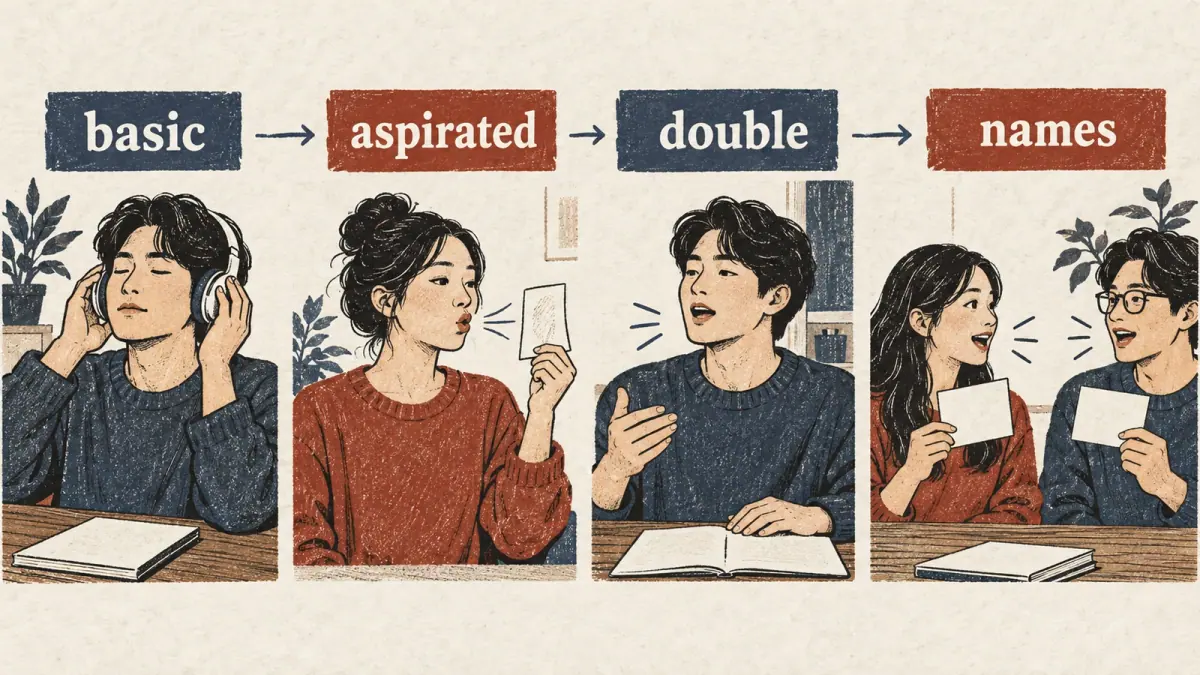
Start with the problem you have today. The choice below sends you to the right subhub.
- You cannot hear the difference between ㄱ, ㅋ and ㄲ. Open Aspirated Consonants, then plain, tense and aspirated sounds.
- You confuse ㄹ with ㄴ or cannot say r and l. Open the lesson on the letter ㄹ, then review ㄴ in basic Korean consonants.
- You cannot say final sounds such as the ㄱ in 책. Read seven final sounds.
- You need letter names to spell aloud. Use Korean Consonant Names.
If you are a complete beginner, follow the order: basic, aspirated, double, names.
Plain vs Aspirated vs Tense: Comparison Table

The three series differ in breath and throat tension. The table compares them with one example set each.
| Feature | Plain (ㄱ) | Aspirated (ㅋ) | Tense (ㄲ) |
|---|---|---|---|
| Breath | light | strong puff | none |
| Throat | relaxed | relaxed | tight |
| Example | 개 (dog) | 캐다 (to dig up) | 깨 (sesame) |
| RR | g | k | kk |
See plain, tense and aspirated sounds for a full treatment.
Which Consonants Change at the End of a Syllable?
At the end of a syllable, the 16 consonant letters that can appear there collapse to 7 final sounds: [k], [n], [t], [l], [m], [p] and [ŋ]. The rule comes from the South Korean standard pronunciation rules (표준 발음법) of the National Institute of Korean Language (국립국어원). Examples: ㅅ in 옷 (clothes) sounds like [t], giving [옫]; ㅋ in 부엌 sounds like [k], giving [부억]. The tense letters ㄸ, ㅃ and ㅉ never appear as finals.
Learn the details in seven final sounds.
Practice Tools for Korean Consonants

Use these resources after the lessons:
- The Korean consonants chart is a printable reference with start and end sounds.
- Consonant flashcards drill shapes and sounds.
- The interactive hangul alphabet plays every letter.
- Pair consonants with Korean vowels to make blocks.
For the wider picture, return to the Korean alphabet hub.
The audio on these pages is generated and awaits review by a Korean specialist. All Korean consonants are covered in the lessons linked above.
Frequently Asked Questions
Does Korean have an F or V sound?
No. Standard Korean has no f or v. Loanwords replace them with the nearest letters: f becomes ㅍ, as in 파이팅 (fighting, a cheer), and v becomes ㅂ, as in 비타민 (vitamin). This follows the official loanword orthography (외래어 표기법). Korean speakers can learn to say f and v, but the writing system does not mark them.
Why do Korean consonants have two romanizations?
Several consonants change sound by position, and Revised Romanization follows the sound. ㄱ is g at the start of a syllable but k at the end, ㄷ is d or t, ㅂ is b or p, and ㄹ is r or l. The Hangul spelling stays the same. The two Latin forms record two pronunciations of one letter.
Is ㅇ a consonant?
Yes. ㅇ is a consonant letter with two jobs. At the start of a syllable it is silent and only fills the empty slot, so 아 sounds like ㅏ alone. At the end of a syllable it sounds like ng, as in 강 (river) [강] gang. The name of the letter is 이응 (ieung).
Which Korean consonant is hardest for English speakers?
It varies by learner, but two things cause trouble most often: the three-way contrast between plain, aspirated and tense sounds, such as ㄱ, ㅋ and ㄲ, and the single letter ㄹ, which covers both r and l. Listening practice with minimal sets and a few minutes of daily repetition usually helps most.