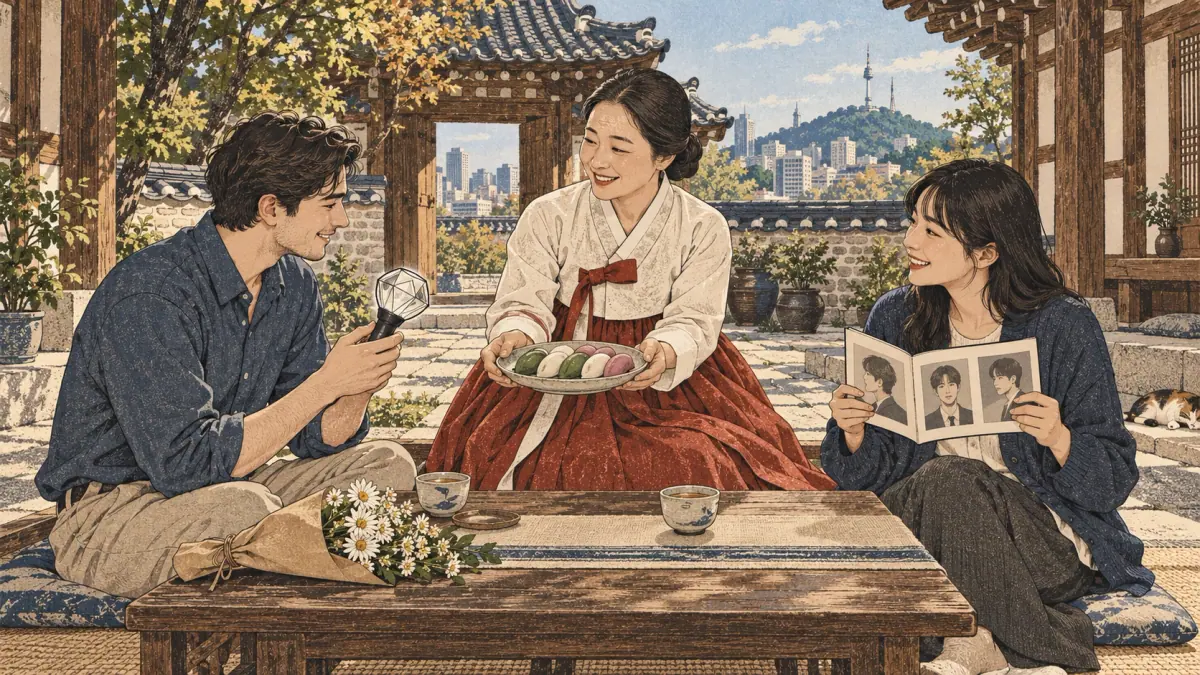
Korean Culture Vocabulary at a Glance
Korean culture vocabulary is the set of words that Koreans use for their holidays, entertainment, traditions and life events. Many of these words have no exact English equivalent, so every list on this site uses the same method: a short English gloss, a note on how the word is used, and an example sentence. Take 명절, for example. It is glossed as traditional holiday, and the note explains that it names the big family holidays, Seollal and Chuseok.
The section belongs to Korean Vocabulary. For manners, names and language facts, which this section does not cover, see Korean language and culture.
| List | Best for | Level |
|---|---|---|
| Holidays and Celebrations | Reading a Korean calendar and joining a celebration | A1 |
| K-Pop Words | Following idols and fan posts | A1 |
| K-Drama Words | Understanding drama summaries and fan talk | A1 |
| Traditional Culture | Hanbok, hanok, palaces and leisure places | A2 |
| Korean Wedding Vocabulary | Attending a wedding | B1 |
| Korean Funeral Vocabulary | Understanding a funeral notice | B1 |
| Korean Religions Vocabulary | Talking about faith and places of worship | B1 |
Which List Should You Open First?
Open the list that matches your next real situation. A useful way to choose is to ask what you need the words for: to understand the news, to take part in a ceremony or to follow fan culture. News words are mostly the holiday words, because 명절 and 연휴 appear in every news bulletin before Seollal and Chuseok. Ceremony words are the wedding and funeral lists. Fan words are the K-pop and K-drama lists.
- To read the news and a calendar. Start with Holidays and Celebrations and its calendar words.
- To follow fan culture. Start with K-Pop Words or K-Drama Words. Both are A1, and many of the words are English loanwords, so they are easy to read.
- To take part in a ceremony. Start with Korean Wedding Vocabulary or Korean Funeral Vocabulary. Both are B1, because the words are formal.
- To understand history and places. Start with Traditional Culture, which leads to the leisure places list.
- To talk about belief. Start with Korean Religions Vocabulary.
The levels are editorial estimates, and a beginner can read the A1 lists straight away.




Holidays and Celebrations
Holidays and Celebrations lists 40 words for birthdays, Seollal, Chuseok, the national holidays, seasonal days and imported days such as Christmas. It is the best first stop if you want to read a Korean calendar. The deeper page Seollal and Chuseok vocabulary covers the ritual, food and travel words of the two biggest holidays.
What Is in the K-Pop List?
K-Pop Words lists 45 words in five groups: the idol industry, fandom, concerts and events, music and releases, and fan-made content. It explains 최애, the favourite member, and shows how fans use words such as 컴백 and 응원봉. Two deeper pages cover the industry and the fandom. The Korean for K-pop fans course is a guided path if you want lessons in order.
K-Drama
K-Drama Words lists 45 words: drama basics, characters, plot tropes, settings and fan words. Two deeper pages follow it, K-drama tropes and roles and Squid Game vocabulary. The list also shows why English subtitles can mislead: words such as 오빠 and 선배 are translated in different ways.
What Is in the Traditional Culture List?
Traditional Culture gathers about 40 words in groups for hanbok, hanok and ondol (the underfloor heating of a traditional house), palaces and history, and leisure places. The first published deeper page is Korean leisure places vocabulary, which covers the 찜질방, the 노래방 and the other rooms ending in 방.
Life Events
Two lists cover the ceremonies at the two ends of life. Korean Wedding Vocabulary has 35 words for engagement, the ceremony, guests and gifts, and the traditional 폐백. Korean Funeral Vocabulary has 30 words for the funeral hall, mourners, condolence money, mourning dress and the memorial rites. Both are B1, and the funeral page teaches words only and does not give advice on etiquette.
What Is in the Religion List?
Korean Religions Vocabulary has 30 words for the main religions, places of worship, people and roles, and rituals and festivals.
Seven Culture Words to Start With
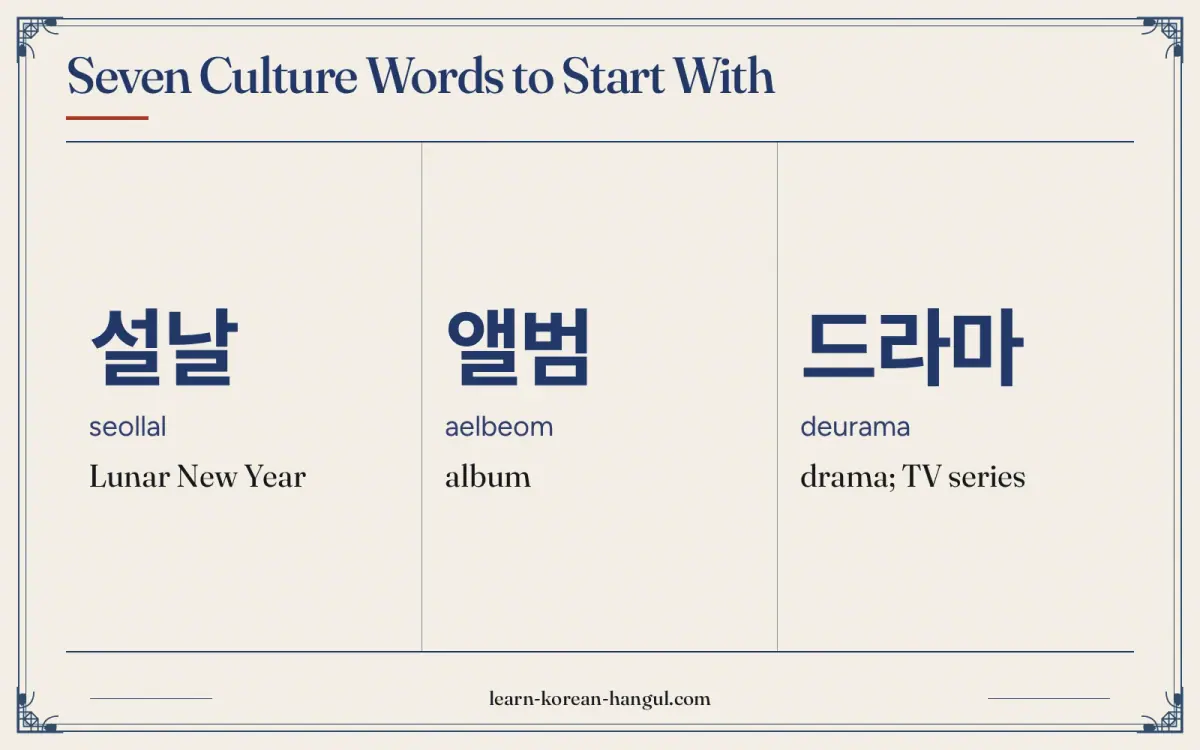
These seven words come one from each list. Press each button, repeat the word and compare.
| No. | Hangul | Revised Romanization | Origin | Meaning | Example sentence | List | Audio assetId |
|---|---|---|---|---|---|---|---|
| 1 | 설날 | seollal | native | Lunar New Year | 설날에 한복을 입어요. (I wear hanbok on Seollal.) | Holidays and Celebrations | au-pg-vocabulary-culture-1; example: au-pg-vocabulary-culture-9 |
| 2 | 앨범 | aelbeom | loanword | album | 새 앨범이 나왔어요. (A new album has come out.) | K-Pop Words | au-pg-vocabulary-culture-2; example: au-pg-vocabulary-culture-10 |
| 3 | 드라마 | deurama | loanword | drama; TV series | 저녁에 드라마를 봐요. (I watch a drama in the evening.) | K-Drama Words | au-pg-vocabulary-culture-3; example: au-pg-vocabulary-culture-11 |
| 4 | 한복 | hanbok | Sino-Korean | hanbok (traditional Korean clothes) | 한복이 예뻐요. (Hanbok is pretty.) | Traditional Culture | au-pg-vocabulary-culture-4; example: au-pg-vocabulary-culture-12 |
| 5 | 결혼식 | gyeolhonsik | Sino-Korean | wedding | 내일 친구의 결혼식에 가요. (I am going to a friend's wedding tomorrow.) | Korean Wedding Vocabulary | au-pg-vocabulary-culture-5; example: au-pg-vocabulary-culture-13 |
| 6 | 장례식 | jangnyesik | Sino-Korean | funeral | 친구 할아버지의 장례식에 가요. (I am going to my friend's grandfather's funeral.) | Korean Funeral Vocabulary | au-pg-vocabulary-culture-6; example: au-pg-vocabulary-culture-14 |
| 7 | 종교 | jonggyo | Sino-Korean | religion | 한국에는 여러 종교가 있어요. (There are several religions in Korea.) | Korean Religions Vocabulary | au-pg-vocabulary-culture-8; example: au-pg-vocabulary-culture-16 |
Notice that 설날 is a native word while 결혼식 and 장례식 are Sino-Korean, built from Chinese-derived syllables, and that 앨범 and 드라마 are English loanwords written in Hangul. The more formal the ceremony, the more Sino-Korean words you will meet. 장례식 is said [장녜식], because the ㄹ becomes ㄴ after ㅇ.
What Do All the Lists Have in Common?
Every list uses the same format, so you can move between them without relearning how to read a page. Each word has four parts: the Hangul, the Revised Romanization as a learning aid, an English gloss and a short example sentence. The origin of each word is marked as native Korean, Sino-Korean, loanword or mixed. Every word has audio, and key words have a slow clip too.
Each list also has a labelled scene with numbered objects that match the word list, a pronunciation table for the sound changes learners miss, a section on common mistakes and a short quiz. Verbs and adjectives are not in these lists. They are in the verbs hub, and words about slang are in Korean Slang.
Practice: Flashcards and Worksheet
Drill culture words with the vocabulary flashcard decks. Consult the vocabulary worksheets page for printable sheets. A printable worksheet for these words (word list, matching, writing practice, fill-in-the-blank exercises and answer key) is available in A4 and US Letter from the download card on this page. Progress in the decks is saved only in your browser.
Korean Culture Words Worksheet
Where to Go Next
This hub sits inside Korean Vocabulary. After culture words, many learners move on to Hobbies and Leisure or to Korean Slang. For the single-word answer, see culture in Korean.
Frequently Asked Questions
Which List in Korean Culture Vocabulary Should I Start With?
Start with the list that matches your next real situation. For a calendar, open Holidays and Celebrations. For fan culture, open K-Pop Words or K-Drama Words. For a ceremony, open the wedding or funeral list. All the A1 lists are readable by a beginner, and you can add the B1 lists later as your reading improves.
How Are the Lists in Korean Culture Vocabulary Organised?
The 7 lists are grouped by occasion: holidays, entertainment (K-pop and K-drama), tradition, life events (wedding and funeral), and religion. Every list follows one format with Hangul, Revised Romanization, an English gloss, audio and an example sentence.
Do These Lists Include Verbs and Adjectives?
No. The culture lists teach nouns, loanwords and set phrases. Verbs and adjectives are covered in the verbs hub, where each has its own conjugation page. Example sentences on the culture pages use common verbs so you can see the words in use.
Where Can I Find Flashcards and Worksheets for These Topics?
Use the vocabulary flashcard decks for audio flashcards and the vocabulary worksheets page for printable sheets. Decks for individual culture lists are planned, and progress stays in your browser. Consult the vocabulary worksheets page for printable sheets. Until they are published, copy the word tables onto cards or write the Hangul from memory and check it against the page.