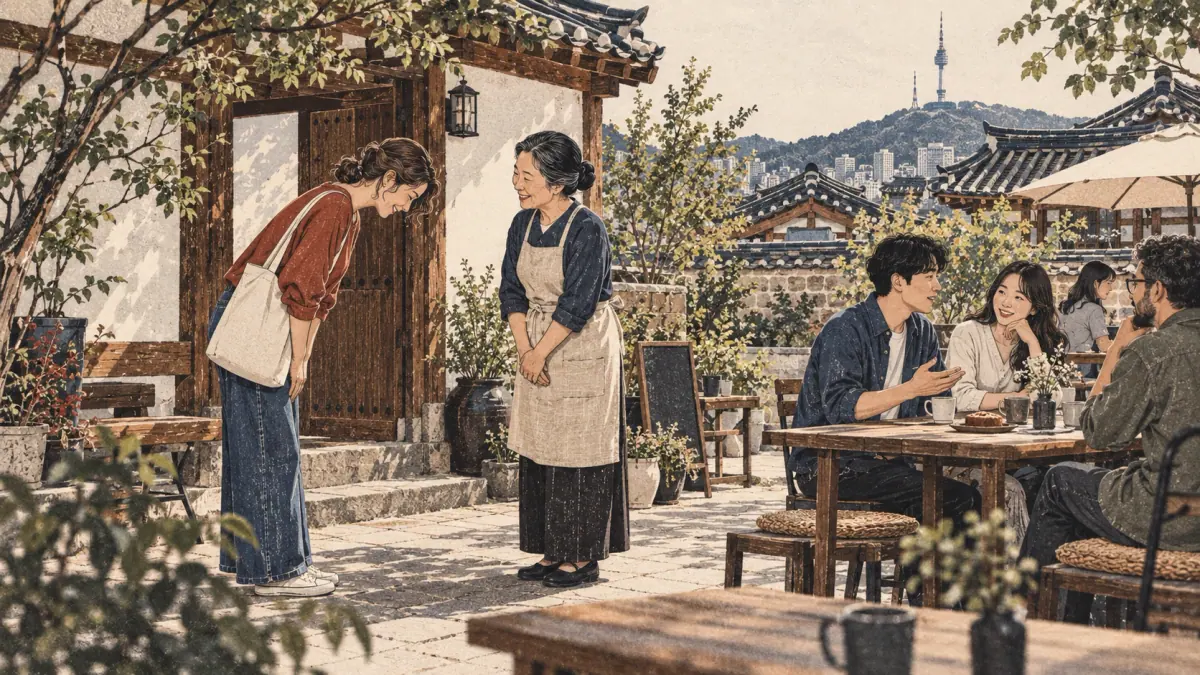
Korean language and culture are closely linked, because how you address people, which speech level you use and how names are ordered all carry social meaning. This hub covers four areas from a learner's point of view: language etiquette, Korean names, facts about the Korean language, and honest comparisons with Japanese, Chinese and English.
Korean Language and Culture: the Essentials
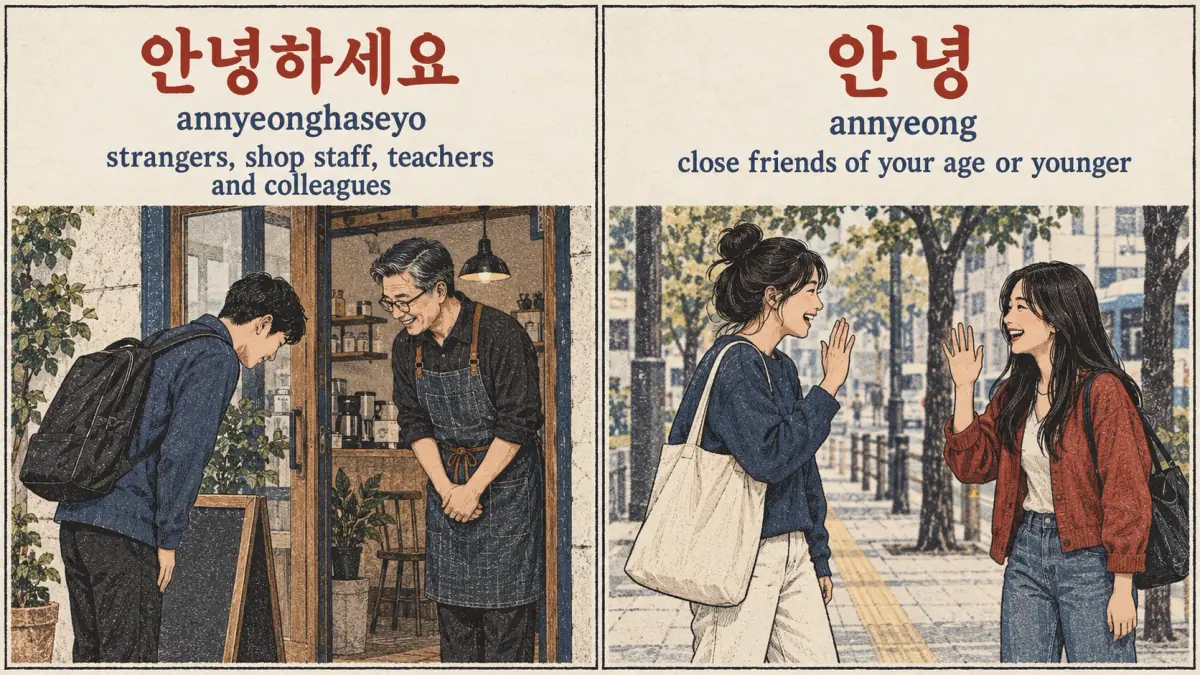
Korean culture shows up in the grammar itself, not only in customs around it. The clearest case is the speech level. Korean verbs change their ending depending on who you are talking to, so the same greeting has a casual form for close friends and a polite form for almost everyone else.
안녕하세요 (annyeonghaseyo) is the polite "hello" you use with strangers, shop staff, teachers and colleagues. 안녕 (annyeong) is the casual form, used with close friends of your age or younger, and with children.
Choosing the wrong one is not a grammar error. It is a social one, which is why culture pages belong on a language site. The table shows five places where a cultural habit becomes a language rule.
| Cultural habit | Where it shows in Korean | Example |
|---|---|---|
| Respect for age and status | speech levels and the honorific -(으)시- | 안녕 to a friend, 안녕하세요 to most adults |
| Titles instead of bare names | 씨, 님 and job titles | 선생님 (seonsaengnim, teacher), 민준 씨 |
| Family words used for non-family | older-sibling terms for friends and strangers | 언니 (eonni), 오빠 (oppa), 형 (hyeong) |
| Family name first | name order | 김민준: family name 김, given name 민준 |
| Avoiding a direct "you" | names and titles replace "you" | 선생님, 커피 드세요. (Teacher, have some coffee.) |
The last row surprises many learners. Korean has words for "you", but in polite conversation people usually repeat the listener's name or title instead. A learner who translates "you" word by word often sounds cold, even with perfect grammar. The pages in this hub explain habits like this one, starting with the four sections below.
What Pages Are in This Hub?
The hub has four sections. Each one starts from a language question: how to address people, how names work, what kind of language Korean is, and how it compares with languages you may already know.




Language Etiquette
Korean etiquette covers the language side of manners: how to greet with a slight bow, why people ask your age, when you may switch to casual speech and which titles to use. It maps everyday situations, such as greeting a stranger, an older person, a colleague or a younger friend, to the right words. Its three guides cover greeting etiquette, age etiquette and etiquette for tourists, and the section links to the grammar of banmal, 씨 and 님.
Korean Names
Korean names explains the structure of a name like 김민준: a family name, usually one syllable, followed by a given name, usually two. It covers how names are romanized, why 이 is often spelled Lee, and how to address someone by name without sounding rude. Its guides cover the most common surnames, how given names get their meaning, popular girl and boy names, how to pronounce names, how to address people and name endings such as -아 and -야.
About the Korean Language
Korean language facts gathers the basics in one fact sheet: roughly 80 million speakers by commonly cited estimates, official status in South and North Korea, subject-object-verb word order and the Hangul alphabet. It also separates common myths from facts. Its guides cover speaker numbers by country, the language family and the stages of Korean language history, and the section links to the pages on dialects and the history of Hangul.
Korean Compared with Other Languages
Korean compared with Japanese, Chinese and English puts the four languages side by side on writing, word order, sounds, vocabulary, grammar and honorifics. It helps you see what transfers from a language you already know and what starts from zero. Its guides cover whether Korean is related to Japanese, Korean vs Japanese grammar, names and etiquette, Korean vs Chinese, Korean vs English, and Korean for Japanese or Mandarin speakers.
Where Do I Start on These Culture Pages?
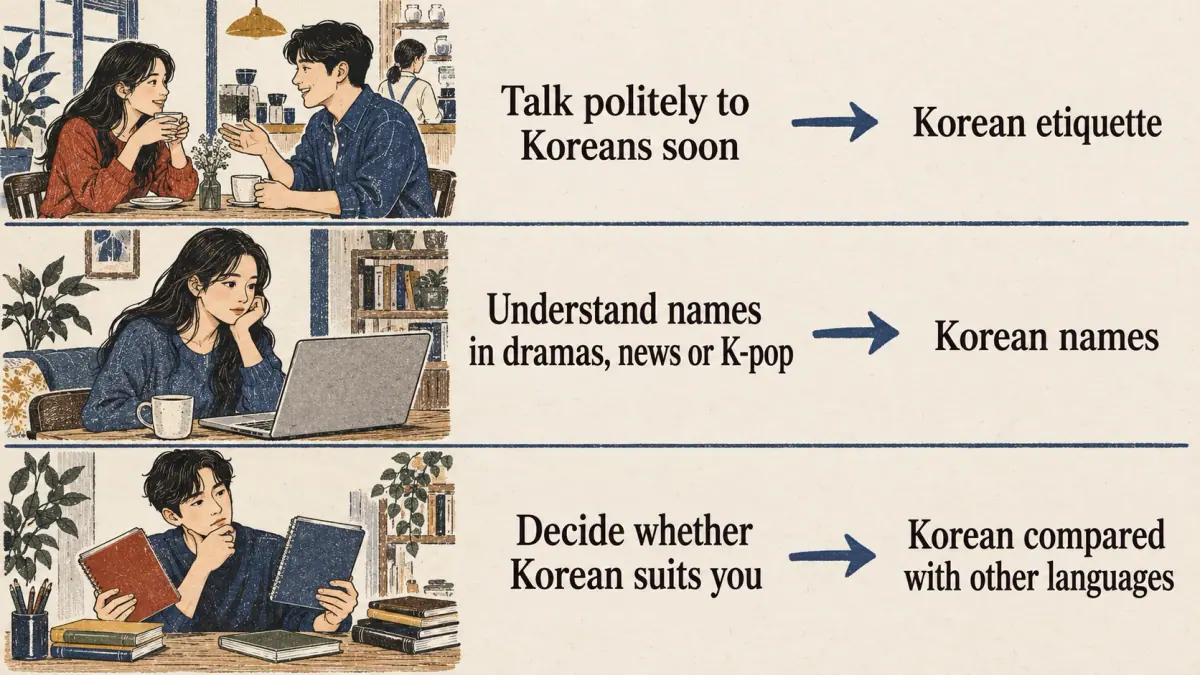
Start with etiquette if you will speak with Koreans soon, because address terms and speech levels affect every conversation. Otherwise, follow your interest. The table gives three reading paths.
| Your goal | Start with | Then read |
|---|---|---|
| Talk politely to Koreans soon | Korean etiquette | Korean names, then Korean speech levels |
| Understand names in dramas, news or K-pop | Korean names | romanization of Korean names |
| Decide whether Korean suits you | Korean compared with other languages | Korean language facts |
Do I Need to Know Korean Culture to Pass TOPIK?
No. TOPIK has no separate culture section: TOPIK I tests listening and reading, and TOPIK II tests listening, writing and reading, as described on the official site, topik.go.kr. Culture still helps, because many dialogues and reading texts turn on speech levels, titles and polite requests. Knowing why a speaker says 부장님 or switches to 반말 makes those questions easier.
How Does This Hub Connect to Grammar and Vocabulary?
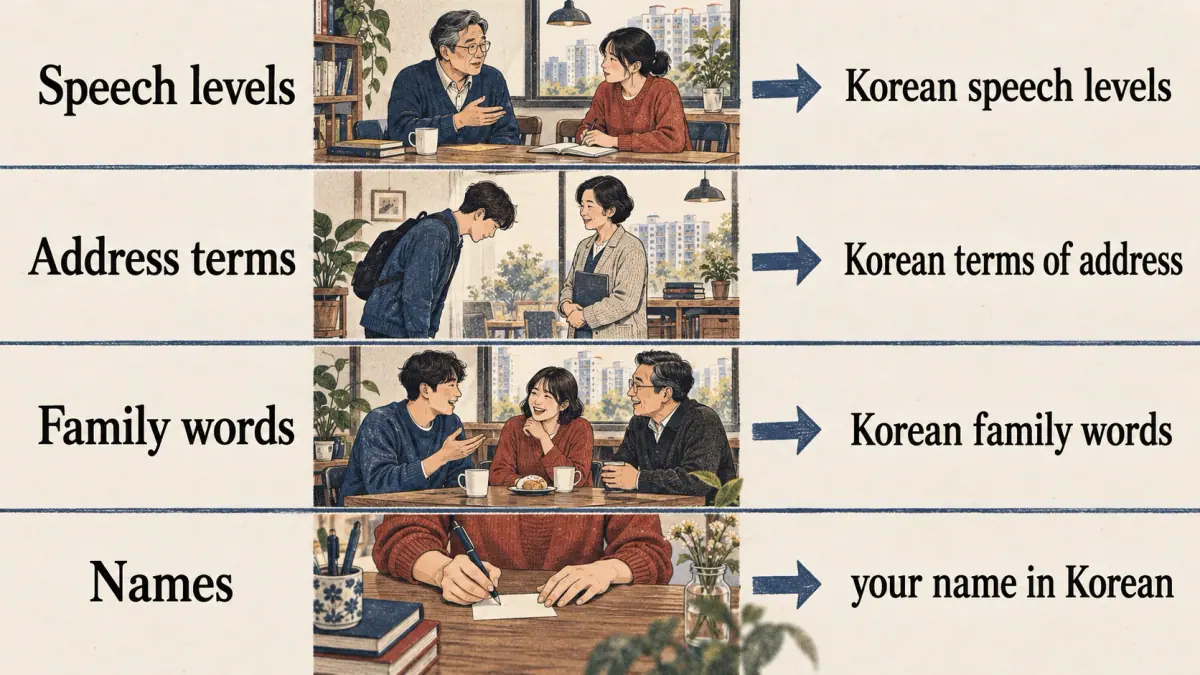
Culture pages explain why a form is used; grammar and vocabulary pages teach how to build it. The map below pairs each culture topic with the lesson that teaches the language.
- Speech levels: etiquette explains when to be polite, and Korean speech levels teaches the endings. The Korean honorifics section adds -(으)시- and honorific verbs.
- Address terms: etiquette explains who gets which title, and Korean terms of address gives the words. Older sibling titles covers 오빠, 언니, 형 and 누나.
- Family words: the Korean family words list teaches the vocabulary that Koreans also use for friends and strangers.
- Names: your name in Korean shows how to write your own name in Hangul.
- Language facts: the history of Hangul and Korean dialects sections go deeper than the fact sheet.
- Comparisons: is Korean harder than Japanese answers the difficulty question in detail.
The hanja section explains the Chinese characters behind many Korean words and names. The next section explains what these culture pages deliberately leave out.
What Do These Pages Cover, and What Do They Leave Out?

These pages cover culture only where it changes the words you choose. They do not try to be a travel guide, and dining or gift customs appear only where language is involved, such as what to say before a meal.
- Sources: etiquette guidance follows the National Institute of Korean Language (국립국어원) and its standard language etiquette guidance. Surname figures come from Statistics Korea census tables, and exam facts from topik.go.kr.
- Dates and numbers: speaker counts and surname shares change, so each figure names its source and is labelled as an estimate where needed.
- No stereotypes: customs differ by generation, region and workplace. Pages say "often" or "in most workplaces" when a habit is common but not universal.
An honest limit: no page can tell you exactly how formal to be with one particular person. Etiquette pages give the safe default, which is polite speech and a title, and explain the signals that let you relax it. Korean speakers generally expect learners to make mistakes, and a polite form is almost never the wrong choice.
Frequently Asked Questions
Do I need to know Korean culture to learn Korean?
You can start without it, but you need some culture to speak naturally. Speech levels, titles such as 선생님 and the habit of avoiding a direct "you" are cultural rules built into the grammar. Learners who know them sound polite even with simple sentences, while perfect grammar with the wrong speech level can sound rude.
Are these culture pages about travel?
Not mainly. The pages cover culture where it changes the words you choose: greetings, titles, names, age and speech levels. The page on Korean etiquette for tourists also stays focused on what to say. For food, shopping and transport phrases, use the phrase and vocabulary sections of the site instead.
How reliable are the facts on these pages?
Each fact names its source, such as the National Institute of Korean Language, Statistics Korea or topik.go.kr. Numbers that change over time, like speaker counts and surname shares, are labelled as estimates and dated. Customs are described as common rather than universal, because habits vary by generation, region and workplace.
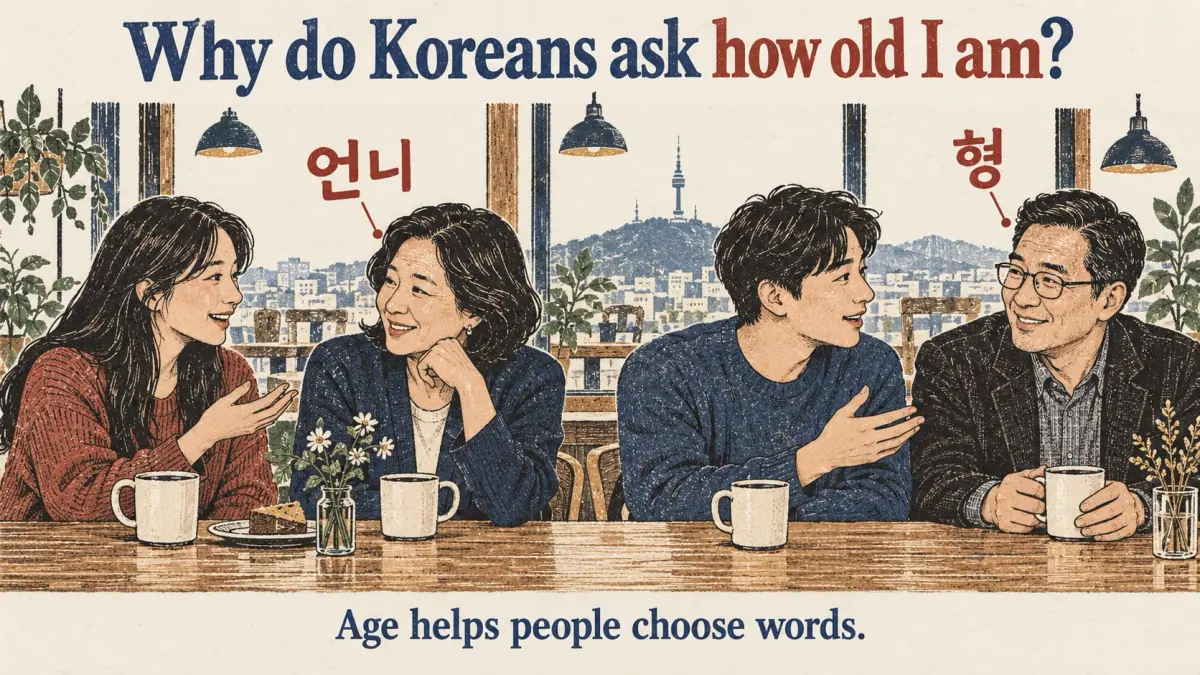
Why do Koreans ask how old I am?
Age helps people choose words. It decides who uses polite speech, who may suggest switching to casual speech and which title fits, such as 언니 or 형. The question is usually practical, not nosy. You can answer it, and as a newcomer you can keep using polite speech whatever the answer.
Is it rude if I make a mistake with Korean etiquette?
Usually not. Korean speakers generally expect learners to make mistakes and respond to effort. The mistakes that do stand out are casual speech to a stranger or an older person, and calling a superior by name plus 씨. Using polite speech and a title by default avoids almost every problem.
Where to Go Next in Korean Language and Culture
Most learners get the most from Korean language and culture by reading Korean etiquette first and then practising the forms in Korean speech levels. If you came here from the alphabet, the Korean alphabet hub is the place to return to, and the homepage shows the full learning path.