
The best Korean textbooks depend on your study style, with university series for structured classes, grammar references for self-study and workbooks for practice. This page sorts Korean books into five types, shows which type fits your situation, and gives the five checks to make before you buy any book, so you do not end up with a classroom book and no teacher, or a workbook with no answers.
Last updated: 2026-10-09.
Best Korean Textbooks: the Essentials

Choose the type of book before the title. The chooser below matches each study situation with a book type and names well-known series of that type as examples. Series names are given so you can recognise them, not as a ranking.
| Your situation | Book type | Example series (check current editions) | What it gives you |
|---|---|---|---|
| In a class, or with a regular tutor | Class-style university series | Sogang Korean, Yonsei Korean, Seoul National University Korean, Ewha Korean, Kyung Hee Korean | A graded course with dialogues, speaking tasks and audio |
| Studying alone from zero | Self-study series | Integrated Korean, Talk To Me In Korean books | English explanations and a steady sequence |
| Already learning, need to look things up | Grammar reference | Korean Grammar in Use (beginning, intermediate, advanced) | One grammar point per unit, with examples and exercises |
| Know the grammar, need practice | Workbook | The workbook that matches your series | Exercises with an answer key |
| Need more words | Vocabulary book | Thematic or TOPIK-level word books | Words grouped by topic or level, with examples |
A simple rule follows from the table. One series is your spine, and a grammar reference is your backup. Most learners need only those two books at a time, plus a dictionary.
How Do Levels Work in Korean Textbooks?
Most series are graded by level, and the larger university series typically run from level 1 (complete beginner) to level 6 (advanced), often with each level split into two volumes. The levels roughly follow the same beginner-to-advanced range as the six TOPIK levels, but a series level is not a TOPIK level: finishing level 2 of a series does not mean you would pass TOPIK level 2. To place yourself, read a sample unit. If you understand most of the dialogue after one listen and two or three new grammar points are introduced, the level is right.
What Pages Are in This Subhub?
Each page uses the five criteria below and shows when its facts were last checked. All 7 are published.
Textbook Series
A series is a complete course in several volumes. These pages help you pick one and compare the best-known ones.
- Best Korean Textbook for Self Study: Nine series compared on four self-study needs: English explanations, audio, an answer key and a level range that lets you keep going from A1 to B1.
- Yonsei Korean Review: Yonsei compared with the Sogang, Seoul National University and Ewha courses: all classroom-first and dialogue-based, with self-study fit that varies by series and edition.
- Integrated Korean Review: The University of Hawaii Press series reviewed: dialogues, vocabulary, English grammar notes and a workbook for each volume. It was written for university classes, so self-study learners should add speaking practice with a person.
Grammar and Workbooks
A grammar reference explains one point per unit; a workbook gives you practice and answers.
- Best Korean Grammar Book: Grammar references compared by level, from beginner guides to pattern dictionaries, with one test: look up the same two patterns in each book and compare how clearly they are contrasted.
- Korean Grammar in Use Review: The three-volume Darakwon pattern reference (Beginning, Intermediate, Advanced) reviewed, with a verdict for each volume. It is a reference for look-up and practice, not a course.
- Best Korean Workbook: Series companions, standalone writing and skills books, and exam practice books compared. An answer key is essential for self-study, and a companion workbook only works with its own edition.
Vocabulary Books
Word books are a supplement, not a course. They work best alongside a series and a flashcard routine.
- Best Korean Vocabulary Book: Frequency, theme and exam-level word books compared. There is no single official TOPIK word list, so a TOPIK vocabulary book is a publisher's estimate of what the exam uses.
Textbook Series
Complete graded courses.


Grammar and Workbooks
References and practice books.


Vocabulary Books
Word lists by level and topic.
How Do We Evaluate Books?

Every book in this section is judged on five criteria:
- Level fit. Does the book state its level, and does the first unit match it? A beginner book that assumes you read Hangul fluently is not a beginner book for you.
- Audio. Are all dialogues and new words recorded? How is the audio delivered: a download from the publisher, an app or a QR code? A used copy may not include access.
- Answer key. Self-study without answers means you never find out what you got wrong.
- Language of instruction. Are explanations in English, Korean or another language? Many class-style series move to Korean-only instructions early, which suits a class but slows a self-learner.
- Exam alignment. Does the book say which TOPIK level it prepares for, and does it practise the exam format?
We also note the edition we checked and the date, because units and page numbers can change between editions.
Can You Study from a Textbook without a Teacher?

Yes, if you give each unit a fixed routine. A unit in most series has a dialogue, new words, grammar points and exercises. Work through it in six steps:
- Listen to the dialogue once without reading.
- Read it with the translation or word list, and look up anything still unclear.
- Study the grammar points and write one sentence of your own for each.
- Do the exercises, then check every answer with the key.
- Shadow the dialogue: play a line, pause, and repeat it aloud with the same rhythm.
- Review the new words in a flashcard app over the next week.
For example, if a unit teaches -고 싶어요 (want to), your own sentence might be 한국에 가고 싶어요 (I want to go to Korea). Write it, say it, and check it against the unit's examples. The Korean grammar lessons on this site explain each point a second way when the book's explanation is not enough, and Korean shadowing covers step 5 in detail.
Which Books Help with TOPIK?
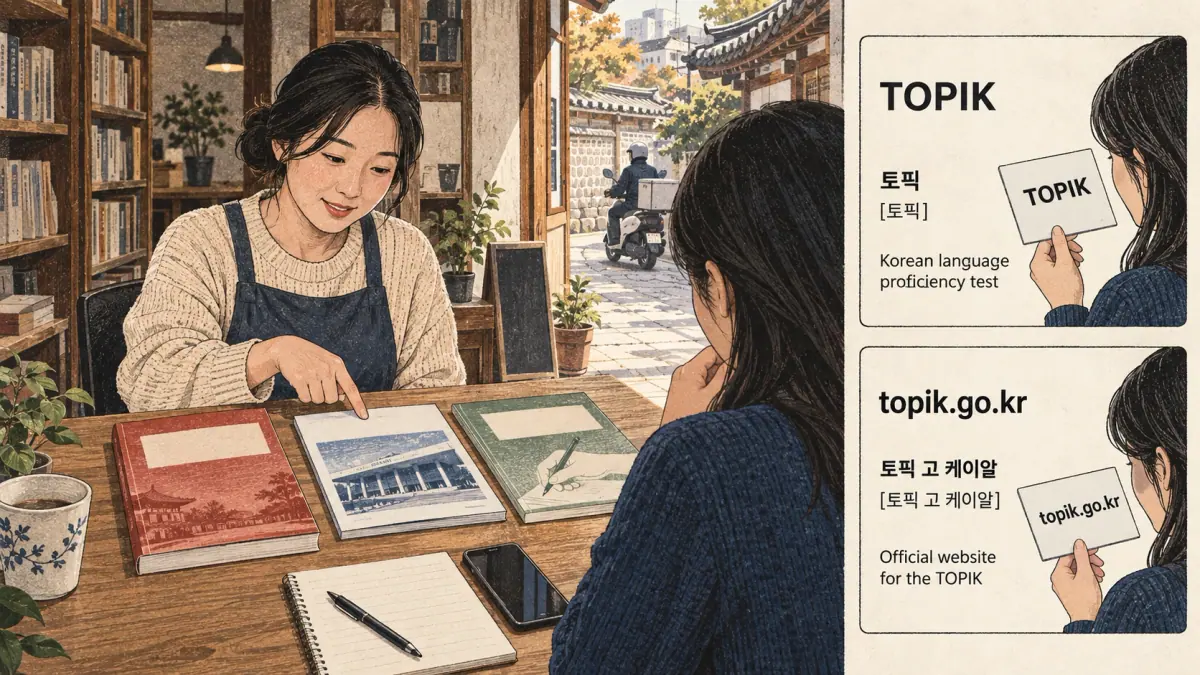
TOPIK, the Test of Proficiency in Korean, is the standard exam for learners. Its official site, topik.go.kr, is the source for the current format, levels and exam dates; check it first. A general series builds the vocabulary and grammar the exam tests, but it does not train exam technique: timing, question types and the writing tasks. For that, add a practice book written for your target level and work through official past papers where they are released. The TOPIK section on this site explains the levels and gives study plans.
Related Sections
- Starting from zero? Learn the Korean alphabet first; most textbooks assume it from the first unit or two.
- Studying alone? The self-study Korean section shows how to build a routine around one book.
- For the words in your book, use Korean flashcards or the Korean vocabulary lessons.
Frequently Asked Questions

Which Korean textbook is best for beginners? For a beginner studying alone, the best textbook is a graded series with English explanations, audio for every dialogue and an answer key. If you take a class, use the series your class uses. Learn Hangul before you open a textbook, because most series assume you can read it within the first unit or two.
Do I need a teacher to use a Korean textbook? Not for every book. Self-study series and grammar references are written for learners working alone. Class-style university series can be used alone too, but they expect a teacher to explain, run the speaking activities and correct your answers, so add a tutor or a language exchange if you use one.
Are university textbooks good for self-study? They can be, if you check three things first: whether the explanations are in English or another language you read well, whether the audio is available to you, and whether there is an answer key. Without those, a self-study series or a grammar reference is easier to work through alone.
Which book is best for TOPIK? Start with the official information and any released past papers on topik.go.kr, because they show the real format. Add a TOPIK-focused practice book for your target level. A general textbook series builds the language the exam tests but does not train exam technique.
Which edition of a Korean textbook should I buy? Buy the current edition from the publisher or a trusted bookshop, and make sure the student book, workbook and audio all belong to the same edition, because units and page numbers can change between editions. Check the publisher's page for how the audio is delivered before you buy a used copy.