








How to Learn Korean, Step by Step
At a glance
- Hangul has 24 basic letters (14 consonants and 10 vowels) and 40 letters once double consonants and compound vowels are counted.
- Most adult beginners can recognise every Hangul letter after roughly 3 to 10 hours of focused study. This is a typical range, not a guarantee.
- The U.S. Foreign Service Institute (FSI) places Korean in Category IV, its hardest group for native English speakers, at about 88 weeks (2,200 class hours) of full-time training to reach professional working proficiency.
- Korean sentences follow subject-object-verb order and mark each word's role with particles such as 은/는 and 을/를.
- Every lesson, flashcard deck and tool here is free and works without an account. Audio is generated by text-to-speech (TTS) and was approved by Min-ji Park on 15 October 2026.
How to Learn Korean in Six Stages
Learning Korean works best in six stages, each with one clear outcome you can check. The stages overlap: you keep reviewing letters while you learn words, and you keep listening at every stage.
- Foundations. Learn Hangul and the basic sounds. You can read any Korean word aloud, slowly.
- First words and phrases. Learn about 100 high-frequency words and survival phrases. You can greet, thank, apologise and ask for things.
- Sentences and grammar. Learn word order, the main particles and polite verb endings. You can make simple sentences about yourself.
- Listening. Train your ear on similar sounds, then short dialogues. You can follow slow, clear speech on familiar topics.
- Reading. Move from word lists to short texts. You can read signs, menus and simple paragraphs.
- Practice and review. Keep everything with flashcards, quizzes, shadowing and speaking. You keep what you learned and keep growing.
The quickest way to see why stage 1 comes first is to build a Korean syllable yourself, right here.
Try It Now: Build Your First Korean Syllable
A Korean syllable block is a group of two to four letters stacked into one square, and you can build one in under a minute. Pick a first consonant, then a vowel, then (if you like) a final consonant. Tap the speaker to hear the result. Nothing plays until you tap, and you do not need an account.
Five sample syllables have audio. They also appear in this table, which works without JavaScript:
| Syllable | Built from | Shape | Sounds like (RR) | Listen |
|---|---|---|---|---|
| 가 | ㄱ + ㅏ | vowel on the right | ga | |
| 나 | ㄴ + ㅏ | vowel on the right | na | |
| 고 | ㄱ + ㅗ | vowel underneath | go | |
| 한 | ㅎ + ㅏ + ㄴ | final consonant at the bottom | han | |
| 글 | ㄱ + ㅡ + ㄹ | vowel underneath, final at the bottom | geul |
Notice the rule the table shows: tall vowels such as ㅏ sit to the right of the consonant, and flat vowels such as ㅗ and ㅡ sit under it. The last two blocks spell 한글 (Hangul), the name of the alphabet. The full Hangul Syllable Builder shows consonant and vowel combinations, and the lesson on how letters stack into syllable blocks explains all four block shapes. (RR means Revised Romanization, the official Latin spelling of Korean. Here it is only a learning aid.)
Now that you have built a block, the next question is where your own route begins.
Where Should You Start?
Start with Hangul if you cannot yet read Korean letters; start with pronunciation and reading practice if you can. Pick the path below that describes you today. Each one links to a single first step, so you never have to choose from a long menu.
I Am a Complete Beginner
Complete beginners should open the guided start page and then learn the alphabet in order. Start learning Korean as a complete beginner with the guided path, which asks what you already know and sends you to the right first lesson. From there you learn the Korean alphabet (Hangul) in a fixed order: the ten basic vowels first, then consonants, then blocks. If you like a short, structured goal, the Learn Hangul in a Week course splits the letters into seven daily sessions.
I Can Already Read Some Hangul
Learners who can read some Hangul usually need sound rules and reading speed, not more letter drills. Read the guide to Korean pronunciation and sound-change rules, because written Korean is not always read letter by letter: 한국어 (Korean language) is said [한구거]. Then build fluency with beginner reading sets and test yourself with Hangul quizzes.
I Am Coming Back to Korean
Returning learners should review before they learn anything new. Use the reference cards to find which letters and sounds you still remember.
Spend a week with Hangul flashcard decks that work without an account. Use them to check which letters and sounds you have kept and which ones need a fresh lesson.
Whichever path you choose, it feeds into the same learning order, set out stage by stage below.
What Is the Best Order to Learn Korean?
The best order to learn Korean is Hangul and sounds first, then core words, then sentence grammar, then structured listening and reading, with review running through every stage. This order follows the structure of the language: you cannot use a particle until you can read it, and you cannot hear a sound change until you know the letters it changes.
Stage 1: Foundations (Hangul and sounds)
Outcome: you can read any Korean word aloud and know the main sound rules. Begin with the ten basic vowels, which teach the lines and dots that every other vowel is built from. Then learn liaison, the rule that moves a final consonant forward into the next syllable, so 밥을 (rice + object particle) is said [바블]. A typical time is 2 to 4 weeks at 30 minutes a day.
Stage 2: First Words and Phrases
Outcome: you can greet, thank, apologise, count and ask for things. Learn the 100 Korean words that appear most in beginner material, such as 물 (water), 사람 (person) and 좋다 (to be good). Add Korean greetings like 안녕하세요 (hello, polite). The Survival Korean course groups these into ready-made situations. A typical time is 1 to 2 months.
Stage 3: Sentences and Grammar
Outcome: you can introduce yourself and describe simple actions politely. Start with the topic particle 은/는, as in 저는 학생이에요 (I am a student), said [저는 학쌩이에요]. Then learn polite -아요/어요 endings, the form you will use with most adults you meet. A typical time is 2 to 4 months.
Stage 4: Listening
Outcome: you can tell similar sounds apart and follow slow, clear dialogues. Use sound discrimination drills to hear differences that English does not make. The plain, tense and aspirated minimal pairs lesson trains words like 달 (moon), 탈 (mask) and 딸 (daughter). Listening starts in stage 1 and never stops; this stage makes it systematic.
Stage 5: Reading
Outcome: you can read signs, menus and short paragraphs without romanization. Start with loanword reading practice: words such as 커피 (keopi, coffee) and 컴퓨터 (keompyuteo, computer) let you check your reading against a meaning you already know. Then move to the beginner reading sets, which add glossaries and audio to every passage.
Stage 6: Practice and Review
Outcome: you keep what you have learned and start speaking with less hesitation. Review with Korean flashcards, which provide reference cards for daily review. Revisit older material regularly before adding new words. Practise speaking with shadowing: play a short line, then repeat it at the same speed and melody. This stage never ends; it is how you keep Korean for years.
The stage times above are planning estimates for about 30 minutes of study a day, not promises. Each stage draws on several sections of the site, grouped next.
How Long Does It Take to Learn Korean?
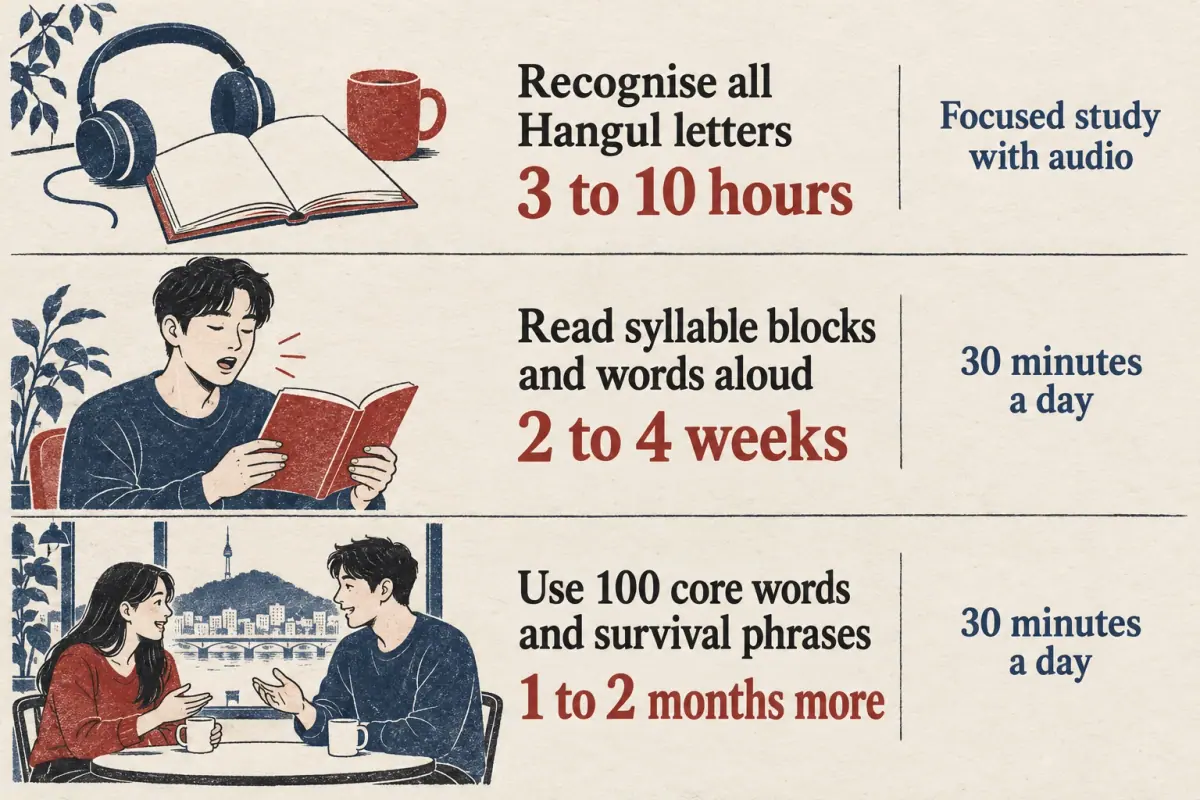
The U.S. Foreign Service Institute (FSI) estimates about 88 weeks (2,200 class hours) of full-time training for a native English speaker to reach professional working proficiency in Korean. Reading Hangul takes far less: roughly 3 to 10 hours for most adults. The table shows typical milestones; your own time depends on daily hours, listening practice and any languages you already know.
| Milestone | Typical time | Assumption |
|---|---|---|
| Recognise all Hangul letters | 3 to 10 hours | Focused study with audio |
| Read syllable blocks and words aloud | 2 to 4 weeks | 30 minutes a day |
| Use 100 core words and survival phrases | 1 to 2 months more | 30 minutes a day |
| Make simple polite sentences (about CEFR A1) | several months | 30 to 60 minutes a day plus listening |
| Professional working proficiency | about 88 weeks (2,200 class hours) | FSI estimate for full-time classroom study |
The first row comes from typical beginner experience and the last from the FSI. The middle rows are our planning estimates, so treat them as a guide, not a promise. CEFR is the Common European Framework of Reference, a six-level scale from A1 (beginner) to C2. For estimates level by level, read how long it takes to learn Korean, and for the alphabet alone, how long Hangul takes.
The hours look large because some parts of Korean are hard for English speakers, while others are easier than people expect.
Is Korean Hard for English Speakers?
Korean is hard overall for English speakers but easy to start: the alphabet is simple, while grammar, vocabulary and listening take the most time. The FSI puts Korean in its hardest group of languages for English speakers. The table rates each skill separately, because "hard" means different things for each one.
| Skill | Difficulty | Why |
|---|---|---|
| Reading the script | Easy | Hangul is a featural alphabet: letter shapes show how the sound is made, and there are only 24 basic letters. |
| Pronunciation | Medium | Korean has a three-way consonant contrast (달, 탈, 딸) and regular sound changes between syllables. |
| Grammar | Hard at first | The verb comes last, particles mark roles, and verb endings carry tense and politeness. |
| Vocabulary | Hard | Few words look like English, apart from loanwords such as 커피 (coffee). Many words come from Chinese roots (Sino-Korean). |
| Politeness | Medium | Speech levels change verb endings, but the polite -요 ending covers most beginner situations. |
| Listening | Hardest for many | Natural speech is fast, links words together and drops sounds. |
We explain in detail whether Korean is hard for English speakers, skill by skill, and how Korean compared with Japanese differs for learners. The easiest skill, reading, is also the one every other skill depends on, which is why the script comes first.
Why Learn Hangul before Anything Else?
Hangul comes first because romanization teaches wrong sounds and every real Korean resource uses Hangul. Romanized spelling uses Latin letters, so English speakers read them with English sounds. For example, 학교 (school) is written hakgyo in Revised Romanization, but Koreans say [학꾜], with a tense kk sound that the spelling hides.
Three facts make Hangul fast to learn:
- It is small. 24 basic letters make all 40 letters: five double consonants and eleven compound vowels are built from the basic ones.
- It is logical. The Hunminjeongeum Haerye (1446), the commentary issued with King Sejong's alphabet, explains that the basic consonant shapes picture the speech organs. ㄱ, for example, shows the back of the tongue raised to block the throat.
- It is regular. Each block is read in a fixed order: top left first, then right or down.
Romanization stays useful for road signs and names, but drop it from your study by the end of stage 1. Read more on why Hangul comes first and on what Korean romanization can and cannot show. Once you can read, the next question is whether you can go on without a teacher.
Can You Learn Korean on Your Own?
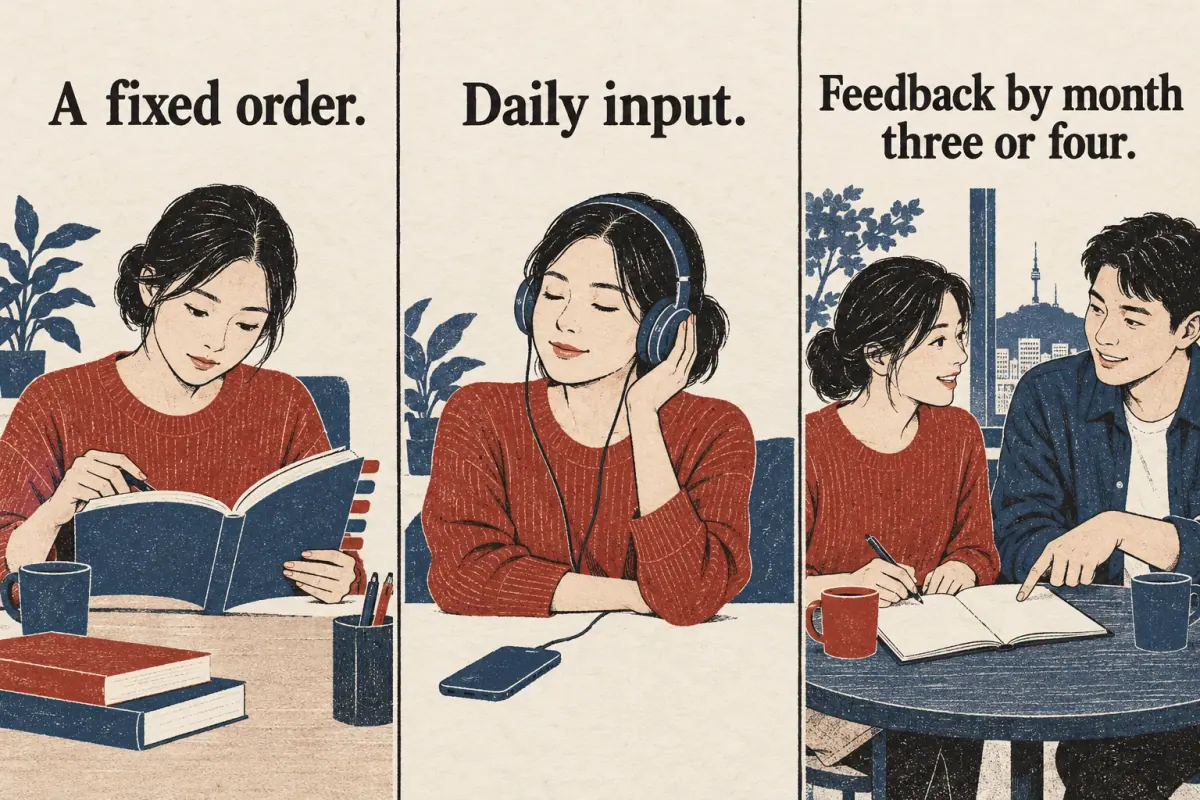
Yes, you can learn Korean on your own up to a solid beginner level, if you have three things: structured lessons, lots of listening, and someone to speak with later. Self-study handles reading, vocabulary and grammar well. It handles speaking poorly, because nobody corrects you.
The conditions for success are specific:
- A fixed order. Follow one path, such as a week-by-week beginner study plan, instead of jumping between apps.
- Daily input. Hear Korean every day. Comprehensible input means audio you mostly understand, with a few new words in it.
- Feedback by month three or four. Book a tutor, or find a language exchange partner who corrects your sentences.
Self-study is not the right choice if you need a certificate on a deadline or learn best with a fixed class time. Compare classes, apps, tutors and self-study to find the best way to learn Korean for your situation, or browse more self-study methods. Whichever route you take, the daily routine is what moves you forward.
How Should You Practise the Four Skills?
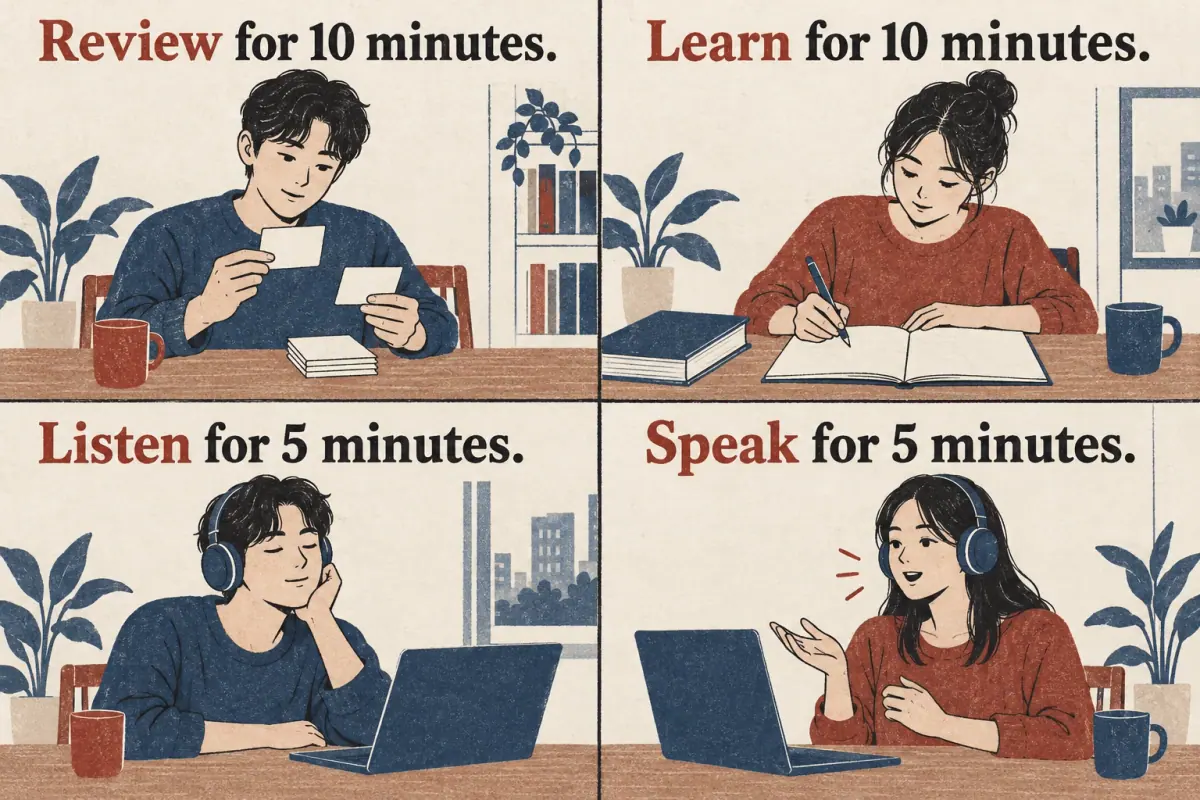
Practise all four skills every week, with listening every day, in short sessions. A 30-minute routine for a beginner can look like this:
- Review for 10 minutes. Run your flashcards first, while you are fresh.
- Learn for 10 minutes. Take one new lesson, such as one particle or ten new words.
- Listen for 5 minutes. Play a short dialogue twice: first without the script, then with it.
- Speak for 5 minutes. Shadow two or three lines aloud, copying speed and melody.
Change the mix as you grow. Reading moves from words to paragraphs in stage 5. For writing, Korean writing practice runs from typing to a short email, and Korean speaking practice builds from shadowing to conversation. For ear training, Korean listening practice runs from single sounds to full conversations. Inside that routine, a few grammar points and words do most of the work.
Which Grammar and Words Matter First?
The first grammar to learn is word order, the main particles, the verbs 이다 and 있다, and the polite -아요/어요 ending; the first words are the 100 most common. These pieces let you build most beginner sentences.
| Point | What it does | Example |
|---|---|---|
| Subject-object-verb order | The verb comes last | 저는 커피를 마셔요 (I drink coffee; literally "I coffee drink") |
| 은/는 | Marks the topic | 저는 (as for me) |
| 이/가 | Marks the subject | 물이 (water, as subject) |
| 을/를 | Marks the object | 커피를 (coffee, as object) |
| 이다 | "to be" (A is B) | 학생이에요 (am a student) |
| 있다 | "to exist / to have" | 물이 있어요? [무리 이써요] (Is there water?) |
| -아요/어요 | Polite present ending | 가다 → 가요, 먹다 → 먹어요, 하다 → 해요 |
The pairs 은/는, 이/가 and 을/를 each have two forms: the first follows a consonant (책은, book), the second follows a vowel (저는). Learn Korean word order and 이다 vs 있다 early, because mixing them up is the most common beginner error. The full list lives in beginner Korean grammar, which starts with particles and the polite -요 ending.
Numbers deserve an early slot too. Korean uses two systems: native Korean (하나, 둘, 셋) for hours and counting things, and Sino-Korean numbers (일, 이, 삼) for minutes, dates and money. So 3:30 is 세 시 삼십 분, a native hour plus Sino-Korean minutes. The Korean numbers section shows which system goes where. Knowing what to learn also helps you judge which resources deserve your time.

Which Resources Help, and Where Does This Site Fit?
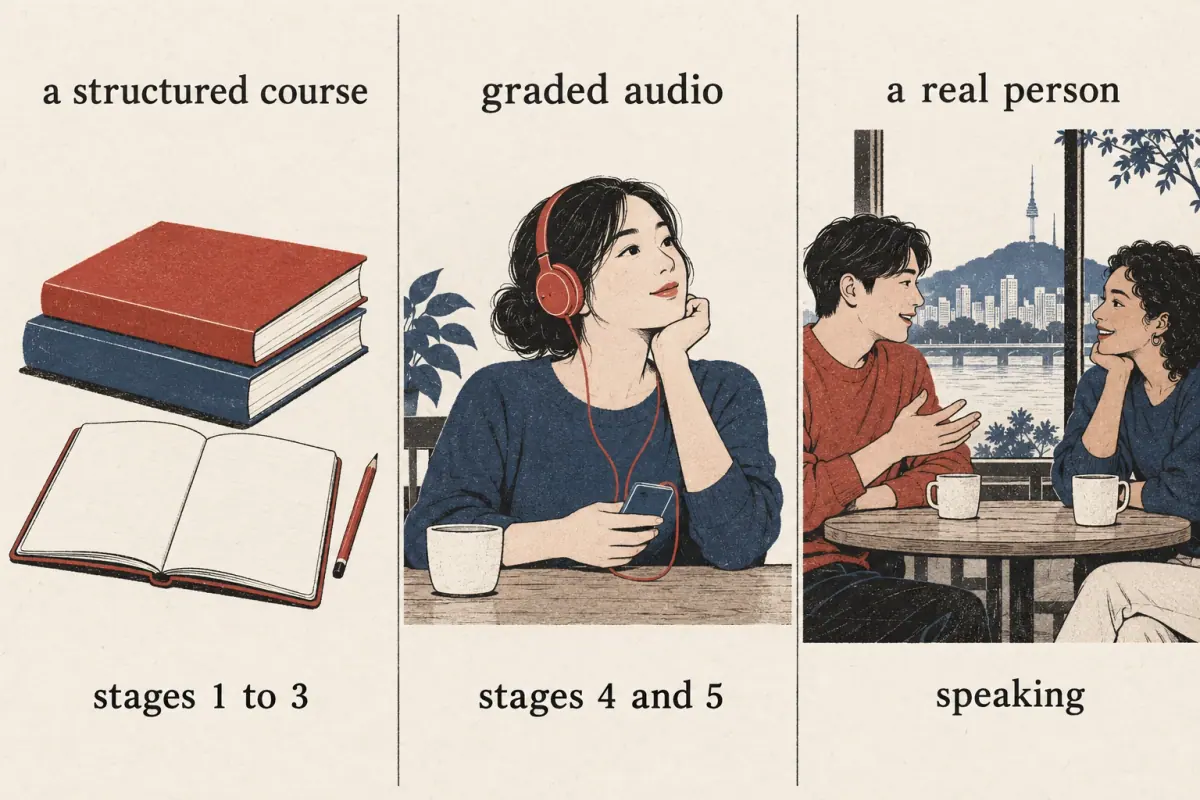
The resources that help most are the ones that match your stage: a structured course for stages 1 to 3, graded audio for stages 4 and 5, and a real person for speaking. No single resource covers everything.
| Resource | Best for | Main limit | Typical cost |
|---|---|---|---|
| Apps | Daily habit, word review | Little grammar explanation; speaking is limited | Free to monthly subscription |
| Textbooks | Clear grammar order | Little audio unless a recording comes with the book | One-time purchase |
| Tutors and classes | Speaking and correction | Cost and fixed schedule | Paid per hour or per term |
| Language exchange | Free conversation | Partners are not trained teachers | Free |
| K-dramas, podcasts, YouTube | Listening input, motivation | Too fast for beginners without support | Free to subscription |
| This site | Hangul, pronunciation, core words, beginner grammar, practice | No live speaking partner; audio is TTS approved by Min-ji Park | Free |
This site is strongest at the start: it teaches the script and sound rules in detail, with audio for every Korean example. It is weakest at live conversation, which you need a human for. The Korean learning resources guide compares apps, textbooks, tutors and media with explicit criteria. Using good resources still goes wrong in a few predictable ways.
What Mistakes Do Beginners Make?
The most common beginner mistakes are relying on romanization, skipping the sound rules, and not listening enough. Each one has a simple fix:
- Reading romanization instead of Hangul. Fix: switch romanization off once you know the letters. Use the romanization controls where available.
- Skipping sound changes. 감사합니다 (thank you) is said [감사함니다], not "gam-sa-hap-ni-da". Fix: learn liaison and nasalization in stage 1.
- Learning only textbook speech. Dramas often use casual forms: 뭐 해? instead of the polite 뭐 해요? (What are you doing?). Fix: learn polite speech first, then learn to recognise casual speech.
- Collecting words without review. Fix: put new words into flashcards the same day.
- Waiting too long to speak. Fix: shadow from week one and find a speaking partner by month three or four.
- Switching resources every week. Fix: follow one path for at least a month before you judge it.
Read more about common Korean learning mistakes. Because mistakes can also appear in lessons, we explain next how ours are written and checked.
How Do We Write and Check Our Lessons?
Our lessons are drafted with AI assistance, checked against Korean standards, and labelled with their real review status. Our Korean reviewer, Min-ji Park, a Korean language teacher, reviews the Korean in every lesson before it is published. We say that openly rather than hide it.
- Text. Lessons are drafted with AI tools and checked by a second model pass. The editorial policy explains who writes the lessons and how corrections are handled, and how we use AI gives the details.
- Standards. Spelling and pronunciation follow the National Institute of Korean Language (국립국어원) rules, including the Standard Pronunciation Rules (표준 발음법). Romanization follows the Revised Romanization of Korean (2000). See the Korean language standards we follow.
- Audio. Every clip is generated by a Korean TTS engine, labelled as generated, and never presented as a human recording. Read how our audio is made and checked, including the review each clip passes before publication.
- Status. Each page shows a review badge, such as "Audio: AI-generated, approved by Min-ji Park", and a last-updated date.
- Corrections. If you find a mistake, report an error. We correct it and note the change.