
Korean Numbers: the Essentials

Korean numbers are the words for quantity, and Korean has two full sets of them. Sino-Korean numbers come from Chinese and are used for money, dates and measurement. Native Korean numbers come from original Korean and are used for counting objects, people and hours. Linguists call a number word a 수사 (susa), and the native and Sino sets are 고유어 (native) and 한자어 (Sino-Korean) numerals.
| Number | Sino-Korean | Native | Native before a counter |
|---|---|---|---|
| 1 | 일 | 하나 | 한 |
| 2 | 이 | 둘 | 두 |
| 3 | 삼 | 셋 | 세 |
| 4 | 사 | 넷 | 네 |
| 5 | 오 | 다섯 | 다섯 |
| 6 | 육 | 여섯 | 여섯 |
| 7 | 칠 | 일곱 | 일곱 |
| 8 | 팔 | 여덟 | 여덟 |
| 9 | 구 | 아홉 | 아홉 |
| 10 | 십 | 열 | 열 |
The last column matters. Native 1, 2, 3, 4 and 20 shorten before a counter: 한 개, 두 개, 세 개, 네 개 and 스무 개. Look at 3 as an example. It is 삼 in a phone number or a date, 셋 when you count aloud, and 세 in 세 개. The same quantity has three forms because the situation selects the system.
Large Sino-Korean numbers are grouped by 만 (10,000) instead of by thousands. So 100,000 is 십만 (ten 만), 1,000,000 is 백만 (a hundred 만), and a price of 35,000 won is 삼만 오천 원.
Next, the situation table shows which system each job uses.
Which System Do You Use for What?
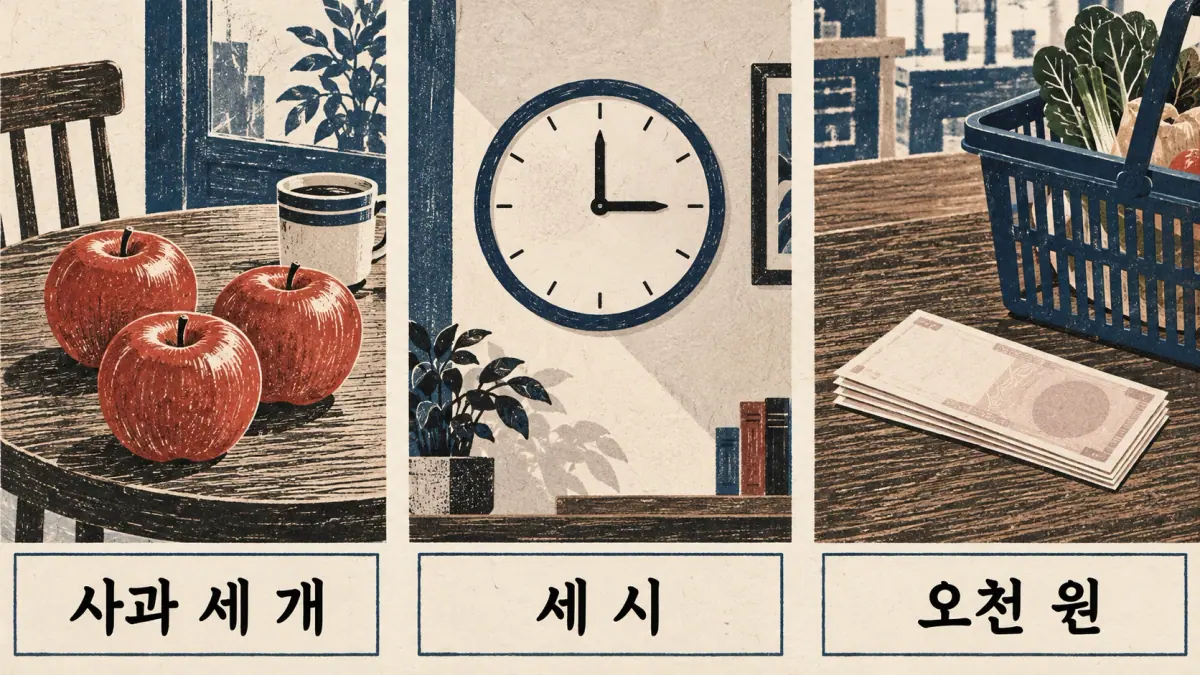
Use native numbers for counting things and for the hour, and use Sino-Korean numbers for money, dates, minutes, phone numbers and floors. The table gives a rule for each common situation.
| Situation | System | Example | Meaning |
|---|---|---|---|
| Counting objects | native + counter | 사과 세 개 | three apples |
| Hour of the day | native + 시 | 세 시 | 3 o'clock |
| Minutes | Sino + 분 | 십오 분 | 15 minutes |
| Age, spoken | native + 살 | 스물다섯 살 | 25 years old |
| Age, written | Sino + 세 | 25세 | age 25 |
| Money | Sino + 원 | 오천 원 | 5,000 won |
| Dates | Sino + 년/월/일 | 오월 오 일 | 5 May |
| Phone digits | Sino, 0 = 공 | 공일공 | 010 |
| Floors | Sino + 층 | 삼 층 | third floor |
Time of day shows the mix in one phrase: 세 시 십오 분 means 3:15, with native 세 for the hour and Sino 십오 for the minutes. A rule of thumb helps: if you can ask "how many things?" use native; if you read a label, a price or a calendar, use Sino-Korean.
Where Should You Start Learning Numbers?
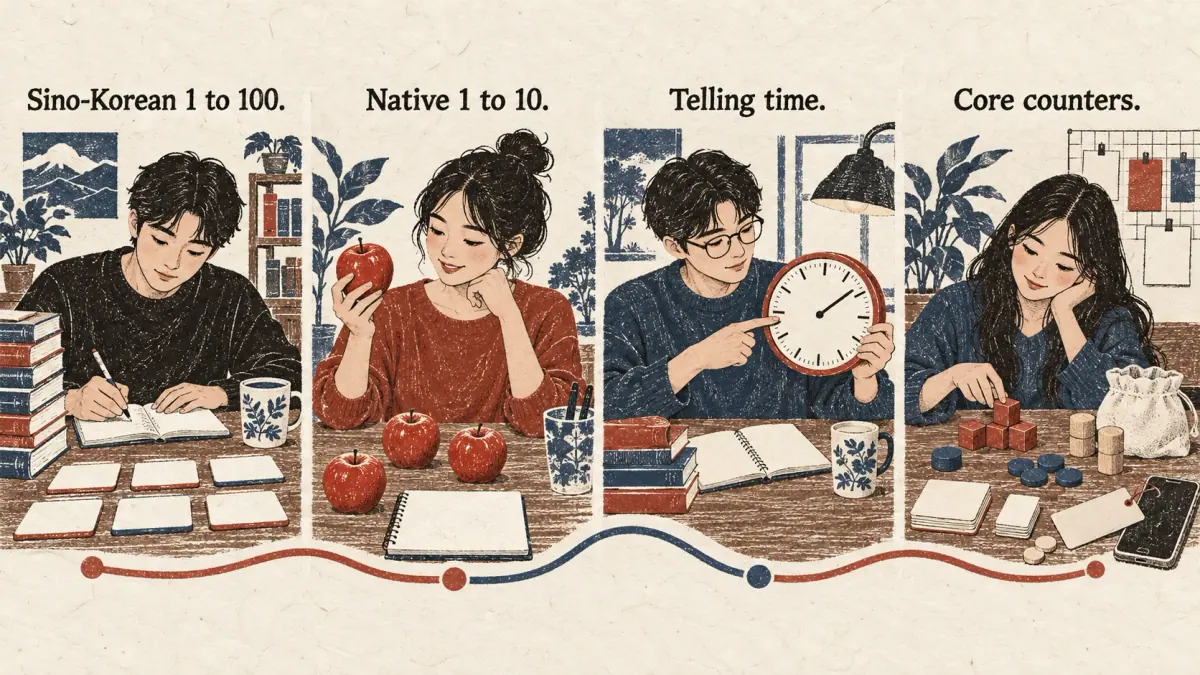
Start with Sino-Korean numbers 1 to 100, then native numbers 1 to 10, then telling time, then the core counters. This order follows the situations beginners meet first and keeps each step small.
- Sino-Korean 1 to 100. You can read prices and phone numbers after this step.
- Native 1 to 10. You can count things and say the hour.
- Telling time. You practise both systems in one phrase.
- Core counters. You learn 개, 명, 살 and 원 first.
- Dates and age. You apply both systems to personal facts.
The page on how to learn Korean numbers expands this order into a plan. With the order in mind, the next section lists everything in this hub.
What Pages Are in This Section?
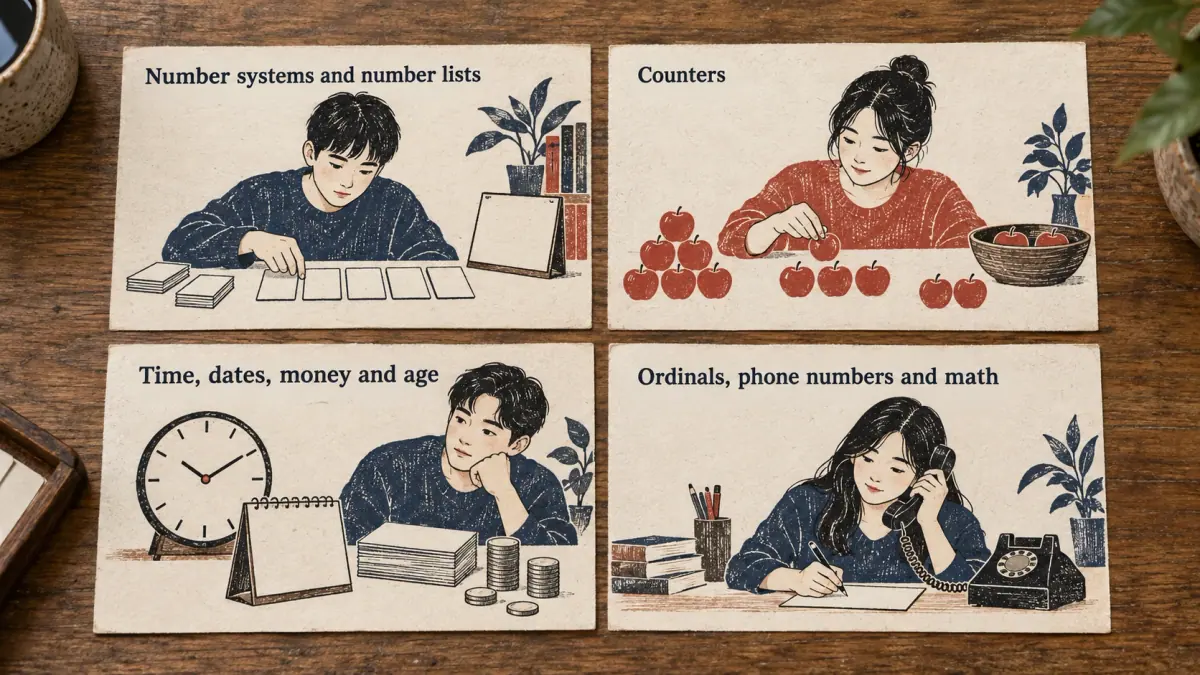
Twenty pages sit in this hub, in four groups. Each snippet tells you what the page teaches, so you can go straight to the one you need.
Number Systems and Number Lists
The two system pages explain each set in depth: Sino-Korean numbers for minutes, dates and money, and native Korean numbers for objects and hours. The page with Sino vs native Korean numbers compared gives the decision rule with examples.
For lists, read Korean numbers 1-10 in both systems and Korean numbers 1-100 charts. For big numbers, 100 in Korean (백), 1000 in Korean (천) and 10000 in Korean (만) explain the units. A printable Korean numbers chart puts both lists on one page.
For study help, the step-by-step study order for Korean numbers gives a plan, and the page on taekwondo counting in Korean teaches the count heard in a dojang. The page on Korean number slang explains why 1004, read 천사, also means "angel" and why some people avoid the number 4.
Counters
Korean counters gathers every counter lesson: people and animals, things, food and drinks, time and floors. It is the place to learn 개, 명, 마리, 권, 잔 and more, and it includes a chooser by object.
Time, Dates, Money and Age
Telling time in Korean teaches hours and minutes with both systems. Dates in Korean covers years, months and days, Money and Prices covers 원 and big sums, and Age in Korean covers 살, 세 and how to ask.
Ordinals, Phone Numbers and Math
Ordinal Numbers covers first, second and third. Phone Numbers covers how to read digits aloud, and Math in Korean covers plus, minus, fractions and percentages.
What Does This Hub Not Cover?
This hub teaches numbers, not every use. To convert a figure into Korean words, use the number converter on the tools hub. Ordinal forms with 번째 sit in the ordinals section, and the vocabulary of weekdays and months belongs to dates. For review, use the Korean numbers flashcards and the Korean numbers quiz.
Limitation: the rule that native numbers are normally used up to 99 is a teaching rule. Some compounds and older usage go further, so treat it as a rule for beginners.
Where to Begin with Korean Numbers

If you are a complete beginner, open the Sino-Korean page and learn 1 to 100 first. If you already know both lists, open the counters hub and learn the objects you will count. Whatever your level, return to this hub when you need to choose between the two Korean numbers systems.
Frequently Asked Questions
Why does Korean have two number systems?
The native system comes from original Korean vocabulary, and the Sino-Korean system was borrowed from Chinese over many centuries. Both stayed in use, so each took a set of jobs. This is why 3 is 셋 or 세 for counting things and 삼 for dates, money and phone numbers. English shows a similar split between native and Latin words.
Which number system do I learn first?
Learn Sino-Korean first, 1 to 100, because it covers money, dates, minutes, phone numbers and floors. Then learn native numbers 1 to 10 for counting things and telling the hour. Add the counters 개, 명, 살 and 원 next. This order matches the situations most beginners meet first, such as shopping and meeting people.
Can I use Sino-Korean numbers for everything?
No. Sino-Korean numbers work for money, dates, minutes and phone numbers, but they sound wrong with most counters. You say 세 개, not 삼 개, and 스무 살, not 이십 살. Native counting is expected for objects, people, animals and hours. Using Sino-Korean everywhere is understood but marks you clearly as a learner.
Are Korean numbers hard for English speakers?
The vocabulary is manageable because each system has only about ten core words. The difficulty is choosing the right system and remembering that five native numbers change shape before counters. Most learners find the choice easier after a few weeks of practice with prices, times and ages, since each situation has a fixed rule.
Is there a tool that converts numbers into Korean?
Yes. The converters on the tools hub change a figure such as 2026 or 15 into Korean words in either system. A converter helps you check your answer, but it cannot choose the system for you. Use this section to decide whether a situation calls for Sino-Korean or native numbers.