
Most Common Korean Words at a Glance
The four pages differ in size and in how the words were chosen. The table shows the choice at a glance.
| List | Size | Level | How the words are chosen | Best for |
|---|---|---|---|---|
| Top 100 Korean Words | 100 words | A1 | Editorial ranking of beginner nouns, pronouns and adverbs | First weeks of study |
| Top 500 Korean Words | 500 words | A2 | The first 100 plus four study units of 100 | Building past the beginner core |
| Top 1000 Korean Words | 500 more words (501 to 1000) | B1 | Five study units of 100 that add abstract, social and written-register words | Moving on to intermediate texts |
| Basic Korean Words | 60 words | A1 | Picked by situation, not by rank | The first two days in Korea |




The levels are editorial estimates, not official levels. The lists are an editorial selection checked against published learner word lists, and Min-ji Park reviewed and signed off the lists on 15 October 2026. They are not a count taken from a corpus, so the site makes no claim about a word's exact frequency.
Which List Should You Open First?

Open Basic Korean Words if you travel soon, and Top 100 Korean Words if you study at home. The first helps you survive; the second helps you build sentences. The decision depends on your next few weeks.
- You arrive in Korea within a week. Open Basic Korean Words and the travel phrases.
- You are starting from zero at home. Read reading Hangul, then open Top 100 Korean Words.
- You know the first 100 words. Move to Top 500 Korean Words, one chunk of 100 at a time.
- You want words for one topic. Pick a themed page such as People and Relationships or Daily Life.
If you need greetings first, they are on the Korean greetings page, not in these lists. The next sections describe what each list contains.
Inside the Top 100 List
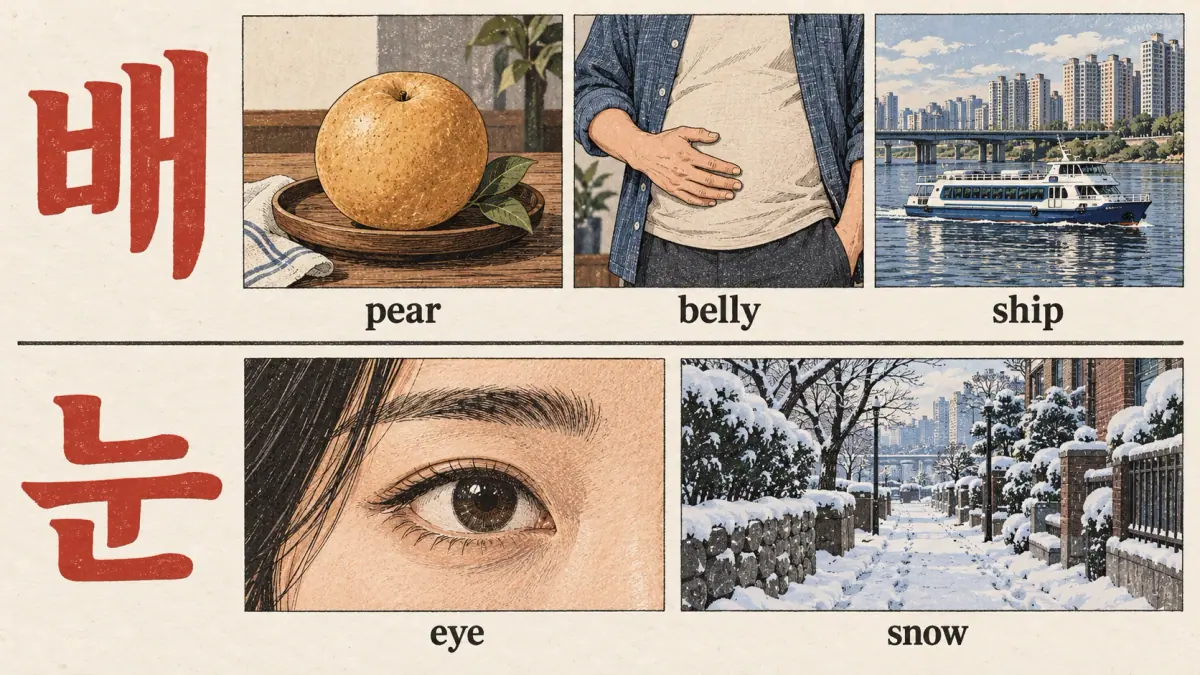
Top 100 Korean Words is a ranked list of 100 nouns, pronouns and adverbs in five groups: pronouns and demonstratives, people and family, time and numbers, places and things, and everyday adverbs and connectors. It includes a 20-sentence self-test and a warning about homophones such as 배 (pear, belly, ship) and 눈 (eye, snow).
Inside the Top 500 List

Top 500 Korean Words is the first 100 words plus four study units of 100 (words 101 to 500), so each page stays short enough to finish in a week or two. The units add objects, work, travel, feelings and abstract ideas, in that order of need.
Inside the Top 1000 List
Top 1000 Korean Words splits words 501 to 1000 into five study units of 100, each in five topic groups of 20. Together with the Top 500 list, it makes a 1000-word core vocabulary. The second 500 words move from daily life to ideas: abstract nouns, social vocabulary and written-register words.
Inside the Basic Survival Words List

Basic Korean Words lists about 60 words picked by situation: first-day survival words, people and titles, yes, no and politeness, food and drink, money and numbers, and directions and places. It splits them into words to recognise on signs and menus and words to say aloud.
How Do Frequency Lists Work?
A frequency list orders words by how often they appear in a body of text or speech. The idea is that a short list of frequent words covers a large share of everyday speech, so learning the common words first pays back fastest. No exact percentage is quoted here, because a figure needs a verified source and a defined corpus.
This site builds its lists differently. The ranking is an editorial selection of beginner words checked against published learner word lists, and Min-ji Park reviewed and signed off the list and its sources on 15 October 2026. The difference matters: a corpus list favours words like 것 and 수 that are frequent but hard to learn alone, while an editorial list puts concrete words such as 물 and 집 earlier. A situation-based list such as Basic Korean Words ignores rank on purpose, so use it for a task and use the ranked lists for breadth.
What Every List Entry Contains
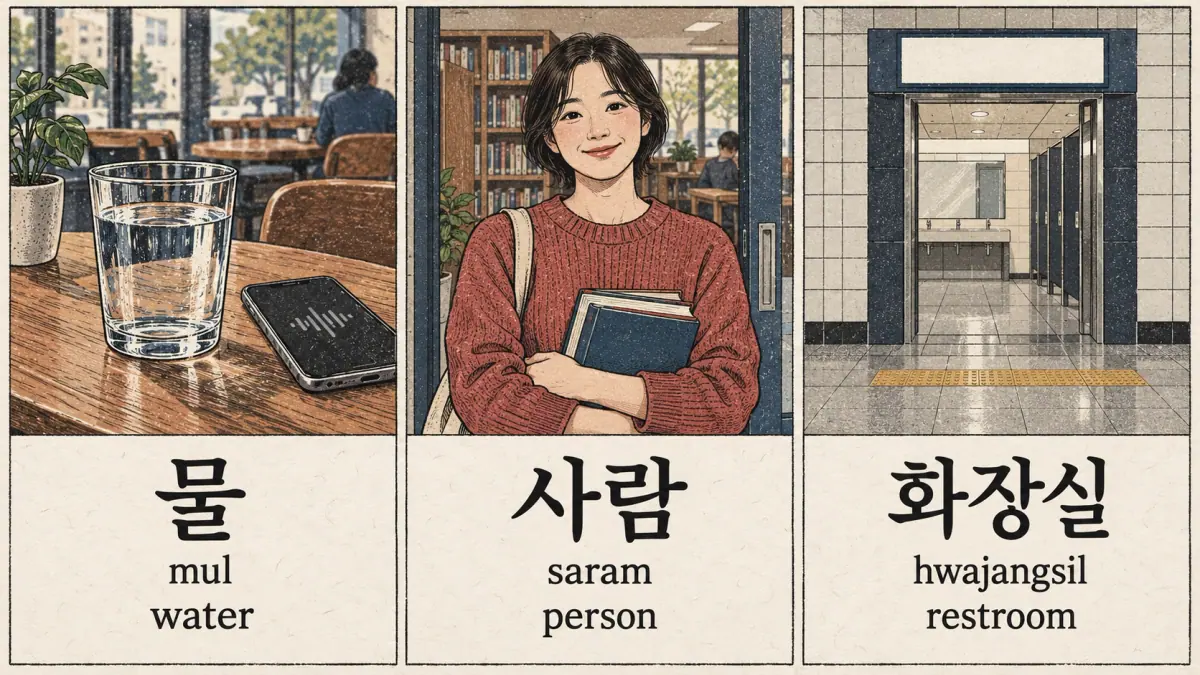
Each entry follows the same layout, so the lists work as a reference and as a deck. The fields are in the order below.
- Hangul is the headword, shown first.
- Revised Romanization is a learning aid in brackets or in its own column, never the only form.
- English meaning gives the common sense of the word.
- Audio plays when you press the button, with a slow clip for the hardest words.
- Example sentence shows the word in a short polite sentence.
Here are three sample entries, each with an audio button.
물 (mul) means water. It is a native Korean word and one of the first nouns most learners need.
사람 (saram) means person. It is counted with the counter 명 and appears in 한국 사람 (a Korean person).
화장실 (hwajangsil) means restroom. It is among the most useful words to read on a sign.
Most of these words are native Korean words, but a large share are Sino-Korean words built from Chinese-derived syllables, such as 시간 (time) and 학교 (school), and a few are loanwords. The pages tag each word with its origin where it helps.
Where Verbs and Adjectives Live
Verbs and adjectives live in the verbs hub, so each word has one home. The lists link to the common verbs pages instead of repeating conjugations. This split keeps the noun lists short and lets the verb pages show every ending in one table.
How Fast Can You Learn These Lists?

At 10 new words a day, the pace below holds. Review time is extra and shown separately, since each flashcard deck schedules reviews on its own.
| List | New words per day | Days to introduce | Approximate time |
|---|---|---|---|
| Basic Korean Words | 10 | 6 | about 1 week |
| Top 100 Korean Words | 10 | 10 | about 1.5 weeks |
| Top 500 Korean Words | 10 | 50 | about 7 weeks |
| Top 1000 Korean Words | 10 | 100 | about 14 weeks |
These figures are for introducing words, not for mastering them. Plan a review pass on the day after you meet a word, then again after about three days and a week, which is how the flashcards schedule it.
Practice: Flashcards and Worksheet
Drill the Top 100 list with the 100 Korean words flashcards, and find every other themed deck in the vocabulary flashcard decks. Print a writing sheet from the vocabulary worksheets. The deck holds the same 100 words as the Top 100 list, in the same order, and your progress is saved only in your browser.
Where to Go Next
After this hub, read Korean Vocabulary for the full topic map, then choose People and Relationships or Daily Life for the next themed list. When these four lists feel easy, study the most common Korean words in themed chunks, since the same words will keep returning in every topic.
Frequently Asked Questions
What Is the Difference between a Frequency List and a Topic List?
A frequency list orders words by how often they are used, so it teaches the words you will meet most. A topic list groups words by situation, such as ordering food or travel, so it teaches the words you need for one task. Use a frequency list for breadth and a topic list for depth.
Should I Learn the Top 100 Words before the Themed Lists?
Yes, if you can read Hangul. The top 100 words are the pronouns, question words and everyday nouns that appear in nearly every sentence, and the themed lists assume you know them. If you are travelling within days, start with the basic survival words instead.
Which List in Most Common Korean Words Should I Start With?
Start with Basic Korean Words if you arrive in Korea this week, and with Top 100 Korean Words if you are studying at home. Both take one to two weeks at 10 new words a day. After either, move to Top 500 Korean Words, then Top 1000 Korean Words, and pick themed lists for your interests.
How Are the Lists in Most Common Korean Words Organised?
Each list is an editorial selection grouped by word type or situation, with Hangul, Revised Romanization, English meaning, audio and an example sentence for every entry. Top 500 and Top 1000 are split into chunks of 100 words, so you can finish one chunk at a time.
Do These Lists Include Verbs and Adjectives?
Mostly nouns, pronouns and adverbs. Verbs and adjectives are listed separately in the verbs hub, which shows their conjugation. The lists here link to the verb pages instead of repeating conjugations, so each word has one home. The Top 100 page links to the 100 Korean verbs page.
Where Can I Find Flashcards and Worksheets for These Topics?
The 100 Korean words worksheet matches the Top 100 list, and the 100 Korean words flashcards hold the same 100 words in the same order. The vocabulary flashcards page lists every other deck, and the vocabulary worksheets page lists the matching printable sheets, so check both pages when you finish a list.