
Korean Vocabulary at a Glance
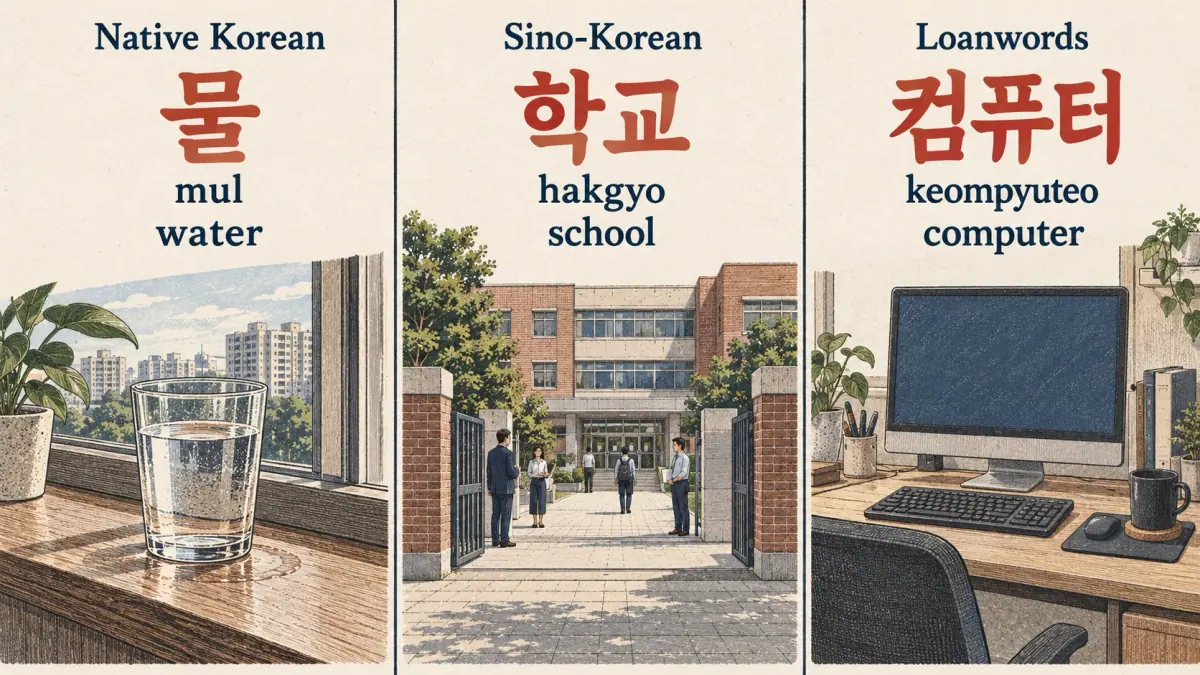
Korean vocabulary on this site is organised by topic, so you learn the words for one situation together. The section has three layers: frequency lists for the most useful words, themed lists for situations, and tools for studying and looking words up. Words come from three sources, which you will meet again and again.
| Word layer | Where it comes from | Example | Typical topics |
|---|---|---|---|
| Native Korean | Words that existed before borrowing | 물 (mul, water) | Body, food, nature, everyday objects |
| Sino-Korean | Syllables from Chinese characters | 학교 (hakgyo, school) | School, work, medicine, society, formal terms |
| Loanwords | Borrowed from English and other languages | 컴퓨터 (keompyuteo, computer) | Technology, clothes, sport, cafes |
Learn the layer together with the word, because it predicts how the word behaves. Sino-Korean words combine easily (학교, 학생, 학년), and loanwords can be guessed from English. See Korean Word Types. The cards below show each page with its level and a lead word.












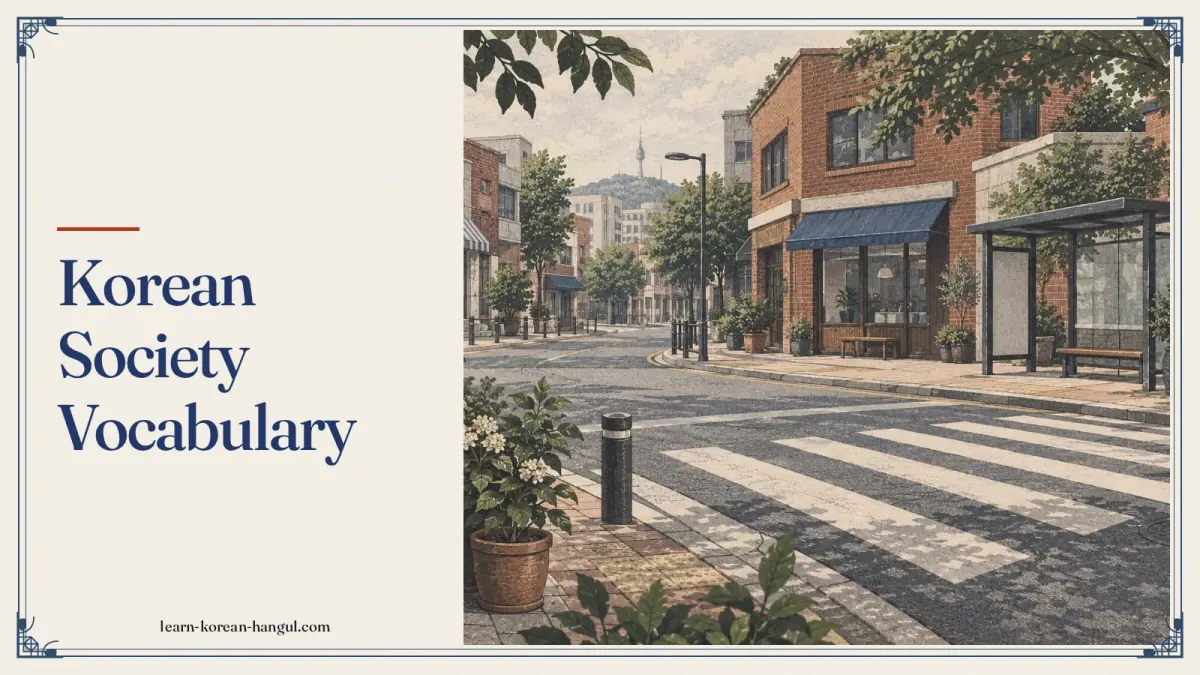




The next section helps you choose a list.
Which List Should You Open First?

Open Most Common Korean Words if you are starting from zero, and a themed list if you have one clear goal. The list you choose should match the next few weeks of your life, because words you use stay in memory.
| Your goal | Start with | Then add |
|---|---|---|
| Survive a trip to Korea | Most Common Korean Words (the basic survival list) | Places and Travel, Food and Drink |
| Follow K-dramas and K-pop | Korean Culture Words | People and Relationships, Korean Slang |
| Prepare for TOPIK I | TOPIK Vocabulary | Most Common Korean Words, Korean Pronouns, Question Words and Connectors |
| Talk about daily life | Daily Life | Time Words, Food and Drink |
If you cannot read Hangul yet, start with the alphabet lessons instead. The reading skills you need are in the Hangul section. Once you can read, the lists below are in a sensible order.
Most Common Words
The frequency lists teach the words that appear in nearly every sentence. Most Common Korean Words holds four lists: the Top 100, Top 500 and Top 1000 Korean words and a survival list picked by situation. Korean Pronouns, Question Words and Connectors adds the small words that hold sentences together: pronouns, question words and connectors.
- Most Common Korean Words (A1): ranked lists of the most useful beginner words, from a first 100 to a thousand, with a situation-based survival list.
- Korean Pronouns, Question Words and Connectors (A1): who, what, where and why words, plus the conjunctions and linking adverbs that join sentences.
Start here whichever theme you choose, because every themed list assumes the first hundred words. Most of those words are nouns. The next cluster applies them to people and the home.
What Is in the People, Daily Life and Food Lists?
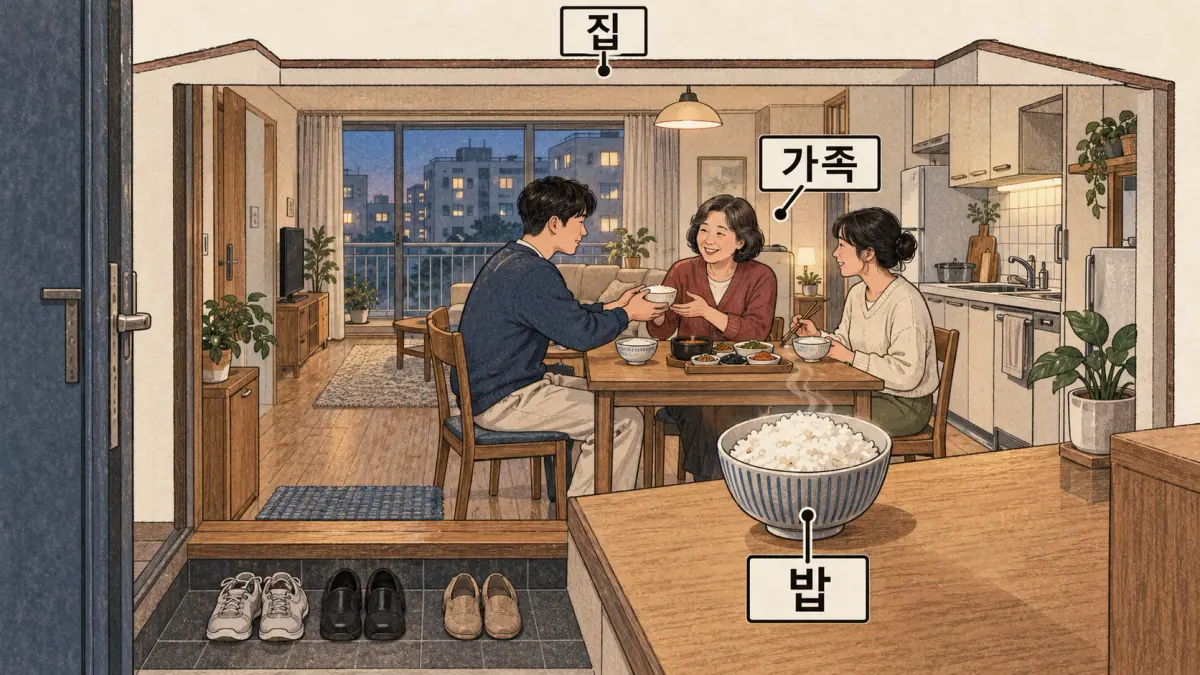
The people, daily life and food lists cover the nouns of everyday living. People and Relationships names family, relationships, jobs and body parts. Daily Life names the home, clothing, routines, shopping, money, technology, health and beauty. Food and Drink names dishes, ingredients, fruit, vegetables and drinks.
- People and Relationships (A1): family terms, titles, jobs and the body, in a hub of seven pages.
- Daily Life (A1): eight topic pages with 30 to 50 words each, from House and Home to Health.
- Food and Drink (A1): Korean dishes, ingredients, fruit and vegetables, drinks, restaurant words and cooking, in a hub of six pages.
These are the lists where Korean culture shows most: family titles depend on age and side of the family, and the food lists include dishes with no English name. The next group moves outdoors.
Nature, Time and Places

The nature, time and places lists cover the world outside the home. Nature and the World names animals, weather, seasons, plants, geography and colours. Time Words names days of the week, months and time expressions. Places and Travel names places in a city, directions, transport and the airport.
- Nature and the World (A1): animals, weather, seasons, plants and flowers, geography and colours, in a hub of six pages.
- Time Words (A1): days, months and relative time words such as today and tomorrow, in a hub of three pages.
- Places and Travel (A1): around the city, directions and position, transport and travel, in a hub of five pages.
Travellers should open the places list first, since it pairs with the Korean phrases section. Work and hobbies come next.
School, Work and Hobbies
The school, work and hobby lists cover what people do with their days.
- School and Work: school subjects, classroom words and workplace terms.
- Hobbies and Leisure: sports, music, movies, games and outdoor activities.
Hobby words are the quickest route to a real conversation, because they are what people ask about first. The cultural lists add more.
Culture, Slang and Society
The culture, slang and society lists teach vocabulary that dictionaries rarely order well.
- Korean Culture Words: holidays, K-pop, K-drama, traditions, weddings and religion.
- Korean Slang: internet slang, abbreviations, texting and swear words.
- Korean Society Vocabulary: environment, government, law, military, housing and media.
Slang changes quickly, so treat the slang list as a snapshot and check it with a Korean friend. Now we look at lists that organise words by type or by exam.
What Word-Type and Exam Lists Are Available?
Three pages organise words by type, shape or exam level, not by topic.
- Korean Word Types: Sino-Korean words, loanwords and Konglish, onomatopoeia, idioms, proverbs and four-character idioms, with a list for each type.
- Shapes, Materials and Measurements in Korean: shapes, materials, units, position, quantity and opposites.
- TOPIK Vocabulary: TOPIK I and II word lists mapped to exam levels.
These lists suit learners with an exam date. The last cluster helps you study.
How Do You Study and Look up Korean Words?

Two pages support study. How to Learn Korean Vocabulary turns the lists into a weekly routine with a target number of new words and a review schedule, and Korean Words A to Z is an A to Z lookup of 751 single words at levels A1 to B1, each with an entry page.
- How to Learn Korean Vocabulary (A1): choosing words that matter, learning them in context, spaced repetition and saying them aloud.
- Korean Words A to Z (A1 to B1): a lookup by English meaning, Hangul initial or theme for 751 words from A1 to B1.
Use the guide before you pick a pace, and use the lookup when you meet a word outside the lists. The next section explains what every entry holds.
What Do All the Lists Have in Common?

Every list entry has the same five parts, so the pages work as a reference and as a deck. Hangul comes first, then Revised Romanization, the English meaning, audio and an example sentence. Here are three sample entries with audio buttons.
물 (mul) means water. It is a native Korean word and one of the first nouns most learners need.
학교 (hakgyo) means school. It is a Sino-Korean word, built from the syllables 학 (learning) and 교 (school).
컴퓨터 (keompyuteo) means computer. It is a loanword, so an English speaker can guess it.
The audio is generated with text-to-speech and checked by a Korean teacher before publication. The romanization is a learning aid, never the only form, and the levels are editorial estimates, not official levels.
Why Are Verbs and Adjectives Not in the Word Lists?
Verbs and adjectives change their endings, so they need conjugation tables and not a plain list. They live in the verbs hub, and the vocabulary lists link to them. Nouns, adverbs and expressions stay here. For the most useful verbs, see common verbs.
Practice: Flashcards and Worksheet
Practise with the vocabulary flashcard decks, which hold the same words as the lists, and with the Korean vocabulary quiz pages for a quick check. Printable sheets for vocabulary are on the vocabulary worksheets page. Progress in the decks is saved only in your browser. Numbers have their own section: see Korean numbers.
Where to Go Next
Choose one list from the table above and finish it before you open another. The TOPIK exam guide shows where the exam lists fit in a longer plan. A complete beginner should open Most Common Korean Words, then a themed list.
Frequently Asked Questions
Where Should a Complete Beginner Start with Korean Vocabulary?
Start with Most Common Korean Words, after you can read Hangul. The top 100 list teaches the nouns, pronouns and question words that appear in most sentences, and the other lists assume them. If you travel within days, start with the survival list in the same hub, then move to Places and Travel.
Why Are Verbs and Adjectives Not in These Word Lists?
Verbs and adjectives change form with the ending, politeness and tense, so a single dictionary entry is not enough. The verbs hub teaches them with conjugation tables. These vocabulary lists keep nouns, adverbs and expressions, so each word has one home and the lists stay short enough to finish.
How Many Korean Words Do I Need to Hold a Basic Conversation?
The answer depends on the topic, so this site does not quote one figure. A practical plan is to learn the top 100 words, then one themed list for the situation you expect, then the top 500. Each list holds 30 to 100 words and takes between three and ten days at 10 words a day.
Which List in Korean Vocabulary Should I Start With?
Start with the list that matches your next goal. Use Most Common Korean Words for general study, Places and Travel for a trip, Culture for K-dramas and TOPIK Vocabulary for the exam. Finish one list before opening the next, because review beats variety for memory.
How Are the Lists in Korean Vocabulary Organised?
Each list is an editorial selection grouped by word type or situation, with Hangul, Revised Romanization, English meaning, audio and an example sentence for every entry. Larger hubs split into pages of 30 to 50 words, so you can finish one page at a time. The levels are editorial estimates.
Is the Romanization on This Site Official?
It follows the Revised Romanization of Korean, which South Korea officially adopted on 7 July 2000 and whose rules the National Institute of Korean Language (국립국어원) publishes. It is a learning aid that does not mark every sound change, so learn the Hangul and use the audio to hear the real sound.