
Basic Korean grammar is the set of core ideas behind every sentence: verb-last SOV order, the copula 이다, existence with 있다 and word classes such as nouns and descriptive verbs. This hub orders three A1 sets, with 15 lessons, audio examples and practice, so you can open the right one.
What Is Basic Korean Grammar?
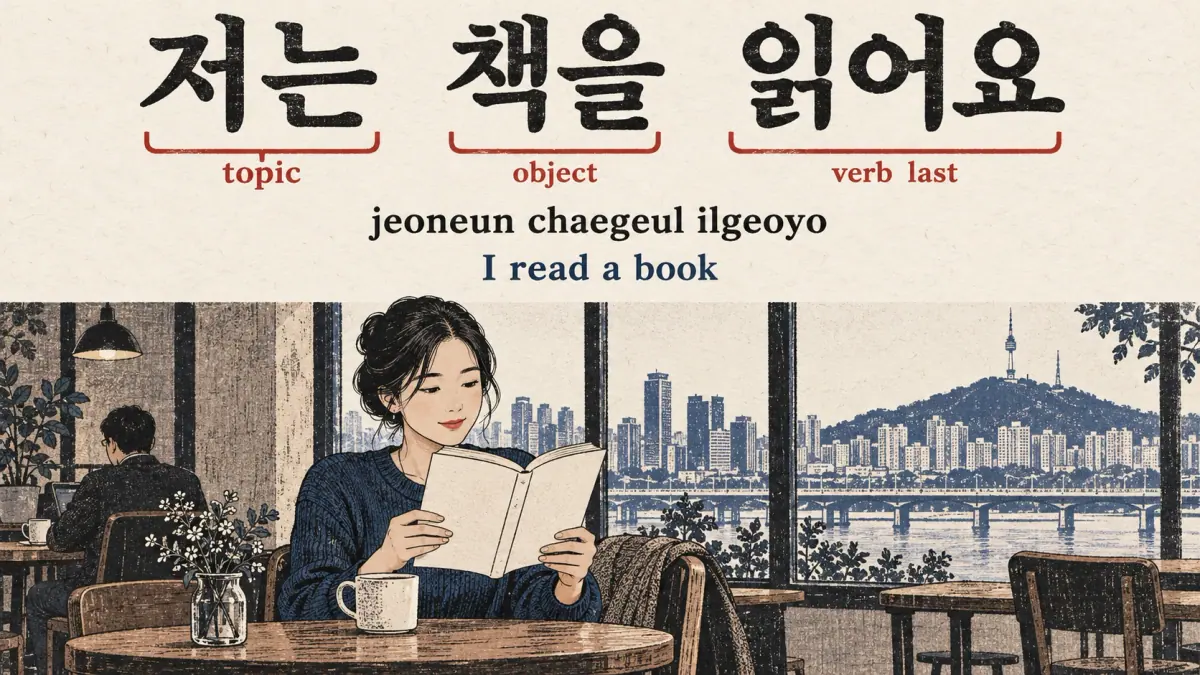
Basic Korean grammar is the minimum set of rules you need to build and understand a simple Korean sentence. SOV stands for subject-object-verb, the order Korean uses. The sentence 저는 책을 읽어요 (jeoneun chaegeul ilgeoyo) means "I read a book" and shows the whole idea in one line: a topic with 는, an object with 을, and the verb last.
Five core ideas sit under this sentence. The table gives each idea with its lesson set and one example.
| Core idea | What it means | Example | Lesson set |
|---|---|---|---|
| Verb-last order | The predicate closes the sentence | 책을 읽어요 | Sentence structure |
| Particles | Short words show each noun's job | 책을 (object) | Sentence structure |
| The copula 이다 | "to be" attaches to nouns | 학생이에요 | Sentence structure |
| Existence with 있다 | "there is" also means "have" | 책이 있어요 | Sentence structure |
| Word classes | Nouns take particles, verbs take endings | 친구가 / 먹어요 | Parts of speech |
Flexible order is the sixth idea: parts before the predicate can move, as long as the particles stay attached. That topic has its own set.
Where Should You Start with Basic Korean Grammar?
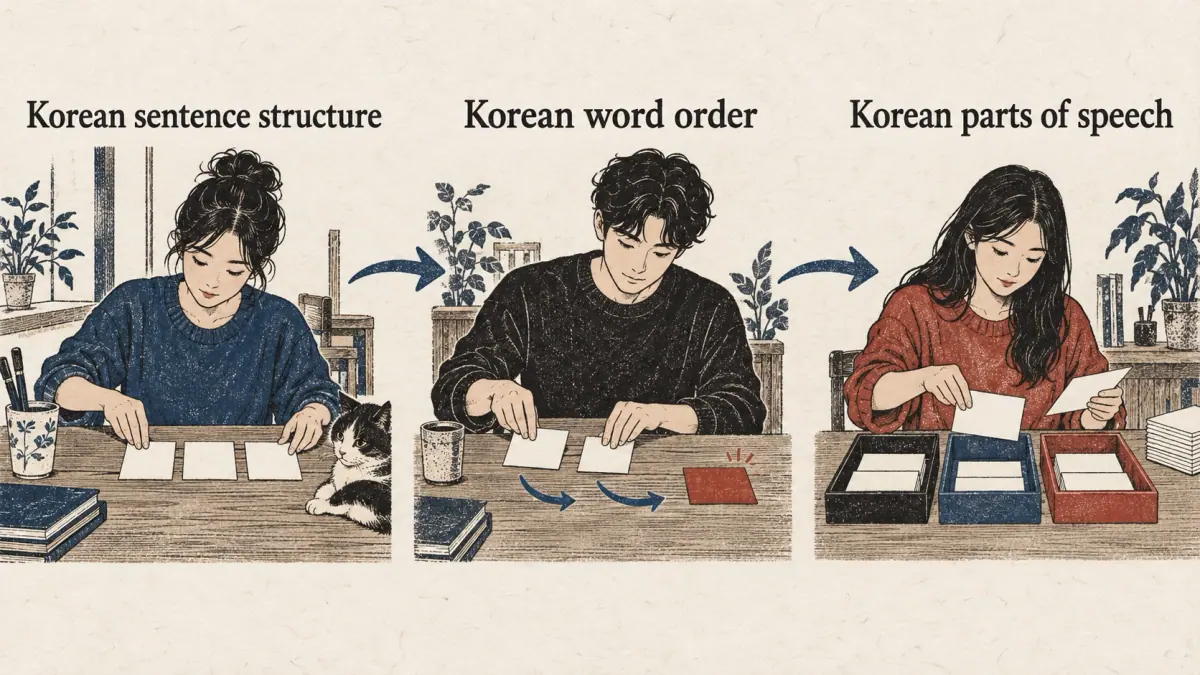
Start with Korean sentence structure, then word order, then parts of speech. The first set gives you the sentence frames, the second shows what can move, and the third names the word classes that fill the frames.
- Korean sentence structure: six lessons from SOV order to dropping the subject.
- Korean word order: four lessons on time and place, flexible order, question words and adverbs.
- Korean parts of speech: five lessons on nouns, descriptive verbs, pronouns, pointing words and indefinite pronouns.
The most common first mistake is skipping this hub and memorising verb endings without particles. Endings alone give you a verb with no nouns around it. Learn the frame first, and the endings have somewhere to go.
Browse by Topic
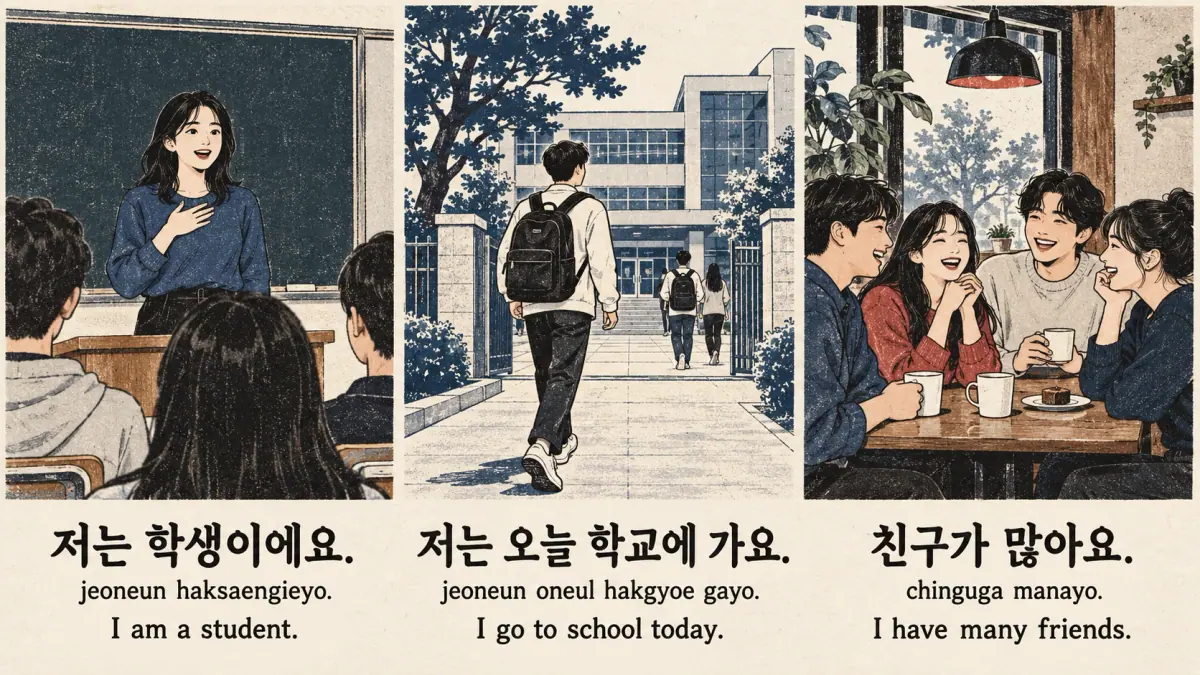
Each set below has a summary of what it teaches, one example sentence with audio and a link.
Korean Sentence Structure
The sentence structure set teaches how a sentence is built: predicate last, particles on nouns, five frames, the polite "to be", existence words, the negative 아니에요 and subject omission. Six lessons, about two hours with practice. Example: 저는 학생이에요. (jeoneun haksaengieyo.) "I am a student."
Open Korean sentence structure.
Korean Word Order
The word order set shows which parts of a sentence can move and which cannot. It covers time and place order, flexible word order, question word position and adverb position. Example: 저는 오늘 학교에 가요. (jeoneun oneul hakgyoe gayo.) "I go to school today."
Korean Parts of Speech
The parts of speech set names the word classes and shows how each behaves: nouns take particles, descriptive verbs conjugate like verbs, pronouns carry politeness and demonstratives point by distance. Five lessons. Example: 친구가 많아요. (chinguga manayo.) "I have many friends."
Which Set Fits Your Sentence?
Pick the set by the question you have. The table maps six common questions to the set and the lesson that answers each.
| Your question | Open this set | Start with this lesson |
|---|---|---|
| Why does the verb come last? | Sentence structure | SOV sentence pattern |
| How do I say "I am a student"? | Sentence structure | 이에요/예요 |
| Where do time and place words go? | Word order | Time and place order |
| Can I swap the order of words? | Word order | Flexible word order |
| Are Korean adjectives verbs? | Parts of speech | Adjectives are verbs |
| How do I say "this" and "that"? | Parts of speech | 이 그 저 demonstratives |
How Do the Three Sets Compare?
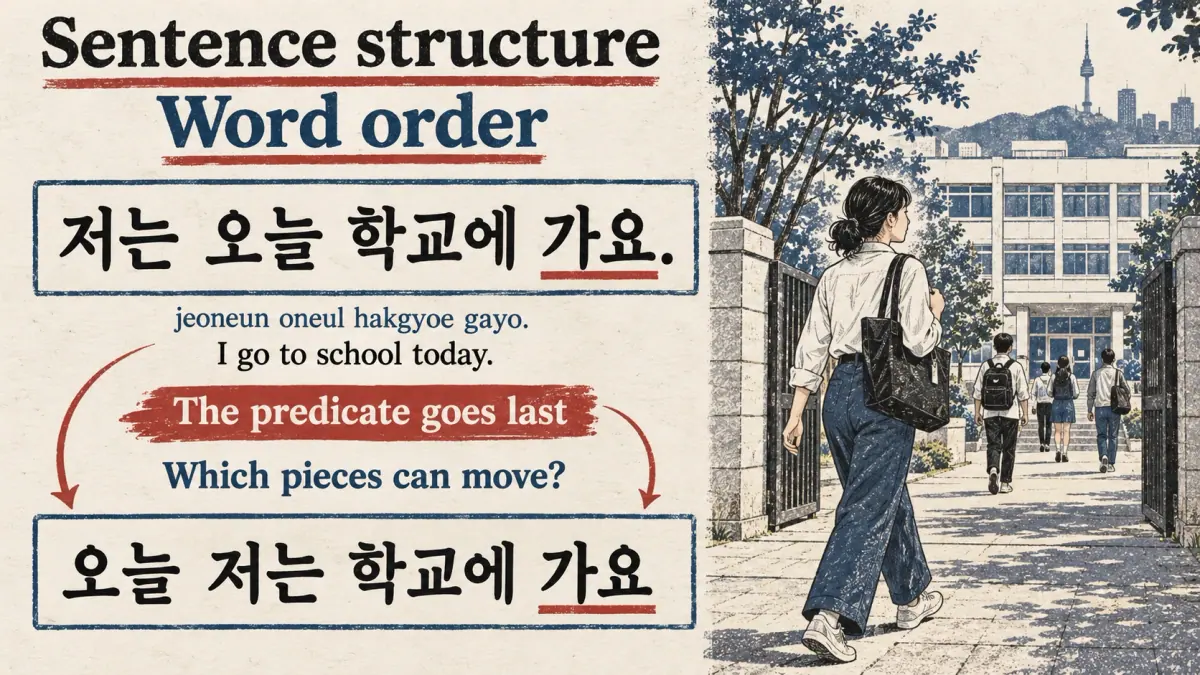
The three sets differ in what they teach: structure gives the frame, word order gives the freedom inside the frame, and parts of speech gives the words that fill it. Use the snapshot below to see the split.
| Set | Main question | Key rule | Example |
|---|---|---|---|
| Sentence structure | What pieces must a sentence have? | The predicate goes last | 저는 학생이에요 |
| Word order | Which pieces can move? | Particles keep roles when order shifts | 오늘 저는 학교에 가요 |
| Parts of speech | What kind of word is each piece? | Nouns take particles, verbs take endings | 친구가 / 먹어요 |
Sentence structure versus word order is the pair learners confuse most. Structure is fixed at the end of the sentence, and order is flexible before it. A sentence can move 오늘 (today) to the front, but 가요 (go) stays last.
How Do You Practise Basic Korean Grammar?
Practise by building sentences, not only reading rules. Each lesson ends with four practice items and an answer key, and many add a sentence builder or a short quiz.
- Take the Korean grammar quizzes after each set to check frame and particle recognition.
- Review the example words with the Korean flashcards.
- Return to the Korean grammar hub when you want the next topic, such as particles or tenses.
A practical routine is one lesson per session: read, play every clip twice, build the sentence yourself, then check the answers.
What Basic Korean Grammar Does Not Cover
Basic Korean grammar covers the A1 core in the present polite style. It does not cover the full particle system, tenses, speech levels, negation, questions or connectors. Those topics have their own hubs: Korean particles, Korean tenses, Korean speech levels and Korean negation.
Finish the lessons in order, and basic Korean grammar gives you the frame that every later grammar point plugs into.
Frequently Asked Questions
What is the basic structure of a Korean sentence? A basic Korean sentence is subject, object, then verb, with a particle after each noun and the predicate last. In 저는 책을 읽어요 (I read a book), 저는 marks the topic, 책을 marks the object and 읽어요 ends the sentence. Words the listener already knows are often dropped.
Why do Korean sentences end with the verb? Korean is a verb-final language, so the predicate carries the final information: tense, politeness and sentence type. Particles on the nouns show their roles, which frees the order of earlier parts. Listeners wait for the ending to learn whether a sentence is a statement, a question or a request.
What level is basic Korean grammar? Level A1, the first stage for beginners. You need to read Hangul and nothing else. The sets here cover the frames for introducing yourself, saying what exists, describing things and pointing at them. Particles, tenses and speech levels follow in their own sections of the grammar hub.
How long does basic Korean grammar take to learn? Fifteen lessons of about 15 to 30 minutes each take roughly five hours with practice, so a learner who studies 30 minutes a day can finish in about two weeks, including review days. The time depends on practice and review, and no result is guaranteed. Repeat the audio examples more often than you re-read the rules.