
Korean learning resources fall into seven groups, apps, books, YouTube, podcasts, dictionaries, tutors and media, and the best choice depends on your level, budget and goal. This hub gives you a decision table, the order in which each type becomes useful, and the criteria we use to judge any resource. The aim is a small set that covers reading, listening and speaking, without paying for things you will not use.
Last updated: 2026-10-09.
How Should You Choose Korean Learning Resources?
Choose Korean learning resources by your goal first, then by your level and budget. A tool that is excellent at one job is often weak at another. A flashcard app drills words well but cannot hold a conversation. A tutor can correct your speech but rarely gives you the hours of listening you need. The table matches six common goals with the type of resource that does each job most directly.
| Your goal | Start with | Add next | Free option |
|---|---|---|---|
| Read Hangul as an absolute beginner | A Hangul course with audio | An alphabet app for daily review | The Korean alphabet lessons on this site |
| Build grammar step by step | A graded textbook series with audio | A grammar reference for lookups | The Korean grammar lessons |
| Start speaking | A tutor or a conversation class | A language exchange partner | Exchange partners, plus Korean shadowing |
| Pass TOPIK | The official exam information on topik.go.kr | A TOPIK-focused book or course | The TOPIK section |
| Understand spoken Korean | Teaching podcasts with transcripts | YouTube at your level, then dramas | Podcasts and YouTube |
| Spend nothing | Free lessons plus a free dictionary | Free spaced-repetition flashcards | Every row above has one |
Read each row from left to right. The second column does the job directly; the third fills that resource's main gap. For example, a learner who starts with a tutor to speak still needs listening between lessons, so podcasts or YouTube come next.
Which Resources Suit Each Level?
Your level changes what is worth your time. Levels here follow the CEFR scale used across this site: A1 is beginner, A2 elementary and B1 intermediate.
- A0–A1, starting out: learn Hangul first, then use an app and short lessons to build a daily habit. Native-speed media is mostly noise at this stage, so keep it for fun rather than study.
- A2, elementary: move to a textbook series with audio. It gives you the grammar sequence that most apps skip. Add teaching podcasts for listening.
- B1 and above, intermediate: spend more time with tutors and native media: YouTube, podcasts at natural speed and dramas with Korean subtitles. A Korean–Korean dictionary starts to pay off here.
How Many Resources Should You Use at Once?
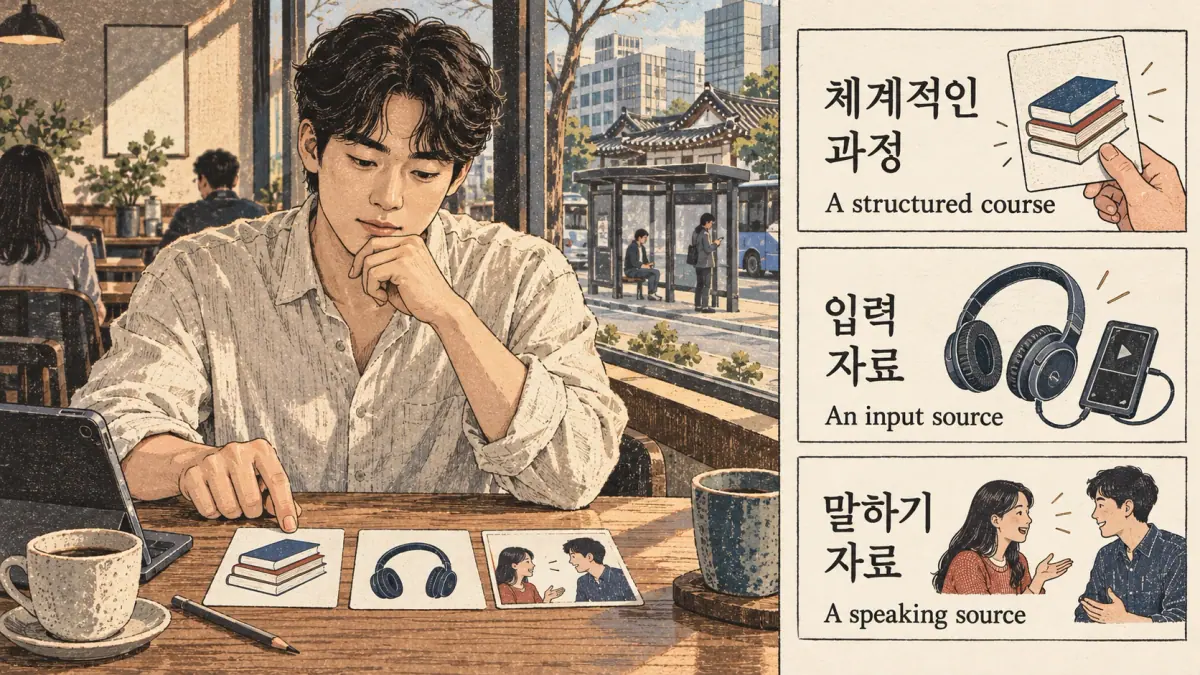
Use three at a time: one structured course, one input source and one speaking source.
- A structured course (a textbook series or a lesson sequence) gives you an order to follow, so you do not skip the basics.
- An input source (podcasts, YouTube or graded reading) gives you volume: many hours of Korean you mostly understand.
- A speaking source (a tutor, a class or an exchange partner) makes you produce Korean and get feedback.
More than three usually means you start many things and finish none. Swap one out only when you have outgrown it, for example when a teaching podcast starts to feel slow.
What Pages Are in This Hub?
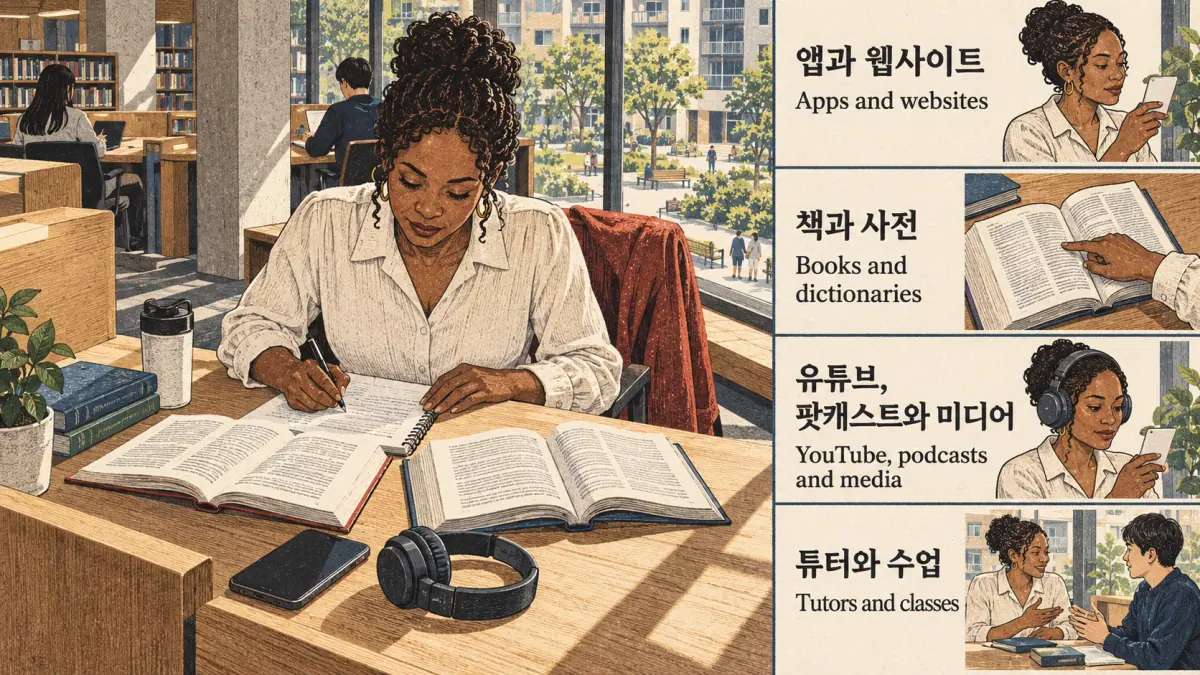
Each section below has its own page with a chooser table and the criteria for that type of resource. All seven are published.
Apps and Websites
Apps are strongest in the first months. They make a daily habit easy and drill Hangul and vocabulary well. Their main limit is speaking, which no app fully replaces.
- Korean Learning Apps: A goal chooser for apps (Hangul, vocabulary, grammar, speaking, flashcards, habit) and the six criteria to judge any app before you pay.
Books and Dictionaries
A textbook series gives you a grammar sequence, dialogues and audio in a fixed order. A good dictionary lets you check every new word, its spelling and its example sentences.
- Korean Textbooks and Books: Textbook types by study style: university series, self-study series, grammar references, workbooks and vocabulary books, with a check for edition, audio and answer keys.
- Korean Dictionaries: Bilingual, learner, Korean-Korean and hanja dictionaries compared, the free official dictionaries, and why a translator is not a dictionary.
YouTube, Podcasts and Media
Video and audio give you listening volume. Choose by level: lesson channels and teaching podcasts first, native-speed shows and dramas later.
- Korean YouTube Channels: A level ladder from lesson channels to news, a subtitle plan for each level and a method that turns watching into study.
- Korean Podcasts: Teaching podcasts versus native-speed shows, where to find transcripts, and a commute listening routine.
- Korean Dramas and Shows for Learners: Five criteria for choosing a show, a subtitle ladder from English to Korean to none, and how to watch on licensed platforms so that dramas support a course rather than replace it.
Tutors and Classes
People give you what software cannot: feedback on your own sentences and practice in real conversation.
- Korean Tutors and Classes: Marketplace tutors, online classes, language exchange and institute courses such as the King Sejong Institute compared, with five criteria from teacher qualification to cancellation policy.
Apps and Websites
Daily habit, Hangul and vocabulary drills.

Books and Dictionaries
A grammar sequence and a way to check every word.


YouTube, Podcasts and Media
Listening volume at each level.



Tutors and Classes
Speaking practice with feedback.

Do You Need to Pay for Korean Learning Resources?
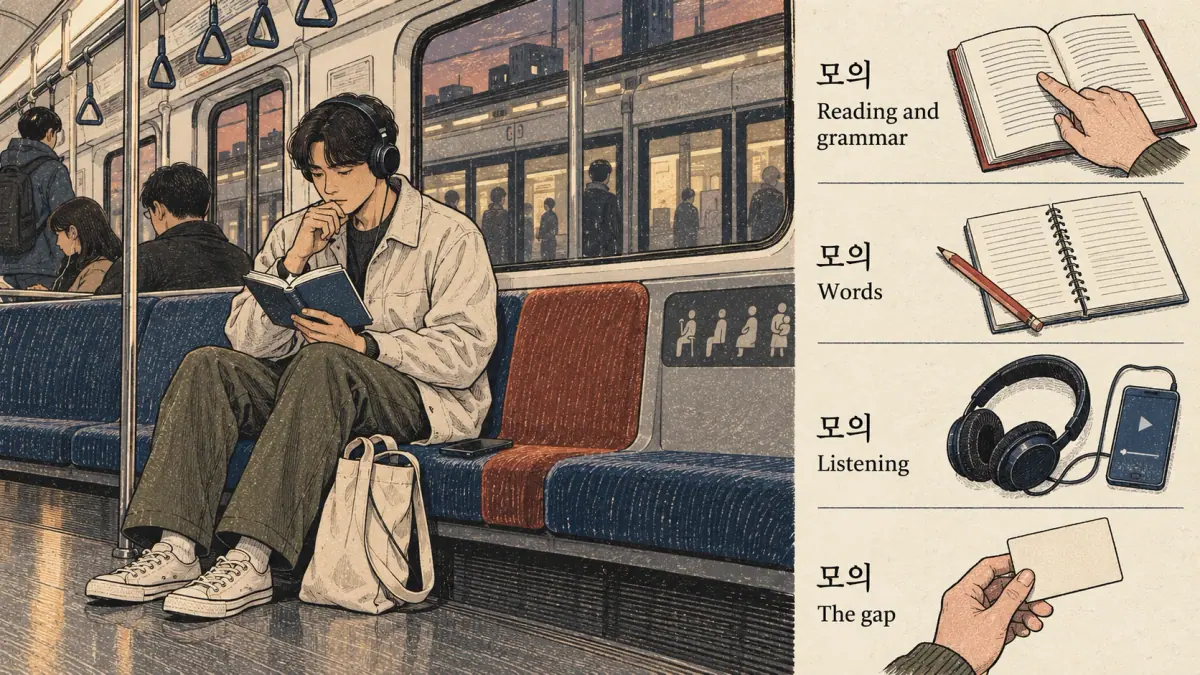
No. You can reach a solid beginner level with free resources, and paying is worth it only where it buys something free resources lack. Here is a complete free set and the one gap it leaves:
- Reading and grammar: the free lessons on this site, from Hangul to basic grammar.
- Words: the Korean Learners' Dictionary (한국어기초사전) and the Standard Korean Language Dictionary (표준국어대사전), both free online from the National Institute of Korean Language, plus free spaced-repetition flashcard software.
- Listening: teaching podcasts and YouTube lesson channels.
- The gap: feedback on your speaking. A language exchange fills part of it, but an exchange partner is not trained to correct you.
Paying helps most in three places: a tutor's feedback, a well-edited textbook series with audio and answer keys, and app features such as offline use. Before you pay, check what the free plan already includes, and look at the price on the official site or app store on the day you buy.
What Is Our Editorial Policy for Resources?
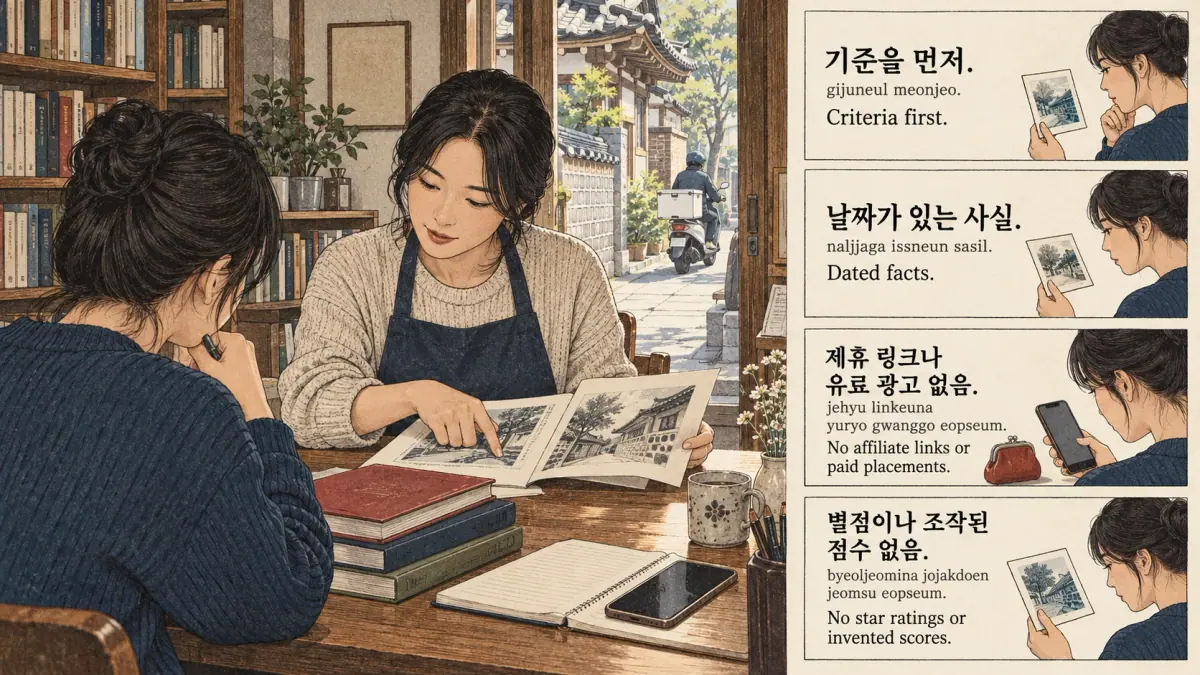
Every page in this section follows the same rules:
- Criteria first. Each section page states what it judges, such as audio quality, grammar explanations, speaking practice and cost, before it names any resource.
- Dated facts. Prices, plans and features are checked against the official site or app store, and the page shows when they were last checked.
- No affiliate links or paid placements. No resource pays to be listed, and no link earns us money.
- No star ratings or invented scores. Pages describe strengths, gaps and who a resource suits, because a single score hides the trade-offs.
- Limits named. Every recommendation says what the resource does not do.
The full rules for the whole site are on the Editorial Policy page.
How Does a Weekly Mix Look in Practice?
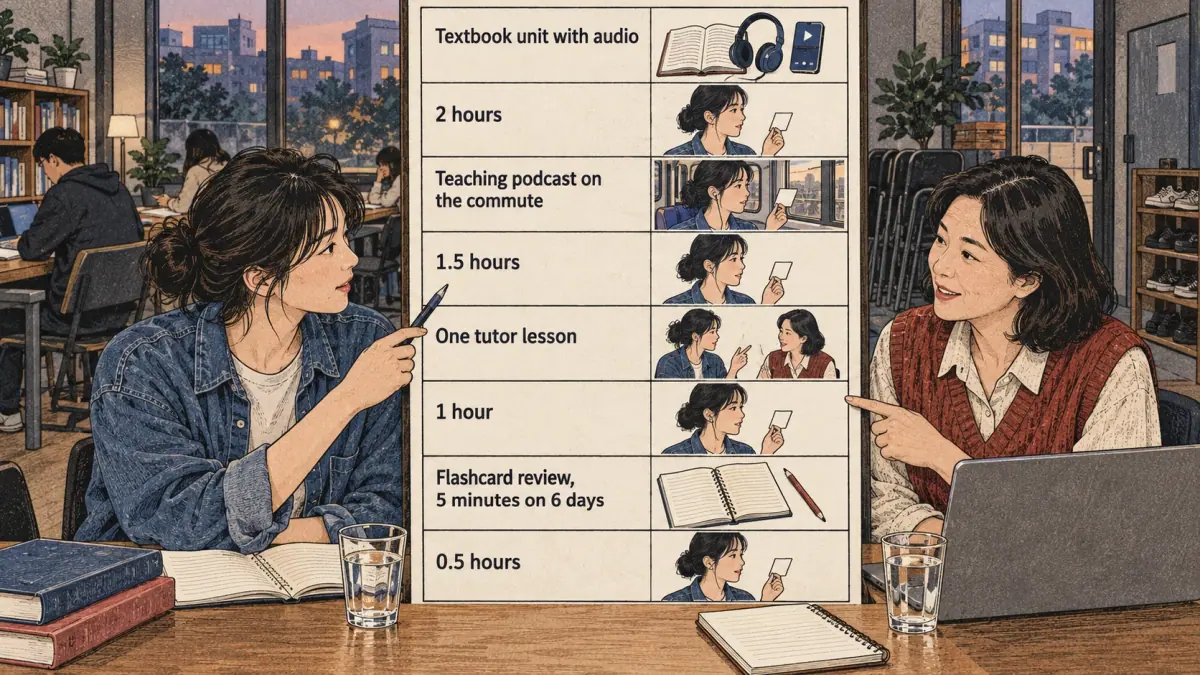
Here is a worked example for an A2 learner with five hours a week, using the three-part mix.
| Resource | Role | Time per week |
|---|---|---|
| Textbook unit with audio | structured course | 2 hours |
| Teaching podcast on the commute | input | 1.5 hours |
| One tutor lesson | speaking | 1 hour |
| Flashcard review, 5 minutes on 6 days | vocabulary upkeep | 0.5 hours |
| Total | 5 hours |
The textbook sets the week's grammar, the podcast recycles it by ear, and the tutor lesson is where you use it aloud. If you have only three hours, cut the podcast to one hour and the textbook to 1.5 hours, but keep the speaking slot. The Korean study plan pages give full schedules by level and time budget.
Related Sections
- New to Korean? Start with learn Korean for beginners, then read the best way to learn Korean for the method behind the three-part mix.
- Studying alone? The self-study Korean section covers routines, and Korean comprehensible input explains why listening volume matters.
- Practice on this site: Korean flashcards, Korean listening practice and Korean learning tools.
Frequently Asked Questions
What is the best resource to learn Korean? There is no single best resource, because each type does a different job. For a complete beginner, the best start is a Hangul course with audio, followed by one structured course such as a textbook series or a lesson app. Add an input source (podcasts or YouTube) and a speaking source (a tutor or an exchange partner) as soon as you can read Hangul.
Do I need to pay for Korean learning resources? No. You can reach a solid beginner level with free resources: free lessons, the free dictionaries of the National Institute of Korean Language, free flashcard software, and podcasts and YouTube. Paying helps most for speaking feedback from a tutor and for a well-edited textbook series with audio.
How many resources should I use at once? Three: one structured course, one input source and one speaking source. More than that usually means starting many things and finishing none. Replace a resource only when you have outgrown it, for example when a teaching podcast feels too slow.
Are your recommendations paid? No. This section has no affiliate links, paid placements or sponsored rankings, and it gives no star ratings. Each page states its criteria, names what a resource does not do, and tells you to check prices on the official site. The full rules are on the Editorial Policy page.
Which resource should a complete beginner start with? Start with Hangul, the Korean alphabet, because every other resource assumes you can read it. Most learners can read Hangul slowly after a week or two of short daily practice. Then move to one structured course and a teaching podcast.