
What Is the Korean Alphabet?
The Korean alphabet is a featural alphabet: each letter stands for one sound, and the shapes of the letters show how those sounds are made. ㄱ pictures the back of the tongue blocking the throat, ㄴ the tongue tip touching the gum, and ㅁ the closed mouth. The 1446 text Hunminjeongeum (훈민정음, "the correct sounds for teaching the people") introduced the script, and its commentary explains this design.
Unlike the English alphabet, Hangul letters are not written in a single line. They are grouped into square syllable blocks: 한 is ㅎ (h) + ㅏ (a) + ㄴ (n). A block always starts with a consonant, so a syllable that begins with a vowel uses the silent ㅇ, as in 아. Hangul is called 조선글 (Chosŏn'gŭl) in North Korea, where the letter order also differs slightly.
How Many Letters Does Hangul Have?
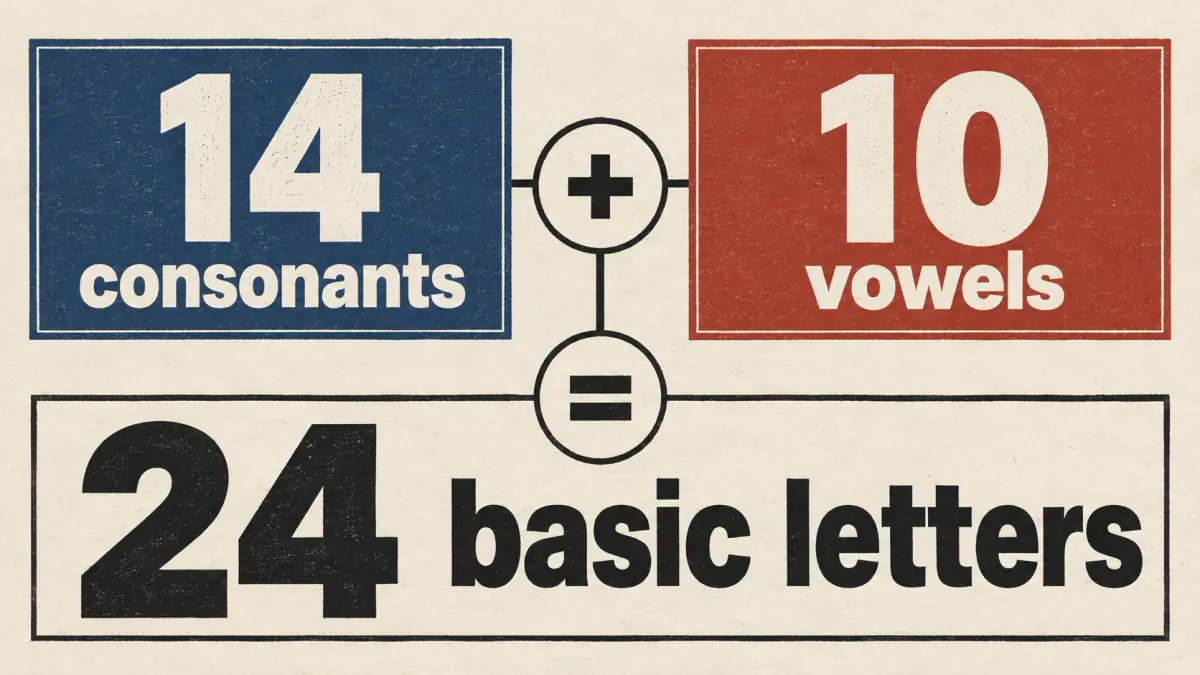
Hangul has 24 basic letters, but three counts are common. 24 is the official count in the Hangul Orthography (14 consonants, 10 vowels). 40 adds the 5 double consonants (ㄲ ㄸ ㅃ ㅆ ㅉ) and 11 compound vowels. 51 also counts the 11 consonant clusters used only as finals, such as ㄳ and ㄺ. The full answer, with a table, is on how many letters are in the Korean alphabet. Those letters can form 11,172 possible modern syllable blocks.
Knowing what the letters are, the next question is the order to learn them in.
Where to Start: the Recommended Hangul Path
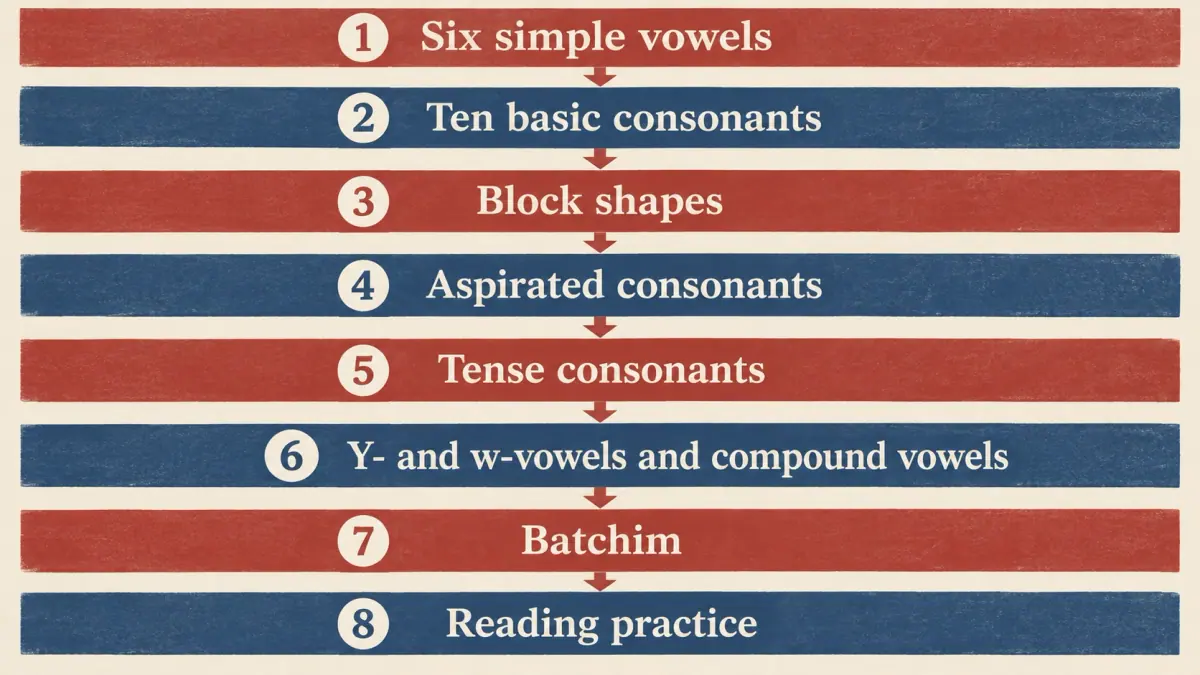
The recommended path teaches Hangul in eight stages, from the simplest sounds to full reading. Most learners start with the first vowel lesson, ㅏ, because every consonant lesson uses it in examples.
- Six simple vowels (ㅏ ㅓ ㅗ ㅜ ㅡ ㅣ): read and say the vowel sounds with the silent ㅇ.
- Ten basic consonants: after the six simple vowels, the course moves to the letter ㄱ and the other basic consonants, and you read your first blocks such as 가 and 나.
- Block shapes: place vowels to the right of or under the consonant.
- Aspirated consonants (ㅋ ㅌ ㅍ ㅊ): add a puff of air.
- Tense consonants (ㄲ ㄸ ㅃ ㅆ ㅉ): tense the throat, with no puff of air.
- Y- and w-vowels and compound vowels: build 야, 와, 애 and the rest.
- Batchim: read consonants at the bottom of a block.
- Reading practice: read real words, signs and short sentences.
If you want a fixed schedule, the learn Hangul in a week course puts these lessons into seven daily sessions. Each stage maps to one of the topic clusters below, starting with vowels.
Korean Vowels: 21 Letters in Four Families
Korean vowels are taught in four families: 6 simple vowels, 6 y-vowels (ㅑ ㅕ ㅛ ㅠ ㅒ ㅖ), 6 w-vowels (ㅘ ㅝ ㅟ ㅙ ㅚ ㅞ) and 3 compound vowels (ㅐ ㅔ ㅢ). Every vowel is built from three original symbols: a dot or short stroke for heaven, a flat line for earth and a vertical line for human. The vowel subhub links one lesson per vowel, each with audio and practice. Start with the vowels because they are the shortest route to reading whole blocks; the consonants follow.
Korean Consonants: 19 Letters in Three Series
Korean consonants come in three series on this site: 10 basic consonants, 4 aspirated consonants that add breath (ㅋ ㅌ ㅍ ㅊ), and 5 tense double consonants (ㄲ ㄸ ㅃ ㅆ ㅉ). The official count of 14 basic consonants includes the aspirated four. Each consonant has its own lesson with its name, sound by position, stroke order and contrast audio. Once you know a few consonants and vowels, the next step is putting them together.
Syllable Blocks: How Letters Combine
Korean syllable blocks explains the layouts every word uses: consonant + tall vowel side by side (가), consonant over a flat vowel (고), and either one with a final consonant underneath (각, 곡). This subhub also covers the silent ㅇ and how batchim sits in the block. With blocks in place, you can read and write real words.
Practice
Reading and Writing Hangul
Reading Hangul takes you from single blocks to words, signs and short sentences, and introduces the most common cases where Korean is not read exactly as written. Writing Hangul covers stroke order for every letter, block proportions and handwriting versus print. Both subhubs assume you know the letters; they turn recognition into fluent use.
When the spelling and the sound differ, as in 국물 [궁물], the Korean pronunciation rules explain why. Reading and writing also depend on reference material, which the next cluster gathers.
Romanization, Charts and Your Name in Korean
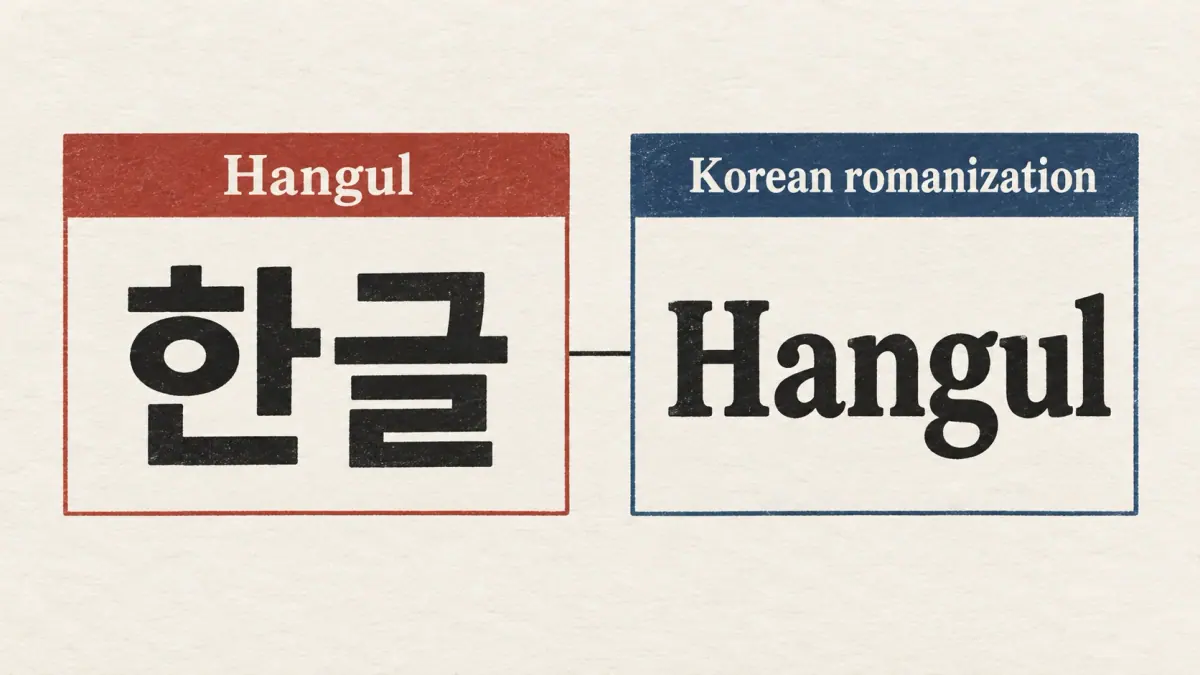
Korean romanization explains Revised Romanization, the official system for writing Korean in Latin letters, and its limits as a pronunciation guide. Hangul charts holds the master chart of all 40 letters with sounds, plus specialised charts for batchim, IPA and romanization. Write your name in Korean shows how to spell your own name in Hangul, with the usual choices for sounds such as f, v and th.
Three short reference pages answer specific questions: Korean alphabet order gives the dictionary order (가나다 order) including double letters and the North–South differences; Hangul mnemonics gives memory aids built on the real design logic; and Hangul vs Hanja compares the alphabet with Chinese characters used in Korean.
History of Hangul and Key Terms
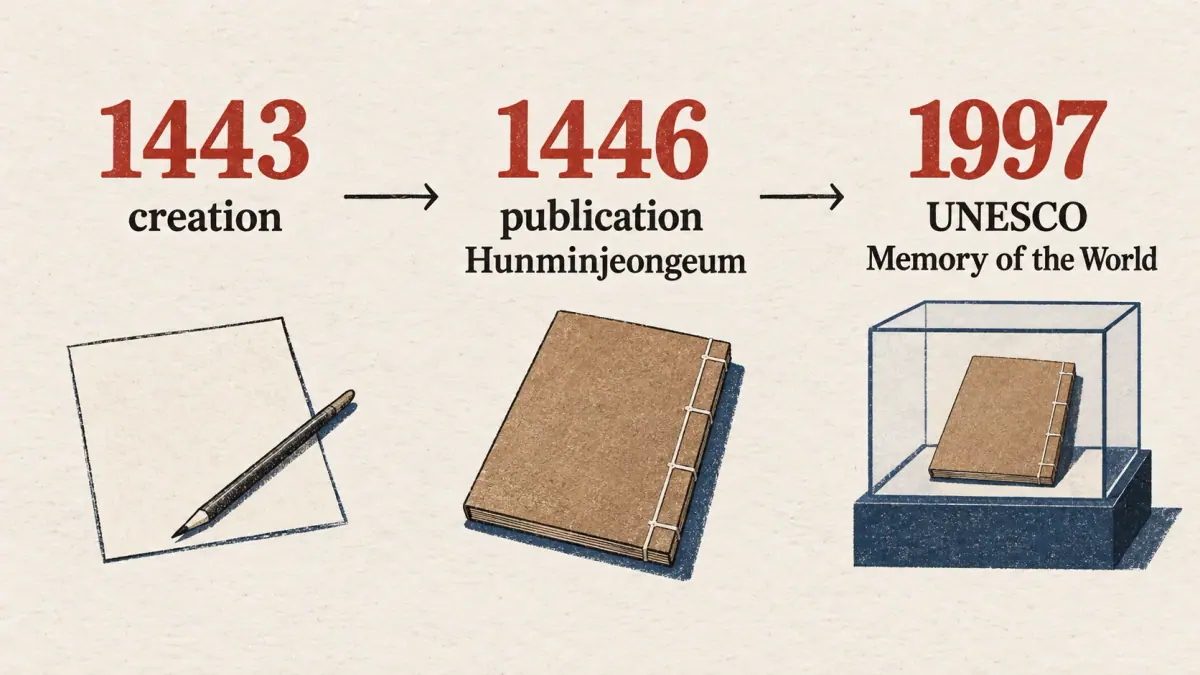
History of Hangul covers King Sejong's 1443 creation, the 1446 publication of Hunminjeongeum, the 28 original letters (four are no longer used), and the 1997 inscription of the Hunminjeongeum manuscript (the Haerye edition) on UNESCO's Memory of the World register. The Hangul terms glossary defines words used across the lessons, such as jamo (자모, the individual letters), batchim (받침, a final consonant) and syllable block.
How Long Does It Take to Learn the Korean Alphabet?
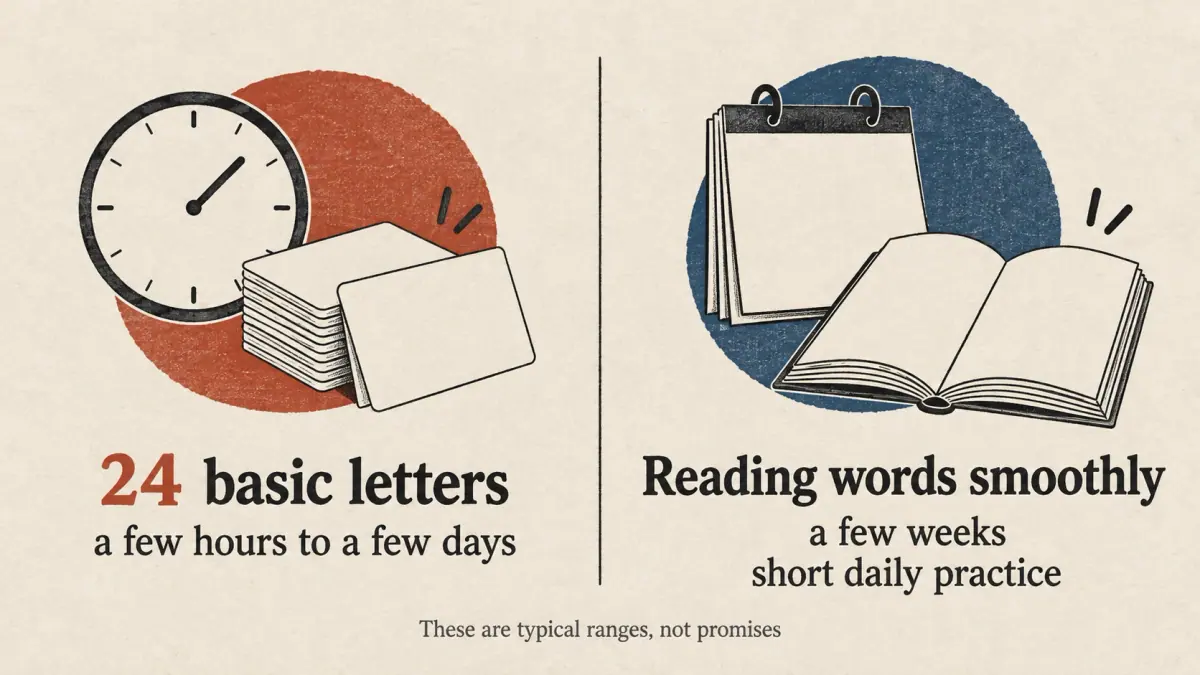
Recognising all 24 basic letters typically takes a few hours to a few days of focused study. Reading words smoothly, with the main sound changes, typically takes a few weeks of short daily practice. These are typical ranges, not promises; speed depends on practice time and on whether you review with audio.
Reading Hangul is not the same as understanding Korean. After the alphabet you still need vocabulary, grammar and listening; what to learn after Hangul maps that next stage.
Which Hangul Topic Should You Study First?
Start with the vowels if you are a total beginner; otherwise pick the topic that matches your situation:
| Your situation | Start here |
|---|---|
| I cannot read any Korean yet | Korean vowels, then the consonants |
| I can read blocks slowly | Reading Hangul |
| I confuse similar sounds such as ㄱ ㅋ ㄲ | Korean consonants and the pronunciation hub |
| I want neat handwriting | Writing Hangul |
| I need a quick reference | Hangul charts |
Korean Alphabet vs Japanese Kana vs Chinese Characters
| Script | Unit | Symbols to learn | Typical time to read basic text |
|---|---|---|---|
| Hangul (Korean) | letters grouped into syllable blocks | 24 basic, 40 with double and compound forms | hours to days for the letters |
| Kana (Japanese) | syllables | 46 hiragana + 46 katakana | weeks for both sets |
| Chinese characters | words or word parts | thousands; Japan's official jōyō list alone has 2,136 | years |
Hangul is the fastest of the three to decode because each letter is one sound and the block shapes follow a few fixed patterns. The tools below help you keep what you learn.
Which Tools Help You Practise Hangul?
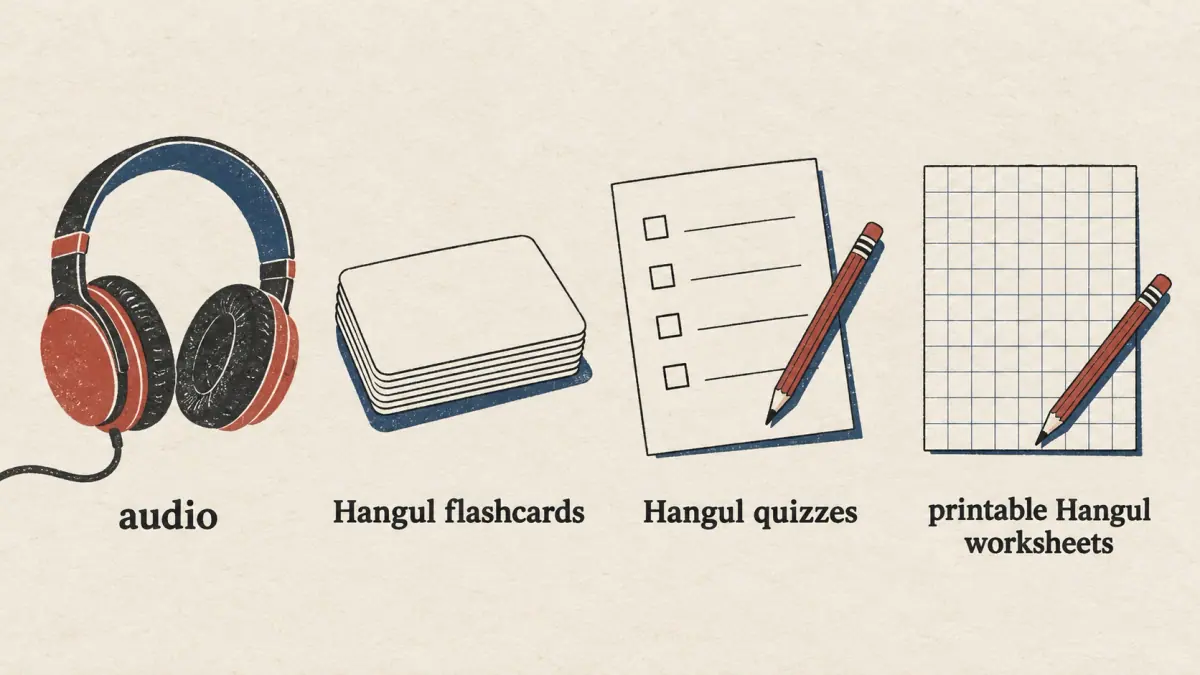
Four kinds of practice support the lessons. The practice tools let you build syllables and hear each letter without signing up, including the Hangul syllable builder and the interactive Hangul alphabet. Review letters daily with Hangul flashcards, check your recognition speed with Hangul quizzes, and practise handwriting with printable Hangul worksheets. Learn typing in Korean once you know the letters.
This page covers the Korean alphabet as a whole; each lesson linked above covers one letter, rule or chart in depth.
Frequently Asked Questions
Is Hangul the same as the Korean language? No. Hangul is the writing system; Korean (한국어) is the language. Korean existed long before Hangul and was written with Chinese characters for centuries. Today Korean is written almost entirely in Hangul, so learning the alphabet is the first step to reading Korean, but knowing the letters does not mean you understand the words.
Does the Korean alphabet have capital letters? No. Hangul has no uppercase or lowercase forms, so every letter has one shape. Sentences start without a capital, and names look the same as other words. Letters do change size and proportion inside a syllable block, for example ㄱ in 가 versus 고, but that is layout, not capitalisation.
Can I learn Korean without learning Hangul? You can learn a few spoken phrases with romanization, but you cannot go far. Romanization hides important sound differences, most textbooks and apps switch to Hangul quickly, and every sign, menu and subtitle in Korea uses Hangul. Because the basic letters typically take hours rather than months, learning Hangul first saves time.
Is the Korean alphabet based on Chinese characters? No. Hangul was designed as a new system in 1443. Its consonant shapes are based on the position of the mouth and tongue, and its vowels on three symbols for heaven, earth and human. Korean vocabulary does include many Chinese-origin words, which can also be written in Hanja, but the letters themselves are unrelated.
What is the best way to memorise Hangul? Learn the letters in families rather than in dictionary order, because the shapes are built from each other: ㄱ to ㅋ, ㄴ to ㄷ to ㅌ, ㅁ to ㅂ to ㅍ. Say each letter aloud with audio, write it by hand, and review a few minutes daily with flashcards. Reading real words early fixes the letters fastest.