
Try a Five-Card Sample
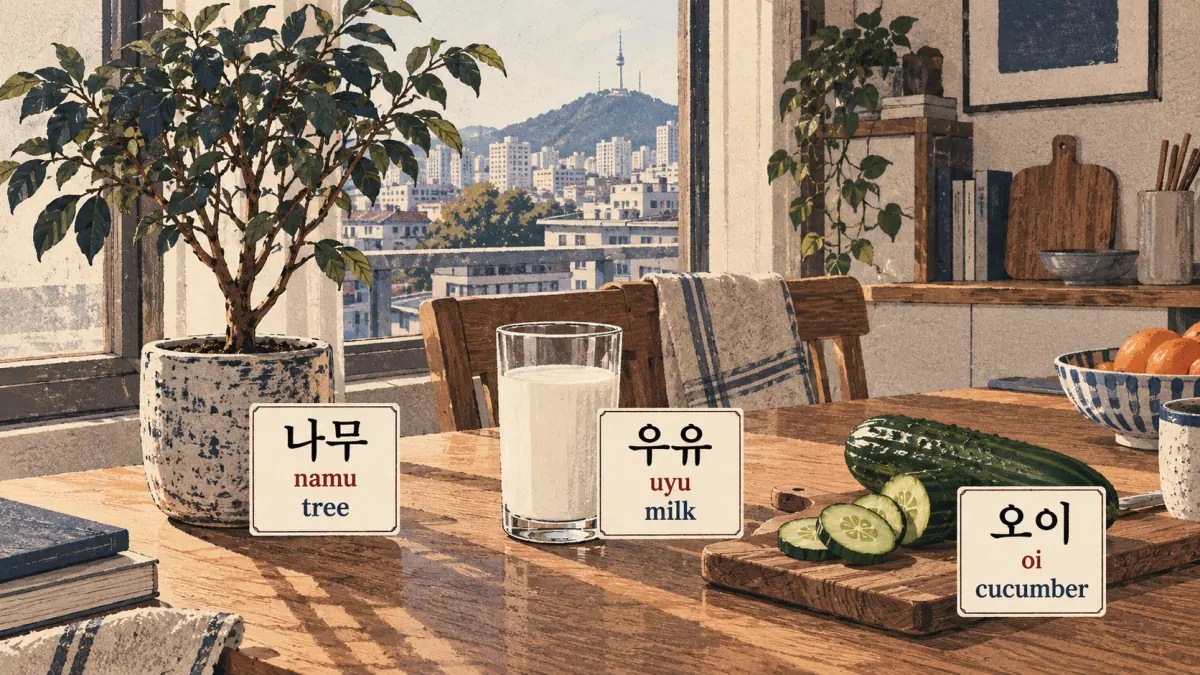
The sample below uses five reading words so you can see how a card works before you pick a deck. Press Show answer, then grade yourself with Got it or Not yet.
Practice · 5
- 01나무
Show answer
namu
tree
- 02아이
Show answer
ai
child
- 03우유
Show answer
uyu
milk
- 04오이
Show answer
oi
cucumber
- 05하나
Show answer
hana
one
Pick a family below when you are ready to study a full deck.
Which Korean Flashcards Should I Start With?
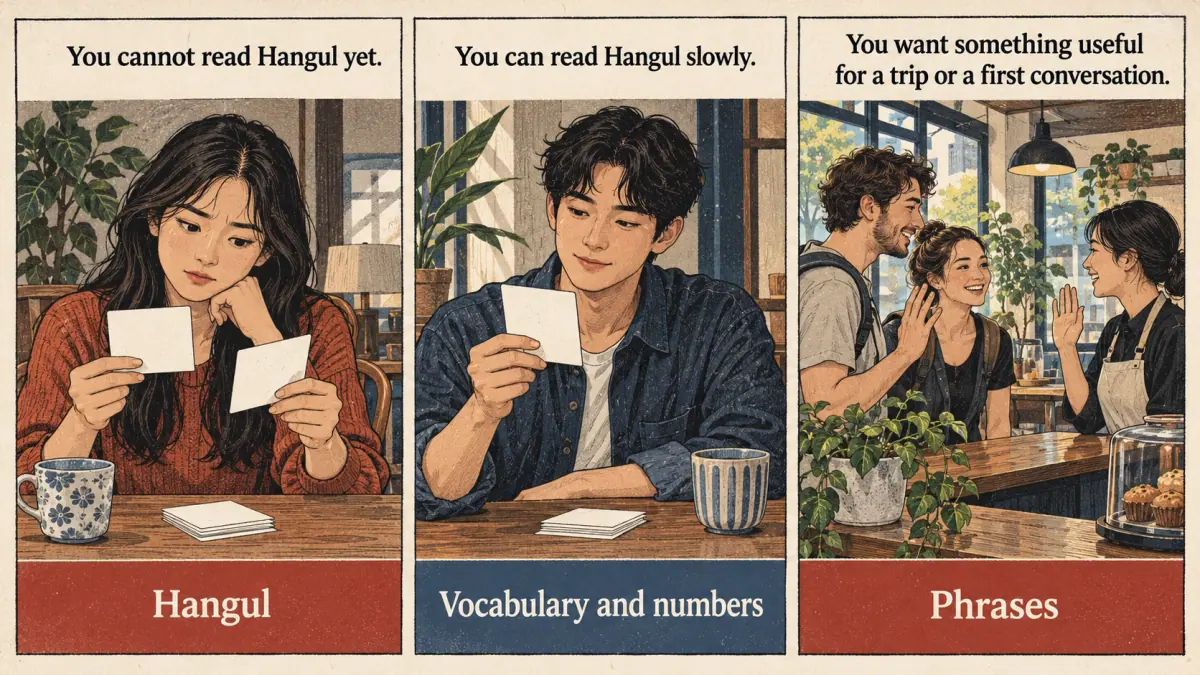
Start with the Hangul decks if you cannot read Korean yet, and start with vocabulary or phrases if you can. The right first deck depends on what you can already do, as the list shows.
- You cannot read Hangul yet. Study basic Korean consonants flashcards, then basic Korean vowels flashcards, then Korean syllable flashcards and Korean batchim flashcards.
- You can read Hangul slowly. Move to 100 Korean words flashcards so each word you read also has a meaning.
- You want something useful for a trip or a first conversation. Start with Korean greetings flashcards and add the phrase decks for the scene you need.
- You are preparing for the exam. Use the TOPIK flashcards after the beginner grammar and vocabulary decks.
- You have trouble hearing the difference between similar sounds. Use Korean minimal pairs flashcards with the audio.
A complete beginner can follow the order consonants, vowels, syllables, batchim, then 100 words, then greetings. The next section lists every family.
All Korean Flashcards on This Site
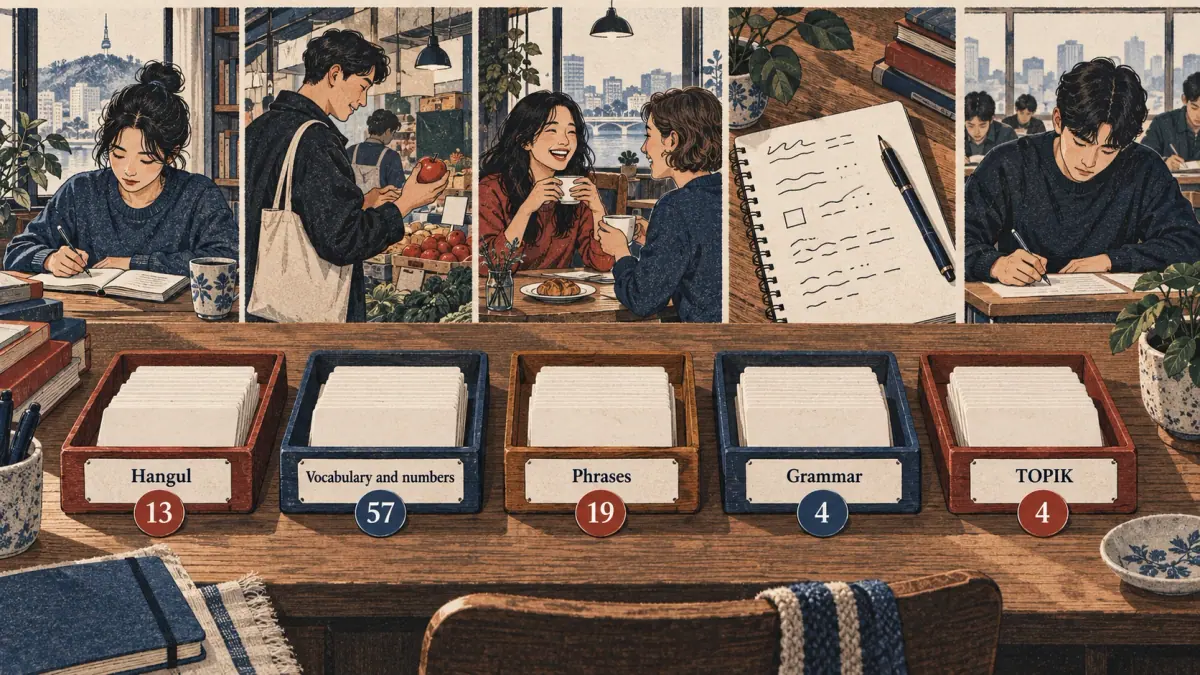




The site has 97 published decks in five families. Each family page lists its decks with card counts and levels.
Hangul Flashcards
13 decks, levels A0 to A1. The Hangul family teaches the alphabet in learning order: consonants, vowels, the full 40-letter set, letter names, syllable blocks, final consonants, reading words and minimal pairs. Every card shows Hangul, Revised Romanization, meaning and an audio button. Begin here if you cannot read Korean yet. Open the hangul flashcards family.
Korean Vocabulary and Number Flashcards
57 decks, levels A1 to B2. The vocabulary family has themed decks for family, food, travel, school and hobbies, plus two decks of the most common words, four number decks and decks for idioms, proverbs and four-character idioms. Each deck mirrors a vocabulary page on the site, so you can read first and drill second. Open the Korean vocabulary flashcards family.
Korean Phrases Flashcards
19 decks, levels A1 to B1. The phrase family has one deck per situation, such as greetings, airport, taxi, restaurant, shopping and K-drama. Cards hold full polite sentences with audio and a politeness label, so you know when a casual form is wrong. Open the Korean phrases flashcards family.
Korean Grammar Flashcards
4 decks, levels A1 to B2. The grammar family has a beginner deck, a separate deck for particles, an intermediate deck and an advanced deck. Each card shows a pattern with its meaning and one example sentence with a gloss, and it is built from the matching lesson pages. Open the Korean grammar flashcards family.
TOPIK Flashcards
4 decks, levels A1 to B2. The TOPIK family has vocabulary and grammar decks for TOPIK I and for TOPIK II, with 113 cards in total. The decks are built from topics typical of the exam, not from an official list. Open the TOPIK flashcards family.
The table compares the five published families side by side.
| Family | Decks | Levels | Card content | Best for |
|---|---|---|---|---|
| Hangul | 13 | A0 to A1 | letters, blocks, short words | learners who cannot read yet |
| Vocabulary and numbers | 57 | A1 to B2 | single words by theme | building word knowledge |
| Phrases | 19 | A1 to B1 | full polite sentences | trips and first conversations |
| Grammar | 4 | A1 to B2 | patterns with an example sentence | learners studying sentence building |
| TOPIK | 4 | A1 to B2 | exam-topic words and patterns | TOPIK I and II preparation |
How Do the Flashcards Work?
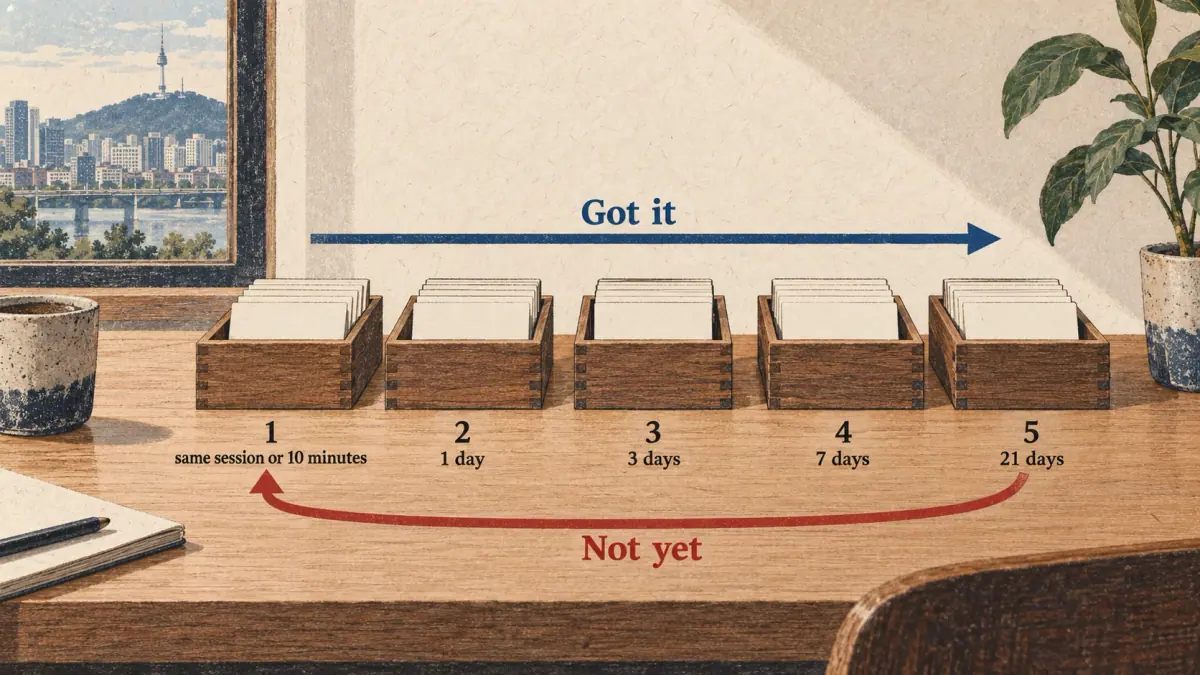
Each deck page contains a deck, a full card table and notes on the cards. The deck has three modes: recognition (Hangul to meaning), recall (meaning to Hangul) and listening (audio to meaning). You press Show answer, then Got it or Not yet. A fourth option, a mixed session, interleaves the three modes.
The review schedule is a simplified Leitner system with five boxes. A new card starts in box 1. Got it moves a card up one box, and Not yet returns it to box 1. Each box sets how long the card waits:
| Box | Wait until the next review |
|---|---|
| 1 | same session or 10 minutes |
| 2 | 1 day |
| 3 | 3 days |
| 4 | 7 days |
| 5 | 21 days |
A session shows due cards first, then up to 10 new cards a day by default, and stops at 20 cards unless you change the limit to 10 or 40. Nothing runs on a timer, there are no streaks, and the results screen reports only what you marked in that session, not your fluency.
Progress is stored only in your browser, on your own device. You can export a small file and import it elsewhere, and clearing site data deletes the saved progress. Session details such as shuffle, mode and score never become page addresses, so the decks themselves are the pages that search engines index and that you can bookmark.
What Is Not a Flashcard Deck?

A flashcard deck is a fixed list of cards you review over time. Other practice formats are separate: quizzes give scored questions with feedback, worksheets are printable sheets for handwriting and drills, and tools such as the interactive hangul alphabet let you explore items beyond a fixed deck. Each has its own hub, and decks link to the matching ones.
Flashcards test recall, not understanding, so they work best next to a lesson. Read the lesson first, then drill the deck.
Limits of These Flashcards
The decks are practice material, not a course. Romanization is an aid and cannot show every sound. All Korean text, glosses and example sentences are generated, and Min-ji Park reviewed and signed off the text and audio on 15 October 2026. Listening mode is now available. Corrections are welcome through the contact route on the site.
Where to Go Next with Korean Flashcards
Pick one family above and open its first deck. If you are unsure, the hangul flashcards are the safest start, and the basic Korean consonants flashcards take about ten minutes. These Korean flashcards are meant for short daily sessions, so a few minutes a day beats a long weekly session.
Frequently Asked Questions
Do the Flashcards Need an Account?
No. Every published deck works without an account, an email address or a payment. You open a deck, study and close it. Because there is no account, your progress lives in your browser instead of on a server, which is explained in the answer below.
Where Is My Progress Saved?
Progress is saved only in the browser you use, on your own device. It stores each card, its Leitner box and its due date, and nothing is sent to a server. Clearing site data removes it, so use the export button to save a small file and import it later.
Which Deck Should a Beginner Start With?
Start with the Hangul decks, in this order: basic consonants, basic vowels, syllables and batchim. After the letters, move to the 100 most common words and then greetings. This order matches the lessons, so each deck uses only letters you have already seen.
Do the Decks Have Audio?
Yes, every card has an audio button, and audio never plays by itself. The clips are generated and were approved by Min-ji Park on 15 October 2026. Listening mode uses the audio approved by Min-ji Park on 15 October 2026.
Can I Print a Deck?
Yes. Each deck page shows all cards in a plain table, so your browser print command gives a printable list with Hangul, romanization and meaning. Matching writing sheets are listed in the worksheets section. Print is for reading and handwriting practice; the review schedule works only on screen.
Are the TOPIK Decks an Official TOPIK List?
No. The TOPIK I and TOPIK II decks are built from topics typical of the exam, not copied from any official word or grammar list. Use them as practice for common exam vocabulary and patterns, and check the exam body for the official scope before you sit a test.