
TOPIK, the Test of Proficiency in Korean, is the official Korean language exam for non-native speakers, with TOPIK I for levels 1-2 and TOPIK II for levels 3-6. This hub explains what the test is, helps you choose between the two papers, and links every TOPIK page on this site, from format and scores to dates and study plans.
What Is TOPIK?

TOPIK is a standardised Korean exam that gives you a level from 1 (lowest) to 6 (highest) based on your total score. The Korean name is 한국어능력시험 (hangugeo neungnyeok siheom). Universities, employers and some immigration routes in Korea use the level as proof of Korean ability.
There is no pass or fail in the usual sense. You sit one paper, and your total score decides which level you reach, or whether you reach a level at all. A score report says, for example, 3급 (level 3); 급 (geup) is the word for "level" or "grade".
Official information, including the current exam guide, is published on topik.go.kr by NIIED. For a two-minute overview, read what is TOPIK. Because TOPIK is really two separate tests, the first decision is which one to sit.
Which TOPIK Should You Take?
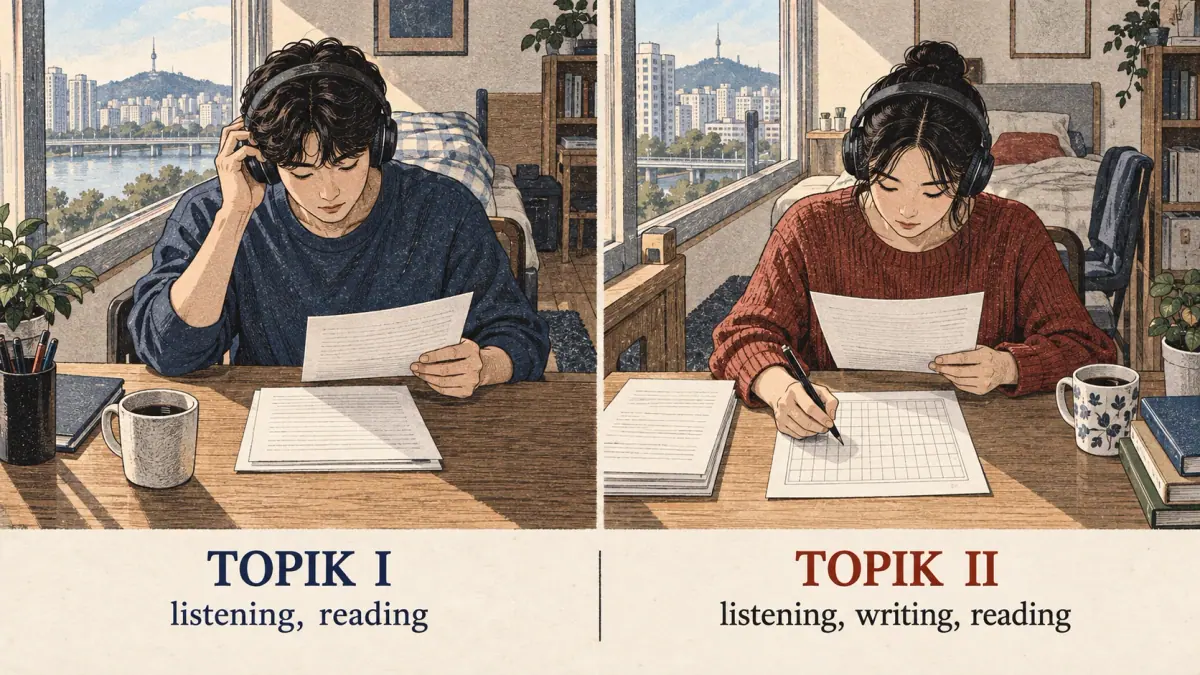
Take TOPIK I if you are a beginner and want level 1 or 2; take TOPIK II if you want level 3 or higher. You cannot reach level 3 by scoring well on TOPIK I, and a low TOPIK II score that misses the level 3 cut gives no level at all.
| Feature | TOPIK I | TOPIK II |
|---|---|---|
| Levels | 1-2 | 3-6 |
| Sections | listening, reading | listening, writing, reading |
| Questions (paper test) | 70 | 104 |
| Test time (paper test) | 100 minutes | 180 minutes |
| Maximum score | 200 | 300 |
| Typical learner | beginner, a few months to a year of study | intermediate to advanced |
| Typical use | personal goal, some scholarships and programmes | university entry, jobs, some visa routes |
Question counts and times are for the paper test; the internet-based test is organised differently. The full side-by-side decision is on difference between TOPIK 1 and 2. Once you know your paper, the next question is what score you need.
How Is TOPIK Scored?

TOPIK is scored by adding your section scores into one total, and the total decides your level. Each section is worth 100 points. TOPIK I has two sections (200 points), and TOPIK II has three (300 points).
| Test | Level | Minimum total |
|---|---|---|
| TOPIK I | Level 1 (1급) | 80 of 200 |
| TOPIK I | Level 2 (2급) | 140 of 200 |
| TOPIK II | Level 3 (3급) | 120 of 300 |
| TOPIK II | Level 4 (4급) | 150 of 300 |
| TOPIK II | Level 5 (5급) | 190 of 300 |
| TOPIK II | Level 6 (6급) | 230 of 300 |
These cut scores come from the official TOPIK guide; confirm them on topik.go.kr before you set a target. TOPIK levels explains what a learner can do at each level, and TOPIK score shows how to calculate a total and read the score report. With the basics clear, the rest of this hub routes you to the right page.
Where Do You Go Next?


Every page in the TOPIK section is listed below by group, with what it covers and what it helps you do.





TOPIK I and II
- What is TOPIK. The short explainer: who runs the test, its two papers and six levels, and whether you should take it at all. Read it first if TOPIK is new to you.
- TOPIK I. The beginner test section, with format, the grammar and vocabulary you need for levels 1-2, and a plan for passing. Start here if you have studied for less than about a year.
- TOPIK II. The intermediate and advanced test section, covering levels 3-6 and the writing paper. Use it once TOPIK I material feels easy.
- Difference between TOPIK 1 and 2. A four-criterion comparison of the two papers to help you choose one with your current level in mind.
- TOPIK levels. The cut score for each of the six levels and a plain description of what a learner can do at each.
- TOPIK score. How points add up, how a total becomes a level and how to read the score report.
- TOPIK exam format. Every section of both papers with question counts, minutes, points and question types, plus how test day runs.
- Is TOPIK hard. A level-by-level and section-by-section judgement of difficulty, with editorial preparation-time estimates.
- TOPIK vs EPS TOPIK. The difference between TOPIK and EPS-TOPIK, the separate test used for the Employment Permit System, so you sit the right one.
Sections: Listening, Reading and Writing
- TOPIK listening. Question types in the listening section and how to train your ear for them.
- TOPIK reading. Reading question types and timing strategies, since time pressure is a main challenge in TOPIK II reading.
- TOPIK writing. The four TOPIK II writing tasks (questions 51-54), from sentence completion to the essay, with structure templates.
- TOPIK grammar. Grammar lists by level, so you know which patterns the test expects. General grammar lessons are in Korean grammar.
Preparation and Study Plans
- TOPIK preparation. Study plans, study time, mock tests and past papers in one section.
- TOPIK study plan. A 12-week weekly schedule you can adapt to any target level.
Exam Logistics
- TOPIK exam dates. The yearly pattern of paper, internet and speaking sessions, which ones are Korea-only, and how to plan backwards from test day.
- TOPIK registration. The application steps in order, documents, how fees work and how to find a test centre.
- TOPIK IBT. What the internet-based TOPIK is, where it is offered and how it differs from the paper test.
- TOPIK IBT vs PBT. A four-criterion choice between computer and paper testing.
- TOPIK speaking test. Whether TOPIK I or II includes speaking (it does not) and what the separate speaking test is.
- TOPIK results. When results come out, how to check them and how to get the certificate.
- Does TOPIK expire. The two-year validity rule, how to work out your expiry date and when to retake.
- TOPIK requirements. The level typically asked for study, visas and work, and how to confirm the official requirement.
With so many pages, a quick chooser helps you open the right one first.
How to Choose Your First TOPIK Page

Choose by the question you have today. These four situations cover most visitors.
| Your situation | Open first | Then |
|---|---|---|
| "I have never heard the details." | what is TOPIK | TOPIK I or II |
| "I need a level for a university by a deadline." | TOPIK requirements | TOPIK exam dates |
| "I know my target and want to study." | TOPIK study plan | the section pages |
| "I am registered and want to know what test day is like." | TOPIK exam format | mock tests in TOPIK preparation |
What Is Not Covered Here
This section covers the exam itself: its structure, scoring, logistics and test-specific preparation. General Korean study, such as Hangul, everyday grammar and vocabulary, lives in the main learning sections, and TOPIK pages link to them where needed. This site is not affiliated with NIIED or the Ministry of Education, does not sell registration and does not reproduce official past papers; practice items on these pages are original. Fees, dates and test centres change every year, so treat topik.go.kr as the final word.
Frequently Asked Questions
What does TOPIK stand for? TOPIK stands for Test of Proficiency in Korean, called 한국어능력시험 in Korean. It is the standard Korean exam for people whose first language is not Korean. South Korea's Ministry of Education oversees it, and the National Institute for International Education (NIIED) runs it and publishes official information on topik.go.kr.
Should I take TOPIK I or TOPIK II? Take TOPIK I if you are a beginner aiming for level 1 or 2, for example after several months of regular study. Take TOPIK II if you can already read short news texts and want level 3 or higher, which most university and many job requirements ask for. The two are separate tests, so a TOPIK I score never reaches level 3.
Is TOPIK required to study or work in Korea? Often, but not always. Many Korean universities ask international students for a TOPIK level, commonly level 3 or 4 for degree entry, and some visa and employment routes give credit for TOPIK. Requirements differ by institution, programme and year, so always check the current rule of the university, employer or immigration office you are applying to.
How long is a TOPIK score valid? A TOPIK score is valid for two years from the date the results are announced, according to the official TOPIK site. After that, the score report can no longer be used for applications that require a valid result. Some institutions set their own rules, so check whether yours accepts an older certificate before relying on it.
Can I take TOPIK online? Not from home. The internet-based TOPIK (IBT) is taken on a computer, but at an approved test centre, not online at home. The paper-based test (PBT) is still offered alongside it. The Ministry of Education has reported that it is exploring at-home testing in the future, so check topik.go.kr for any change.
In short, TOPIK is two tests and six levels: pick TOPIK I or TOPIK II, learn the format, set a target score, and confirm every date and fee on the official site.