
Korean grammar is the system of particles, verb endings, speech levels and sentence patterns that builds Korean sentences. This hub orders 14 grammar sets from the first sentence to intermediate patterns, with audio examples, a decision table and practice in plain English.
What Is Korean Grammar?
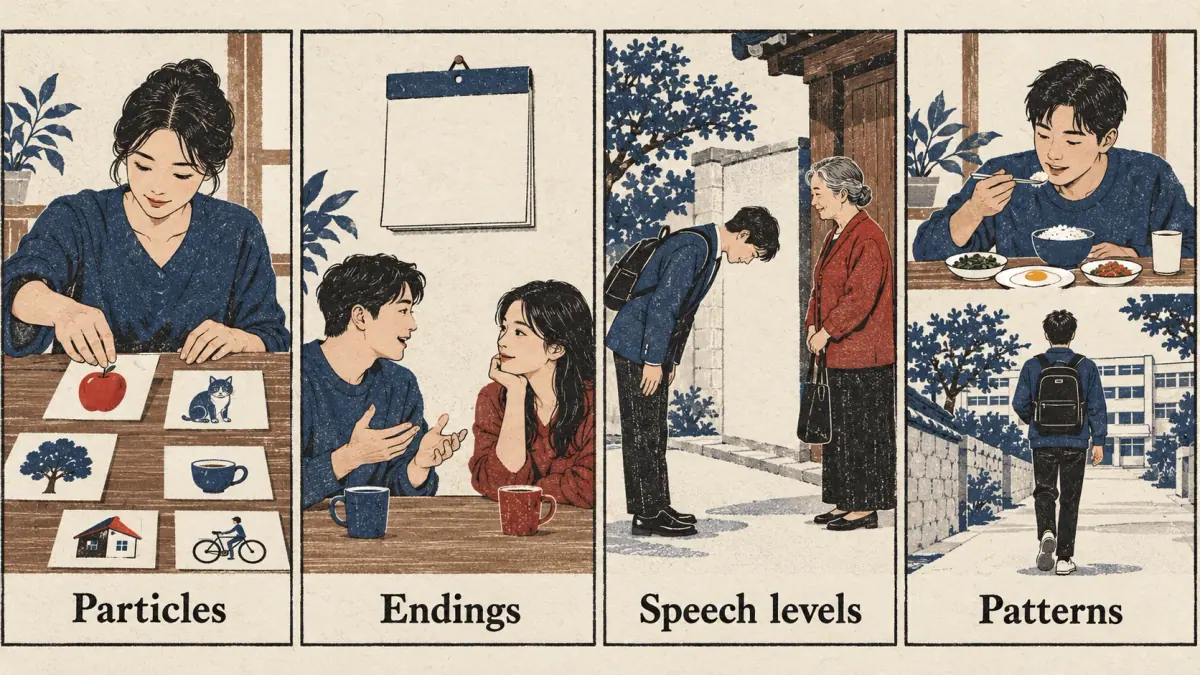
Korean grammar is the set of rules that decide how Korean words join into sentences. Korean builds meaning by attaching pieces to the end of words, which linguists call agglutination: a noun takes a particle (조사, josa) and a verb takes an ending (어미, eomi). English does most of the same work with word order and helper words.
One verb shows the idea. The stem 먹 (eat) plus the past marker 었 plus the polite ending 어요 gives 먹었어요 (ate). Each piece adds one meaning, and the order is fixed. Korean also has no articles such as "a" or "the" and no grammatical gender, so the grammar sits in the pieces that follow words, not in small words before them.
Korean grammar covers four large areas:
- Particles show the role of each noun.
- Endings show tense, mood and politeness on each verb.
- Speech levels decide how formal or respectful a sentence sounds.
- Patterns join, modify and extend sentences.
Where Should You Start with Korean Grammar?
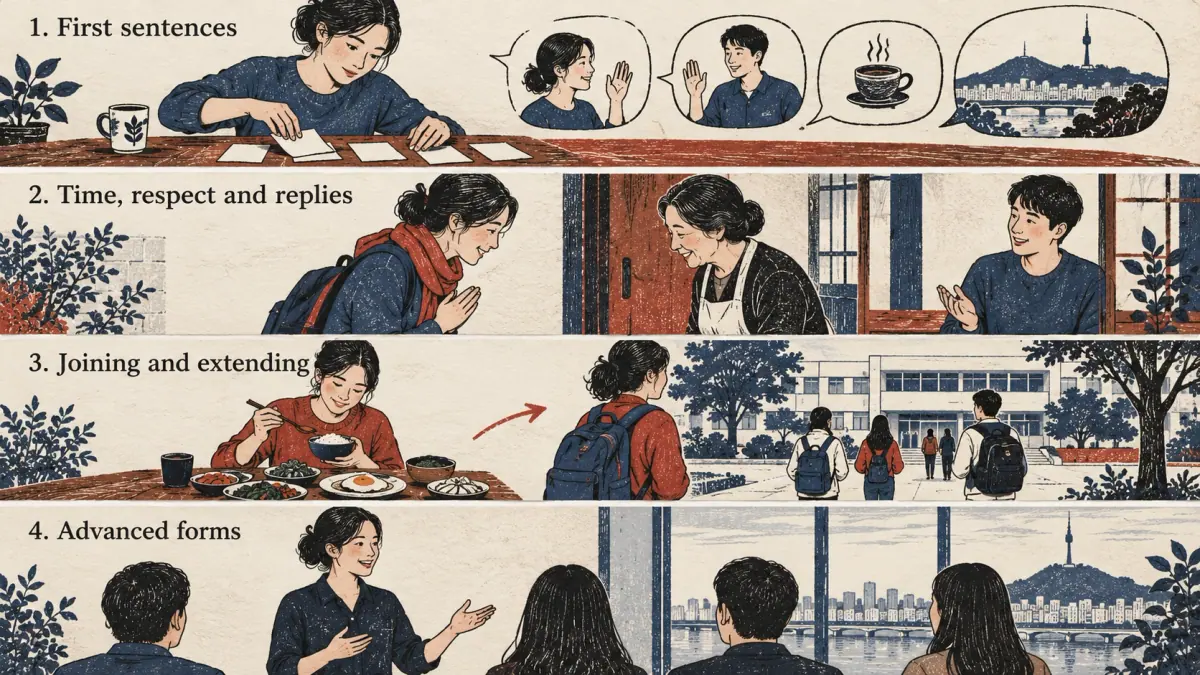
Start with Korean grammar basics, then follow the sets in the four stages below. Each stage builds on the one before, and the order prevents the most common false start: memorising verb endings before you know particles.
| Stage | Sets | What you can do afterwards | Typical level |
|---|---|---|---|
| 1. First sentences | Basics, particles | Build and read a simple sentence | A1 |
| 2. Time, respect and replies | Tenses, speech levels, negation, questions | Talk about past and future, be polite, say no, ask | A1 to A2 |
| 3. Joining and extending | Connectors, sentence endings, modifiers | Link ideas and describe nouns | A2 to B1 |
| 4. Advanced forms | Nominalization, passive and causative, auxiliary verbs | Turn verbs into nouns, change who acts, add nuance | B1 and above |
Two more sets work as reference: Korean grammar by level sorts 161 connector and ending patterns into beginner, intermediate and advanced lists, and confusing grammar compared explains look-alike pairs side by side. The levels in the table are typical placements, and learners vary.
Browse by Topic

Each set below has a short summary, one example sentence with audio and a link. The summaries say what each set solves, so you can choose before you click.
Korean Grammar Basics
The basics set teaches the verb-last order, the polite "to be", existence words and the word classes. Learners who start here avoid the common false start of memorising endings without particles. Example: 저는 학생이에요. (jeoneun haksaengieyo.) "I am a student."
What Are Korean Particles?
Particles are short words attached to nouns that show topic, subject, object, place, direction and possession. The set explains 은/는 versus 이/가 and the choice by last sound. Example: 저는 커피를 마셔요. (jeoneun keopireul masyeoyo.) "I drink coffee."
What Do Korean Tenses Cover?
The tenses set covers the present, past and future endings and the progressive. Past is built with 았/었 and future with -(으)ㄹ 거예요. Example: 어제 영화를 봤어요. (eoje yeonghwareul bwasseoyo.) "I watched a movie yesterday."
How Do Korean Speech Levels Work?
Speech levels are verb-ending styles that show respect to the listener, and honorifics show respect to the subject. The set compares formal, polite and casual styles. Example: 안녕하세요? (annyeonghaseyo?) "Hello" in the polite style.
How Does Korean Negation Work?
The negation set teaches the short forms 안 and 못 and the long forms -지 않다 and -지 못하다, plus prohibitions. It separates "choose not to" from "cannot". Example: 저는 안 가요. (jeoneun an gayo.) "I am not going."
Asking Questions in Korean
The questions set covers question words that stay in place (뭐, 누구, 어디), yes-no questions by intonation, and question endings. Example: 이게 뭐예요? (ige mwoyeyo?) "What is this?"
Open asking questions in Korean.
How Do Korean Connectors Work?
Connectors join two clauses: -고 (and, then), -지만 (but) and -아서/어서 (so, because). The set sorts patterns by function. Example: 밥을 먹고 학교에 가요. (babeul meokgo hakgyoe gayo.) "I eat and go to school."
Open Korean connectors, which sorts patterns from -고 and -지만 to -아/어서 by function, with meaning, rules and examples for TOPIK I and II.
Korean Sentence Endings
Sentence endings add meaning to the final verb: ability, desire, duty, requests and guesses. The set lists patterns by meaning. Example: 한국어를 공부하고 싶어요. (hangugeoreul gongbuhago sipeoyo.) "I want to study Korean."
Open Korean sentence endings, grouped by meaning: ability, desire, duty, requests, guesses, reactions and reported speech.
Korean Modifiers
Modifiers come before what they describe. Noun modifiers (-는, -(으)ㄴ, -(으)ㄹ) turn verbs and descriptive verbs into descriptions, and adverbs use -게. Example: 예쁜 꽃 (yeppeun kkot) "a pretty flower."
Nominalization
Nominalization turns verbs and descriptive verbs into nouns with -기, -(으)ㅁ or -는 것. Example: 말하기가 어려워요. (malhagiga eoryeowoyo.) "Speaking is difficult."
Open nominalization, which covers -기, -(으)ㅁ and -는 것 in learning order, with comparisons and practice.
Passive and Causative
Passive and causative forms change who acts, using suffixes such as 이, 히, 리, 기 and constructions like -아/어지다. Example: 문이 열렸어요. (muni yeollyeosseoyo.) "The door opened."
Open passive and causative, which covers the passive and causative suffixes and constructions in learning order.
Auxiliary Verb Constructions
Auxiliary constructions pair a main verb with a helper such as 보다, 주다 or 싶다 to add trying, doing for someone or wanting. Example: 한번 먹어 보세요. (hanbeon meogeo boseyo.) "Please try eating it."
Open auxiliary verb constructions.
Korean Grammar by Level
The by-level set lists grammar patterns by learner stage, from beginner to advanced, with a link to the lesson for each. Example: 시간이 있으면 같이 가요. (sigani isseumyeon gachi gayo.) "If you have time, let's go together."
Open Korean grammar by level, with 161 connector and ending patterns in beginner, intermediate and advanced lists, each mapped to TOPIK.
Confusing Grammar Compared
The comparison set explains look-alike patterns side by side, such as -아/어서 versus -(으)니까. Each page gives a simple rule and paired examples. Example: 비가 와서 늦었어요. (biga waseo neujeosseoyo.) "I was late because of the rain."
Open confusing grammar compared, with pairs such as -아/어서 vs -(으)니까 and -고 vs -아/어서, each with a simple rule, side-by-side examples and typical errors.
Which Lesson Fits Your Sentence?
Pick the set by what you want to say. The table maps eight common goals to the set that solves each.
| You want to say | Open this set | Example |
|---|---|---|
| "I am a student" | Basics | 저는 학생이에요. |
| "I read a book" (object) | Particles | 책을 읽어요. |
| "I went", "I will go" | Tenses | 갔어요. / 갈 거예요. |
| Polite or casual speech | Speech levels | 가요 / 가 / 갑니다 |
| "I do not", "I cannot" | Negation | 안 가요. / 못 가요. |
| "What is this?" | Questions | 이게 뭐예요? |
| "I eat and go" (join two actions) | Connectors | 먹고 가요. |
| "a pretty flower" | Modifiers | 예쁜 꽃 |
How Do Basics and Particles Differ?
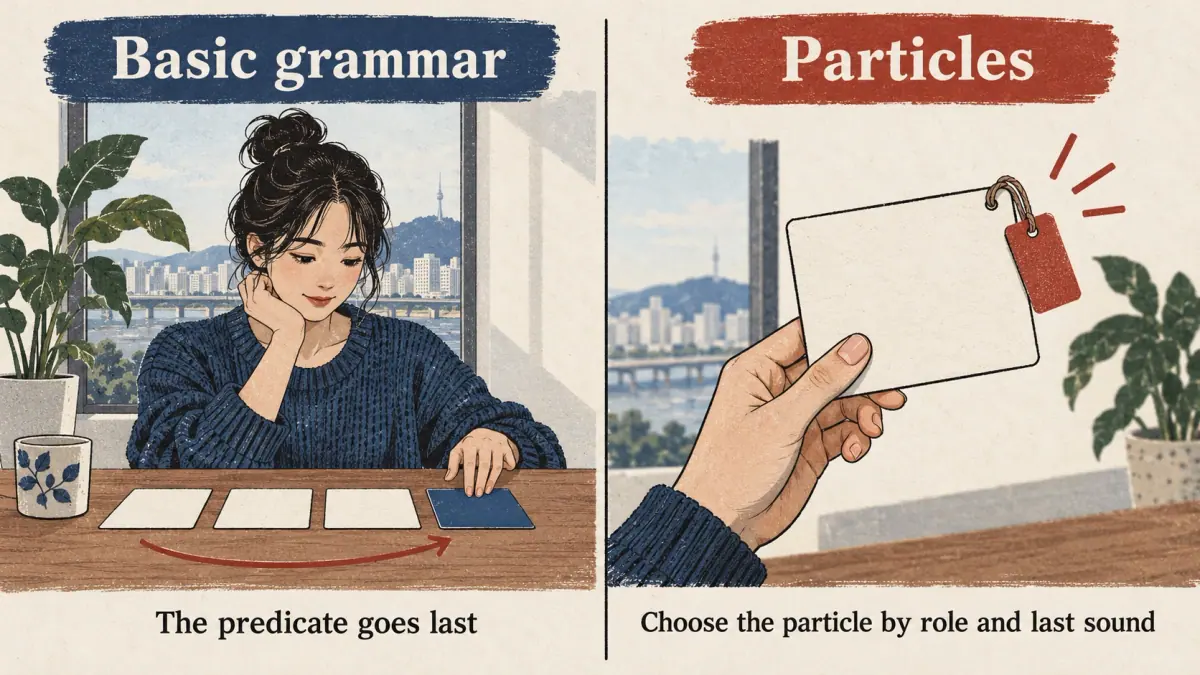
Basics and particles differ in scope: the basics set teaches the whole sentence frame, and the particles set teaches one part of it in depth. Learners confuse them because both start with the same simple sentences.
| Feature | Basic grammar | Particles |
|---|---|---|
| Main question | How is a sentence built? | What job does each noun do? |
| Key rule | The predicate goes last | Choose the particle by role and last sound |
| Example | 저는 학생이에요 | 은/는, 이/가, 을/를, 에, 에서 |
| Read first? | yes | second |
How Do You Practise Korean Grammar?

Practise by pairing a lesson with a quiz, a deck and a conjugation check. Each published lesson ends with four practice items and an answer key.
- Take the Korean grammar quizzes after each set.
- Review example words with the Korean flashcards.
- Check verb forms with the tools in Korean learning tools.
A practical routine is one lesson per session: read the rule, play every clip twice, build the sentence yourself, then check the answers.
What Korean Grammar Does Not Cover on This Hub
The Korean grammar hub covers rules and patterns. It does not teach Hangul reading, verb conjugation tables for individual verbs, or vocabulary lists. Those topics live in Hangul, Korean verbs and Korean vocabulary.
Start with the basics set, follow the four stages in order, and Korean grammar becomes a sequence of small, testable steps.
Frequently Asked Questions
Where should a beginner start with Korean grammar? Start with Korean grammar basics: sentence structure, word order and parts of speech. These sets teach the verb-last order and the idea of particles, which every later topic assumes. Then move to particles, tenses and speech levels. Memorising verb endings before you know particles is the most common false start.
Does Korean grammar have articles, genders or plurals? Korean has no articles such as a or the and no grammatical gender. Plural marking exists as an optional 들, but speakers often leave it out when a number or context already shows the plural. Korean instead adds particles after nouns and endings after verbs, and those carry most of the grammar.
What level is Korean grammar? This hub spans several levels. The first six sets (basics, particles, tenses, speech levels, negation and questions) are mostly A1 to A2. Connectors, endings and modifiers are mostly A2 to B1, and nominalization, passives and auxiliary verbs are mostly B1 and above. These are typical placements, and learners vary.
How long does Korean grammar take to learn? The beginner core takes weeks, and the full set takes many months, because each topic needs practice, not only reading. A learner who studies 30 minutes a day usually needs about two weeks for the basics hub alone. No timeline is guaranteed, and review matters more than speed.