
| Korean | Name | Romanization | Family | Sound |
|---|---|---|---|---|
| ㄱ | 기역 (giyeok) | g / k | plain | g in "go", softer at the start of a word |
| ㄴ | 니은 (nieun) | n / n | other | n in "no" |
| ㄷ | 디귿 (digeut) | d / t | plain | d in "do" |
| ㄹ | 리을 (rieul) | r / l | other | quick tap between r and d |
| ㅁ | 미음 (mieum) | m / m | other | m in "me" |
| ㅂ | 비읍 (bieup) | b / p | plain | b in "boy" |
| ㅅ | 시옷 (siot) | s / t | plain | s in "sun" |
| ㅇ | 이응 (ieung) | none / ng | other | silent |
| ㅈ | 지읒 (jieut) | j / t | plain | j in "jam" |
| ㅊ | 치읓 (chieut) | ch / t | aspirated | ch in "cheese" with a puff |
| ㅋ | 키읔 (kieuk) | k / k | aspirated | k in "kite" with a puff |
| ㅌ | 티읕 (tieut) | t / t | aspirated | t in "top" with a puff |
| ㅍ | 피읖 (pieup) | p / p | aspirated | p in "pin" with a puff |
| ㅎ | 히읗 (hieut) | h / t | other | h in "hat" |
| ㄲ | 쌍기역 (ssanggiyeok) | kk / k | tense | k with a tight throat |
| ㄸ | 쌍디귿 (ssangdigeut) | tt / none | tense | t with a tight throat |
| ㅃ | 쌍비읍 (ssangbieup) | pp / none | tense | p with a tight throat |
| ㅆ | 쌍시옷 (ssangsiot) | ss / t | tense | s said with tension |
| ㅉ | 쌍지읒 (ssangjieut) | jj / none | tense | j with a tight throat |
| ㅏ | 아 | a | basic | a in "father" |
| ㅑ | 야 | ya | basic | ya in "yacht" |
| ㅓ | 어 | eo | basic | between u in "cup" and aw in "law" |
| ㅕ | 여 | yeo | basic | y + ㅓ |
| ㅗ | 오 | o | basic | o in "go", shorter and pure |
| ㅛ | 요 | yo | basic | yo in "yoga" |
| ㅜ | 우 | u | basic | oo in "moon" |
| ㅠ | 유 | yu | basic | "you" |
| ㅡ | 으 | eu | basic | oo in "moon" with lips spread |
| ㅣ | 이 | i | basic | ee in "see" |
| ㅐ | 애 | ae | compound | e in "bed" |
| ㅒ | 얘 | yae | compound | ye in "yes" |
| ㅔ | 에 | e | compound | e in "bed" |
| ㅖ | 예 | ye | compound | ye in "yes" |
| ㅘ | 와 | wa | compound | "wah" |
| ㅙ | 왜 | wae | compound | we in "wet" |
| ㅚ | 외 | oe | compound | we in "wet" |
| ㅝ | 워 | wo | compound | "wuh" |
| ㅞ | 웨 | we | compound | we in "wet" |
| ㅟ | 위 | wi | compound | "wee" |
| ㅢ | 의 | ui | compound | ㅡ gliding into ㅣ |
The Complete Hangul Chart (40 letters)

The complete Hangul chart has 19 consonants and 21 vowels, grouped by sound family instead of dictionary order. Grouping by sound puts similar letters next to each other, so you can see the plain, aspirated and tense versions together. Revised Romanization (RR) is South Korea's official Latin spelling system; here it is a learning aid, and you should always read the Hangul first.
Consonants (19)
| Family | Letter | Name | RR start / end | Sound hint |
|---|---|---|---|---|
| Plain | ㄱ | 기역 | g / k | g in "go"; k at the end |
| Plain | ㄷ | 디귿 | d / t | d in "do"; t at the end |
| Plain | ㅂ | 비읍 | b / p | b in "boy"; p at the end |
| Plain | ㅈ | 지읒 | j / t | j in "jam"; t at the end |
| Plain | ㅅ | 시옷 | s / t | s in "sun"; t at the end |
| Aspirated | ㅋ | 키읔 | k / k | k in "kite" with a puff |
| Aspirated | ㅌ | 티읕 | t / t | t in "top" with a puff |
| Aspirated | ㅍ | 피읖 | p / p | p in "pin" with a puff |
| Aspirated | ㅊ | 치읓 | ch / t | ch in "cheese" with a puff |
| Tense | ㄲ | 쌍기역 | kk / k | k with a tight throat, no puff |
| Tense | ㄸ | 쌍디귿 | tt / none | t with a tight throat, no puff |
| Tense | ㅃ | 쌍비읍 | pp / none | p with a tight throat, no puff |
| Tense | ㅆ | 쌍시옷 | ss / t | s said with tension |
| Tense | ㅉ | 쌍지읒 | jj / none | j with a tight throat, no puff |
| Other | ㄴ | 니은 | n / n | n in "no" |
| Other | ㅁ | 미음 | m / m | m in "me" |
| Other | ㅇ | 이응 | silent / ng | silent at the start; ng in "sing" at the end |
| Other | ㄹ | 리을 | r / l | between r and l; l at the end |
| Other | ㅎ | 히읗 | h / t | h in "hat" |
Vowels (21)
| Family | Letters | RR | Sound hint |
|---|---|---|---|
| Basic | ㅏ ㅑ | a, ya | a in "father" |
| Basic | ㅓ ㅕ | eo, yeo | u in "cup" (open mouth) |
| Basic | ㅗ ㅛ | o, yo | o in "go" (shorter) |
| Basic | ㅜ ㅠ | u, yu | oo in "moon" |
| Basic | ㅡ ㅣ | eu, i | ㅡ has no English match; ㅣ is ee in "see" |
| Compound | ㅐ ㅒ ㅔ ㅖ | ae, yae, e, ye | e in "bed"; ㅒ and ㅖ add a y (ㅐ and ㅔ now sound alike) |
| Compound | ㅘ ㅙ ㅚ ㅝ ㅞ ㅟ | wa, wae, oe, wo, we, wi | w + vowel glides |
| Compound | ㅢ | ui | varies by position |
These sound hints are approximate. Korean has no exact English twin for ㅓ, ㅡ or the tense consonants, so use the audio in the chart as the final guide. The audio on this site is generated and awaits review by a Korean specialist.
Now that you have the whole chart, here is how to read it.
How Do You Read This Chart?

Read each row from left to right: family, letter, name, romanization, sound. The name is what you say when you spell a letter aloud, such as 기역 for ㄱ. The sound is what the letter does inside a word. The two are different on purpose: the name 기역 contains the sounds g and k because ㄱ is g at the start of a syllable and k at the end.
Three habits make the chart useful:
- Say the name, then the sound, then a word that uses the letter.
- Cover the sound column and guess from the letter, then check.
- Treat the "start / end" column as a reminder that some letters change at the end of a syllable.
The romanization in any chart is an aid. For example, ㄱ is "g" at the start and "k" at the end, but it is the same Hangul letter. See Korean alphabet for how the letters combine into blocks.
Consonant and Vowel Charts
The master chart is a summary; two specialised charts go deeper. The Korean consonants chart lists all 19 consonants with their start and end sounds, grouped as plain, aspirated and tense. The Korean vowels chart lists all 21 vowels grouped as basic, y-vowels and w-vowels, and flags the pairs ㅐ/ㅔ that now sound the same. Use them when you need names, mouth position or the full sound of one letter.
Syllable and Batchim Charts
Hangul letters combine into blocks, and two charts cover this step. The Korean syllable chart combines 14 consonants with 10 vowels to make 140 blocks from 가 to 히. The batchim chart covers final consonants, the letters written under a block, and shows how they reduce to seven final sounds. Use the syllable chart for reading drills and the batchim chart when a block has a letter at the bottom.
Romanization, IPA and a-to-Z Charts
Three charts translate Hangul into other systems. The romanization chart maps every letter to Revised Romanization and compares it with McCune–Reischauer, an older system found in many books. The Korean IPA chart maps letters to International Phonetic Alphabet symbols for precise sound. The Korean alphabet A to Z chart shows the closest Hangul letter for each English letter, and explains why a one-to-one match is impossible.
Which Chart Do You Need?

Pick the chart that matches the question you have right now. The table maps seven common tasks to the right page.
| If you want to... | Use this chart |
|---|---|
| See all consonants and their start and end sounds | Korean consonants chart |
| See all vowels grouped by type | Korean vowels chart |
| Practise reading blocks like 가 and 나 | Korean syllable chart |
| Read blocks that end in a consonant | batchim chart |
| Write Korean words in Latin letters | romanization chart |
| Study exact sounds | Korean IPA chart |
| Find a Hangul match for an English letter | Korean alphabet A to Z |
Which Chart Helps a Total Beginner?
A total beginner should use the consonants chart and the vowels chart first, then the syllable chart. Spend one session on each: the first two give you the letters, and the third shows you how they join. Skip the IPA and romanization charts until you can read simple blocks.
Which Chart Is Best for Printing?
The master Hangul chart on this page is the best chart to print, because it fits all 40 letters on one sheet. The PDF version is available in A4 and US Letter and is built from the same data as the HTML table, so the two always match.
Hangul Chart (PDF)
The comparison below shows how the charts differ in size and use.
Hangul Charts Compared
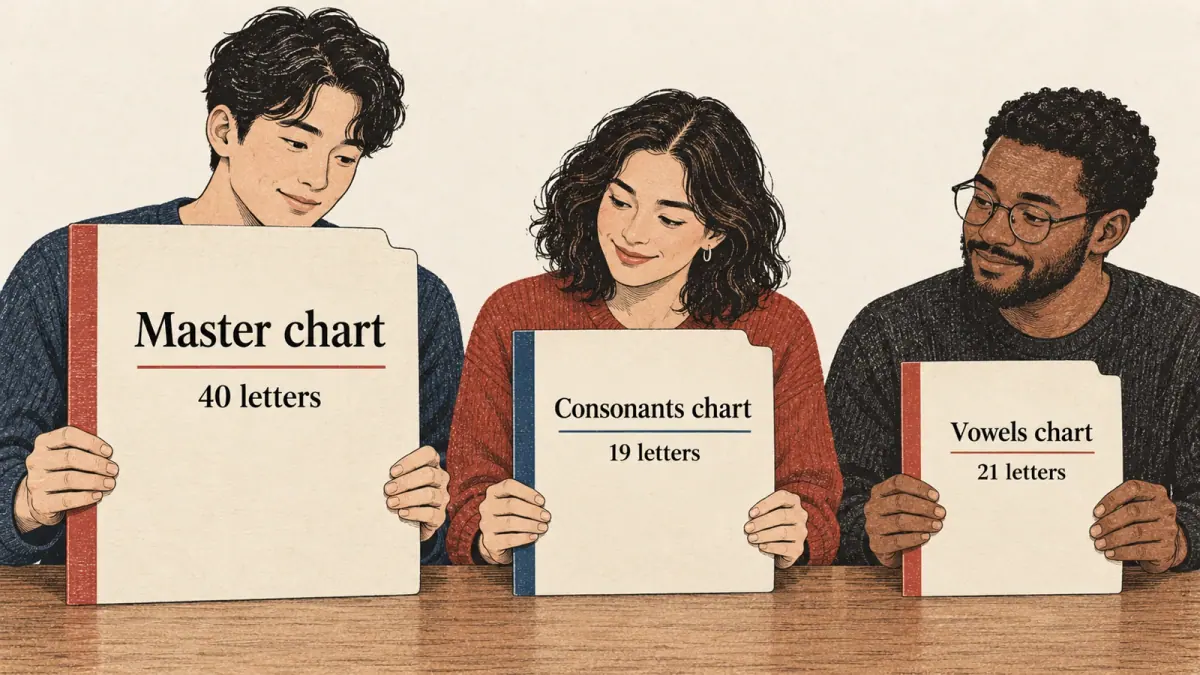
Charts differ in how many items they hold and how much they teach. Use the numbers to choose.
| Chart | Items | Best for | Printable |
|---|---|---|---|
| Master chart | 40 letters | first look at the alphabet | yes |
| Consonants chart | 19 letters | names and start/end sounds | yes |
| Vowels chart | 21 letters | mouth position and merged vowels | yes |
| Syllable chart | 140 blocks | reading drills | yes |
| Batchim chart | final consonants | blocks with a bottom letter | yes |
| Romanization chart | letters to Latin letters | decoding signs and maps | yes |
| A to Z chart | 26 English letters | English-to-Hangul matching | yes |
The next section shows how to turn a chart into a learning habit.
How Should You Practise with a Chart?

A Hangul chart is a reference, and it works best as a 5-minute daily drill. Follow these steps:
- Read the chart aloud, row by row, saying the letter and its name.
- Cover the sound column and recall it from the letter shape.
- Play the audio for the letters you missed and repeat them.
- Close the chart and write five letters from memory.
For interactive review, use the interactive hangul alphabet, the Hangul flashcards or the Hangul worksheets. If you want the 40-letter picture first, see how many letters Hangul has.
Honest limit: a chart shows letters in isolation. It cannot show the sound changes that happen between syllables, which are taught in the pronunciation lessons.
Frequently Asked Questions
Is a Hangul chart enough to learn the alphabet?
A chart is a good start but not enough alone. It shows letters in isolation, so it cannot teach how they join into blocks or how sounds change between syllables. Use the chart for names and sounds, then practise reading real words, listening to audio and writing letters by hand.
Why does ㅇ appear twice in some charts?
Because ㅇ does two jobs. At the start of a syllable it is silent and only fills the empty consonant slot, so 아 sounds like ㅏ. At the end of a syllable it sounds like ng, as in 강 [gang]. Some charts list both roles separately, while others list ㅇ once and add a note.
Can I use the chart offline?
Yes, if you print the chart or download the PDF in A4 or US Letter. The PDF is built from the same data as the HTML tables, so it matches the web page. A printed or saved copy works without a connection. The audio buttons and the interactive features on the web page need a connection.
Are North Korean charts different?
Yes, in order and in a few names. North Korean dictionaries place the double consonants after ㅎ and order the vowels differently, and some letter names differ, for example 기윽 for ㄱ instead of South Korea's 기역. The letter shapes and sounds are the same. This site follows the South Korean standard.
Do I need to memorise the whole chart at once?
No. Learn the 14 basic consonants and 10 basic vowels first, because they build most words. Add the double consonants and compound vowels in later sessions. Five minutes a day with the chart is enough, and most learners can read simple blocks after a few short sessions.