Korean speaking practice is the work of producing Korean aloud: repeating model audio by shadowing, rehearsing role plays, answering questions and finally holding real conversations. This section orders those four steps into one ladder, gives every set a script, audio and the same four-part rubric, and keeps confidence methods separate from skill work.
Key facts
- Korean speaking practice here follows one ladder of four steps: shadow, role play, answer questions, converse.
What Is Korean Speaking Practice?
Korean speaking practice is any activity where you say Korean out loud and check the result. Reading silently, listening and flashcards build knowledge; speaking practice turns that knowledge into sound under time pressure. A learner who knows 주세요 ("please give me") but has never said 아메리카노 한 잔 주세요 at normal speed will usually freeze in a café.
This hub covers three groups of pages: shadowing sets, conversation practice (role plays and question sets) and speaking confidence. It does not teach single sounds; those live in Korean pronunciation, and you should be able to read Hangul before you start. Ear training lives in Korean listening practice, which pairs well with every step here. The next question is where to begin.
Where to Start with Korean Speaking Practice
Start at the step that matches what you can already say, not at the step that sounds most exciting. Use the table: find your situation in the left column and open the page on the right.
| If you are… | Start with | Why |
|---|---|---|
| able to read Hangul but have never spoken | Korean shadowing | copying audio builds rhythm before you build sentences |
| able to say set phrases but freeze in real situations | Korean conversation practice | role plays rehearse the exact exchange in advance |
| able to answer simple questions but slow | the question sets in conversation practice | timed answers build speed |
| skilled enough but too nervous to speak | speaking confidence | anxiety is not a skill gap and needs a different fix |
| unsure how to start alone | practise speaking Korean alone | a solo routine with self-recording |
The ladder has four steps, and the next three sections describe them in order.
How Does Shadowing Work?
Shadowing is speaking along with an audio clip, a split second behind it, until your timing and melody match the model. You first listen with the script, then read aloud with the audio, then speak with the audio while looking away from the text. It trains pronunciation, rhythm and speed without asking you to build sentences.
안녕하세요. 저는 민수예요.
annyeonghaseyo. jeoneun minsuyeyo.
Hello, I am Minsu.
Try it with the line above: play it three times, then say it with the audio until you finish at the same moment. Notice that 안녕하세요 runs as one smooth breath, not five separate syllables, and that 민수예요 ends without a pause before 예요.
- Korean shadowing. The shadowing section explains the method and offers scripted sets for greetings, ordering food, shopping, directions, phone calls and a daily routine. Each set has normal and slow audio and a checklist, so you can complete one set at normal speed.
- How to shadow Korean. The step-by-step method page shows the six steps of one shadowing session, with a common mistake for each step, such as reading the script before you listen.
Shadowing builds the mouth; role plays build the first real exchanges.
How Do Role Plays and Questions Work?
Role plays and question sets are the middle steps of the ladder, where you start choosing words yourself. A role play gives you a script for a real situation, such as ordering coffee, and you practise both roles until you can say your lines without reading. A question set gives you a prompt and a model answer, and you answer aloud in your own words.
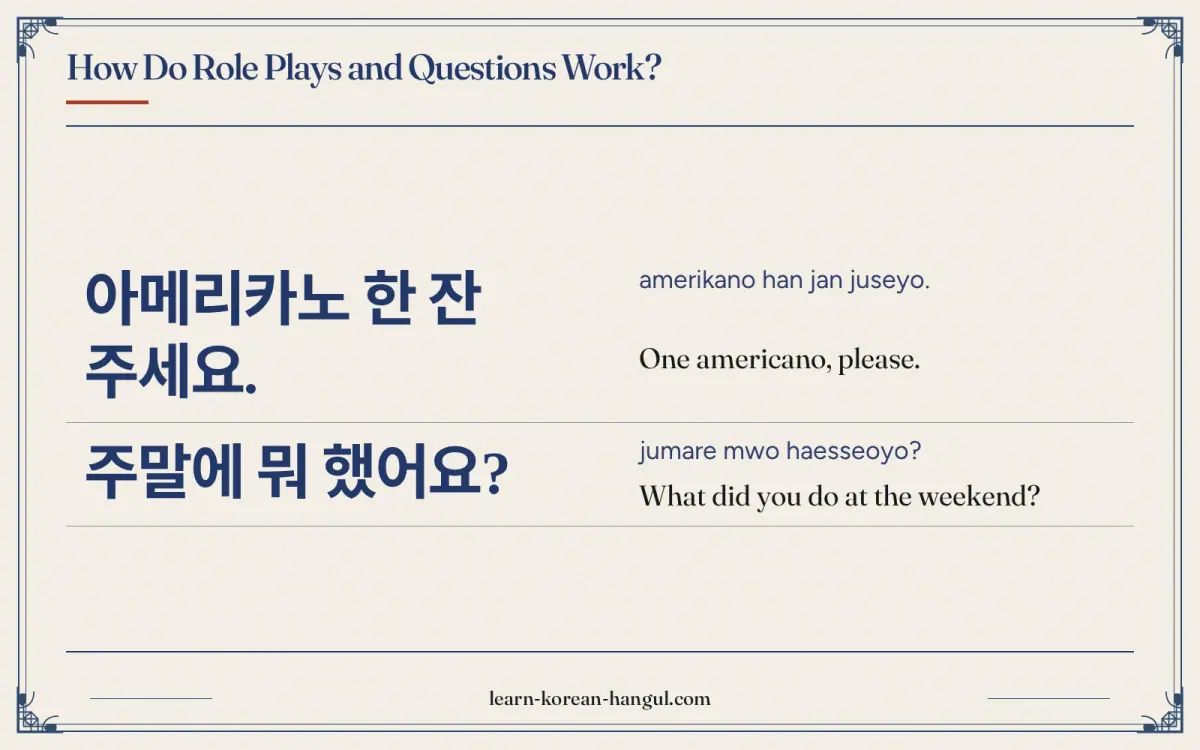
아메리카노 한 잔 주세요.
amerikano han jan juseyo.
One americano, please.
주말에 뭐 했어요?
jumare mwo haesseoyo?
What did you do at the weekend?
친구를 만났어요. 같이 영화를 봤어요.
chingureul mannasseoyo. gachi yeonghwareul bwasseoyo.
I met a friend. We watched a film together.
Answer the question 주말에 뭐 했어요? aloud before you play the model answer. Then change one detail, such as the friend or the film, and answer again. Changing details is the moment repetition becomes speaking.
- Korean conversation practice. Role plays for cafés, restaurants, shopping, directions, phone calls, making plans and a doctor's visit, plus question sets. The aim is to complete one role play in both roles and score it with the rubric.
- Self-introduction role play. The usual first role play: name, country, job and a closing line, in the polite style.
- Korean conversation questions. Common questions grouped by topic, each with a model answer to adapt.
The phrases these scripts use are taught one by one in Korean conversation. Skill alone is not always the problem, which is why confidence has its own group.
How Do I Build Confidence?
Build confidence by lowering the stakes first and raising them in planned steps, not by waiting until you feel ready. Speaking anxiety is a fear of judgement or mistakes; a skill gap is missing words or grammar. A learner with anxiety may know the answer and still go silent, while a learner with a skill gap is calm but cannot find the word. The fixes differ: anxiety needs safe repetitions and small exposures, while a skill gap needs more input and practice.
Two repair phrases help with both, because they buy time instead of ending the conversation:
다시 한번 말해 주세요.
dasi hanbeon malhae juseyo.
Please say that once more.
천천히 말해 주세요.
cheoncheonhi malhae juseyo.
Please speak slowly.
- Speaking confidence. Strategies for nerves, sounding natural and finding partners, ending with a plan for a 15-minute speaking session. If your goal is to learn how to speak Korean fluently, this is where fluency habits are explained.
- 30-day Korean speaking plan. A day-by-day plan that moves through all four steps of the ladder in one month.
With all three groups described, a side-by-side view helps you compare them.
Comparing the Korean Speaking Practice Groups
The three groups differ in what they fix, how much you must produce yourself and whether you need another person.
| Group | What it fixes | You produce | Partner needed | Typical level | Session time |
|---|---|---|---|---|---|
| Shadowing | pronunciation, rhythm, speed | repeated model lines | no | A0–A2 | 15 minutes |
| Conversation practice | freezing in set situations, slow answers | scripted lines, then own answers | optional | A1–B1 | 15–20 minutes |
| Speaking confidence | nerves, avoidance, finding partners | a planned routine | for later stages | any | 15 minutes |
Levels and times are editorial estimates. Every group uses the same rubric, described next.
How Do You Score Your Korean Speaking Practice?
Score each recording with the same four-part rubric, giving 0, 1 or 2 points per part, for a total out of 8. Using one rubric across every page means a 5 in week two and a 7 in week six describe real progress.
- Sounds. 0: often not understood. 1: understood with effort. 2: clear, with only small slips.
- Flow. 0: long pauses inside sentences. 1: pauses between sentences. 2: steady speech at a natural pace.
- Form. 0: endings or particles often missing. 1: mostly correct polite -요 forms. 2: correct forms throughout.
- Task. 0: the task was not completed. 1: completed with help from the script. 2: completed without the script.
The total decides the next step. A total of 6 to 8 means you can move on to the next set. A total of exactly 5 means one more round-two pass on the same set the next day, aimed at the part that scored lowest. A total of 0 to 4 means repeating round one tomorrow.
A self-score is a rough guide, not a test result. A teacher or partner will notice errors you cannot hear, so ask for an outside score now and then.
Study Order at a Glance
The study order is a ladder: each step adds one new demand to the one before.
- Shadow. Copy a model until your timing matches. New demand: speed and melody.
- Role play. Say scripted lines in both roles. New demand: remembering whole exchanges.
- Answer questions. Respond in your own words. New demand: choosing words.
- Converse. Talk with a partner or tutor. New demand: reacting to the unexpected.
Keep the minimum session through every step: 15 minutes, aloud, with one recording a week. When step 1 feels easy, continue with Korean shadowing sets at normal speed and move up a step.
Audio, Review Status and Scope
The page on how the audio is made explains the process. Synthetic audio gives a clear standard model, but it is not a conversation partner and cannot react to you, which is the honest limit of any solo method.
This section does not score your speech automatically and does not prepare you for a speaking exam. It also does not teach individual sounds or grammar; it assumes you meet those in lessons and bring them here to practise aloud.
Frequently Asked Questions
How can I practise speaking Korean alone? Practise alone with three tools that need no partner. Shadow a short audio clip until you can speak with it, read a role-play script aloud in both roles, and answer simple questions about your day out loud. Record one answer each week and compare it with the model audio. Fifteen minutes a day, spoken aloud, is enough to start.
Is shadowing enough to speak Korean? No. Shadowing trains pronunciation, rhythm and speed, but you only repeat sentences someone else built. To speak, you also need to choose words and build your own sentences under time pressure. That is why this section moves from shadowing to role plays, then to answering questions, then to real conversation with a partner.
How long until I can hold a conversation? Most learners who practise aloud for about 15 minutes a day can manage a short, simple conversation about themselves after a few months, if they also study vocabulary and basic grammar. This is an editorial estimate, not a promise. Progress depends on your study time, your first language and how often you speak with real people.
Do I need a tutor? Not at the start. Shadowing, scripted role plays and self-recording work alone. A tutor or language exchange partner becomes useful once you can answer simple questions, because only a live listener reacts unpredictably and corrects what you did not notice. A tutor is paid; a language exchange is free but less structured.
In short, Korean speaking practice works best as a ladder: shadow first, rehearse role plays, answer questions in your own words, then talk with real people, 15 minutes a day.