
The best app to learn Korean depends on your goal, since apps excel at different jobs: some teach Hangul, some drill vocabulary and some connect you to speakers. This page helps you pick the right type of app first, then judge any specific app with six criteria, so you can tell a useful app from one that only keeps you on a streak.
Last updated: 2026-10-09.
Best App to Learn Korean: the Essentials

Start with the goal, not the brand. The table shows what each type of app should do and the warning sign to look for before you commit.
| Your goal | App type to look for | What it should do | Warning sign |
|---|---|---|---|
| Read Hangul | Alphabet app | Play audio for every letter and build syllables, such as 가 from ㄱ + ㅏ | Leans on romanization for weeks |
| Learn words | Spaced-repetition (SRS) app | Schedule each review just before you would forget the word | Cards with no audio or wrong spelling |
| Understand grammar | Course app with explanations | Say why a form is used, such as the topic particle 은/는 versus the subject particle 이/가 | Tile-matching with no explanation |
| Speak | Tutor, AI conversation or exchange app | Give feedback on your own sentences | Accepts anything you type or say |
| Build a daily habit | Gamified course | Short lessons and reminders | Progress measured in streaks, not skills |
| Review your own material | Flashcard app | Let you make cards with audio and example sentences | No export, so your cards are locked in |
Spaced repetition, the method behind the second row, means the app shows a card again after a growing gap (for example 1 day, then 3 days, then a week) and shortens the gap when you forget. It is the most efficient way known to keep a large vocabulary, which is why most serious learners use at least one SRS app.
Here is a quick test for the grammar row. A course app asks you to build 저는 학생이에요 (I am a student) from tiles. If you get it right but cannot say why 는 follows 저, or why the ending is 이에요 and not 예요, the app is drilling, not teaching. (The answer: 는 marks the topic, and 이에요 follows a final consonant, here the ㅇ of 생.)
What Pages Are in This Subhub?
Each page applies the six criteria below to one goal or one app, with the date its facts were last checked. All 14 are published.
Best Apps by Goal
Start with these if you know which skill you want to improve.
- Best Apps to Learn Korean for Free: What each free tier really includes: Hangul and early vocabulary are usually free, while grammar notes, offline use and unlimited practice are usually paid. Seven options, each with a stated drawback.
- Best App to Learn Korean Alphabet: Hangul apps compared on audio for every letter and syllable, writing practice and how they teach final consonants (batchim), the part apps usually leave until last.
- Best Korean Vocabulary App: Six vocabulary apps compared on spaced-repetition scheduling, audio, example sentences and custom cards, with a fair trial: 20 words in 10 minutes, then a recall test 24 hours later.
- Best App for Korean Speaking Practice: Four partner types compared, a tutor, an exchange partner, an AI partner and a pronunciation checker, with feedback as the key criterion and basic safety habits for exchange apps.
- Best Korean Grammar App: What a good grammar app explains, six criteria from clarity to conjugation drills, and why books still win at contrasting look-alike patterns such as -아/어서 and -(으)니까.
- Best Korean Flashcards App: Anki, Quizlet and others compared on scheduling, Korean typing, audio and cost, with a quick test: type 옛날 and 값 on your phone and computer before you build a deck.
Single-App Guides
These pages look at the most-searched apps one at a time: what each does well, what it leaves out and who it suits.
- Duolingo Korean: A game-style course that teaches Hangul and beginner vocabulary and builds a daily habit. Its gaps are thin grammar explanation and limited speaking feedback, so pair it with both.
- LingoDeer vs Duolingo Korean: Grammar notes before exercises (LingoDeer) versus short game-style exercises and habit (Duolingo): which to choose, and why many learners use one for explanation and the other for habit.
- LingoDeer Korean Review: A course app with short grammar notes beside vocabulary and sentence drills. It suits learners who want structure; its drawbacks are limited speaking depth and a paid full course.
- Talk To Me In Korean Review: Free online lessons, paid books and audio from one teaching brand, with a conversational style that covers beginner level upward. You plan your own review, and the free and paid parts differ.
- Pimsleur Korean: An audio-first course built on guided, spaced recall. Strong on pronunciation and speaking rhythm, it needs a separate source for Hangul, reading and grammar.
- Anki Korean: How to install Anki, pick or build a Korean deck, add audio and design cards, with a sustainable pace of 10 to 20 new cards a day. Desktop and Android are free; iOS is a one-time purchase.
- Rosetta Stone Korean: An immersion course that matches pictures, audio and text without English. It suits learners who like to infer meaning; most need a grammar explainer alongside it.
Websites and Tools
Some of the best material runs in a browser rather than an app.
- Best Korean Learning Websites: Free lesson libraries, guided course sites and reference sites compared on six criteria, including this site with its stated drawback: no live feedback or speaking partner.
Best Apps by Goal
Start here if you know what you want to improve.






Single-App Guides
One app per page, judged on the same criteria.







Websites and Tools
Browser-based options.

How Do We Evaluate Apps?
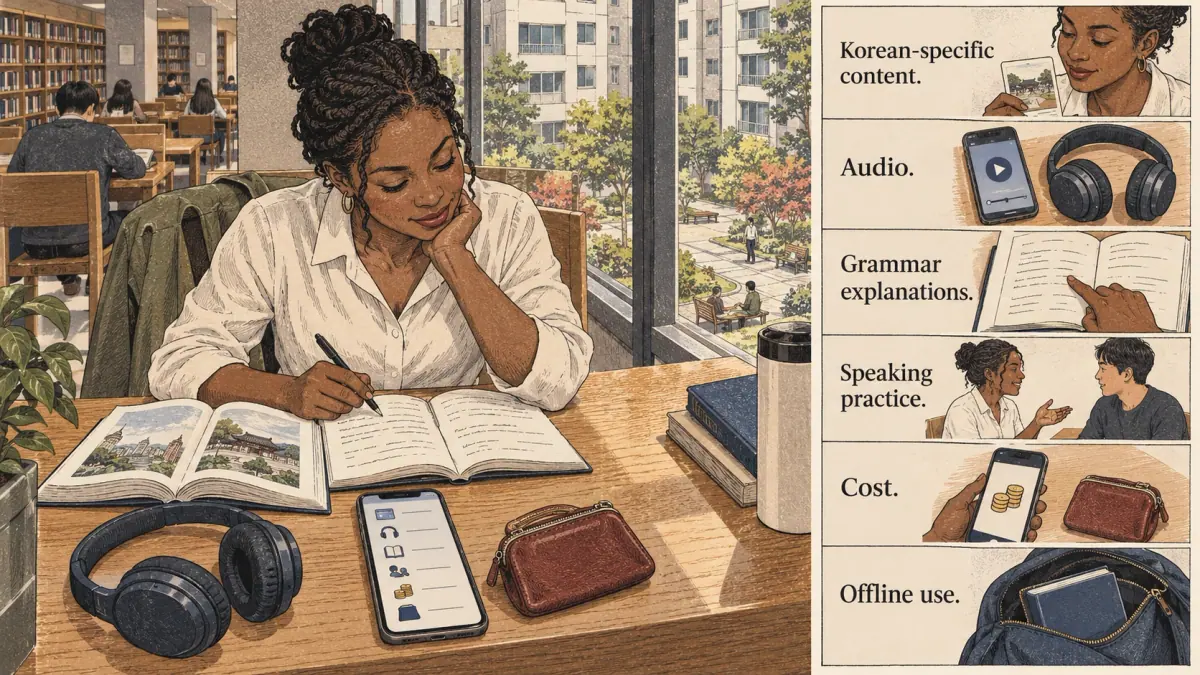
Every app in this section is judged on the same six criteria, so you can compare pages directly.
- Korean-specific content. Was the course built for Korean, or adapted from a template shared with other languages? A Korean-specific course teaches speech levels (polite 요 forms versus casual forms) and particles early, because Korean sentences depend on them.
- Audio. Every Korean word and sentence should have audio, ideally with a slower option. The app should say whether the audio is recorded or generated by text-to-speech.
- Grammar explanations. Does it explain why a form is used, with examples, or only mark answers right or wrong?
- Speaking practice. Does it ask you to say things aloud, and does anyone (a person or a well-built AI) respond to what you said?
- Cost. What the free plan includes, whether the paid plan is a subscription or a one-off purchase, and what you lose if you stop paying.
- Offline use. Can you download lessons and audio for a commute or a flight?
Each page also shows the date its facts were checked, and none uses star ratings or affiliate links. App plans and prices change often, so the page tells you what to check rather than quoting a price as permanent.
Are Free Apps Enough?

Free apps are enough for three jobs: learning Hangul, building a daily habit and reviewing vocabulary with spaced repetition. They usually fall short in two places, deep grammar explanations and feedback on your speaking. A free-first plan looks like this:
- one free course app or free online lessons for the grammar sequence;
- one free SRS flashcard app for words;
- one free speaking source, such as a language exchange partner.
Pay only for the part that is missing after a month of steady use, such as a grammar-rich course or a tutor.
What Can an App Not Do for You?

Apps are good at repetition and instant right-or-wrong checks. They are weak at three things learners need:
- Real conversation. An app follows a script, or an AI follows your lead; a person interrupts, changes topic and asks follow-up questions.
- Your own habits. An app rarely notices that you always say 감사합니다 (thank you) too fast or drop a particle in the same place.
- Social judgement. Whether a polite form sounds warm or cold depends on who is speaking to whom. Apps teach the forms, but people teach the effect.
That is why the decision table on the Korean learning resources hub pairs every app with a speaking source. The Korean speaking practice section shows how to practise aloud alone.
A 15-Minute Daily App Routine

This routine uses two apps and your own voice:
- 5 minutes, new material: one short lesson in your course app.
- 5 minutes, review: your SRS deck. Clear the reviews due today before adding new cards.
- 5 minutes, aloud: say three sentences from today's lesson out loud, then record one and compare it with the app's audio.
That is 15 minutes a day, or 1 hour 45 minutes a week. The third step is the one most app users skip, and it is the one that turns recognition into speech. For a ready-made routine, see the Korean study routine page.
Related Sections
- Learning the alphabet first? The Korean alphabet lessons cover every letter with audio.
- For ready-made review decks, browse Korean flashcards; for free practice tools, see Korean learning tools.
- Using an AI chatbot as a tutor? Read learn Korean with ChatGPT for prompts and its limits.
Frequently Asked Questions
Is there one best app to learn Korean? No. Apps are built for different jobs: some teach Hangul, some schedule vocabulary reviews, some explain grammar and some connect you with speakers. The best app is the one that does the job you need now. Most learners combine one course app or textbook with one flashcard app and a speaking source.
Are free apps enough to learn Korean? Free apps are enough to learn Hangul, build a daily habit and review a few thousand words with spaced repetition. They are rarely enough for grammar explanations or speaking feedback. Pair a free app with free grammar lessons and a language exchange, and pay only for the part that is missing.
Can an app replace a Korean teacher? Not fully. An app can drill words and patterns and give instant right-or-wrong feedback, but it cannot follow an unpredictable conversation, notice a pronunciation habit you repeat or explain why a polite form sounds cold in a given situation. AI conversation features narrow the gap but can accept wrong forms. Use an app between sessions with a person.
Which app is best for learning Hangul? Choose an app that plays audio for every letter and syllable, shows how blocks are built (가 is ㄱ plus ㅏ) and moves you off romanization quickly. Many learners can read slowly after a week or two of short daily practice. The free Hangul lessons on this site cover the same ground with audio.
Should I pay for a Korean learning app? Pay only when the paid plan adds something you will use: offline lessons, more grammar content or speaking practice. Try the free plan or trial first, check the current price in your app store, and cancel any subscription you have not opened for two weeks.