
What Are Hanja?
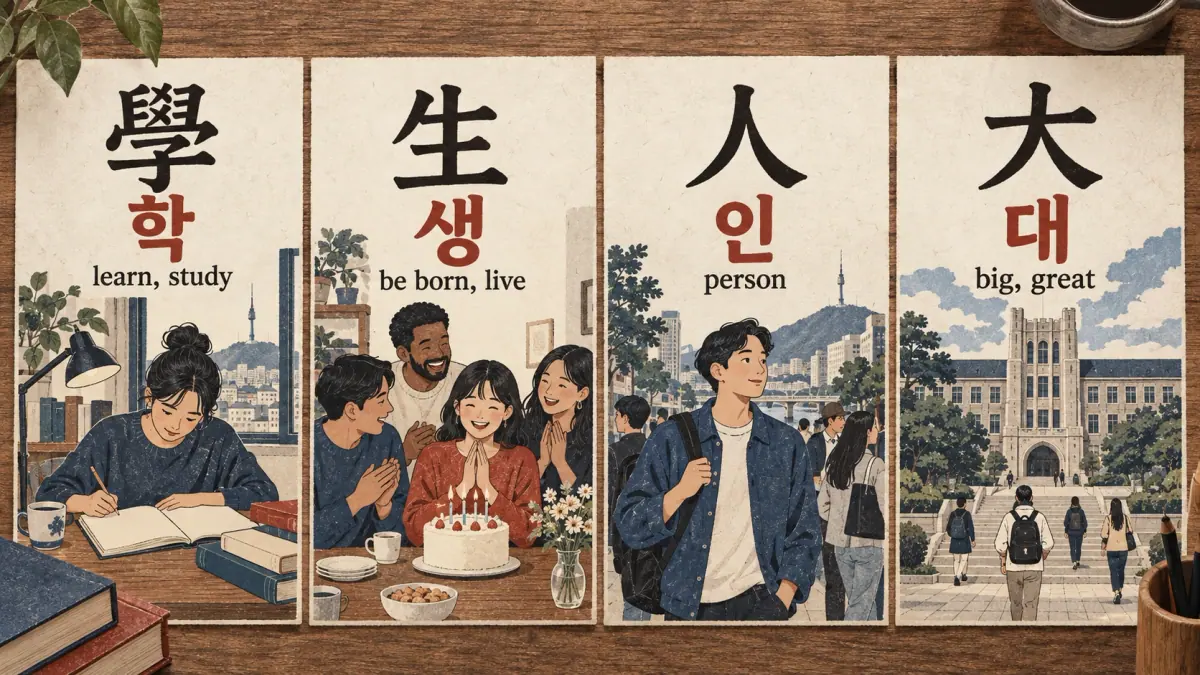
Hanja are Chinese characters that Korean borrowed over many centuries and reads with Korean sounds. The word 한자 (hanja) itself is written 漢字, "Han characters". Each character stands for a meaning and is read as exactly one Korean syllable. Korean words built from these syllables are called 한자어 (hanjaeo), Sino-Korean words, and they are written in Hangul in daily life.
Korean dictionaries teach each character with its 음훈 (eumhun): the 훈 is a native Korean word that gives the meaning, and the 음 is the sound used in words. 學 is taught as 배울 학, "learn, read 학". The four characters below appear in the first words most learners meet.
| Hanja | 음훈 (meaning + sound) | Reading | Meaning | Words you may know |
|---|---|---|---|---|
| 學 | 배울 학 | 학 | learn, study | 학교 [학꾜] (school), 학생 [학쌩] (student) |
| 生 | 날 생 | 생 | be born, live | 생일 (birthday), 학생 [학쌩] (student) |
| 人 | 사람 인 | 인 | person | 한국인 [한구긴] (Korean person), 인구 (population) |
| 大 | 큰 대 | 대 | big, great | 대학 (university), 대한민국 (Republic of Korea) |
Listen to one word for each character.
Two details trip learners up. A few characters have more than one reading: 金 is 금 (gold) but 김 in the surname Kim. And some readings change at the start of a word under the initial-sound rule, 두음법칙: 女 is 녀 in 자녀 (children) but 여 in 여자 (woman). Korea also keeps the traditional character forms, such as 學 and 國, where mainland China and Japan use 学 and 国. The next question is whether you need any of this.
Do You Need to Learn Hanja?
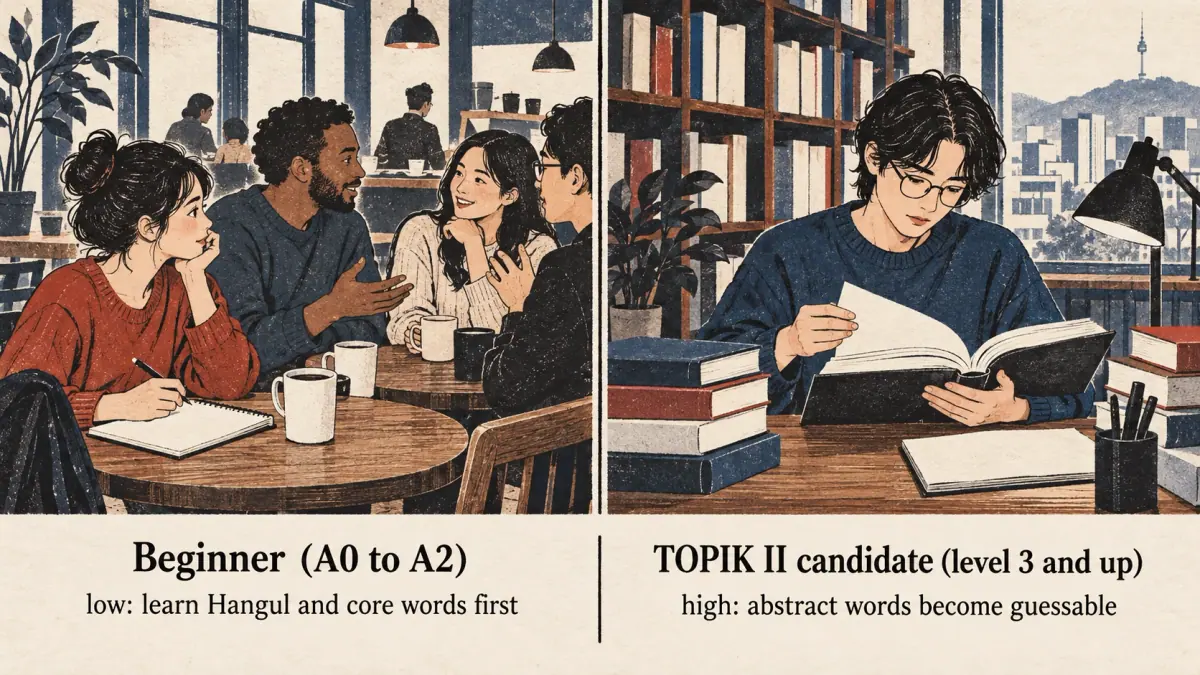
No, not to speak, listen or read everyday Korean. Hanja become useful once your vocabulary turns abstract, usually around TOPIK level 3, because academic and news words are mostly Sino-Korean. Who benefits depends on your goals.
| Learner | Benefit from hanja | Suggested start |
|---|---|---|
| Beginner (A0 to A2) | low: learn Hangul and core words first | none yet; read Hangul vs Hanja |
| TOPIK II candidate (level 3 and up) | high: abstract words become guessable | TOPIK hanja, then word families |
| Speaker of Chinese or Japanese | high: many words map across | word families |
| Reader of news, law or academic texts | high: dense Sino-Korean vocabulary | basic hanja, then word families |
| Learner interested in names | medium: names often have hanja forms | basic hanja |
For the full comparison of the two scripts, read Hangul vs Hanja. The next section lists every page in this hub.
What Pages Are in This Hub?
The hanja hub has 14 pages, grouped below by what they help you do. Sino-Korean prefixes and suffixes are taught in the vocabulary section.














Basics and Background
- What is hanja? explains how one character carries both a meaning and a one-syllable Korean reading, how Sino-Korean words are built, and lets you decode five words you already know.
- Should I learn hanja? gives the answer by goal: beginners can wait, and from about B1 a light route of 100 characters in four weeks helps vocabulary.
- Does Korean use hanja? shows where characters still appear today: names, a few newspaper headlines, school 한문 classes and academic terms.
- Hanja vs kanji vs hanzi compares readings, character forms and everyday use in Korea, Japan and China, and warns about compounds that look alike but mean different things.
- Hanja history is a timeline from the first use of Chinese characters in Korea, through idu and hyangchal, to Hangul in 1446 and the modern shift to Hangul.
The 100 Useful Hanja
Basic hanja is the starting set: 100 characters in 10 themes of 10, from numbers (一 二 三) and weekdays (日 月 火) to school words (學 校 敎) and opposites (出 入, 有 無). Each theme shows the 음훈, the reading and Korean words that use the character. The section also explains how the 100 relate to the official 1,800 list.
Radicals
Hanja radicals explains the 부수 (busu), the component that files a character in a dictionary and often hints at its meaning, such as 氵 "water" in 海 (sea). It covers the 214-radical system, the common radicals worth knowing and how to look up a character you cannot read.
Word Families and Names
Hanja word families teaches vocabulary through 16 productive characters, such as 學 (학), 生 (생), 人 (인) and 大 (대), each opening a family of 10 to 12 everyday words. Hanja in Korean names covers the standard surname characters (金 for 김, 李 for 이, 朴 for 박), how given names pair sound and meaning, and generation syllables (돌림자). Prefixes and suffixes such as 불-, 무- and -적 are taught on Sino-Korean prefixes and suffixes. For name spelling in English letters, see romanization of Korean names.
Study, Tests and Tools
- How to learn hanja sets out a five-step word-family method with spaced repetition and a four-week plan at 25 characters a week.
- How to write hanja covers the eight stroke-order rules with 人, 大 and 學, and suggests writing 10 characters well before doing more.
- TOPIK hanja answers whether the exam tests characters (it does not) and gives 20 characters that pay back fastest for TOPIK II reading.
- Korean hanja proficiency tests explains the graded tests run by private associations, where 8급 is the beginner grade, and whether a learner needs one.
- Choosing a hanja app compares four app types against five criteria, such as Korean readings and spaced repetition, with no ratings or affiliate links.
The next section helps you pick your first page.
Where Should You Start with Hanja?
Start from your goal. These five situations cover most learners.
- You are still learning Hangul or basic words. Skip hanja for now; should I learn hanja? and Hangul vs Hanja explain why.
- You are preparing for TOPIK II. Read TOPIK hanja, then study the word families that match your reading texts.
- You are curious about the characters. Read what is hanja?, then open basic hanja and begin with numbers and weekdays, which you already say every day.
- You speak Chinese or Japanese. Skim hanja vs kanji vs hanzi, then go straight to word families: you know the characters and need the Korean readings.
- You keep meeting characters you cannot read. Learn the look-up method on hanja radicals.
Whichever route you take, learn characters inside words, as the next section explains.
Why Study Word Families Instead of Single Characters?
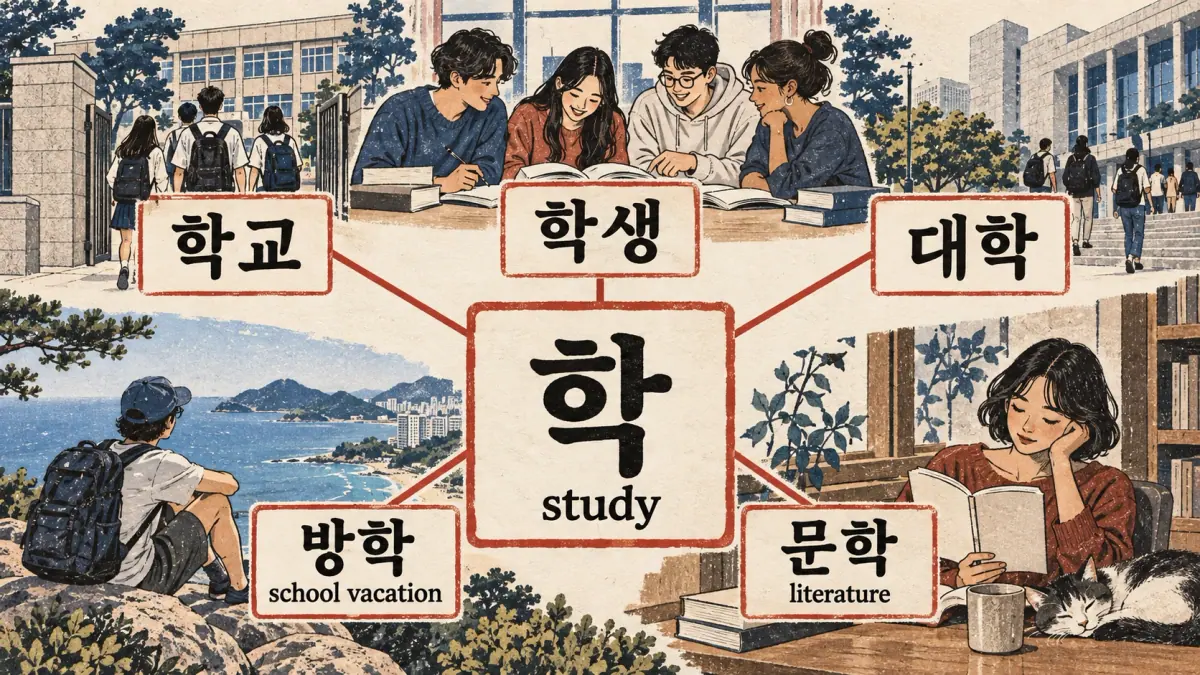
A character is worth learning only for the words it builds, so word families give the fastest return. Once you know that 학 often means "study", 학교, 학생, 대학, 방학 (school vacation) and 문학 (literature) all become easier to remember, even in Hangul with no characters shown.
Word families also expose the main trap, homophones. 학 is nearly always 學, but 전 can be 電 "electricity" (전화, telephone), 前 "before" (오전, morning), 全 "whole" (전부, all) or 展 "unfold" (발전, development). Grouping words by character, not by sound, keeps these apart. The site's Sino-Korean vocabulary list teaches the same words by topic without characters, and Sino-Korean vs native Korean words explains when Korean picks each layer. The number words are a ready-made example: the Sino-Korean numbers 일, 이, 삼 are the readings of 一, 二, 三.
Hanja, Hangul and Sino-Korean Words Compared
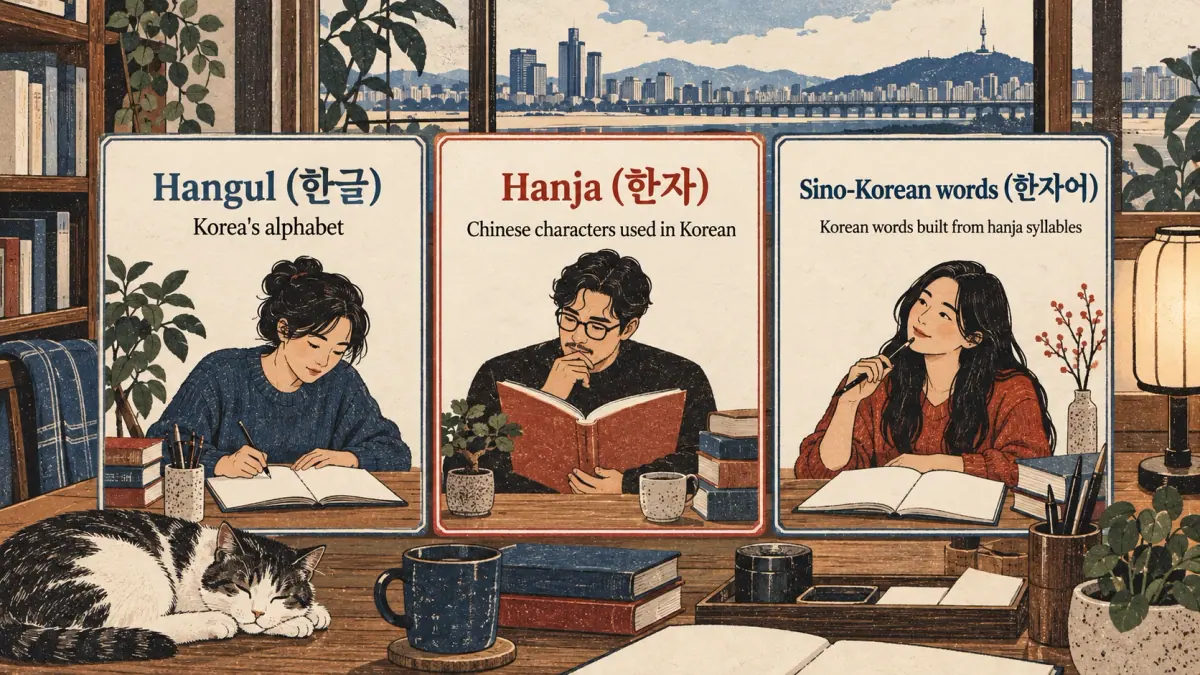
Hanja, Hangul and Sino-Korean words are three different things that learners often mix up. The table separates them.
| Feature | Hangul (한글) | Hanja (한자) | Sino-Korean words (한자어) |
|---|---|---|---|
| What it is | Korea's alphabet | Chinese characters used in Korean | Korean words built from hanja syllables |
| Units | 24 basic letters | 1,800 basic education characters | a very large share of dictionary entries |
| How it is read | letters spell sounds | one syllable per character | read as normal Korean |
| Where you see it | almost all modern text | names, some headlines, dictionaries | everywhere, written in Hangul |
| Needed for daily life | yes | no | yes |
What Does This Hub Not Cover?
This hub explains the characters. Sino-Korean word lists by topic live in the vocabulary section, and the exam itself is covered in the TOPIK section. Classical Chinese texts, Chinese and Japanese pronunciation, and calligraphy are outside its scope. One honest limit: the readings and 음훈 given here follow standard Korean dictionary practice, but a few characters have regional or older readings that dictionaries also list. Hanja are optional, and that is the main thing to remember.
Frequently Asked Questions
How many hanja do Koreans know?
There is no reliable single figure. Schools teach characters from the 1,800-character basic list in the hanmun (한문) subject, but how much is taught has changed with each curriculum. Most adults recognise common characters in words and names, while fewer can write many from memory. Knowledge varies with age, schooling and profession.
Are hanja the same as Chinese or Japanese characters?
They share an origin but differ in form and reading. Korea uses the traditional forms, such as 學 and 國, where mainland China and Japan write 学 and 国. Each hanja usually has one Korean reading, such as 學 = 학, while Japanese kanji often have several readings. The meanings mostly overlap, with some differences in compound words.
Can I read Korean without knowing hanja?
Yes. Signs, menus, messages, novels and most news articles are written in Hangul. Hanja appear only now and then: in some newspaper headlines, in brackets to separate words that sound the same, in names on formal documents, and in academic or legal writing. You can reach an advanced level without writing a single character.
How long does it take to learn the 100 basic hanja?
At ten characters a week, the 100 take ten weeks, and at two a day they take fifty days. Learn each one through two or three words you already know, such as 學 through 학교 and 학생. Recognition is the goal; writing by hand is optional and takes longer, so add it only if you need it.
Do hanja have more than one reading?
Most have one, but some have two or more. 金 is 금 (gold) but 김 as a surname, and 不 is 불 but 부 before ㄷ and ㅈ (부족). Some readings also change at the start of a word: 女 is 녀 in 자녀 but 여 in 여자. This is the initial-sound rule, 두음법칙.