
What Are the Most Useful Korean Phrases to Learn First?

Learn greetings first, then thanks and apologies, then introductions. These three clusters cover about every first minute with a new person, and every other phrase guide assumes you can already say hello and thank you. After them, pick a situation guide such as travel, restaurant or shopping when you have a trip or a meeting coming.
| Step | Cluster | Lead phrase | Why it comes first |
|---|---|---|---|
| 1 | Korean greetings | 안녕하세요 (annyeonghaseyo) | opens every conversation |
| 2 | Polite Korean phrases | 감사합니다 (gamsahamnida) | thanks and apologies keep exchanges smooth |
| 3 | Introduce yourself in Korean | 처음 뵙겠습니다 (cheoeum boepgetseumnida) | names and language level at a first meeting |
| 4 | A situation guide | varies | matches your trip, job or hobby |
Revised Romanization (the South Korean government standard of 2000) appears beside the Hangul as a reading aid only. The rest of the page explains how to choose among the three speech styles and where each guide fits.
How Do You Choose between Formal, Polite and Casual Korean Phrases?
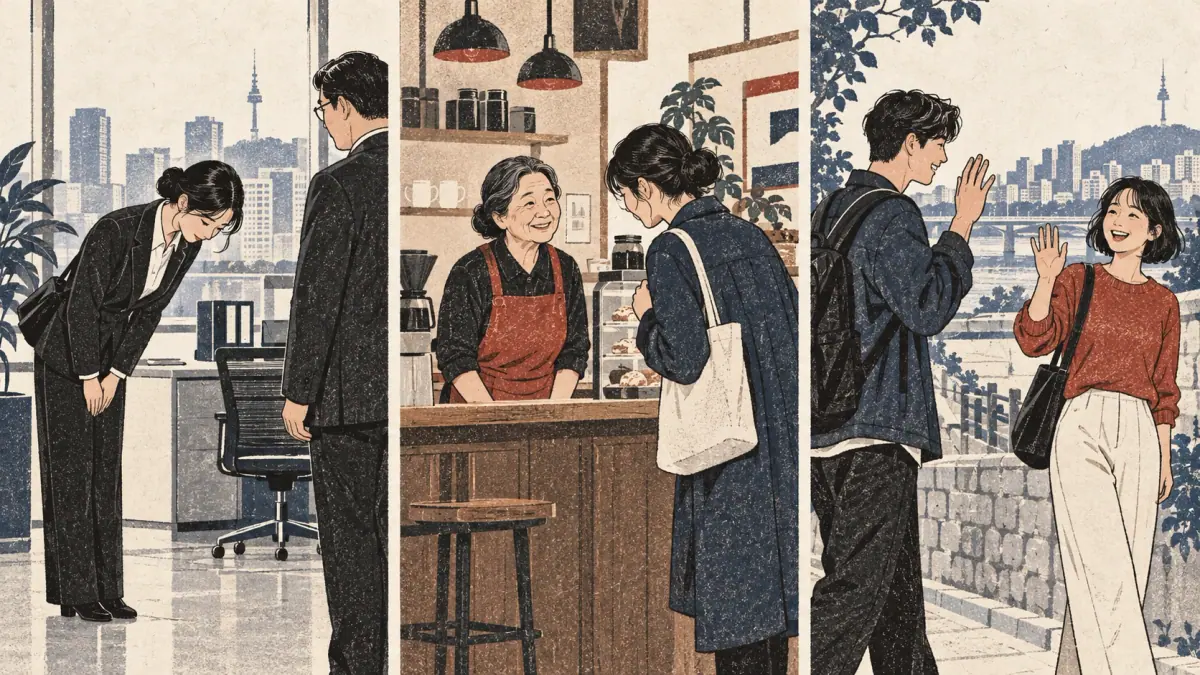
Most Korean phrases come in three registers: formal (합쇼체), polite (해요체) and casual (해체). The polite 요 form is the safe default, because it suits strangers, coworkers and elders, while the casual form is for close friends and younger people. Every register choice here follows the Korean speech levels.
Three pairs show the rule in action:
- Sorry: 죄송합니다 (joesonghamnida) is formal, 죄송해요 (joesonghaeyo) is polite, and 미안해요 (mianhaeyo) and 미안해 (mianhae) are for friends.
- Thank you: 감사합니다 (gamsahamnida) is formal and works almost everywhere, and 고마워요 (gomawoyo) and 고마워 (gomawo) are warmer and for people you know.
- Hello: 안녕하세요 (annyeonghaseyo) is polite for everyone, and 안녕 (annyeong) is only for close friends.
| Register | Typical ending | Use with | Example |
|---|---|---|---|
| Formal (합쇼체) | -ㅂ니다 / -습니다 | speeches, news, customers | 감사합니다 |
| Polite (해요체) | -아요 / -어요 | strangers, coworkers, elders | 고마워요 |
| Casual (해체) | -아 / -어 (no 요) | close friends, younger people | 고마워 |
Pick the form by the listener, not by the room. After choosing the register, pick the situation guide.
All Korean Phrases Guides

Each of the 19 guides below has a lead phrase and a short audio clip, and each opens a cluster of phrase pages with the same layout: a quick answer, a register table, pronunciation, usage scenes, dialogues and mistakes. Three clusters come first, and the rest are grouped by situation.
Start Here
Korean Greetings
The lead phrase is 안녕하세요 (annyeonghaseyo), which means "hello." The first cluster to learn, with 20 guides for hello, goodbye, good morning, good night and how are you. It shows that Korean uses one hello all day and two different goodbyes.
Thank You, Sorry and Please
The lead phrase is 감사합니다 (gamsahamnida), which means "thank you." The polite core: thank you, sorry, excuse me, please and you're welcome, each with formal, polite and casual forms. Learn this cluster second, because every situation guide assumes you can thank and apologise.
Introducing Yourself
The lead phrase is 처음 뵙겠습니다 (cheoeum boepgetseumnida), which means "nice to meet you (first meeting)." Phrases for names, jobs, home towns and language level, such as asking whether someone speaks English. It suits a first meeting at school, work or a trip.
More Phrases
The remaining 16 guides are grouped by situation.
Everyday situations
- Everyday Conversation: 그래요? (geuraeyo), "really?" Short reactions and follow-ups that keep a conversation moving.
- Common Responses and Fillers: 맞아요 (majayo), "that is right." Yes, no, maybe and the small sounds that Koreans use while thinking or listening.
- Terms of Address: 선생님 (seonsaengnim), "teacher, sir or madam." Titles and names for teachers, elders, coworkers and friends, since Korean avoids the word "you" with seniors.
- How to Say ... in Korean: ...은/는 한국어로 뭐예요? (eun/neun hangugeoro mwoyeyo), "how do you say ... in Korean?" Quick answers for common "how do you say" questions that have no cluster of their own.
Travel and services
- Travel Phrases: 화장실이 어디예요? (hwajangsiri eodiyeyo), "where is the restroom?" Directions, transport, tickets and emergencies for a first trip.
- Restaurant and Café Phrases: 물 좀 주세요 (mul jom juseyo), "water, please." Ordering, asking for the bill and handling allergies at a table.
- Shopping Phrases: 얼마예요? (eolmayeyo), "how much is it?" Prices, sizes, payment and returns in markets and stores.
- Hotel Phrases: 방 있어요? (bang isseoyo), "do you have a room?" Booking, check-in, requests and problems at a front desk.
- Health Phrases: 아파요 (apayo), "it hurts, I am sick." Describing pain and symptoms at a pharmacy or clinic.
Study and work
- Work and Business Phrases: 잘 부탁드립니다 (jal butakdeurimnida), "I look forward to working with you." Formal lines for meetings, emails and office life.
- Classroom Phrases: 질문 있어요 (jilmun isseoyo), "I have a question." Lines for asking, repeating and checking in a Korean class.
Feelings, culture and fandom
- Love and Romance: 사랑해요 (saranghaeyo), "I love you." Confessions, compliments and dating phrases, with notes on tone.
- Expressing Feelings: 기뻐요 (gippeoyo), "I am glad." Words for joy, sadness, worry and tiredness.
- Birthdays and Celebrations: 생일 축하해요 (saengil chukahaeyo), "happy birthday." Congratulations for birthdays, weddings and holidays.
- K-Drama Phrases: 대박 (daebak), "wow, awesome." Famous lines and slang heard in dramas, with a note on which ones are too dramatic for daily life.
- K-Pop Fan Phrases: 화이팅 (hwaiting), "you can do it, go for it." Fan chants, concert lines and messages to idols.
Single Words That Live in the Vocabulary Hub
Some topics look like phrases but are single words, such as family terms, animals and colours. Those words live in the Korean vocabulary hub, where each word has its own entry. Use this hub when you want a whole line to say, and use the vocabulary hub when you want to build your own sentences from words. The two hubs link to each other where topics overlap.
How Do You Practise Korean Phrases?

Phrases stick when you hear them, say them and use them in a short scene. Try this ten-minute routine:
- Play the audio beside a lead phrase and repeat it twice, matching the speed.
- Say the polite form and the casual form, and name a listener for each.
- Cover the Romanization and read the Hangul alone.
- Practise with the phrase flashcards, which pair each phrase with audio.
- Move to the next guide only when the current phrases come out without thought.
Short daily practice beats a long weekly session, and the clips follow the audio methodology described on the About pages. The phrase pages also include dialogues to read aloud, which train the rhythm that single lines cannot. After practice, watch for the mistakes below.
What Mistakes Do Learners Make with Korean Phrases?
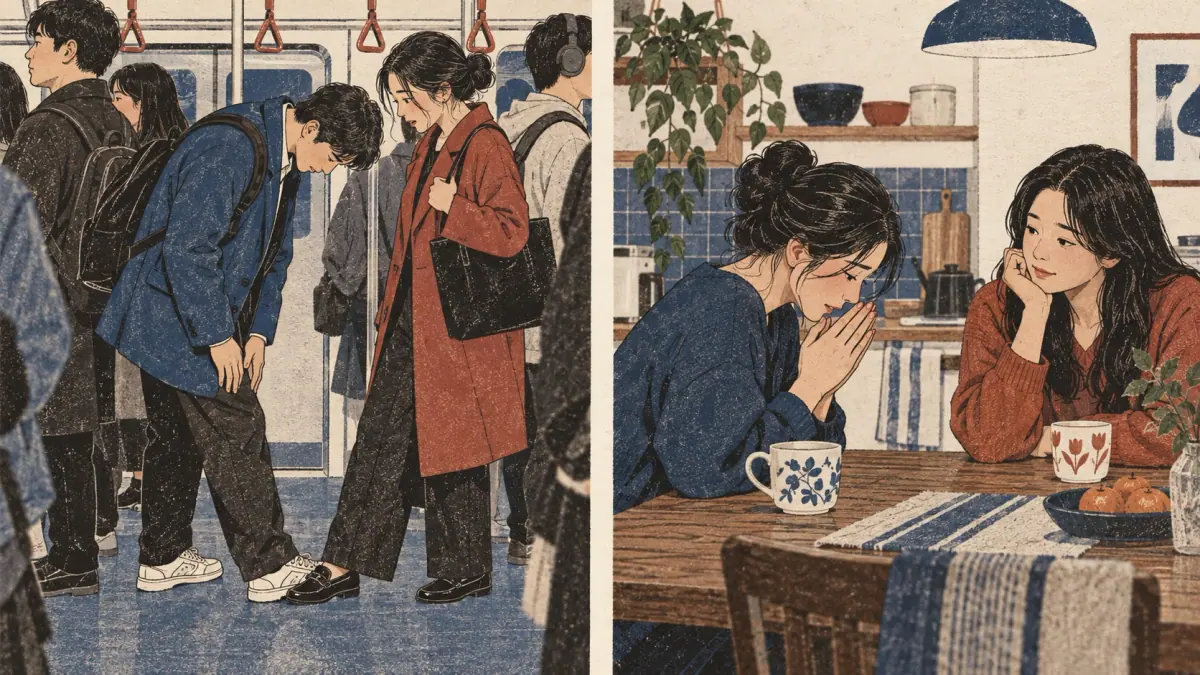
Learners most often copy a casual phrase from a drama and use it with a stranger. Four more mistakes appear often:
- Treating romanization as the real spelling. Revised Romanization is a reading aid. Fix: learn the Hangul and check the audio.
- Skipping the ending. Dropping 요 from a polite phrase sounds rude to elders. Fix: keep the ending unless the listener is a close friend.
- Using one phrase for every situation. 죄송합니다 fits a stepped-on foot, but 용서해 주세요 (yongseohae juseyo, "please forgive me") is for serious mistakes. Fix: read the usage notes on each page.
- Learning long lists without scenes. Fix: learn a phrase together with the situation and the reply.
Each fix comes from matching the phrase to the listener. The questions below answer common details.
Frequently Asked Questions
The answers below add details about Korean phrases beyond the guides above.
Do I need to read Hangul before I learn these phrases?
No. You can start with the audio and the Revised Romanization beside each phrase. Hangul is a small alphabet, though, and the Hangul hub teaches it letter by letter. Learning to read it makes every phrase easier to say correctly, because romanization hides some sounds.
How many Korean phrases do I need for a trip?
Ten to fifteen phrases cover a short trip: a greeting, thanks, sorry, excuse me, please, yes and no, how much, where is, and a few food lines. This is a practical target, not a standard. Add the travel and restaurant guides, then practise the phrases aloud with audio.
What is the difference between formal, polite and casual Korean phrases?
Formal (합쇼체) uses -ㅂ니다 and suits speeches and customers. Polite (해요체) uses -아요 or -어요 and suits strangers, coworkers and elders. Casual (해체) drops the 요, so 고마워요 becomes 고마워, and suits close friends. The polite form is the safest default when you are unsure.
Are the romanized spellings on this site standard?
Yes, the spellings follow the Revised Romanization of Korea (Ministry of Culture notice 2000-8), the South Korean government standard. They are a reading aid only, and they hide some sounds, such as tense consonants. The Hangul is the real spelling, and the audio shows the real sound.
Where can I hear how Korean phrases sound?
Each guide places a play button beside its lead phrase, and each phrase page adds slow and normal clips. Clips are produced and checked under the process on the audio methodology page. Nothing plays automatically, so you choose when to listen and can repeat as often as you like.