Key facts
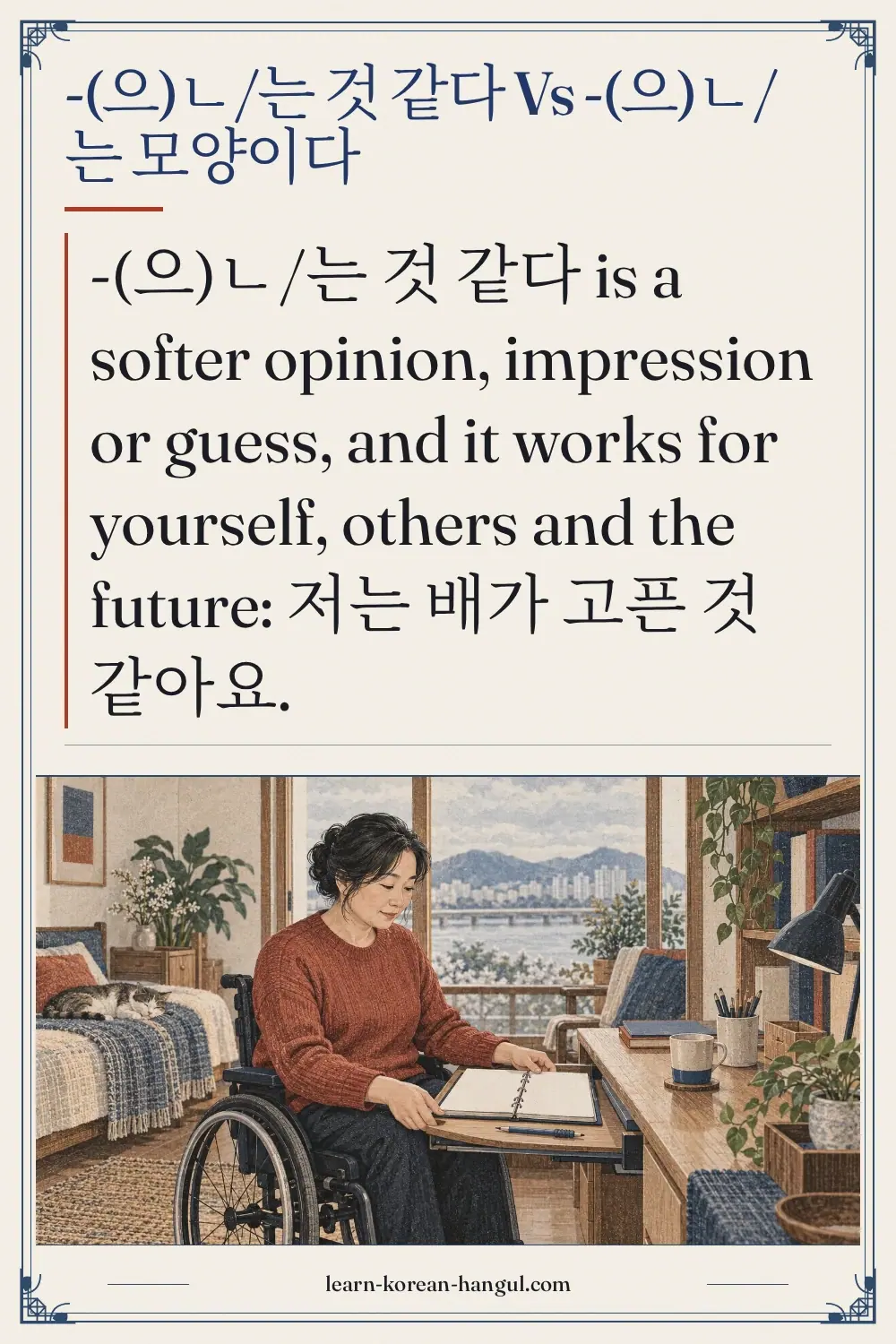
- -(으)ㄴ/는 것 같다 is a softer opinion, impression or guess. You can use it about yourself, about other people and about the future.
- -(으)ㄴ/는 모양이다 is a firmer conclusion drawn from clear signs. It is used about someone or something else, mostly in the present or the past.
- -모양이다 is not used for the speaker's own feelings. Its future form, -(으)ㄹ 모양이다 (비가 올 모양이에요), also needs a visible sign; for a plain forecast use -(으)ㄹ 것 같다.
What you'll learn
- Say which pattern is an opinion and which one is a deduction from signs.
- Build both patterns for verbs, adjectives, 있다/없다 and 이다 in the present and the past.
- Choose the right pattern for five sentences and give the reason.
- Avoid the main traps: your own feelings, forecasts with no sign and wrong modifiers.
Before you start: you should know the polite ending -아요/어요 and the modifier endings -는, -(으)ㄴ and -(으)ㄹ (the endings that make 가는, 간 and 갈). The full rules for each pattern are on their own lesson pages, named below. Audio plays only when you press a button.
What Is the Difference between -(으)ㄴ/는 것 같다 and -(으)ㄴ/는 모양이다?
The difference is the source of the guess. Both patterns say "it seems that...", but they do not point to the same thing. With -(으)ㄴ/는 것 같다 the guess comes from the speaker: an impression, a feeling, an opinion or a little information. With -(으)ㄴ/는 모양이다 the guess comes from the situation: the speaker has noticed something, and the conclusion follows from it.
Here are two sentences about the same person.
그는 피곤한 것 같아요.
geuneun pigonhan geot gatayo
He seems tired.
Pronunciation: [그는 피곤한 걷까타요]. The speaker has an impression, perhaps from the man's face or voice, and states it gently. It is a personal view and the speaker could be wrong.
그는 피곤한 모양이에요.
geuneun pigonhan moyangieyo
He appears to be tired.
Pronunciation: [그는 피곤한 모양이에요]. The speaker has seen or heard something that points to tiredness, such as yawning, slow steps or an empty coffee cup, and draws a conclusion from it. It sounds more like a report of what the facts suggest.
The noun 모양 helps you remember this. It means shape or appearance, so 모양이다 says "the shape of things is such that...". The speaker reads the shape of the situation. The next section lines the two patterns up in a table.
-(으)ㄴ/는 것 같다 vs -(으)ㄴ/는 모양이다: Side-by-Side Table
The table compares the two patterns on the points that decide the choice.
| Point | -(으)ㄴ/는 것 같다 | -(으)ㄴ/는 모양이다 |
|---|---|---|
| Core meaning | I think, it seems | it looks as though, it appears that |
| Source of the guess | impression, opinion, partial information | signs the speaker has seen or heard |
| Confidence | softer | firmer |
| The speaker's own state | possible: 저는 배가 고픈 것 같아요 | not used |
| Who it is about | anyone, including "I" | usually someone or something else |
| Future guess | yes, with or without a sign: 갈 것 같아요 | only from a visible sign: 비가 올 모양이에요 |
| Present and past | 가는 것 같다, 간 것 같다 | 가는 모양이다, 간 모양이다 |
| Where you hear it | very common everywhere, especially in speech | less common in casual chat; typical of stories, news and explanations |
| Built from | modifier + 것 같다 | modifier + 모양이다 |
| Example | 이 방법이 더 쉬운 것 같아요. | 시험이 쉬운 모양이에요. |
Both patterns are written as separate words. 것 is a dependent noun (a noun that cannot stand alone) and 모양 is used the same way here, so write 피곤한 것 같아요 and 피곤한 모양이에요 with spaces. Because 모양 ends in a consonant, the copula takes 이에요, as in 모양이에요, and the past is 모양이었어요.
How Do You Form the Two Patterns?
Both patterns take the same modifier in front. Verbs use -는 in the present and -(으)ㄴ in the past. Adjectives use -(으)ㄴ in the present. 있다 and 없다 act like verbs and take -는. A noun takes 인 (이다 in modifier form).
| Type | Dictionary form | with 것 같다 | with 모양이다 |
|---|---|---|---|
| Verb, present | 가다 (to go) | 가는 것 같아요 | 가는 모양이에요 |
| Verb, past | 가다 | 간 것 같아요 | 간 모양이에요 |
| Verb, future | 가다 | 갈 것 같아요 | 갈 모양이에요 (only from a sign) |
| Adjective, present | 바쁘다 (to be busy) | 바쁜 것 같아요 | 바쁜 모양이에요 |
| Adjective, past | 바쁘다 | 바빴던 것 같아요 | 바빴던 모양이에요 |
| Existence | 없다 (to not exist, to not have) | 없는 것 같아요 | 없는 모양이에요 |
| Noun + 이다 | 학생 (student) | 학생인 것 같아요 | 학생인 모양이에요 |
For a past state of an adjective, the form is -았/었던: 바쁘다 gives 바빴던 (pronounced [바빧떤]). The guess is made now, so the modifier carries the past tense of the thing you are guessing about.
When Do You Use -(으)ㄴ/는 것 같다?
Use -(으)ㄴ/는 것 같다 when you give an opinion, an impression or a cautious guess. It is also the polite way to soften a statement, because it does not claim to be certain. It is the more flexible of the two patterns, because it works for any subject and any time.
Here are five typical uses.
- An opinion. 이 방법이 더 쉬운 것 같아요. (i bangbeobi deo swiun geot gatayo) "I think this method is easier."
- How you feel. 저는 배가 고픈 것 같아요. (jeoneun baega gopeun geot gatayo) "I think I am hungry." The speaker is not sure of the feeling and describes it gently.
- A guess about the future. 내일은 비가 올 것 같아요. (naeireun biga ol geot gatayo) "I think it will rain tomorrow." The pronunciation is [내이른 비가 올껃까타요].
- A polite hedge. 저는 잘 모르겠는데, 이게 맞는 것 같아요. (jeoneun jal moreugenneunde, ige manneun geot gatayo) "I am not sure, but I think this is right." Pronunciation: [저는 잘 모르겐는데 이게 만는 걷까타요].
- An impression of a film or a thing. 이 영화는 재미있는 것 같아요. (i yeonghwaneun jaemiinneun geot gatayo) "I think this film is fun." Pronunciation: [이 영화는 재미인는 걷까타요].
저는 배가 고픈 것 같아요.
jeoneun baega gopeun geot gatayo
I think I am hungry.
내일은 비가 올 것 같아요.
naeireun biga ol geot gatayo
I think it will rain tomorrow.
저는 잘 모르겠는데, 이게 맞는 것 같아요.
jeoneun jal moreugenneunde, ige manneun geot gatayo
I am not sure, but I think this is right.
Notice that none of these sentences needs a particular sign in front of the speaker's eyes. The speaker's own sense of the matter is enough. That is why -(으)ㄴ/는 것 같다 is the natural choice for personal opinions. For the full rules, read the lesson on -(으)ㄴ/는 것 같다.
When Do You Use -(으)ㄴ/는 모양이다?
Use -(으)ㄴ/는 모양이다 when you have noticed something and you conclude, from that evidence, that something is so. The "something" is nearly always another person or a situation outside you, and the time is usually the present or the past. The evidence can be anything the speaker can point to: wet streets, a queue, a silent phone, a crying child.
Here are five typical uses.
- Wet streets. 길이 젖어 있어요. 비가 온 모양이에요. (giri jeojeo isseoyo. biga on moyangieyo.) "The road is wet. It seems it has rained." Pronunciation: [기리 저저 이써요. 비가 온 모양이에요].
- A person who is missing. 민수 씨가 안 보여요. 벌써 집에 간 모양이에요. (minsu ssiga an boyeoyo. beolsseo jibe gan moyangieyo.) "I cannot see Minsu. He seems to have gone home already."
- A crying child. 아이가 우는 걸 보니 배가 고픈 모양이에요. (aiga uneun geol boni baega gopeun moyangieyo.) "Judging by the way the child is crying, he seems to be hungry."
- A queue. 사람들이 줄을 서 있어요. 이 식당이 유명한 모양이에요. (saramdeuri jureul seo isseoyo. i sikdangi yumyeonghan moyangieyo.) "People are lining up. This restaurant must be famous." Pronunciation: [사람드리 주를 서 이써요. 이 식땅이 유명한 모양이에요].
- A silent house. 집에 아무도 없는 모양이에요. (jibe amudo eomneun moyangieyo.) "Nobody seems to be home." Pronunciation: [지베 아무도 엄는 모양이에요].
길이 젖어 있어요. 비가 온 모양이에요.
giri jeojeo isseoyo. biga on moyangieyo.
The road is wet. It seems it has rained.
아이가 우는 걸 보니 배가 고픈 모양이에요.
aiga uneun geol boni baega gopeun moyangieyo
Judging by the way the child is crying, he seems to be hungry.
학생들이 모두 일어나요. 저분이 선생님인 모양이에요.
haksaengdeuri modu ireonayo. jeobuni seonsaengnimin moyangieyo.
The students are all standing up. That person must be the teacher.
The phrase 보니 ("when I looked", "judging by") often sits in front of -모양이다, because it names the evidence. Compare 우는 걸 보니 ("seeing him cry") with the bare 배가 고픈 것 같아요, which could come from nothing more than a hunch. For the full rules, read the lesson on -(으)ㄴ/는 모양이다.
Can You Use Both in the Same Sentence?
Often both patterns fit the same situation, and the difference is in the stance the speaker takes. When you judge a third person from something you can see, either pattern is grammatical.
- 어제 많이 피곤했던 것 같아요. "I think he was very tired yesterday." Pronunciation: [어제 마니 피곤핻떤 걷까타요]. This is a personal impression of how he looked.
- 어제 많이 피곤했던 모양이에요. "He seems to have been very tired yesterday." Pronunciation: [어제 마니 피곤핻떤 모양이에요]. This reads as a conclusion from signs, for example that he left early and did not answer his phone.
The speaker choosing -모양이다 is saying "I have grounds for this". The speaker choosing -것 같다 is saying "this is how it looks to me". If a friend replies "How do you know?", the -모양이다 speaker can point to evidence, and the -것 같다 speaker can only say "it just seems so".
The overlap ends at three points. First, for yourself, only -것 같다 works. Second, for a future guess with no sign, only -ㄹ 것 같다 works; -(으)ㄹ 모양이다 needs evidence, as in 구름이 많아요. 비가 올 모양이에요. Third, for an opinion with no sign at all, only -것 같다 works. Stacking both in one clause adds nothing, so choose one. A third pattern, -나 보다, is also close in meaning to -모양이다. You can compare them on the page about -(으)ㄹ 것 같다 vs -나 보다.
How Does a Conversation Use Both?
A short dialogue shows how the two patterns work in real talk. Two coworkers discuss a colleague who did not come to work.
A: 민수 씨가 오늘 회사에 안 왔어요. (minsu ssiga oneul hoesae an wasseoyo.) "Minsu did not come to work today."
B: 어제 아파 보였어요. 아마 병원에 간 것 같아요. (eoje apa boyeosseoyo. ama byeongwone gan geot gatayo.) "He looked unwell yesterday. I think he probably went to the hospital."
A: 전화도 안 받아요. 많이 아픈 모양이에요. (jeonhwado an badayo. mani apeun moyangieyo.) "He is not answering the phone either. He must be quite ill."
어제 아파 보였어요. 아마 병원에 간 것 같아요.
eoje apa boyeosseoyo. ama byeongwone gan geot gatayo.
He looked unwell yesterday. I think he probably went to the hospital.
전화도 안 받아요. 많이 아픈 모양이에요.
jeonhwado an badayo. mani apeun moyangieyo.
He is not answering the phone either. He must be quite ill.
Speaker B offers a personal guess, so B uses -것 같다. Speaker A has just noticed a fact, the unanswered phone, and draws a conclusion from it, so A uses -모양이다. The same conversation would feel odd if A said 많이 아픈 것 같아요 and then stopped, because A would lose the link to the evidence.
Which One Should You Pick? a Simple Rule of Thumb
Ask three questions in order.
- Is the sentence about you, or a forecast with no sign behind it? If yes, use -(으)ㄴ/는 것 같다 or -(으)ㄹ 것 같다. Example: 저는 배가 고픈 것 같아요.
- Have you seen or heard a sign that leads to your conclusion? If yes, and the subject is someone or something else, use -(으)ㄴ/는 모양이다. Example: 길이 젖어 있어요. 비가 온 모양이에요.
- Do you only want to say what you think? If yes, use -(으)ㄴ/는 것 같다. Example: 이 방법이 더 쉬운 것 같아요.
When you are not sure, choose -(으)ㄴ/는 것 같다. It works for any subject, any time and any amount of evidence, so it is the safer pattern. A learner who uses -것 같다 everywhere sounds a little vague. A learner who uses -모양이다 wrongly sounds odd. That is why this page leans on the first.
What Mistakes Do Learners Make with These Two?
Most mistakes come from treating -모양이다 as a full replacement for -것 같다. Five of them appear again and again.
- Using -모양이다 for your own feelings. 저는 배가 고픈 모양이에요 sounds odd, because the speaker is the one person who does not need to read signs to know. Say 저는 배가 고픈 것 같아요 (or simply 배가 고파요).
- Using -모양이다 for a forecast with no sign. -(으)ㄹ 모양이다 exists, but only when you can see the signs: 하늘이 어두워요. 비가 올 모양이에요. For a plain guess about tomorrow, say 내일은 더울 것 같아요.
- Using -모양이다 for a plain opinion. 이 방법이 더 쉬운 모양이에요 sounds as if you are reading the facts, not giving a view. For "I think this is easier", use -것 같다.
- Using the wrong modifier. An adjective takes -(으)ㄴ in the present: 바쁜 것 같아요, not 바쁘는 것 같아요. A verb takes -는 for the present and -(으)ㄴ for the past, so 간 모양이에요 means he has gone, while 가는 모양이에요 means he is going. 있다 and 없다 take -는.
- Writing the pattern without a space. Write 피곤한 것 같아요, not 피곤한것같아요, and 피곤한 모양이에요, not 피곤한모양이에요. 것 and 모양 are separate words.
A quick self-check: ask "Do I have a sign?" If your honest answer is "no, it is just my view", reach for -것 같다. If the answer is "yes, and I can say what it is", -모양이다 is available.
Practice: Choose the Right Pattern
Try the five questions, then read the answers below.
Practice · 5
You feel hungry and want to say "I think I am hungry." Which sentence fits?
Show answer
저는 배가 고픈 것 같아요.
For your own state, only -것 같다 works. An adjective takes -(으)ㄴ, so the modifier is 고픈.
You want to say "I think it will be hot tomorrow." Which sentence fits?
Show answer
내일은 더울 것 같아요.
A plain guess about the future uses -(으)ㄹ 것 같다. 덥다 is ㅂ-irregular, so its -(으)ㄹ form is 더울, not 덥을.
The street is wet. Choose the right modifier: 어제 비가 ___ 모양이에요. (It seems it rained yesterday.)
Show answer
온
A past event takes the past modifier -(으)ㄴ, so 오다 becomes 온.
Which sentence sounds unnatural?
Show answer
저는 지금 졸린 모양이에요.
You do not read signs to learn your own sleepiness, so -모양이다 sounds odd for the speaker's own state.
Choose the correct form: 저분이 선생님___ 모양이에요. (That person must be the teacher.)
Show answer
인
The noun 선생님 takes the modifier form 인 before 모양이다.
Answer key
- 저는 배가 고픈 것 같아요. The subject is "I", so only -것 같다 fits.
- 내일은 더울 것 같아요. A plain forecast uses -(으)ㄹ 것 같다, and the ㅂ-irregular 덥다 becomes 더울.
- 온. A past event is a past modifier, and 오다 gives 온.
- 저는 지금 졸린 모양이에요. A speaker does not read signs to learn their own sleepiness, so -모양이다 sounds odd here.
- 인. The noun 선생님 takes the modifier 인 before 모양이에요.
Now write your own pair: one remark about a friend, with -모양이다 and a visible sign, and one opinion of your own with -것 같다.
What Should You Learn Next?
After this comparison, study each pattern on its own lesson page, then look at the other pairs on the list.
- Learn the full rules for -(으)ㄴ/는 것 같다, including its future form.
- Read the lesson on -(으)ㄴ/는 모양이다 for every form of the second pattern.
- Read the other guessing pair, -(으)ㄹ 것 같다 vs -나 보다.
- Compare other confusable pairs on Confusing Grammar Compared.
- See where both patterns sit on the Advanced Grammar list.
Frequently Asked Questions
What Is the Difference between -(으)ㄴ/는 것 같다 and -(으)ㄴ/는 모양이다?
Both express a guess. -(으)ㄴ/는 것 같다 is a softer opinion or impression that can come from the speaker alone. -(으)ㄴ/는 모양이다 is a firmer conclusion that the speaker draws from clear signs, and it is used about someone or something else.
Can I Always Replace -(으)ㄴ/는 것 같다 with -(으)ㄴ/는 모양이다?
No. -모양이다 does not work for your own feelings, for a plain opinion, or for a future guess with no sign behind it. 저는 배가 고픈 것 같아요 cannot become 저는 배가 고픈 모양이에요. When the subject is another person and you have a visible sign, the two patterns are often interchangeable, with a small change in confidence.
Which One Sounds More Natural in Speech?
-(으)ㄴ/는 것 같다 is the everyday choice and appears in almost every kind of conversation. -(으)ㄴ/는 모양이다 is also used in speech, but it is less common in casual chat and is typical of stories, news and explanations.
Which One Appears More Often on TOPIK?
This site does not publish exam statistics. Both patterns are taught at the upper-intermediate stage. For current exam content, check the level descriptions and past papers on the official TOPIK site, topik.go.kr.
What Is the Quickest Rule to Remember?
Ask whether you can point to a sign. If you can, and the subject is someone or something else, use -(으)ㄴ/는 모양이다. If it is only your opinion, a forecast with no sign, or about you, use -(으)ㄴ/는 것 같다.