What you'll learn
- Attach -기 위해(서) to verbs and 을/를 위해(서) to nouns.
- Use it in commands, requests and advice, where -(으)려고 does not fit.
- Use the frames 위해서는 and 이를 위해 in essays and speeches.
- Choose between -기 위해(서), -(으)려고 and -도록.
Prerequisites: the polite ending -아요/어요 and the pattern -(으)려고. Time: about 15 minutes.
Key facts
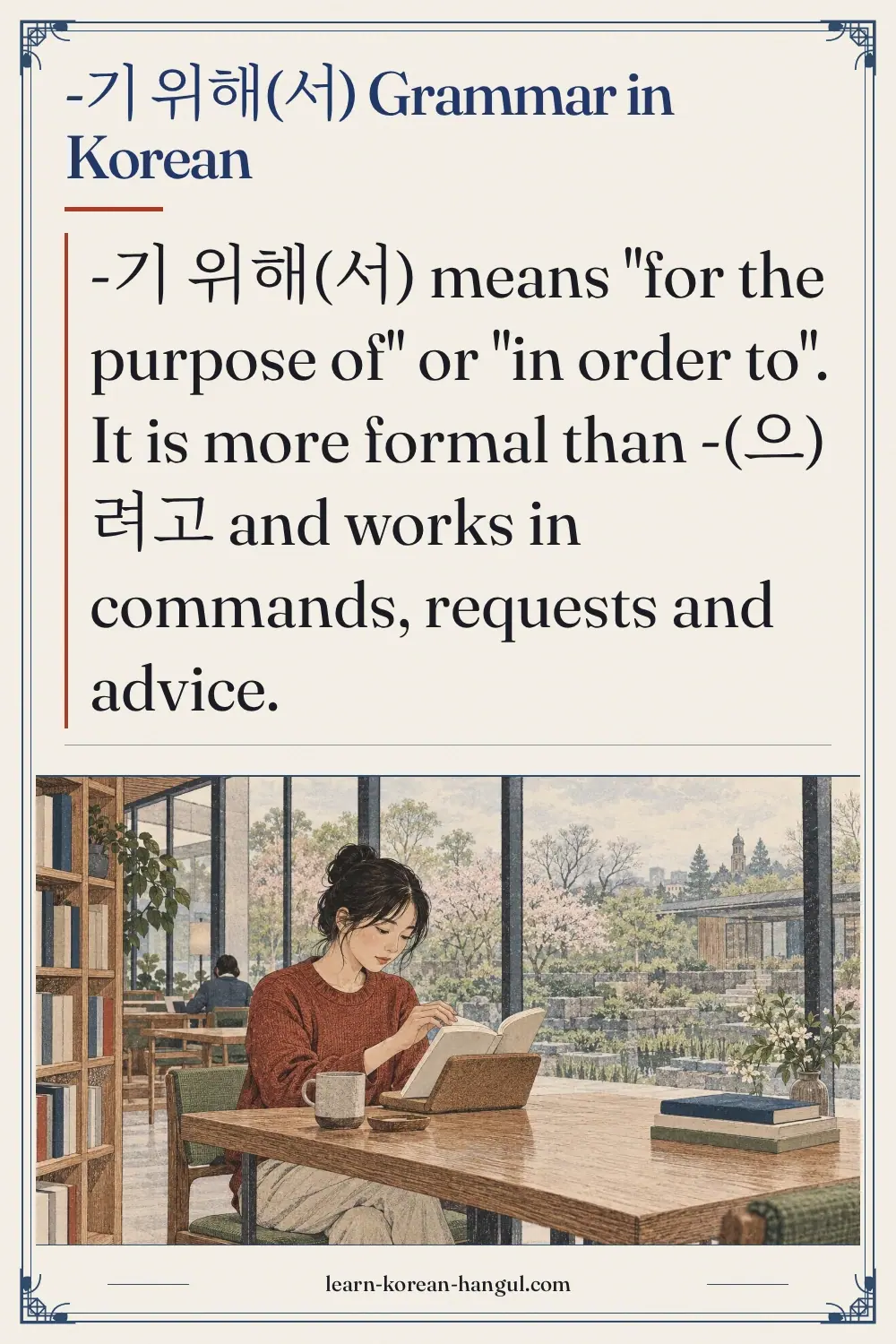
- -기 위해(서) means "for the purpose of" or "in order to". The first clause is the aim.
- Verb stem + 기 위해(서). Noun + 을/를 위해(서).
- It is more formal than -(으)려고, and the main clause can be a command or request.
- The subject is the same in both clauses, and no tense marker goes before 기.
- 위해 is a separate word. 서 is optional.
Listen to two model sentences.
The next section defines the pattern.
What Does -기 위해(서) Grammar Mean?
-기 위해(서) means "for the purpose of" or "in order to". The first clause names an aim, and the main clause names what the speaker does for it. It is a plain, respectful way to state a goal.
The pattern has two parts. 기 is a nominalizer, an ending that turns a verb into a noun-like word. 건강해지기 means "becoming healthy". 위해(서) comes from the verb 위하다, "to act for the sake of". Together they say "for the sake of becoming healthy". The nominalizer is explained on the page for the -기 nominalizer.
| Part | 건강해지기 위해서 매일 운동해요. | 꿈을 이루기 위해 노력하세요. |
|---|---|---|
| Aim | 건강해지기 위해서 (to get healthier) | 꿈을 이루기 위해 (to achieve your dream) |
| Action | 매일 운동해요 (I exercise every day) | 노력하세요 (please make an effort) |
| Spoken | [건강해지기 위해서 매일 운동해요] | [꾸믈 이루기 위해 노려카세요] |
| RR (aid) | geonganghaejigi wihaeseo maeil undonghaeyo | kkumeul irugi wihae noryeokaseyo |
| English | I exercise every day to get healthier. | Make an effort to achieve your dream. |
The 서 is optional. 위해서 and 위해 mean the same. 위해서 is a little fuller, and 위해 is a little shorter. Both are correct in speech and writing.
The next section shows how to build the form.
How Do You Form -기 위해(서)?
The form for verbs is simple. Remove 다 from the dictionary form to get the stem, then add 기 위해(서). The stem is the verb without its dictionary ending -다. For 먹다 the stem is 먹.
Most connective endings change with the last sound of the stem. They need 아/어 or 으 in some cases. -기 위해(서) does not, because 기 starts with a consonant. The stem is left exactly as it is.
| Dictionary form | Stem | Stem + 기 위해 | Spoken | RR (aid) |
|---|---|---|---|---|
| 가다 (go) | 가 | 가기 위해 | [가기 위해] | gagi wihae |
| 배우다 (learn) | 배우 | 배우기 위해 | [배우기 위해] | baeugi wihae |
| 이루다 (achieve) | 이루 | 이루기 위해 | [이루기 위해] | irugi wihae |
| 노력하다 (make an effort) | 노력하 | 노력하기 위해 | [노려카기 위해] | noryeokagi wihae |
| 만들다 (make) | 만들 | 만들기 위해 | [만들기 위해] | mandeulgi wihae |
| 먹다 (eat) | 먹 | 먹기 위해 | [먹끼 위해] | meokgi wihae |
| 읽다 (read) | 읽 | 읽기 위해 | [일끼 위해] | ilgi wihae |
| 놓다 (put) | 놓 | 놓기 위해 | [노키 위해] | noki wihae |
| 늦지 않다 (not be late) | 늦지 않 | 늦지 않기 위해 | [늗찌 안키 위해] | neutji anki wihae |
Two sound changes appear. After a final consonant such as ㄱ or ㄺ, the ㄱ of 기 is said as a tense ㄲ, so 먹기 sounds like [먹끼] and 읽기 like [일끼]. This tensing happens in speech only. Revised Romanization (RR) does not mark tensing that comes from a neighbouring sound, so it writes meokgi and ilgi. The second change is aspiration. The ㅎ of 놓, 않 and 노력하 joins the next ㄱ and makes ㅋ, so 놓기 sounds like [노키]. RR writes this aspiration in predicates, so it is noki.
Stems Ending in a Vowel
Vowel stems take 기 위해 directly: 가기 위해, 배우기 위해, 이루기 위해. For verbs made with 하다, add 기 위해 to 하.
Stems Ending in a Consonant
Consonant stems also take 기 위해 directly: 먹기 위해, 읽기 위해, 놓기 위해. There is no 으 to insert.
Irregular Stems
Irregular stems do not change before 기 위해. An irregular stem is one that changes its shape before an ending that begins with a vowel. 기 begins with a consonant, so the change never happens.
| Type | Dictionary form | With 기 위해 | Note |
|---|---|---|---|
| ㄷ-irregular | 듣다 (listen) | 듣기 위해 | ㄷ stays; compare 들어요 |
| ㅂ-irregular | 돕다 (help) | 돕기 위해 | ㅂ stays; compare 도와요 |
| ㅅ-irregular | 짓다 (build) | 짓기 위해 | ㅅ stays; compare 지어요 |
| 르-irregular | 부르다 (call) | 부르기 위해 | 르 stays; compare 불러요 |
| ㄹ stem | 살다 (live) | 살기 위해 | ㄹ stays, because 기 is not ㄴ, ㅂ or ㅅ |
| ㅡ stem | 쓰다 (write) | 쓰기 위해 | ㅡ stays; compare 써요 |
Nouns: 을/를 위해(서)
With a noun, use the object particle 을 or 를 and then 위해(서). 을 comes after a consonant, and 를 comes after a vowel. The meaning is "for the sake of" a person or a goal.
| Noun | With 을/를 위해(서) | Meaning |
|---|---|---|
| 건강 (health) | 건강을 위해 | for health |
| 가족 (family) | 가족을 위해 | for my family |
| 미래 (future) | 미래를 위해 | for the future |
| 아이들 (children) | 아이들을 위해 | for the children |
When the noun is a person, 위해서 often means "for the benefit of". 부모님을 위해서 선물을 샀어요 means "I bought a present for my parents". The same pattern can modify a noun with 위한: 건강을 위한 운동 means "exercise for health".
Adjectives and 이다 cannot take 기 위해. To say you want to reach a state, turn it into a verb with 아/어지다 ("become"): 건강하다 gives 건강해지기 위해, and 예쁘다 gives 예뻐지기 위해.
The next section builds a full sentence.
Worked Example: Building 꿈을 이루기 위해 노력하세요
Say that you tell someone to work hard to achieve a dream. Follow five steps.
- Write the aim. "To achieve a dream" is 꿈을 이루다. The verb is 이루다, "achieve".
- Find the stem. The stem is 이루. It ends in a vowel.
- Add 기 위해. 이루 + 기 위해 gives 이루기 위해. Remove any polite ending, because it belongs to the main verb.
- Write the action. "Please make an effort" is 노력하세요. The honorific 세요 makes it a polite request, which -기 위해(서) allows.
- Join the two parts. 꿈을 이루기 위해 노력하세요.
You'll know it worked when the first clause ends in 기 위해 with nothing after it, the same person is meant in both clauses, and the polite ending appears only on the last verb. Try the same steps with "I study every day to pass the exam": 시험에 합격하기 위해 매일 공부해요.
Sentence
Make an effort to achieve your dream.
Show answer
꿈을 이루기 위해 노력하세요
The next section covers tense and sentence types.
Which Tenses and Sentence Types Work with -기 위해(서)?
Tense in Korean is shown on the verb. For -기 위해(서), put the tense on the main verb at the end, not before 기.
| Slot | Form | Example | English |
|---|---|---|---|
| Present | stem + 기 위해 + present | 건강해지기 위해 운동해요. | I exercise to get healthier. |
| Past | stem + 기 위해 + past | 늦지 않기 위해 택시를 탔어요. | I took a taxi so as not to be late. |
| Future | stem + 기 위해 + future | 합격하기 위해 열심히 공부할 거예요. | I will study hard to pass. |
| Tense inside 기 | not possible | 배웠기 위해 | Wrong. |
| Statement after | any style | 매일 운동해요. | I exercise every day. |
| Question after | rising for yes/no | 합격하기 위해 공부해요? | Are you studying in order to pass? |
| Wh-question after | falling or rise-fall | 성공하기 위해서 뭘 해야 해요? | What should I do to succeed? |
| Command after | 세요 | 꿈을 이루기 위해 노력하세요. | Make an effort to achieve your dream. |
| Suggestion after | -ㅂ시다 | 건강을 지키기 위해 운동합시다. | Let's exercise to protect our health. |
The last two rows set it apart from -(으)려고, which cannot be followed by a command or suggestion. -기 위해(서) can, because it names a goal in a general way, as in advice, rules and speeches.
Yes/no questions end with a rise: 합격하기 위해 공부해요? A wh-question puts the stress on the question word and often ends with a fall or a rise-fall rather than a sharp rise: 성공하기 위해서 뭘 해야 해요?
The next section compares -기 위해(서) with its neighbours.
How Is -기 위해(서) Different from -(으)려고?
Both can be translated as "in order to", and both need the same subject. The difference is register and range.
| Pattern | Register | Command after? | Noun form | Example |
|---|---|---|---|---|
| -(으)려고 | everyday | no | no | 한국어를 배우려고 학원에 다녀요. |
| -기 위해(서) | neutral to formal | yes | 을/를 위해 | 한국어를 배우기 위해 학원에 다녀요. |
| -고자 | very formal | rare | no | 한국어를 배우고자 학원에 다닙니다. |
| -도록 | careful | yes | no | 아이가 배울 수 있도록 도와요. |
Tell the same facts with each ending. The facts are "I attend an academy" and "I learn Korean".
- 한국어를 배우려고 학원에 다녀요. The everyday sentence, said to a friend.
- 한국어를 배우기 위해 학원에 다녀요. The same meaning, a little more careful. Good in an interview or an essay.
- 한국어를 배우고자 학원에 다닙니다. Very formal, for a speech or a formal statement.
The deciding question is the register and the sentence type. If you need a command or a suggestion, choose -기 위해(서). If you are talking to a friend about your own plan, -(으)려고 is enough. If the aim belongs to someone else, choose -도록.
The next section covers set phrases and edge cases.
Variations and Edge Cases of -기 위해(서)
위해서는
Adding 는 gives a general rule: "if one is to...". 성공하기 위해서는 노력이 필요합니다 means "In order to succeed, effort is needed." This frame is common in essays, advice and exam answers.
이를 위해
이를 위해(서) means "for this purpose". It opens a sentence and points back to the previous one: 건강이 중요합니다. 이를 위해 일찍 일어납니다. ("Health is important. For this, I get up early.") It is formal and common in presentations.
위한 before a Noun
위한 turns the aim into a modifier. 건강을 위한 운동 means "exercise for health", and 공부하기 위한 방법 means "a way to study". The noun after it is the thing that serves the aim.
위하여
위하여 is the formal, written form of 위해(서). It means the same, and you will see it in laws, speeches and slogans: 평화를 위하여 ("for peace"). In conversation, speakers say 위해.
Negative Aims
To state an aim you want to avoid, put -지 않다 before 기: 늦지 않기 위해, 잊지 않기 위해. 늦지 않기 위해 택시를 탔어요 is the natural way to say that you took a taxi to be on time.
Different Subjects
The first clause keeps the same subject as the main clause. If another person reaches the aim, use -도록 (아이가 잘 수 있도록) or put that person in a noun phrase (아이를 위해). The page on -도록 covers the first option.
The next section lists the mistakes that appear most often.
What Mistakes Do Learners Make with -기 위해(서)?
Learners make six predictable mistakes. Each has a reason and a fix.
Learners often attach 기 to a noun. Actually 기 turns a verb into a noun-like word. Wrong: 건강기 위해서 운동해요. Right: 건강을 위해서 운동해요. Fix: if the aim is a noun, use 을/를 위해(서).
Learners often attach 을/를 to a verb. Wrong: 배울을 위해 학원에 다녀요. Right: 배우기 위해 학원에 다녀요. Fix: a verb needs 기, not 을/를. If you need the noun form, use the noun: 한국어 공부를 위해.
Learners often put a tense before 기. Wrong: 배웠기 위해 학원에 다녀요. Right: 배우기 위해 학원에 다녀요. Fix: the tense belongs on the main verb only.
Learners often use it for a reason. Wrong: 아프기 위해서 병원에 갔어요 (meaning "because I was sick"). Right: 아파서 병원에 갔어요. Or: 낫기 위해서 병원에 갔어요 ("I went to the hospital in order to get better"). Fix: a reason that already exists needs -아/어서.
Learners often give the two clauses different subjects. Wrong: 아이가 자기 위해 불을 껐어요. Right: 아이가 잘 수 있도록 불을 껐어요. Fix: if two different people are involved, use -도록.
Learners often write 기위해 without a space. Wrong: 배우기위해. Right: 배우기 위해. Fix: 위해 is a separate word, so a space comes before it.
The next section gives you practice.
Practice and Answers
Do the four tasks, then compare with the key.
Task 1: join the sentences with -기 위해(서). Write one sentence for each pair.
- 건강해져요. / 매일 운동해요.
- 시험에 합격해요. / 열심히 공부해요.
- 늦지 않아요. / 일찍 출발해요.
- 꿈을 이뤄요. / 노력하세요.
Task 2: fix the error. Each sentence has one mistake. Rewrite it correctly.
- 건강기 위해서 야채를 많이 먹어요.
- 한국어를 배웠기 위해 한국에 왔어요.
- 한국어를 배우기위해 학원에 다녀요.
Task 3: translate. Write in Korean: "I save money for my future." and "To succeed, we need to practise."
Task 4: write your own. Write one sentence that says why you study Korean using 기 위해(서), and one sentence that uses 을/를 위해(서) with a person.
Practice · 5
Which form is correct for the verb 배우다 (learn)?
Show answer
배우기 위해
Verb stem + 기, then 위해 as a separate word. A tense marker never goes before 기.
How do you say "for my family" with 가족 (family)?
Show answer
가족을 위해
A noun takes 을/를 위해. 기 attaches to verb stems only.
Which sentence is correct and ends with a request?
Show answer
꿈을 이루기 위해 노력하세요.
-기 위해(서) can be followed by a command or request. A tense marker never goes before 기, 러 needs a movement verb, and 기 is followed directly by 위해.
Which sentence means "In order to succeed, effort is needed"?
Show answer
성공하기 위해서는 노력이 필요합니다.
위해서는 adds 는 for a general "if one is to..." statement. The first clause stays in the bare stem form.
Which sentence uses the pattern for a reason by mistake?
Show answer
아프기 위해서 병원에 갔어요.
아프기 위해서 means "in order to be sick". The reason "because I was sick" needs 아파서.
Answer key
- (1) 건강해지기 위해서 매일 운동해요. (2) 시험에 합격하기 위해서 열심히 공부해요. (3) 늦지 않기 위해서 일찍 출발해요. (4) 꿈을 이루기 위해 노력하세요.
- (1) 건강을 위해서 야채를 많이 먹어요. (2) 한국어를 배우기 위해 한국에 왔어요. (3) 한국어를 배우기 위해 학원에 다녀요.
- 미래를 위해 돈을 모아요. 성공하기 위해서는 연습이 필요해요. Other correct versions exist.
- Sample answers: 한국 친구를 사귀기 위해 한국어를 공부해요. 부모님을 위해 요리해요. Any sentence is correct if 기 sits on a verb stem or 을/를 sits on a noun before 위해(서).
If task 1 was correct, you have the formation rule. If task 2 was hard, check whether the word before 위해 is a verb or a noun. The next section points you to what comes after this lesson.
What Should You Learn after -기 위해(서) Grammar?
After -기 위해(서), the next step is -고자, the very formal "with the aim of". To review the everyday version, go back to -(으)려고. The ending 기 itself is described on the page for the -기 nominalizer.
For a wider view, the parent page Purpose and Intention lists every connector in this group. To plan by level, use Intermediate Grammar.
This lesson covers -기 위해(서) in the polite, casual and formal styles. It does not cover every written variation. About this page. Last updated 2026-10-09. Revised Romanization follows the national rules and is shown only as a learning aid.
Frequently Asked Questions
What Does -기 위해(서) Mean?
-기 위해(서) means "for the purpose of" or "in order to". It names an aim and then the action taken for it. 건강해지기 위해서 매일 운동해요 means "I exercise every day to get healthier." It is more formal than -(으)려고, and the main clause may be a command or a suggestion.
How Do I Attach -기 위해(서) to a Verb or Noun?
For a verb, remove 다 and add 기 위해(서): 배우기 위해, 먹기 위해, 만들기 위해. For a noun, add 을/를 위해(서): 건강을 위해, 가족을 위해. Adjectives and 이다 cannot take it; use 아/어지다 to make a verb, as in 건강해지기 위해. Always write 위해 as a separate word.
Can -기 위해(서) Be Used in the past Tense?
Not inside the -기 위해(서) clause, so 배웠기 위해 is wrong. The tense goes on the main verb: 늦지 않기 위해 택시를 탔어요 means "I took a taxi so as not to be late." The aim is always something that had not happened yet when the action was taken.
Is -기 위해(서) Used in Speech or Only in Writing?
Both. It is common in speeches, news, emails, instructions and polite conversation. In relaxed talk with friends, speakers prefer -(으)려고, which is shorter. The form 위해서는 appears often in essays and advice: 성공하기 위해서는 노력이 필요합니다. Formal writing may use 위하여, which has the same meaning.
What Is the Most Common Mistake with -기 위해(서)?
The most common mistake is attaching 기 to a noun. 건강기 위해서 is wrong. With a noun, use 을/를 위해(서): 건강을 위해서. Another frequent mistake is using the pattern for a reason that already exists. 아프기 위해서 병원에 갔어요 means "I went to the hospital in order to be sick".
What Is the Difference between -기 위해(서) and -(으)려고?
Both mean "in order to" and need the same subject in both clauses. -(으)려고 is shorter and more spoken, and it cannot be followed by a command. -기 위해(서) is more formal, adds noun forms with 을/를 위해, and can be followed by commands, requests and suggestions.