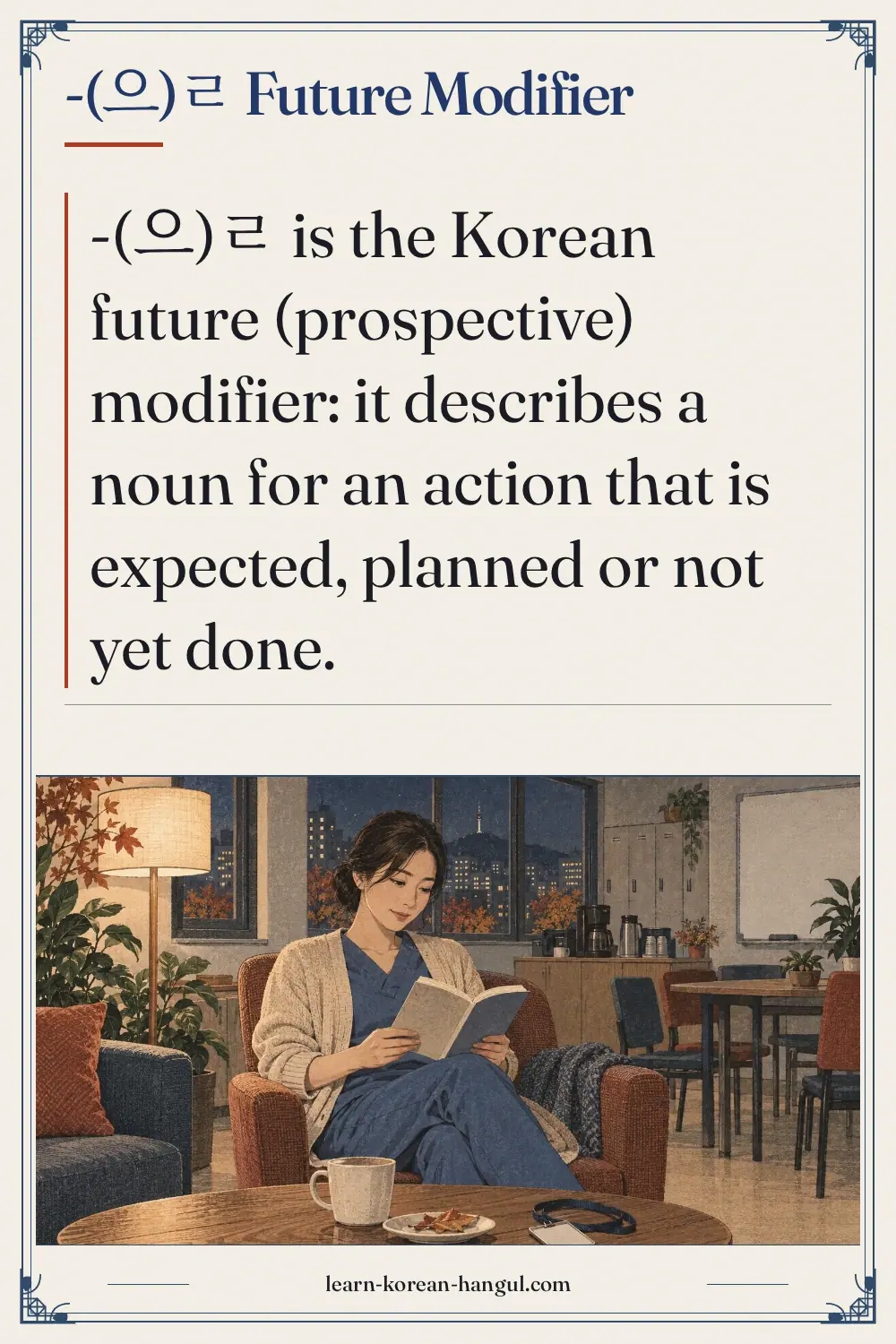
What you'll learn
- Turn verbs such as 가다, 먹다 and 만들다 into future modifiers.
- Say "a book to read" and "clothes to wear" with 읽을 책 and 입을 옷.
- Hear and say the tense consonant that follows -(으)ㄹ, as in 갈 곳 [갈꼳].
- Recognize the patterns built on -(으)ㄹ: 수 있다, 때 and 거예요.
Prerequisites: the lesson on -(으)ㄴ adjective and past modifier and the polite ending -아요/어요. Time: about 15 minutes.
Key facts
- The ending -(으)ㄹ describes a noun for an action that is planned, expected, possible or not yet done.
- It is added to the stem: 가다 becomes 갈 and 먹다 becomes 먹을.
- In English the result is usually "to + verb" (a book to read) or "that I will + verb".
- The next consonant is pronounced tense, but the spelling stays the same.
- Words such as 수, 때 and 거 need this modifier in front of them, which is why -(으)ㄹ appears in many fixed patterns.
Listen to the two model sentences for this lesson.
The next section defines the ending and shows it in two sentences.
What Is the -(으)ㄹ Future Modifier?
The -(으)ㄹ future modifier is the ending that puts a verb before a noun and points forward in time. A modifier is a form that describes a noun, and Korean always places it in front of that noun. With -(으)ㄹ, the action has not been done: it is planned, expected, wanted or possible.
The most useful English match is "to + verb". 읽을 책 is "a book to read", 마실 물 is "water to drink" and 입을 옷 is "clothes to wear". The second match is "that I will + verb": 내일 먹을 음식 is "the food I will eat tomorrow". A third use is a guess, as in 비가 올 날 ("a day when it will probably rain").
A First Example
| Part | 내일 먹을 음식이에요. | 읽을 책이 많아요. |
|---|---|---|
| Modifier | 먹을 (that I will eat), from 먹다 + 을 | 읽을 (to read), from 읽다 + 을 |
| Other words | 내일 (tomorrow) | none |
| Noun | 음식 (food), then 이에요 (it is) | 책이 (books, as the subject) |
| Predicate | 이에요 (it is) | 많아요 (there are many) |
| Spoken | [내일 머글 음시기에요] | [일글 채기 마나요] |
| RR (aid) | naeil meogeul eumsigieyo | ilgeul chaegi manayo |
| English | It is the food I will eat tomorrow. | There are many books to read. |
The next section shows how to build the form from any stem.
How Do You Form -(으)ㄹ?
The rule has two cases. A stem that ends in a vowel takes ㄹ, which joins the last syllable as a final consonant. A stem that ends in a consonant takes the syllable 을. A stem that already ends in ㄹ takes nothing at all.
| Stem type | Rule | Example | Result | Spoken |
|---|---|---|---|---|
| Ends in a vowel | add ㄹ | 가다 (go) | 갈 | as spelled |
| Ends in a vowel | add ㄹ | 마시다 (drink) | 마실 | as spelled |
| Ends in a vowel | add ㄹ | 하다 (do) | 할 | as spelled |
| Ends in a consonant | add 을 | 먹다 (eat) | 먹을 | [머글] |
| Ends in a consonant | add 을 | 읽다 (read) | 읽을 | [일글] |
| Ends in a consonant | add 을 | 앉다 (sit) | 앉을 | [안즐] |
| Ends in ㄹ | keep ㄹ, add nothing | 살다 (live) | 살 | as spelled |
| Ends in ㄹ | keep ㄹ, add nothing | 만들다 (make) | 만들 | as spelled |
| ㅂ-irregular | ㅂ becomes 우, add ㄹ | 돕다 (help) | 도울 | as spelled |
| ㄷ-irregular (verbs) | ㄷ becomes ㄹ, add 을 | 듣다 (listen) | 들을 | [드를] |
| ㅅ-irregular | ㅅ drops, add 을 | 짓다 (build) | 지을 | as spelled |
Two points save the most mistakes.
ㄹ-stems differ from -(으)ㄴ. With -(으)ㄴ the final ㄹ drops (살다 gives 산). With -(으)ㄹ the ㄹ stays, because the ending is itself ㄹ: 살다 gives 살, not 살을.
Irregular stems follow the polite ending. If a stem changes before -아요/어요, it changes before -(으)ㄹ as well. 돕다 gives 도와요 and 도울, and 듣다 gives 들어요 and 들을.
The next section explains the sound change that follows the ending.
Why Does the Consonant after -(으)ㄹ Sound Tense?
The first consonant of the next word is pronounced tense when it is ㄱ, ㄷ, ㅂ, ㅅ or ㅈ. A tense consonant is a stronger, tighter sound, written ㄲ, ㄸ, ㅃ, ㅆ and ㅉ. This is Article 27 of the Standard Pronunciation Rules (표준 발음법) of the National Institute of Korean Language (국립국어원). The spelling never changes, and the Revised Romanization does not show tensing that comes from a sound rule.
| Phrase | Spoken | RR (aid) | Meaning |
|---|---|---|---|
| 갈 곳 | [갈꼳] | gal got | a place to go |
| 먹을 것 | [머글껃] | meogeul geot | something to eat |
| 할 수 | [할쑤] | hal su | the ability to do |
| 읽을 사람 | [일글싸람] | ilgeul saram | a person who will read |
| 갈 거예요 | [갈꺼예요] | gal geoyeyo | I will go |
A word that already starts with a tense or aspirated consonant, such as 때 in 갈 때, does not change. The brackets on this page join the two words ([갈꼳]) because the two words are said as one unit.
The next section builds a full sentence step by step.
Worked Example: Building 내일 먹을 음식이에요
To say "It is the food I will eat tomorrow", start from the verb and add the ending in five steps.
- Pick the verb. The idea is "eat", so the dictionary form is 먹다.
- Take off 다. The stem is 먹-.
- Look at the last sound. The stem ends in the consonant ㄱ, so the ending is 을.
- Add the ending. 먹 + 을 gives 먹을, which means "that I will eat".
- Put the noun after it. 먹을 음식 is "food to eat". Add 내일 in front for "tomorrow", and finish with 이에요.
You'll know it worked when the modifier stands directly before the noun, and the time word 내일 stands before the modifier. The reading with 내일 is "the food that I will eat tomorrow". Without a time word, 먹을 음식 can also mean "food to eat" in general.
The next section shows the patterns that rely on this ending.
Patterns Built on -(으)ㄹ
Many common patterns are a -(으)ㄹ modifier followed by a dependent noun. A dependent noun is a noun that cannot stand alone and always needs a modifier before it. 수 ("way, possibility"), 때 ("time") and 것 ("thing") are three of them. They are listed in korean dependent nouns 것 수 때 줄 적.
| Pattern | Meaning | Example | Spoken |
|---|---|---|---|
| -(으)ㄹ 수 있다 | can, is able to | 갈 수 있어요 | [갈쑤 이써요] |
| -(으)ㄹ 때 | when | 갈 때 | as spelled |
| -(으)ㄹ 거예요 | will, probably | 갈 거예요 | [갈꺼예요] |
| -(으)ㄹ 것 같다 | it seems that | 갈 것 같아요 | [갈껃 가타요] |
The logic is literal. 갈 거예요 is "it is a thing that I will go", with 거 as the short form of 것. The future tense that this pattern creates has its own lesson at future tense -(으)ㄹ 거예요. Each dependent noun is spaced from the modifier in writing: 갈 수, 갈 거, 갈 때.
The next section compares -(으)ㄹ with the other two time endings.
How Is -(으)ㄹ Different from -는 and -(으)ㄴ?
The three endings place an action before, at or after now, and each one answers a different question. -는 is the present, -(으)ㄴ is the finished action and -(으)ㄹ is the action that has not happened.
| Ending | Time | Example | Meaning |
|---|---|---|---|
| -는 | now or habit | 가는 곳 | the place I go (or am going) |
| -(으)ㄴ | finished | 간 곳 | the place I went |
| -(으)ㄹ | not yet | 갈 곳 | the place I will go |
The side-by-side comparison with more verbs is on -는 vs -(으)ㄴ vs -(으)ㄹ. The present form has its own lesson at -는 noun modifier.
Adjectives rarely use -(으)ㄹ directly before a noun. Learners do not say 예쁠 꽃 for "a flower that will be pretty". Adjectives take -(으)ㄹ mostly inside the patterns above: 좋을 거예요 means "it will probably be good", and 추울 때 means "when it is cold". This is a natural limit of use, so the list of patterns matters more than the single form.
What this lesson does not cover. It does not cover the retrospective -던, the detailed meaning of each pattern, or the question ending -(으)ㄹ까요.
An honest limit. The boundary between a plan and a guess is set by context. 갈 곳 can mean "a place I will go" or "a place worth going", and only the sentence decides.
The next section lists the errors that appear most often.
Common Mistakes with -(으)ㄹ
Learners make six predictable mistakes. Each one has a reason and a fix.
Learners often use -는 for a plan. Actually -는 points to a routine or something happening now, and -(으)ㄹ is the natural choice for a plan. Weak: 내일 먹는 음식 for "the food I will eat tomorrow". Better: 내일 먹을 음식. Fix: when the action has not happened yet, choose -(으)ㄹ.
Learners often put ㄹ alone on a consonant stem. Actually a consonant stem needs the full syllable 을. Wrong: 먹ㄹ 음식, 읽ㄹ 책. Right: 먹을 음식, 읽을 책. Fix: only a vowel stem takes the single consonant ㄹ.
Learners often add 을 to an ㄹ-stem. Actually the stem already ends in ㄹ. Wrong: 살을 집, 만들을 음식. Right: 살 집, 만들 음식. Fix: leave an ㄹ-stem as it is.
Learners often keep the ㅂ of an irregular stem. Actually irregular stems rebuild. Wrong: 돕을 사람. Right: 도울 사람. Fix: build the polite form first; if the stem changes there, it changes here.
Learners often join the dependent noun to the modifier. Actually the two are written as separate words. Wrong: 갈수 있어요, 갈꺼예요. Right: 갈 수 있어요, 갈 거예요. Fix: write the two words separately, as the spelling shows, and keep the tense sound for speech only.
Learners often use -(으)ㄹ for something already done. Actually a finished action needs -(으)ㄴ. Wrong: 어제 읽을 책 for "the book I read yesterday". Right: 어제 읽은 책. Fix: look at the time word. 어제 points back, so use -(으)ㄴ.
Practice turns these rules into habits, as the next section shows.
Practice and Answers
Complete the four tasks, then compare your answers with the key.
Task 1: choose the form. Write the -(으)ㄹ form of each word before the noun.
- 가다 (go) + 곳
- 마시다 (drink) + 물
- 만들다 (make) + 음식
- 읽다 (read) + 책
Task 2: fix the error. Each phrase has one mistake. Rewrite it correctly.
- 먹ㄹ 것
- 살을 곳
- 돕을 사람
Task 3: translate. Write in Korean: "There are many books to read." and "I have nothing to wear."
Task 4: write your own. Name one place you plan to go this week using 갈 곳 or a similar phrase.
Sentence
It is the food I will eat tomorrow.
Show answer
내일 먹을 음식이에요
Practice · 5
Which phrase means "water to drink"?
Show answer
마실 물
마시다 ends in a vowel, so -(으)ㄹ adds only ㄹ. The result 마실 points forward: water to drink.
Which form of 살다 (live) goes before 곳 to mean "a place to live"?
Show answer
살
An ㄹ-stem keeps its ㄹ and adds nothing before -(으)ㄹ.
Which form of 돕다 (help) is correct before 사람?
Show answer
도울
돕다 is ㅂ-irregular. The ㅂ becomes 우, and then ㄹ is added.
How is 갈 곳 usually pronounced?
Show answer
[갈꼳]
After -(으)ㄹ the next ㄱ, ㄷ, ㅂ, ㅅ or ㅈ is tense, and the final ㅅ is pronounced [ㄷ].
Which phrase is the standard way to write "I can go"?
Show answer
갈 수 있어요
수 is a dependent noun and is written as a separate word. Only the pronunciation is tense.
Answer key
- (1) 갈 곳 (2) 마실 물 (3) 만들 음식 (4) 읽을 책.
- (1) 먹을 것 (2) 살 곳 (3) 도울 사람.
- 읽을 책이 많아요. 입을 옷이 없어요.
- Sample answers: 이번 주에 갈 곳은 부산이에요 ("The place I will go this week is Busan."), 갈 곳이 없어요 ("I have nowhere to go."). Any -(으)ㄹ phrase before a noun is correct.
If task 1 was correct, you have the formation rule. If task 2 was difficult, return to the table of stem types. The next section points you to the lessons that follow.
Next Lessons after the -(으)ㄹ Future Modifier
After the -(으)ㄹ future modifier, read -는 vs -(으)ㄴ vs -(으)ㄹ for the full comparison of the three time endings. The retrospective modifier -던, which looks back on an unfinished action, is a later B2 topic.
The parent page, Noun-Modifying Forms, lists every lesson in learning order. For the patterns that grew out of this ending, start with future tense -(으)ㄹ 거예요.
This lesson covers the form, the tensing rule and the main patterns. It does not cover -던 or the question ending -(으)ㄹ까요. About this page. Last updated 2026-10-09. The Korean text and spoken forms on this page were generated with AI assistance. Romanization follows the Revised Romanization of Korean and is shown only as a learning aid.
Frequently Asked Questions
What does -(으)ㄹ mean? -(으)ㄹ is an ending that lets a verb describe a noun for an action that has not happened yet. 먹을 음식 means "food to eat" or "food I will eat", and 갈 곳 means "a place to go". It can also show a guess or a plan, so 비가 올 날 means "a day when it will rain".
How do I form -(으)ㄹ? Add ㄹ to a stem that ends in a vowel and 을 to a stem that ends in a consonant. 가다 gives 갈, and 먹다 gives 먹을. A stem that ends in ㄹ keeps it and adds nothing, so 살다 gives 살 and 만들다 gives 만들. Irregular stems rebuild first: 돕다 gives 도울, and 듣다 gives 들을.
What is the most common mistake with -(으)ㄹ? The most common mistakes are using -는 for a planned action, as in 내일 먹는 음식, and adding 을 to an ㄹ-stem, as in 살을 곳. For a plan use -(으)ㄹ, so the phrase is 내일 먹을 음식. An ㄹ-stem needs no extra 을, so the phrase is 살 곳 ("a place to live").
How is -(으)ㄹ different from -는 and -(으)ㄴ? The three endings mark time for action verbs. -는 is the present (먹는 음식, food I eat), -(으)ㄴ is the past (먹은 음식, food I ate) and -(으)ㄹ is the future (먹을 음식, food I will eat or food to eat). Only -(으)ㄹ also sets up patterns such as 갈 수 있다 and 갈 거예요.
Do I use -(으)ㄹ in speech, writing or both? Both. -(으)ㄹ appears in everyday speech and in writing at every level, because it is part of patterns such as -(으)ㄹ 수 있다 ("can") and -(으)ㄹ 때 ("when"). In speech the next consonant is pronounced tense, so 갈 거예요 sounds like [갈꺼예요], but the spelling never changes.