
The Standard Pronunciation Rules (표준 발음법) are official Korean language regulations that define how Standard Korean is pronounced, in 30 numbered articles. They explain, for example, why 국물 is said [궁물] and 같이 [가치]. This site follows them for every pronunciation it gives.
Standard Pronunciation Rules in Korean
The Standard Pronunciation Rules turn the idea of Standard Korean into concrete sound rules. Article 1 sets the principle: follow the actual pronunciation of the standard language, while considering the tradition and logic of Korean. Each later article states one rule and lists example words.
| Chapter | Topic | Articles | Lessons on this site |
|---|---|---|---|
| 1 | General principle | 1 | this page |
| 2 | Consonants and vowels | 2–5 | vowel and consonant lessons |
| 3 | Vowel length | 6–7 | vowel length |
| 4 | Final consonants (batchim) | 8–16 | the seven final sounds, liaison |
| 5 | Assimilation | 17–22 | palatalization, nasalization, liquidization |
| 6 | Tensification | 23–28 | tensification |
| 7 | Sound insertion | 29–30 | ㄴ insertion, 사이시옷 |
The full set of lessons is grouped under Korean pronunciation rules.
How Are the Articles Cited?
Articles are cited by number with 제 … 항: 표준 발음법 제18항 means Article 18. A fuller citation names the parent document: 표준어 규정 제2부 표준 발음법 제18항. In English, this site writes "Article 18 of the Standard Pronunciation Rules".
Standard Pronunciation Rules vs Hangul Orthography
The nearest confusable term is Hangul Orthography (한글 맞춤법), the official spelling rules. The two documents work as a pair: one fixes how a word is written, the other how it is said.
| Feature | Standard Pronunciation Rules (표준 발음법) | Hangul Orthography (한글 맞춤법) |
|---|---|---|
| Governs | how words sound | how words are spelled |
| Example | 국물 is said [궁물] | 국물 is written 국물, not 궁물 |
| Official text | Part 2 of the Standard Language Regulations | a separate regulation |
| Where learners see it | bracketed forms such as [궁물] | dictionary headwords |
Neither one is Revised Romanization, which only sets Latin spellings.
What Are Examples of Standard Pronunciation Rules?
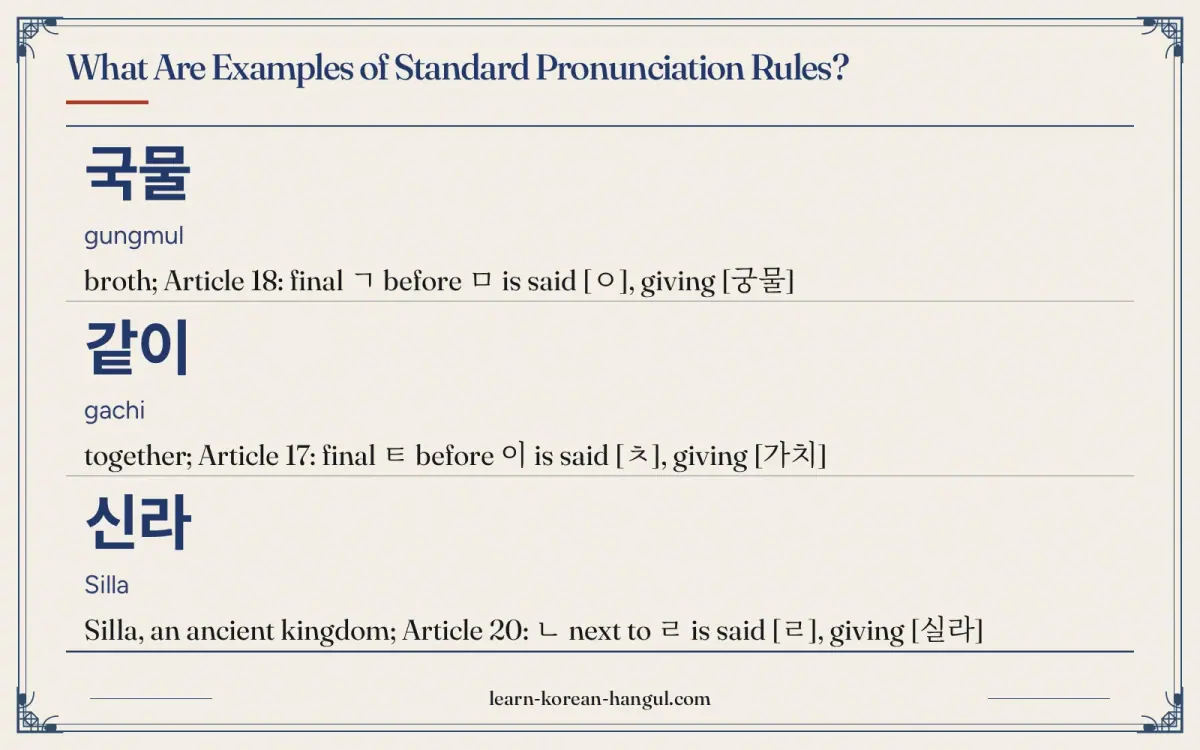
Three everyday words show three different articles at work.
국물
gungmul
broth; Article 18: final ㄱ before ㅁ is said [ㅇ], giving [궁물]
같이
gachi
together; Article 17: final ㅌ before 이 is said [ㅊ], giving [가치]
신라
Silla
Silla, an ancient kingdom; Article 20: ㄴ next to ㄹ is said [ㄹ], giving [실라]
In each case the spelling stays the same and only the pronunciation changes.
What Do Learners Get Wrong about Standard Pronunciation Rules?
Learners often assume the rules describe how everyone talks. Actually, they set a standard. The rules (Article 4) still list ㅐ and ㅔ as two vowels, but most Seoul speakers today pronounce them the same, and most also ignore the vowel length described in Chapter 3.
Learners also assume each word has exactly one correct form. Some articles allow two: Article 5 accepts both [시계] and [시게] for 시계 (clock). This site gives the first form and notes the second, and its audio methodology explains how recordings follow the rules.
Frequently Asked Questions
What are the Standard Pronunciation Rules? The Standard Pronunciation Rules are the official regulations for pronouncing Standard Korean. They form Part 2 of the Standard Language Regulations (표준어 규정) and contain 30 articles in 7 chapters. They tell you, for example, that 국물 is pronounced [궁물] and that a final ㅅ is said [ㄷ]. Dictionaries and teachers use them as the reference.
Who publishes the Standard Pronunciation Rules? The rules were announced by South Korea's Ministry of Education in 1988 and took effect in 1989. Today the National Institute of Korean Language (국립국어원), under the Ministry of Culture, Sports and Tourism, maintains the text and publishes it online with explanations. The institute's Standard Korean Language Dictionary shows the pronunciation of words according to these rules.
Does everyone follow the Standard Pronunciation Rules? No. The rules describe a standard, not every speaker. Regional dialects follow their own patterns, and even many Seoul speakers no longer keep the vowel-length differences in Chapter 3. Broadcasters, teachers and dictionaries follow the rules closely. For learners, the standard is the safest target because it is understood everywhere in Korea.
Are the Standard Pronunciation Rules the same as Revised Romanization? No. The Standard Pronunciation Rules describe how Korean sounds; Revised Romanization (국어의 로마자 표기법) describes how to write Korean in Latin letters. Romanization is partly based on pronunciation, so 신라 is written Silla after the rule that gives [실라], but it ignores some sound changes, such as tensification.
Related Terms and Lessons
The wider policy is described in the language standards this site follows. Every sound term is listed in the Korean Pronunciation Glossary. In short, the standard pronunciation rules are the reference behind every bracketed pronunciation on this site.