
The best app for Korean speaking practice is the type that gives you the feedback you lack: tutors correct you, exchange partners give volume, AI partners give availability and pronunciation tools give targeted checks. This page compares five ways to practise speaking, names well-known apps for each, gives each an honest drawback and ends with a 20-minute first session you can run at A1, A2 or B1. It uses no ratings, scores or affiliate links.
Key facts
- Feedback is the key criterion: speaking without correction can repeat errors.
- AI partners need testing: they can accept wrong Korean and invent explanations.
- Exchange apps need basic safety habits, given in this page.
- No app replaces speaking with a person who can follow an unplanned conversation.
Last updated: 2026-10-09.
Best App for Korean Speaking Practice: the Essentials
Choose the partner type before you choose the app, because the types do different jobs. A tutor is a trained person who corrects you and plans lessons. An exchange partner is a learner of your language who wants to practise yours, so you take turns. An AI partner is a chatbot that talks with you at any hour. A pronunciation check is a tool, such as your phone's dictation, that tells you whether your speech was understood. Solo recording costs nothing and trains your mouth, but it gives no feedback from anyone else.
Our top picks
| Situation | Pick | Why |
|---|---|---|
| Best for correction | A tutor, booked through a marketplace such as italki or Preply | A trained person notices and explains your errors |
| Best for free volume | An exchange app such as HelloTalk or Tandem | Real people, at no cost, whenever both are free |
| Best for availability | An AI partner | Ready at any hour, with no scheduling |
These are editorial judgements based on the checks below, not scores. Each type has a drawback, given in its section. The Korean tutors and classes hub covers tutors in more depth, and Korean speaking practice shows how to practise aloud alone.
How Did We Choose?
We compared each type on six criteria, listed from the most important to the least. The page does not run hands-on tests and gives no scores. It compares what the publishers say in their public descriptions and what is widely known about each type, and it asks you to check the current details in the store.
- Quality of correction feedback. Does anyone tell you what was wrong, why and how to fix it?
- Availability. Can you practise at 2 a.m. or only at a booked time?
- Cost per hour. What do you pay, and what does a paid plan add?
- Structure. Do you get a lesson plan, or is it free chat?
- Pronunciation analysis. Does the tool tell you about sounds, not just words?
- Privacy and safety. What do you share, and with whom?
A type that wins on one criterion usually loses on another. A tutor wins on feedback but loses on availability and cost. An AI partner wins on availability but needs checking on feedback. That is why the section "Which should you pick?" combines two types.
1. Tutor Marketplaces (italki, Preply): Best for Correction
A tutor is the best way to get correction, because a trained person hears your errors and explains them. Specs: paid, per lesson; you book a time; tutors set their own prices.
Marketplaces such as italki and Preply list tutors, with profiles, reviews and a calendar. You can choose a tutor for conversation, for exam preparation or for beginners, and many offer a trial lesson, which you can use to see whether you like their style. A tutor can give you a plan, set homework and track your progress.
The drawback is cost and scheduling. You pay for each lesson, prices vary widely by tutor, and you must keep to a booked time. Quality also varies between tutors, so read profiles and use a trial lesson before you pay for a block of them.
Choose it if you want correction and a plan. Skip it if your budget is zero or your schedule changes daily.
2. Exchange Apps (HelloTalk, Tandem): Best for Free Volume
Exchange apps are the best for free volume, because you chat or talk with real people who want to learn your language. Specs: free to use with optional paid features; text, voice and sometimes video; you find your own partners.
In an exchange, you spend half the time on Korean and half on your partner's language, such as English. HelloTalk and Tandem are two well-known apps of this kind. Some include tools to correct a message in the chat, which gives feedback at no cost. Read the whole language exchange guide for how to run an exchange well.
The drawback is inconsistency. Partners may disappear, may not correct you, may want to practise only English or may be at a different level. Few exchange partners are trained teachers, so explanations can be wrong. Safety also needs care; see the safety section below.
Choose it if you want free conversation and have the patience to find a good partner. Skip it if you need structured lessons or reliable correction.
3. AI Chat Assistants: Best for Availability and Rehearsal
An AI partner is the best for availability, because it is ready at any hour and does not mind repetition. Specs: free tiers and paid plans vary by tool; text, and in some tools voice; no scheduling.
You can ask an AI to play a shop assistant, a classmate or a taxi driver, and rehearse a conversation as many times as you like. It is a good place to try new sentences without feeling shy. For prompts that work, read learn Korean with ChatGPT and AI.
The drawback is reliability. An AI can accept a wrong sentence as correct, can give a confident but wrong explanation, and may be too agreeable to challenge you. Its quality differs by tool and changes when the tool is updated, so test it yourself instead of trusting a claim. A simple test: type 어제 친구를 만나요, which is wrong because the past tense is needed for "yesterday", and ask the tool to correct it. A good tool changes it to 어제 친구를 만났어요 and says why. Ask the same question twice, and see whether the answers agree. If a tool fails, do not use it for corrections.
Choose it if you want rehearsal at any time, and you check its corrections. Skip it if you want a guarantee that corrections are right.
4. Pronunciation Checks: Best for a Quick Sound Test
A pronunciation check is the best for a quick test of whether you can be understood. Specs: free if you use your phone's dictation; some language apps include a speaking exercise.
Say a sentence into your phone's Korean dictation. If the text that appears matches what you meant, your speech was clear enough for the machine. If it shows a different word, listen to your recording and find the sound that differed. Speaking exercises in language apps work in a similar way, by comparing what you said with the expected text.
The drawback is depth. The tool tells you that something was unclear but not which sound caused it or how to fix it. A machine can also guess a word from context, so it may write the right word from a poor pronunciation. Treat it as a quick check and not as a teacher.
Choose it if you want a free, instant check of the words you practise. Skip it if you need an explanation of what to change.
5. Solo Recording and Shadowing: Best for Free Practice Anywhere
Solo practice is the best for free practice anywhere, because you need only a voice recorder. Specs: free; use your phone's recorder; no partner needed.
Shadowing means listening to a short Korean clip and repeating it at the same time or just after it. You then record yourself and compare. The shadowing lessons on this site give scripted sets with steps for this method. Recording yourself builds the habit of noticing differences, which is the first step to correcting them.
The drawback is that no one tells you what is wrong. You must hear the differences yourself, and early on that is difficult, so combine solo practice with one of the other types.
Choose it if you want a free daily habit. Skip it if you need an outside opinion on your Korean.
Which Gives the Best Corrections?
A trained tutor gives the best corrections, because a tutor hears the pattern in your errors and can explain it. Exchange partners can correct you, but their explanations vary. AI partners can correct written sentences quickly, but their accuracy needs checking. Pronunciation checks flag a problem without explaining it. Solo recording gives none unless you compare with a model.
To get the most from any correction, keep an error log. Each time you are corrected, write three things: what you said, the corrected form and the rule in one line. Then turn the best ones into flashcards. Here is one entry:
| What I said | Corrected form | Rule |
|---|---|---|
| 어제 친구를 만나요 | 어제 친구를 만났어요 | Use the past tense for a finished event such as "yesterday" |
Add the corrected sentence to a flashcard deck, and say it aloud each time you review it. After a month, you will see which errors repeat, and you can ask your tutor to work on those.
어제 친구를 만났어요.
eoje chingureul mannasseoyo
I met a friend yesterday.
Which Is Cheapest?
From cheapest to dearest, the usual order is solo recording, a pronunciation check with your phone, exchange apps, AI partners and tutors. The first two are free. Exchange apps are usually free, with optional paid features. AI partners range from free tiers to paid plans. Tutors are paid by the lesson, and the price depends on the tutor and the platform, so compare several profiles and a trial lesson instead of trusting a single figure. Prices change, so check them before you pay.
Free does not mean best. A free exchange partner who never corrects you costs time and not money, and a tutor who fixes one repeated error can save weeks.
Best for Beginners
Beginners do best with a tutor or a structured lesson, because a beginner does not yet know enough to practise alone or to judge corrections. Start with the alphabet and a few phrases from your first lessons. Learn to read Hangul before you start a conversation app, since you will need to read the chat. Then book one trial lesson with a tutor who teaches beginners, and practise the same phrases with an AI partner in between.
An exchange partner is harder at the very start, because many partners expect you to be able to write a simple sentence. Wait until you can introduce yourself and ask two questions.
A 20-Minute First Session
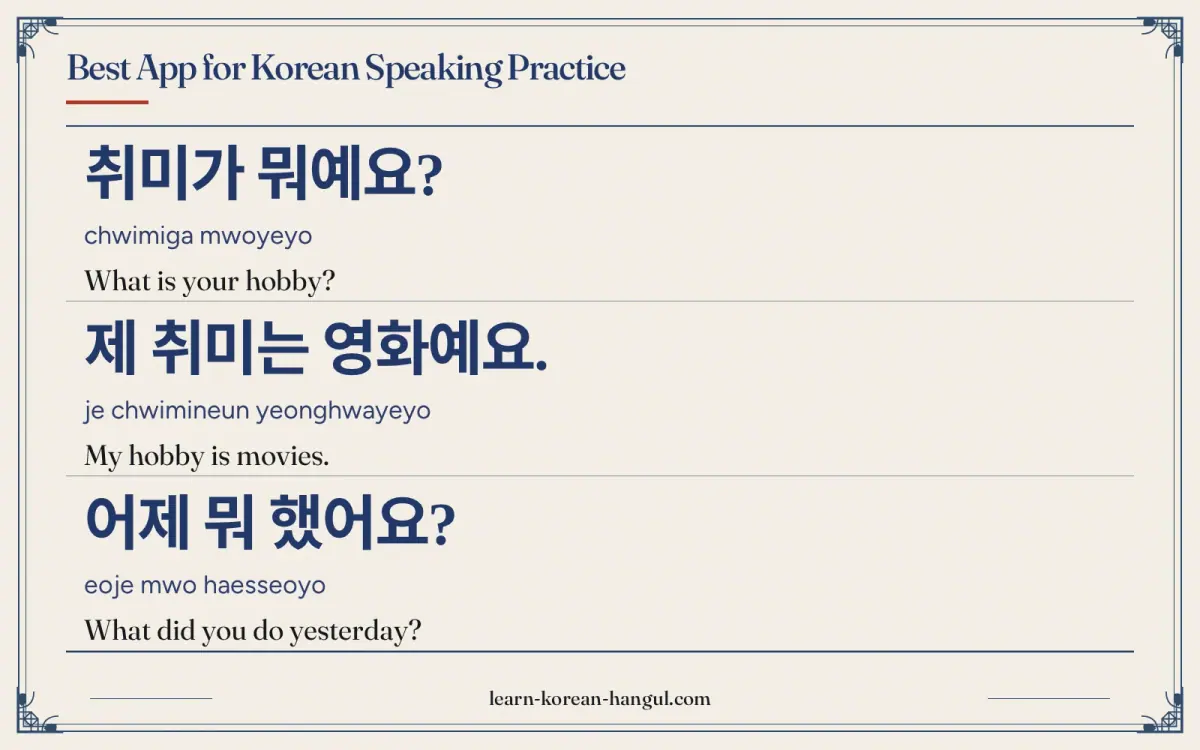
Use this script with a tutor, an exchange partner or an AI partner. It has four parts: 2 minutes of warm-up, 6 minutes of prompts, 8 minutes of conversation and 4 minutes of corrections, which makes 20 minutes. Start at your level and move up when the prompts feel easy.
| Level | Prompt (your partner asks) | Sample answer |
|---|---|---|
| A1 | 취미가 뭐예요? | 제 취미는 영화예요. |
| A2 | 어제 뭐 했어요? | 어제 친구를 만났어요. |
| B1 | 주말에 보통 뭐 하세요? | 주말에는 보통 집에서 쉬어요. 가끔 친구를 만나요. |
A question word such as 뭐 already marks a question, so the tone does not need to rise at the end. Put the stress on 뭐 and let the end fall, or rise and then fall.
취미가 뭐예요?
chwimiga mwoyeyo
What is your hobby?
제 취미는 영화예요.
je chwimineun yeonghwayeyo
My hobby is movies.
어제 뭐 했어요?
eoje mwo haesseoyo
What did you do yesterday?
주말에 보통 뭐 하세요?
jumare botong mwo haseyo
What do you usually do on weekends?
The spoken forms are [어제 뭐 해써요] for the second prompt and [주마레는] for the first part of the B1 answer. Use these steps for the session:
- Warm up (2 minutes). Greet and introduce yourself: 안녕하세요? 저는 민수예요.
- Prompts (6 minutes). Answer two or three prompts for your level.
- Conversation (8 minutes). Ask your partner the same questions, and follow up with 왜요? (why?).
- Corrections (4 minutes). Ask for the three most important corrections, and write them in your error log.
Three Phrases That Keep a Conversation Going
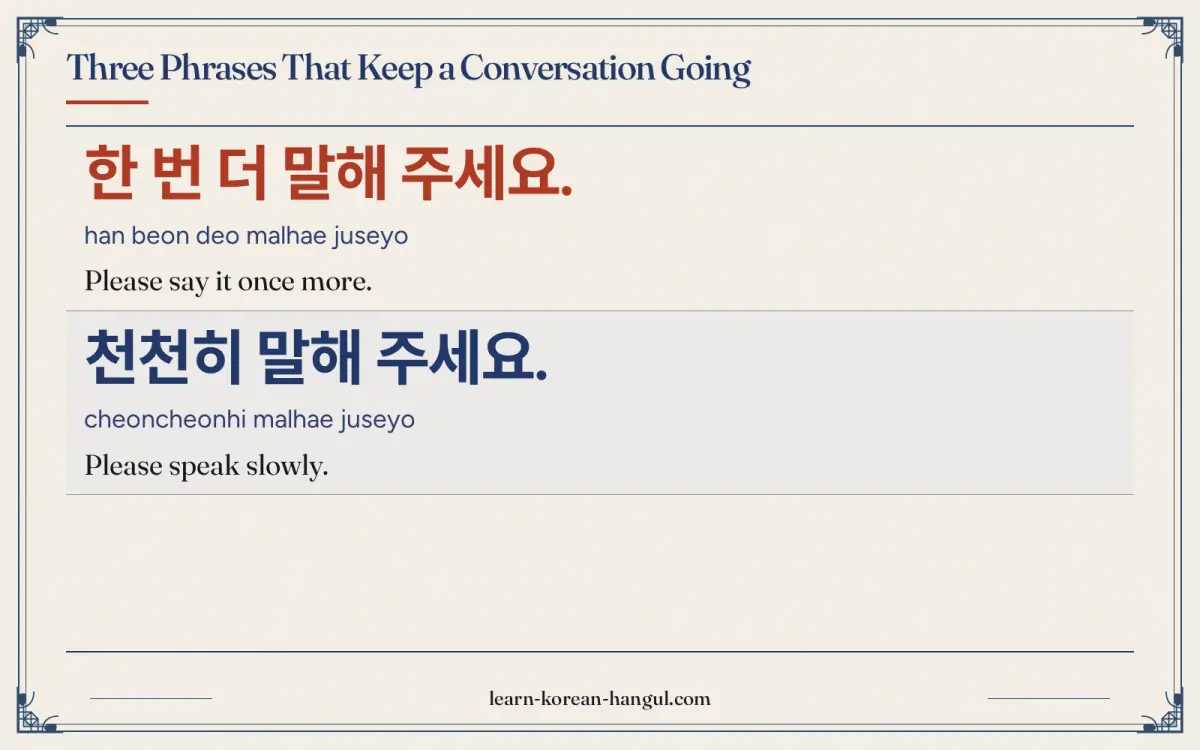
Beginners often freeze when they do not understand. Learn three repair phrases before the first session, and use them as often as you need. They work with any partner, human or AI, and they show that you are in charge of the pace.
| Phrase | Revised Romanization | Meaning |
|---|---|---|
| 한 번 더 말해 주세요. | han beon deo malhae juseyo | Please say it once more. |
| 천천히 말해 주세요. | cheoncheonhi malhae juseyo | Please speak slowly. |
| 무슨 뜻이에요? [무슨 뜨시에요] | museun tteusieyo | What does it mean? |
The last phrase is spoken with the final ㅅ of 뜻 moving to the next syllable, so 뜻이에요 sounds like [뜨시에요]. Because 무슨 is a question word, the question does not need a rising tone. Say the phrases aloud five times each before the session, so that they come out without thought.
How to Prepare so That 20 Minutes Is Enough
A short session is productive when you arrive with a plan. A tutor, a partner or an AI cannot help you with what you have not decided to practise. Spend five minutes before each session on three things.
- Choose one topic. Pick a small, concrete topic such as your hobby, your weekend or your food. Narrow topics let you reuse words.
- Write five sentences. Write the sentences you would like to be able to say, then check them in a dictionary. Bring them to the session and say them aloud.
- List two questions. Prepare questions for your partner, such as 취미가 뭐예요? These keep the conversation moving when you run out of things to say.
After the session, spend five minutes on the error log. Together, that is a 30-minute routine around a 20-minute session. If you do this once a week, you add about two hours of focused speaking work a month (4 sessions × 30 minutes), which is more useful than occasional long, unprepared chats.
How Often and for How Long?
Short, regular sessions beat rare long ones. A good target for most learners is two or three speaking sessions a week, and each can be 20 minutes. Two sessions give 40 minutes a week, three give 60 minutes, and either adds up to about 2 to 4 hours of speaking in a month (40 minutes × 4 weeks is 160 minutes, or 2 hours 40 minutes). Add daily solo practice of five minutes, such as reading five sentences aloud, and your mouth gets more exercise than any single weekly lesson can give.
Do not wait until you feel ready. At A1, you can already say your name, ask a question and answer 취미가 뭐예요? with one sentence. Early sessions will be slow and full of pauses, and that is normal. The aim is to produce Korean aloud, not to produce it perfectly.
What to Do with a Correction
A correction helps only if you use it. When a tutor, a partner or an AI corrects you, follow three steps.
- Repeat the corrected sentence aloud, at least twice, straight away. Saying it fixes it in your mouth.
- Ask why, if the reason is not clear. A rule you understand lasts longer than a form you copy.
- Write it in the error log and turn it into a card. Then check in a week whether you still make the same error.
Be careful when two sources disagree. A tutor, a dictionary and the lessons on this site count for more than a single chat partner or an AI answer. If you are unsure, look the form up in the Standard Korean Language Dictionary (표준국어대사전) from the National Institute of Korean Language, or ask a second source.
Safety Basics for Exchange and Online Tutors
A few habits keep online practice safe.
- Keep personal details private. Do not share your home address, phone number, passwords, bank details or workplace until you know someone well, and perhaps never.
- Stay on the platform. Keep chats and payments inside the app, so that its reporting and refund tools can help.
- Expect mixed motives. Some people on exchange apps look for dating or sales instead of language practice. You may end a chat at any time, and you can block and report anyone who is rude or pushy.
- Meet in public. If you decide to meet a partner, choose a public place and tell a friend.
- Check privacy settings. Voice and text may be stored. Read the privacy notice, and do not share anything with an AI tool that you would not want stored.
Which Should You Pick?
Match your situation to a pick.
- You want fast progress and have a budget. Book a tutor once a week, and practise the same material with an AI partner between lessons.
- You have no budget. Use an exchange app and solo recording, and keep an error log.
- You are an absolute beginner. Book a trial lesson with a beginner tutor after your first Hangul lessons.
- You are shy. Rehearse with an AI partner, then move to a tutor, who is trained to be patient.
- You want to check pronunciation. Use phone dictation on sentences you have practised.
Apps are not the only choice. A tutor or class may suit you better, so look at the Korean tutors and classes hub.
Frequently Asked Questions
Can an AI replace a speaking partner? Not fully. An AI partner is available at any hour and lets you rehearse without pressure, but it can accept wrong sentences, give wrong explanations and follow your lead instead of changing the topic as a person would. Use it for rehearsal and check its corrections with a tutor, a dictionary or an exchange partner.
How much do tutors cost? Tutors set their own prices, and the price depends on the tutor's experience and on the platform, so no single figure fits. Compare several profiles, ask about a trial lesson and check the current price on the platform before you book. Cost is the main drawback of this option.
Which is best for beginners? A tutor or a structured lesson. A beginner benefits from correction and a plan, and does not yet know enough to judge an AI's answers or to carry an exchange chat. Learn Hangul and a few phrases first, then book a trial lesson.
Can I practise speaking alone? Yes. Read sentences aloud, shadow short clips and record yourself. You can check your speech with your phone's dictation. The weakness of solo practice is the lack of outside feedback, so add a tutor or partner now and then.
Are speaking apps suitable for absolute beginners? Yes, if you choose the right type. Tutor lessons suit absolute beginners well. Exchange apps work better once you can introduce yourself and ask two or three questions, and AI partners work best after you can read Hangul and check the replies.