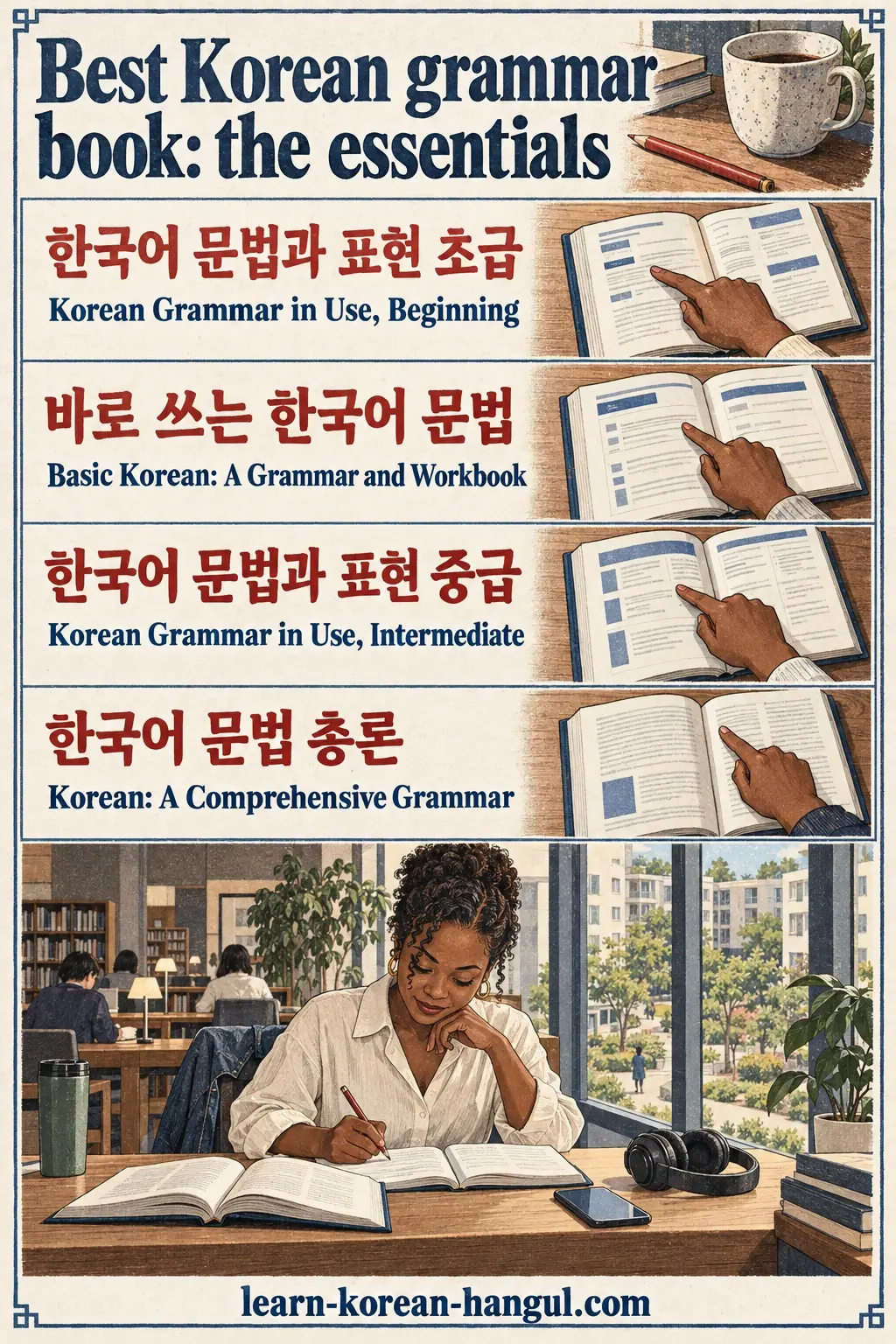
The best Korean grammar book is a reference that explains each pattern with examples and contrasts near-synonyms, and different books suit beginners, intermediate learners and TOPIK candidates. This page compares six grammar books and series on explanation clarity, examples, contrast of similar patterns, exercises and level coverage. It gives a two-pattern test you can run in any bookshop or library, explains the difference between a reference and a workbook, and recommends a book for each situation.
Last updated: 2026-10-09. Titles, editions and prices change. Check the publisher's page for the edition you plan to buy. This page has no scores and no affiliate links.
Best Korean Grammar Book: the Essentials
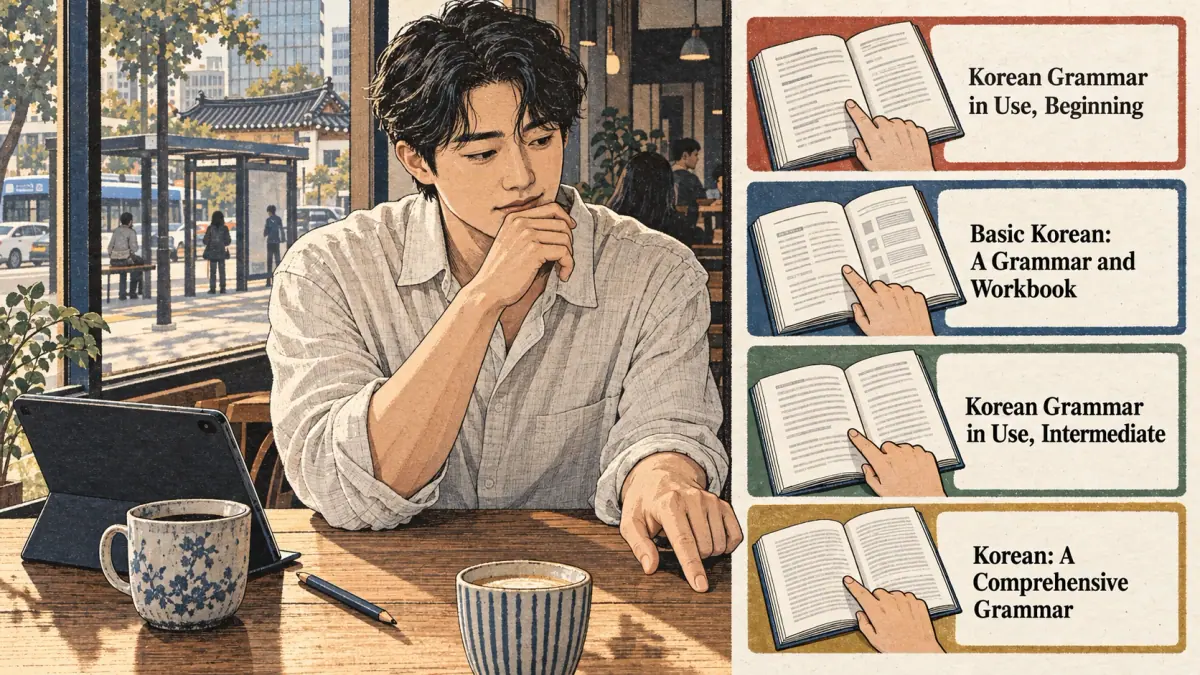
Top picks, by situation. Each pick is the book that fits one situation, not a ranked score.
| Situation | Book to look at first | Why | Drawback |
|---|---|---|---|
| You are learning from beginner level and want a look-up book | Korean Grammar in Use, Beginning | One pattern per spread, with examples and exercises | Few real conversations; it is a reference, not a course |
| You want a grammar book that also has a workbook feel | Basic Korean: A Grammar and Workbook, and its Intermediate companion | A lesson-style grammar with exercises in English | Fewer patterns than a dedicated pattern dictionary |
| You are intermediate and want to contrast similar patterns | Korean Grammar in Use, Intermediate | Contrasts near-synonyms and lists related patterns | Dense; some explanations expect a teacher |
| You are advanced or a teacher | Korean: A Comprehensive Grammar | Complete, with linguistic terms | Far too dense for a beginner |
| You want a conversational explanation style | Talk To Me In Korean grammar books | Short, friendly notes in English | Smaller coverage than a pattern dictionary |
How many were compared, and on what basis: six books or series, on six criteria, using the publishers' descriptions and sample pages, checked on 2026-10-09. The answer people ask for on forums, "which grammar book is best?", has two parts. For learners at beginner and intermediate level, the usual answer is Korean Grammar in Use, because it is organised for look-up and has the most levels. For other needs, another book fits better, as the table shows.
How Did We Choose?

A grammar book is a tool for looking things up and practising. These six criteria show which tool is better for you.
- Pattern coverage by level. Does the book cover the patterns you meet at your stage, and does it say which level each belongs to?
- Clarity of English explanations. Can you understand the note without a teacher? Short sentences, defined terms and an example after each claim are the signs.
- Number of examples per pattern. Two examples are thin. Four to six with translations let you see the pattern in several contexts.
- Contrast of similar patterns. Korean has many near-synonyms. A good book tells you how they differ and when each is used.
- Exercises and an answer key. Practice with a key turns a reference into a study tool.
- Edition currency. A recent edition is likely to have clearer layout and updated examples.
The Two-Pattern Test
You can compare any two books in ten minutes. Look up the same two things in each.
Test 1: the because-patterns. Korean has two common ways to say "because": -아/어서 and -(으)니까. Look both up and ask: does the book say that the clause with -아/어서 cannot be followed by a command or a suggestion, while the clause with -(으)니까 can? That one rule explains a very common mistake: 공부해서 피곤해요 (gongbuhaeseo pigonhaeyo), "I am tired because I studied," is a fine sentence, but a sentence that ends in a command after -아/어서, such as *비가 와서 집에 가세요, is ungrammatical. (The * marks a wrong sentence.) If the book does not warn you, it is not contrasting well.
Test 2: the copula. Look up 이에요 and 예요. Does the book say that 이에요 follows a consonant (학생이에요 [학쌩이에요]) and 예요 follows a vowel (의사예요), and does it say the negative is 이/가 아니에요? This is the first thing every learner meets, so a book that explains it clearly is usually careful elsewhere.
Which Has the Clearest Explanations?
Strongest on this criterion: the pattern books written for learners at a defined level. Korean Grammar in Use presents each pattern on a short, uncluttered page: the form, the meaning, a few examples and the points to watch. The layout is a strength because you can find a pattern fast and understand it in one sitting. Basic Korean: A Grammar and Workbook explains in lesson form, with more running text, which suits readers who like a paragraph of explanation. Talk To Me In Korean grammar books use short, conversational notes.
The weakest on this criterion is the reference grammar for linguists. Korean: A Comprehensive Grammar is thorough, but its explanations use linguistic terms such as "nominalizer" and "sentence-final particle" and assume you can follow them. That is the right book when you want completeness and the wrong book when you want a quick answer.
Winner on clarity: Korean Grammar in Use for look-up; Basic Korean for lesson-style reading. Drawback of both: they cover only a selection of patterns, so a rare pattern may not appear.
Which Has the Most Examples (compared)?

Strongest on this criterion: the books designed around a pattern and its examples. Korean Grammar in Use gives several example sentences per pattern with translations, and the Intermediate and Advanced volumes group related patterns together so that you see them side by side. A book with fewer examples makes you guess the range of use.
Here is what a good entry looks like. Take the future pattern -(으)ㄹ 거예요. A book should show the form, that it is attached to a verb stem (가다 becomes 갈 거예요), and several uses.
| Part of a good entry | What it should say | Example |
|---|---|---|
| Form | How to attach it | 가다 becomes 갈 거예요 |
| Meaning | What it expresses | A plan or a prediction |
| Example sentences | Several, with translations | 내일 한국에 갈 거예요. (I will go to Korea tomorrow.) |
| Pronunciation note | Sound changes the spelling hides | 갈 거예요 is said [갈꺼예요] |
| Contrast | How it differs from near-synonyms | -겠- expresses intention or a guess |
| Exercises | Practice with an answer key | Fill-in and sentence completion |
A book that gives only the form and one example will leave you unable to use the pattern. The pronunciation note matters too: after -ㄹ, the next sound is tensed, and a book that shows [갈꺼예요] saves you from a flat, textbook accent.
Winner on examples: Korean Grammar in Use. Drawback: the examples are short and sometimes artificial, so read them alongside real material.
Which Is Best for TOPIK (compared)?
Strongest on this criterion: a level-organised pattern book used together with official papers. TOPIK, the Test of Proficiency in Korean, tests common grammar at each level. A pattern book organised by level, such as the three volumes of Korean Grammar in Use, lets you cover each stage in order. As an editorial mapping, not an official one, the Beginning volume suits TOPIK I preparation, the Intermediate volume suits the middle of TOPIK II, and the Advanced volume suits the upper levels.
Two cautions apply. First, a grammar book does not teach the exam format, timing or question types; official information and released papers on topik.go.kr do. Second, the exam changes over time, so check the official site for the current format before you plan. The free TOPIK grammar lessons on this site list patterns by level, and they can be used alongside any book.
Winner for TOPIK: Korean Grammar in Use for pattern coverage, together with official papers for format. Drawback: no grammar book alone replaces timed practice.
Best for Beginners
Strongest on this criterion: a lesson-style or pattern book with English explanations and an answer key. Beginners need three things: a gentle pace, an example after every claim and a way to check their answers. Korean Grammar in Use, Beginning, and Basic Korean: A Grammar and Workbook are the two usual choices. The first is a look-up book and the second is a lesson-style book. Use whichever matches how you like to study.
A beginner should not start with a comprehensive reference grammar. The explanations assume you already know the terms. If you do buy one for later, treat it as a dictionary, and look up one item at a time.
Reference books are not workbooks. A reference tells you what a pattern is; a workbook makes you use it. The best Korean workbook page covers practice books, and the free Korean grammar lessons on this site include exercises.
What Does Each Book Do Well, and Where Does It Fall Short?
Here are the profiles, with the choose-or-skip line.
1. Korean Grammar in Use (best for look-up by level)
Verdict: one of the most widely used pattern references for learners. Specs: three volumes (Beginning, Intermediate, Advanced), published by Darakwon; check the exact edition and language on the listing. Drawback: little communicative context, since it is a reference, not a course. Choose this if you want to look up patterns and practise them. Skip it if you want a course with dialogues. The Korean Grammar in Use review goes through the three volumes.
2. Korean Grammar for International Learners (best for a university-style explanation)
Verdict: a grammar guide from a Korean university press, aimed at learners. Specs: check the edition and whether it is available in English. Drawback: more text than a pattern book, which can slow look-up. Choose this if you like a fuller explanation from a Korean-language institute's perspective. Skip it if you want one pattern per page.
3. Basic Korean and Intermediate Korean (best for lesson-style reading)
Verdict: English-language grammar-and-workbook books with units and exercises. Specs: two titles, beginner and intermediate; check the current editions. Drawback: they cover a selected set of patterns. Choose these if you like a unit-by-unit grammar with practice. Skip them if you want a pattern dictionary.
4. Korean: a Comprehensive Grammar (best for advanced readers)
Verdict: a full reference grammar in English. Specs: one volume; check the current edition. Drawback: it is dense and assumes linguistic terms. Choose this if you are advanced, a teacher or a linguist. Skip it if you are a beginner or an intermediate learner.
5. Talk to Me in Korean Grammar Books (best for a friendly tone)
Verdict: conversational grammar notes in English, from the publisher covered in the Talk To Me In Korean review. Specs: check the level and the edition. Drawback: smaller coverage and lighter exercises. Choose these if you already use the lessons. Skip them if you want complete coverage.
6. Sogang Grammar Companions (best as a classroom partner)
Verdict: grammar notes and companion material that go with a Sogang course. Specs: check what is available for your edition. Drawback: designed to follow the course order, not for look-up. Choose these if you use the Sogang series. Skip them if you use another course.
What Is the Difference between a Reference and a Workbook?
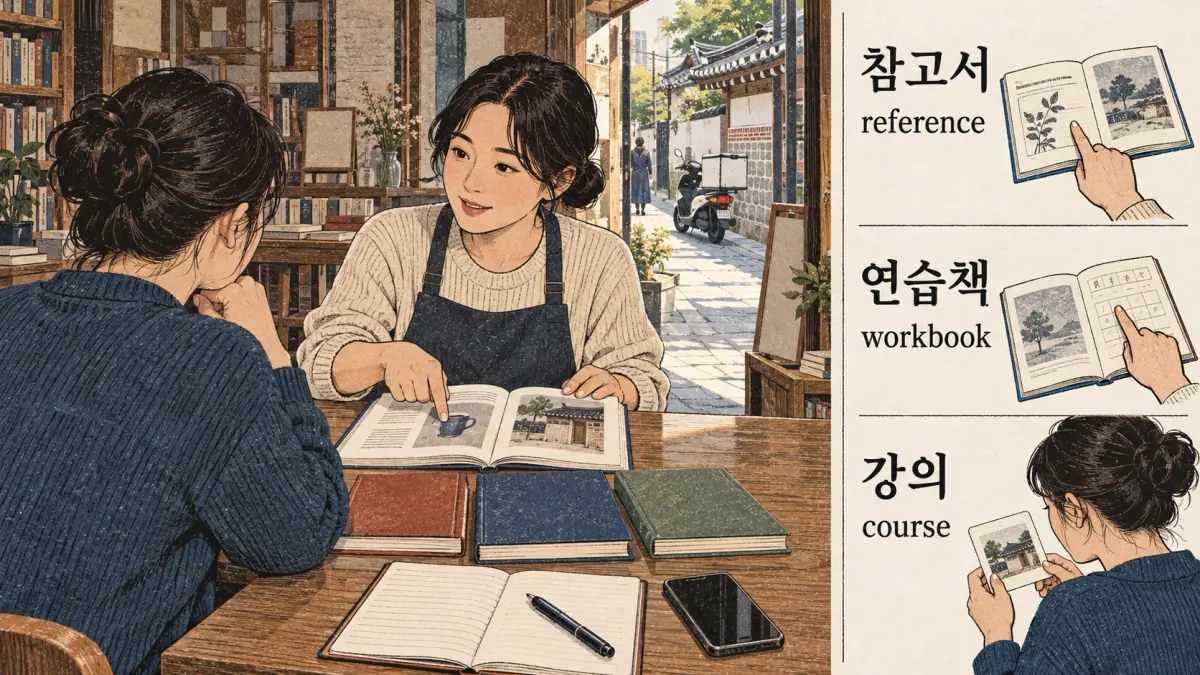
Learners often buy one when they need the other, so the roles are worth separating.
- A reference answers "what does this pattern mean, how is it formed and how does it differ from a similar one?" You open it when you have a question. It has explanations, tables and examples. Korean Grammar in Use works as a reference with exercises added.
- A workbook answers "can I use this pattern?" It has fill-in-the-blank items, sentence building and translation tasks, with an answer key. You work through it in order.
- A course answers "what should I study next?" It has dialogues, vocabulary and a sequence.
A solid setup for a self-study learner is one course, one reference and one source of practice. If the course comes with a workbook, you may not need a separate one. If you use apps for your course, the reference is the piece that fills the explanation gap.
How Do the Levels Line Up?
The table gives an editorial guide to which volume or book fits which stage. It is a planning aid, not an official mapping, and the TOPIK column describes the stage of preparation, not a promise about a test result. For official TOPIK information, use topik.go.kr.
| Your stage | Typical patterns you meet | Book to use | Stage of TOPIK preparation |
|---|---|---|---|
| Beginner (A1) | Particles 은/는 and 이/가, 이에요/예요, -아/어요, -고 싶어요 | Korean Grammar in Use, Beginning; Basic Korean | Early TOPIK I |
| Elementary (A2) | -(으)ㄹ 거예요, -아/어서, -(으)니까, -(으)면 | Korean Grammar in Use, Beginning; Basic Korean | TOPIK I |
| Intermediate (B1) | Connective endings, reported speech, passive and causative | Korean Grammar in Use, Intermediate; Intermediate Korean | TOPIK II, lower levels |
| Upper intermediate (B2) | Fine contrasts between near-synonyms, formal written patterns | Korean Grammar in Use, Intermediate and Advanced | TOPIK II, middle levels |
| Advanced (C1) | Rare and literary patterns, nuance | Korean Grammar in Use, Advanced; a comprehensive grammar | TOPIK II, upper levels |
Notice that one book can serve two stages. You do not need to buy the next volume the day you finish the last one. Buy it when your current one stops answering your questions.
What Mistakes Do Buyers Make?
- Buying a reference as a first book. A grammar book is not a course. If you have nothing to apply the rules to, you will read a lot and remember little. Start with a course and add the reference.
- Buying the wrong level. The Advanced volume is not for a beginner who wants to "see ahead". Open a sample page: if you cannot read the example sentences, it is the wrong level.
- Ignoring the language of the edition. The same series can appear in several language editions. Check that the one you buy has explanations in a language you read well.
- Buying an old edition without checking the layout. Newer editions may reorder or add items. If you follow a course that refers to a unit number, match the editions.
- Reading instead of practising. A grammar book is used by writing sentences. After each pattern, write two sentences of your own and say them aloud.
- Looking for a free PDF. Unauthorised copies are common in searches and are often incomplete. A library copy or a current edition is a better option, and the free lessons on this site cover the same ground while you save.
Do You Need a Grammar Book If You Use Apps?

Apps drill grammar through repetition, but most give brief explanations. If you notice that you can answer app questions without being able to say why, that is the signal to add a reference. The guide to the best Korean grammar app shows which apps explain more. Use it in a lookup loop: when an app marks a sentence wrong and you do not see why, find the pattern in the book, read the entry, write two new sentences and return to the app.
For example, an app asks you to complete 저는 학생___ and you type 예요. The app says it is wrong. A good reference explains that 학생 ends in a consonant, so the ending is 이에요: 학생이에요. You then know the rule, not just the answer.
Which Should You Pick?
You Study with a Course and Want a Look-up Book
Pick Korean Grammar in Use at your level. Use it when a lesson raises a question; do not read it cover to cover, and keep a pencil beside it to mark the entries you have practised.
You Study Alone from a Textbook and Need More Practice
Pick a grammar-and-workbook book such as Basic Korean, and use the answer key.
You Are an Intermediate Learner Stuck on near-Synonyms
Pick the Intermediate volume of Korean Grammar in Use and look up the pairs that confuse you, such as -아/어서 and -(으)니까.
You Are Preparing for TOPIK
Pick a level-organised pattern book, study the patterns of your target level and practise with official papers. Check topik.go.kr for the current exam information.
You Are Advanced or a Teacher
Add a comprehensive reference to your shelf, and use it to check edge cases.
How Should You Use a Grammar Book with This Site?
Use the book as a reference and the free Korean grammar lessons as a second explanation. When a book's note is too short, read the matching lesson; when a lesson raises a question about a rare pattern, check the book. Write one sentence of your own for each pattern you study, say it aloud, and check it against the book's examples. Keep a short list of the patterns that keep tripping you, and review that list once a week. Ten patterns that you can use in speech are worth more than a hundred you have only read once in a book.
Frequently Asked Questions
Do I need a grammar book if I use apps? Most learners benefit from one. Apps drill patterns and give instant right-or-wrong feedback, but many give short explanations or none. A grammar book lets you look up why a form is used and how it differs from a near-synonym. You do not need to read it from front to back; use it when an app or a lesson raises a question.
Which is best for TOPIK grammar? A pattern reference organised by level helps, because the exam tests common patterns at each stage. Pair it with official information from topik.go.kr and with practice papers. No grammar book is an official TOPIK publication unless the exam organisation says so. See the free TOPIK grammar lessons on this site for a level-by-level view.
Is Korean Grammar in Use in English? The series has English editions, and the series is also published in other languages. Check the exact title and language on the listing, because the same cover design is used for several editions. Choose the edition whose explanations you read comfortably, and make sure the volume matches your level.
Can beginners use advanced references? They can look things up, but should not study from them. A reference written for linguists or advanced learners uses terms and examples that assume a lot of Korean. A beginner will learn faster from a beginner's pattern book, with short explanations, many examples and exercises with answers.