
The best Korean podcasts for beginners are teaching shows with English explanations, short episodes, a clear series order and downloadable transcripts. This page explains how to judge any beginner show on six criteria, compares the main kinds of show with their drawbacks and gives you a three-listen routine and a four-week plan that turn 15 minutes a day into steady listening progress.
Key facts
- Look for English explanations, episodes of 5 to 15 minutes, a series order and transcripts.
- Six criteria are used. There are no scores or star ratings.
- A podcast trains your ear but does not replace reading, writing and speaking practice.
- Use three listens per episode: gist, with transcript, without.
- Check show details yourself, because formats and prices change.
Last updated: 2026-10-09.
Best Korean Podcasts for Beginners: the Essentials
Audio is the easiest way to add Korean to a busy day. You can listen on a commute, on a walk or while cooking. The risk is passive listening: a podcast that washes over you teaches little. A good beginner show does three things. It explains in English, so you know what you are hearing. It repeats key phrases slowly and then at normal speed. And it gives you something to read afterwards.
Because shows change, this page names kinds of show and well-known examples to check, and does not rank them. Use the table to decide which kind suits you.
| Kind of show | Good for | Honest drawback | Example to check |
|---|---|---|---|
| Structured lesson series with English teachers | Learning in order, from first words upward | Lessons can be long, and extras may cost money | Talk To Me In Korean |
| Audio course from a language-learning company | Short lessons with dialogues, by level | Full access often needs a paid plan | KoreanClass101 podcast |
| Vocabulary or phrase of the day | Very short, easy to fit in a day | Little explanation; lacks structure | Beginner shows on major podcast apps |
| Dialogue or story shows for learners | Hearing slow, simple conversation | Few explanations, so you need a transcript | Learner dialogue shows on major podcast apps |
| Korean-only native talk shows | Real speech | Far too fast for a beginner | Not for this level; see intermediate shows |
If you want a short answer, start with a structured lesson series that explains in English and has notes, listen to it in order, and add a dialogue show when your ear is ready. The names above are examples that exist and teach Korean. Check each one's current format, episode list and price before you commit.
How Did We Choose?
Every kind of show is read against the same six criteria. We give no scores, no star ratings and no affiliate links, and no show or company pays to appear. We have not claimed to have listened to every episode of any show. Where a detail about a show depends on its current version, the page tells you to check.
- English explanation. Does the host explain grammar and vocabulary in English? A beginner cannot learn from Korean-only explanations.
- Episode length. Are episodes short enough to repeat? Five to fifteen minutes is practical. A one-hour episode is hard to replay.
- Structure and series order. Is there a clear path from episode one onward, with levels or numbered lessons?
- Transcript or notes. Can you read what was said? Transcripts are the single most useful extra.
- Pace and clarity. Are the hosts clear, and do they slow down for key phrases?
- Free or paid. What do you get without paying, and what do notes, workbooks or extra lessons cost? We name the model, not a price.
Which Has the Clearest Explanations?
Clear explanation depends on structure. The clearest teaching shows follow a pattern in every episode.
- They state the goal at the start. For example, "In this lesson you will learn to say what you did yesterday".
- They give a few examples, then explain. Hearing the phrase first and the rule second feels natural.
- They repeat the key phrase slowly, then at normal speed. This models how real speech differs from careful speech.
- They summarise at the end. A recap helps memory.
Shows built around two hosts, one native Korean speaker and one learner or teacher who explains in English, often work well, because the English speaker asks the questions you would ask. Audio courses from language companies tend to follow a fixed script, which is clear and slightly formal.
Whatever the show, test it with one episode. After 10 minutes, ask yourself: Can I say what I learned in one sentence? Can I say the key phrase aloud? If not, the explanation is not working for you, and another show may suit you better.
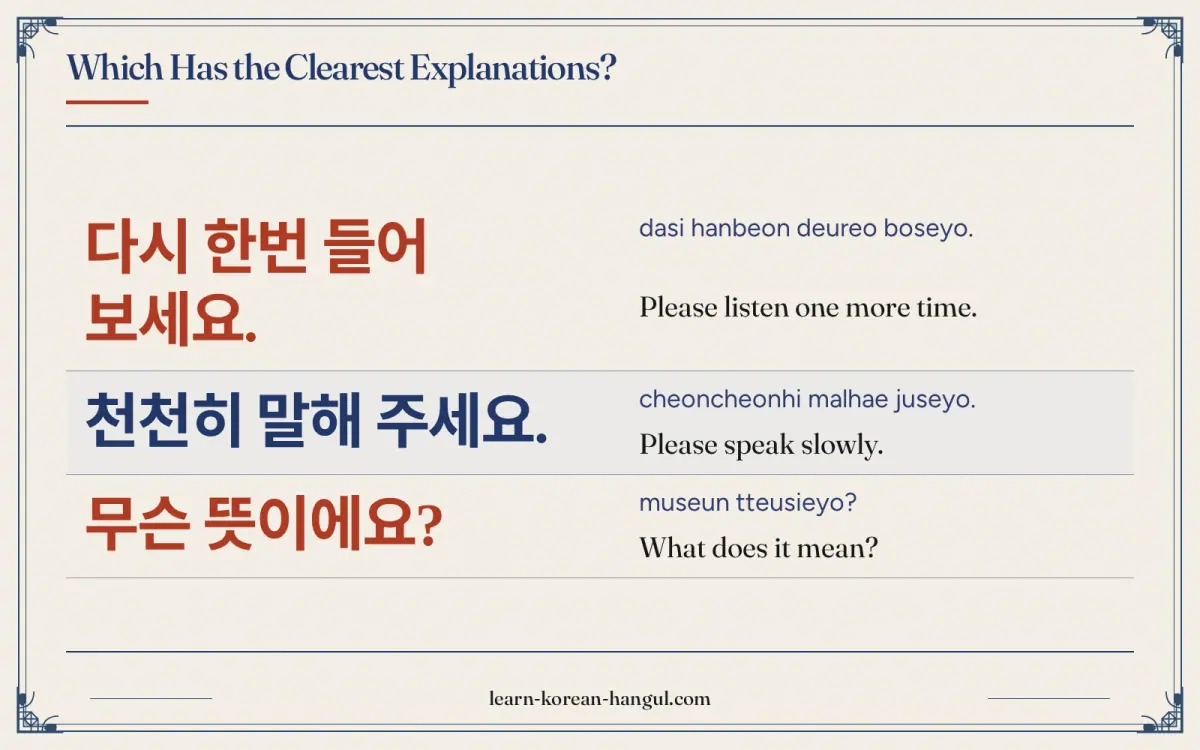
Here are three phrases you will hear in beginner podcasts or can use yourself, in class or in a real conversation. The first is what a teacher says; the other two help you ask for what you need:
다시 한번 들어 보세요.
dasi hanbeon deureo boseyo.
Please listen one more time.
천천히 말해 주세요.
cheoncheonhi malhae juseyo.
Please speak slowly.
무슨 뜻이에요?
museun tteusieyo?
What does it mean?
Note the question 무슨 뜻이에요? is a wh-question, so it does not end with a rise. Listen to how teachers let the pitch fall at the end.
Winner for explanations: a structured lesson series with English teachers, as long as the episodes are short enough for you to replay.
Which Has the Best Transcripts?
A transcript turns audio into reading practice. What you can get varies by show.
| Transcript type | What you get | Honest drawback |
|---|---|---|
| Full transcript with translation | Every line in Korean and English | May be a paid extra |
| Lesson notes | Key phrases and short explanations | Not word for word |
| Automatic transcript from a podcast app | A machine-made text of the audio | Mistakes in Korean spacing and endings |
| None | Audio only | You must write your own |
When a show gives lesson notes or a PDF, use them in the second listen. When it gives nothing, make your own mini-transcript: replay a 30-second part, write down what you hear, then check the key words in a dictionary.
Be careful with automatic transcripts. Korean has endings that sound alike, and machines often drop them. Use an automatic transcript as a rough guide, not as a source of truth.
A good check: pick one episode and see how the show handles the transcript. Is it linked from the episode page? Is it free? Does it show Korean text as well as English? A show with a clean, easy-to-find transcript has done a lot of the work for you.
Winner for transcripts: the show that gives you the full text, in Korean and English, with the least effort to find it. Compare shows by looking at one episode page each.
Which Is Best for Commuters?
Commuting is where podcasts shine, but not every show suits the way you travel.
- A bus or train ride of 15 to 30 minutes. Pick a show with 10 to 15 minute episodes, so you can finish one and repeat part of it.
- A walk or run. Pick a show with audio you can follow without looking at the screen. Avoid episodes that rely on a PDF.
- Driving. Choose listening you can do with your full attention on the road. Save reading the transcript for later.
- A noisy place. Pick a show with clear audio and use headphones that block noise.
Download episodes before you leave if your app supports it. Offline listening saves data and works when the signal fails.
Winner for commuters: short-episode series with clear audio and downloadable files.
A Three-Listen Routine for Any Episode
The same routine works for any beginner show.
- Listen one: gist (10 to 15 min). Play the episode without stopping. Do not look at the transcript. Write down in English what it was about.
- Listen two: with the transcript (10 to 15 min). Read as you listen. Mark the words you missed. Look up two or three.
- Listen three: without text (10 to 15 min). Play again with nothing in front of you. Count the phrases that now sound clear.
If an episode is 10 minutes long, one episode takes about 30 minutes to work through. That is more than a commute, so split it across three days: gist on day one, transcript on day two, no text on day three.
After the third listen, say two key phrases out loud, as if you were talking to the host. The aim is to move from understanding to speaking.
A Four-Week Plan at 15 Minutes a Day
Here is a plan for a beginner who has 15 minutes on weekdays. It assumes episodes of about 10 to 15 minutes and five study days a week.
| Week | Focus | Daily 15 minutes | Weekly total |
|---|---|---|---|
| 1 | Greetings and basics | Day 1: listen once. Day 2: listen with transcript. Day 3: listen without. Day 4: new episode. Day 5: review | 5 × 15 = 75 min |
| 2 | Numbers and everyday phrases | Same pattern with a new episode | 75 min |
| 3 | Simple sentences | Same pattern, plus say two phrases aloud each day | 75 min |
| 4 | Review and one new episode | Re-listen to the best two episodes from weeks 1 to 3 | 75 min |
Four weeks at 75 minutes a week is 300 minutes, or 5 hours. In that time you can expect to hear two or three episodes well, not twelve. Hearing a few episodes many times is the point.
The Kinds of Show in Detail
The notes below follow one pattern for each kind of show: a verdict, a specs line, one honest drawback and who should choose or skip it. They describe the format in general terms. Details such as episode counts, lengths and prices change, so confirm them on the show's own page.
Structured Lesson Series: Talk to Me in Korean
Verdict. A teaching-first series that explains Korean in English from the first sounds upward, and a natural place for a beginner to start.
Specs. Audio lessons arranged by level and in numbered order; hosts explain in English and read Korean examples aloud; lesson notes or workbooks are offered, and some of those are sold separately (check).
Drawback. Because the series is long and structured, it takes weeks to cover a level, and some of the extra materials may cost money. A listener who wants quick phrases may find it slow.
Choose it if you want a path from first words to simple conversation. Skip it if you want only a quick phrase each day.
Audio Course from a Language Company: KoreanClass101 Podcast
Verdict. A lesson-by-lesson audio course with short dialogues, arranged by level.
Specs. Short lessons organised by level, with a dialogue and an explanation; part of a wider paid learning platform, with a free sample of lessons (check which ones).
Drawback. Full access, including lesson notes and extras, is likely to need a subscription. Dialogues follow a script, so they sound tidier than real life.
Choose it if you like a clear lesson format with a dialogue in each episode. Skip it if you want everything free.
Phrase-of-the-Day Shows
Verdict. Very short episodes that fit anywhere, good as a supplement.
Specs. Episodes of a few minutes; one phrase or word per episode; many shows on major podcast apps (search for the show you like and check it is current).
Drawback. There is little explanation or structure, so you can collect phrases without knowing how to build sentences.
Choose it if you have only a few minutes a day. Skip it if you want grammar explained.
Dialogue and Story Shows for Learners
Verdict. Slow, simple conversations that train your ear on connected speech.
Specs. Slow Korean with a short English frame; dialogues of a minute or two; transcripts vary by show.
Drawback. Few explanations, so you need a transcript or a dictionary. Some shows are made by individuals and update irregularly.
Choose it if you can already read Hangul and know basic greetings. Skip it if you are in your first week of Korean. The Korean audio dialogues on this site offer a similar slow format with audio.
What to Listen for at A1
Listening has levels too. At A1, aim for a few clear targets instead of trying to understand everything.
- Greetings and set phrases. 안녕하세요, 감사합니다 and 네 / 아니요 repeat in almost every episode.
- Numbers and times. Numbers come in two systems, so notice which one the host uses.
- Sentence endings. Listen for -요 at the end of polite sentences and -ㅂ니다 in formal ones.
- Particles. Short sounds like 은/는, 이/가 and 을/를 follow nouns. Hear them as part of the noun.
- Sound changes. Spoken Korean joins sounds, so a written word may sound different. For example, 있어요 is pronounced [이써요] and 괜찮아요 is pronounced [괜차나요].
Listen for one target per week. In week one, count how many times you hear 네. In week two, notice every -요 ending. This turns a vague listen into a clear task, and it keeps you from feeling lost.
An Episode Map from A1 to A2
A rough map helps you see where a series should take you. The topics below are a general guide, not a list from any one show, and a good series will cover them in this order.
| Stage | Topics to expect | Listening goal |
|---|---|---|
| Early A1 | Sounds, greetings, introducing yourself | Repeat phrases after the host |
| Mid A1 | Numbers, time, basic nouns, polite -요 | Understand a short question and answer |
| Late A1 | Present tense, objects and places, simple questions | Follow a slow dialogue of 4 to 6 lines |
| Early A2 | Past tense, wants, plans, shopping | Follow a slow dialogue without a transcript |
| Mid A2 | Reasons, requests, directions | Catch the main idea of a one-minute exchange |
If a series skips a stage or jumps ahead too fast, add a grammar source for the missing part.
Setting up Your Podcast App for Study
A few settings help.
| Setting | Suggestion | Why |
|---|---|---|
| Downloads | Download the next three episodes on Wi-Fi | You can listen anywhere |
| Skip back | Set it to 10 or 15 seconds | Fast replay of a phrase |
| Speed | Normal; 0.9 for hard parts | Slowing too much distorts rhythm |
| Queue | Keep episodes in order | Beginner shows build on earlier ones |
| Notes | Keep a list of phrases and the episode number | Makes review easy |
Use the skip-back button as your main study tool. Press it, say the phrase and press it again. Ten seconds of replay does more than ten minutes of passive play.
A Five-Minute Check for Any Show
You can judge a beginner show before you listen to a whole episode. Open its page in your podcast app or on its website and look for the following.
- Is there a clear starting episode? Look for "Episode 1", "Level 1" or "Start here" in the list. If episodes are in random order, move on.
- How long are the episodes? Open three and look at the length. If they range from 5 to 40 minutes, the show may not be consistent.
- Is the date recent? A show that has not published for years can still be useful, but its links and extras may be broken.
- Where is the transcript? Open one episode page and see whether text, notes or a download link is there.
- Does the description say who it is for? "Absolute beginner" or "Level 1" is a good sign. "All levels" can mean none.
- What does the paid tier add? Read the page that explains it so that you know what you can get free.
Then play two minutes of one episode. If you can follow the host's English and hear the Korean examples clearly, the show passes the first test.
Turning Listening into Speaking
Listening alone leaves you with an ear that is ahead of your mouth. Close the gap with two small habits.
- Echo the host. When the host says a phrase, pause and say it back at the same speed. Repeat three times.
- Make one sentence. After each episode, build one new sentence from the phrase. If the episode taught 천천히 말해 주세요, try 천천히 읽어 주세요 or any sentence of your own, and say it aloud.
If you want more structure, the Korean shadowing pages give a step-by-step method for repeating audio.
Which Should You Pick?
Choose by your situation.
You are a complete beginner. Pick a structured lesson series with English explanations and numbered episodes, start from episode one and use the three-listen routine. Learn to read Hangul at the same time with the Korean alphabet lessons.
You have only a short commute. Choose a show with episodes of 5 to 10 minutes and a phrase of the day format. Keep the longer lesson for a weekend.
You like to read as you listen. Choose a show that gives transcripts and lesson notes, even if you have to pay for them.
You want to hear natural speech. Add a dialogue show for learners and later the Korean audio dialogues on this site, which have slow, clear conversations with audio.
You are on a budget. Use the free episodes of one structured series. Pay only if the paid extras (notes, workbooks) are what you are missing.
You already study with a course. Use a podcast to hear the patterns you are learning in real sentences. Pick episodes on the same topic as your current lesson.
When You Are Ready for More
You are ready for harder shows when you can follow a slow dialogue of a minute or two without a transcript and understand most of it. At that point, the next step is the page on Korean podcasts for intermediate learners, which compares slow Korean-only shows with native talk shows.
For other ways to build your ear, see the guide on how to improve Korean listening, and for practice in speaking after you listen, the conversation practice section.
Common Mistakes with Beginner Podcasts
- Listening passively. If you do not pause, repeat or read, you retain little.
- Skipping ahead. Beginner shows build on earlier lessons. Go in order.
- Never using the transcript. The transcript is where listening becomes reading and spelling.
- Changing shows too often. Give a show at least two weeks before you decide it is not for you.
- Listening only. Say the phrases aloud. Speaking makes the sounds yours.
- Using Korean-only shows too early. If you understand almost nothing, you are not learning. Return to teaching shows.
- Ignoring spoken forms. Beginner podcasts often point out that Korean sounds differ from spelling, for example 있어요 is pronounced [이써요]. Write these down.
How Does a Podcast Fit with the Rest of Your Study?
A podcast is one tool among several. A balanced beginner week might have five podcast sessions of 15 minutes, 20 minutes on Hangul and vocabulary on three days, and one speaking session. Check the site's other sections for grammar, vocabulary and speaking, and use the podcast as the ear-training part of the week.
A good test of whether a podcast is working: after two weeks, can you say five new phrases without looking at notes? If yes, keep going. If no, change one thing: slow down, add the transcript or switch to a more structured show.
FAQ
Are podcasts enough to learn Korean?
No. A podcast is excellent for listening and for hearing explanations while you commute or walk, but you cannot learn to read, write or speak from audio alone. Pair a teaching podcast with Hangul practice, a grammar source and some speaking practice. Use the podcast for what it does best, which is regular, low-effort exposure to the sound of Korean.
Do I need transcripts?
At the beginner level, yes, whenever you can get one. A transcript lets you check what you heard, see how spoken Korean is spelled and look up words you missed. Some shows give transcripts or lesson notes free, some sell them and some have none. If a show has none, replay short parts slowly and write down what you hear.
How many episodes a week?
Five short episodes a week, one per day, is a good start. If each episode is 10 to 15 minutes, that is 50 to 75 minutes a week. Replay an episode instead of rushing to the next. One episode heard three times teaches more than three episodes heard once.
What about Korean-only shows?
Korean-only podcasts are too hard for a true beginner, because you cannot yet follow the speech. Wait until you can understand most of a slow, simple dialogue. Learner shows in slow Korean come first, then native talk shows. The page on intermediate podcasts explains the steps.