
Business Korean Phrases Flashcards: Study the 22 Cards
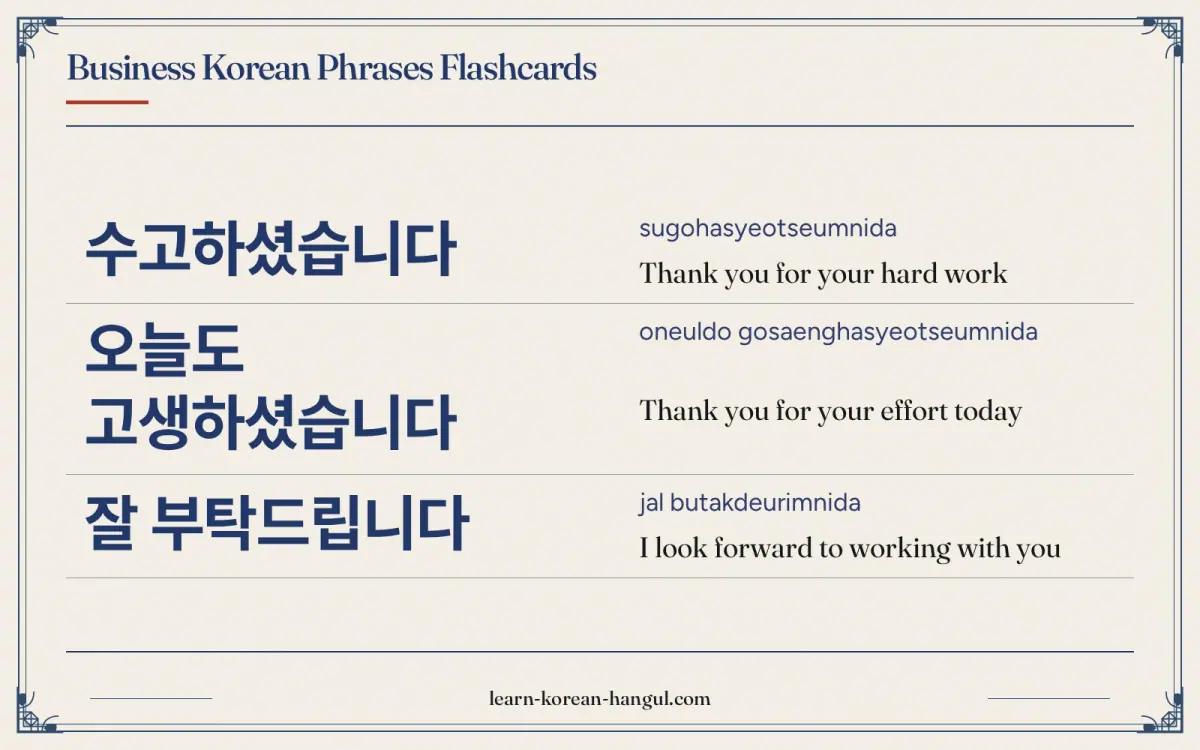
The cards start with acknowledging work and thanks (cards 1 to 8), then meetings and reports (9, 10, 17 and 18), going home and meeting people (11 to 14), requests and follow-up (15, 16 and 19), and finish with leave, business trips and a casual farewell (20 to 22).
How Do I Use These Flashcards?
Use the deck above in four steps. It works with tap, click or keyboard, and nothing plays until you press an audio button.
- Choose a mode. Start with recognition (Hangul to meaning). Switch to recall (meaning to Hangul) or listening (audio to meaning) once recognition feels easy.
- Show the answer. Read the line aloud as if you were saying it to a manager, then check the meaning. Then press Show answer (or Space). Turn on the romanization toggle only if you need it; the table below always shows it.
- Grade yourself. Press Got it if you answered correctly without help, or Not yet if you hesitated or guessed.
- Finish the session. A session holds up to 20 cards (you can set 10, 20 or 40). With 22 cards, a first-time learner should expect about 3 days at the default limit of 10 new cards a day, with review sessions on top.
What Do the Three Modes Do?
Recognition shows the Hangul and asks for the meaning, so with the first card it shows 수고하셨습니다 and you answer "Thank you for your hard work". Recall reverses this: it shows the meaning and asks for the Hangul, and you may type the answer with your Hangul keyboard or just say it in your head. Listening plays a clip and hides the letters, which trains the ear. Listening mode is useful here, because formal endings run together in fast speech and you need to hear -습니다 as one smooth sound. The pronunciation audio is generated with text-to-speech and a Korean teacher approves it before it is switched on. Listening mode only uses cards whose audio is approved, and cards without approved audio are skipped in that mode with a note.
What Do Got It and Not yet Do?
Got it moves a card up one Leitner box, so it comes back later. Not yet sends the card back to box 1, so it returns in the same session or within 10 minutes. The grades are your own judgement; the deck does not score you or claim fluency.
Deck Scope: What Is and Is Not Covered
The deck covers polite-formal (합쇼체) lines for the office: acknowledging work (수고하셨습니다, 확인했습니다, 알겠습니다), thanking and apologising, setting up and running a meeting, sending materials, greetings, requests, leave and business trips. It does not cover casual coworker chatter or phone etiquette, and it does not teach how to write a full business email.
What Is Left out of This Deck?
Casual talk with coworkers is in the small talk flashcards, and phone lines are in the phone phrases flashcards. Texting with friends is in the Korean texting phrases flashcards. The grammar of the -습니다 style is explained in the formal -ㅂ니다 lesson. Job titles and office words are in the Korean business vocabulary flashcards.
All 22 Cards in One Table
All 22 cards appear below in deck order. The table is plain HTML, so you can use it as a drill without the deck: cover the Meaning column, say each item aloud, then uncover it.
| # | Hangul | Revised Romanization | Meaning | Note | Audio assetId |
|---|---|---|---|---|---|
| 1 | 수고하셨습니다 | sugohasyeotseumnida | Thank you for your hard work | Said to colleagues and staff at the end of a task or the day. Saying it upward to a boss is debated, so many people choose 고생하셨습니다 there. Said [수고하셛씀니다]. | au-pg-flashcards-work-phrases-flashcards-1; slow: au-pg-flashcards-work-phrases-flashcards-23 |
| 2 | 오늘도 고생하셨습니다 | oneuldo gosaenghasyeotseumnida | Thank you for your effort today | A warm end-of-day line that people often use toward a senior. | au-pg-flashcards-work-phrases-flashcards-2 |
| 3 | 잘 부탁드립니다 | jal butakdeurimnida | I look forward to working with you | Said when you meet new colleagues or hand over a request. Said [잘 부탁뜨림니다]. | au-pg-flashcards-work-phrases-flashcards-3 |
| 4 | 확인했습니다 | hwaginhaetseumnida | I have confirmed it | Past tense: you have already checked. Said [화긴핻씀니다]. | au-pg-flashcards-work-phrases-flashcards-4; slow: au-pg-flashcards-work-phrases-flashcards-24 |
| 5 | 알겠습니다 | algetseumnida | Understood | The standard reply to an instruction. Said [알겓씀니다]. | au-pg-flashcards-work-phrases-flashcards-5 |
| 6 | 확인하겠습니다 | hwaginhagetseumnida | I will check | -겠습니다 makes a polite promise about the future. Add 나중에 for later: 나중에 확인하겠습니다. | au-pg-flashcards-work-phrases-flashcards-6 |
| 7 | 감사합니다 | gamsahamnida | Thank you | The formal word for thanks. Said [감사함니다]. | au-pg-flashcards-work-phrases-flashcards-7 |
| 8 | 죄송합니다 | joesonghamnida | I am sorry | More formal than 미안해요 and suited to work. Said [죄송함니다]. | au-pg-flashcards-work-phrases-flashcards-8 |
| 9 | 회의는 세 시에 있습니다 | hoeuineun se sie itseumnida | The meeting is at three o'clock | Native number 세 goes before 시. Said [회의는 세 시에 읻씀니다]. | au-pg-flashcards-work-phrases-flashcards-9 |
| 10 | 회의 자료를 보내 드리겠습니다 | hoeui jaryoreul bonae deurigetseumnida | I will send you the meeting materials | 드리다 is the humble form of 주다 (to give). | au-pg-flashcards-work-phrases-flashcards-10 |
| 11 | 먼저 퇴근하겠습니다 | meonjeo toegeunhagetseumnida | I will leave work first | A polite announcement when you go home before others. | au-pg-flashcards-work-phrases-flashcards-11 |
| 12 | 내일 뵙겠습니다 | naeil boepgetseumnida | See you tomorrow | 뵙다 is the humble form of 보다 (to see). Said [내일 뵙껟씀니다]. | au-pg-flashcards-work-phrases-flashcards-12 |
| 13 | 처음 뵙겠습니다 | cheoeum boepgetseumnida | Nice to meet you (first meeting) | Formal greeting at a first meeting. Said [처음 뵙껟씀니다]. | au-pg-flashcards-work-phrases-flashcards-13 |
| 14 | 명함을 드리겠습니다 | myeonghameul deurigetseumnida | Let me give you my business card | Offer the card with two hands. Said [명하믈 드리겓씀니다]. | au-pg-flashcards-work-phrases-flashcards-14 |
| 15 | 잠시만 기다려 주십시오 | jamsiman gidaryeo jusipsio | Please wait a moment | 주십시오 is a formal request used in announcements and to customers. Said [잠시만 기다려 주십씨오]. | au-pg-flashcards-work-phrases-flashcards-15 |
| 16 | 다시 한번 말씀해 주시겠습니까? | dasi hanbeon malsseumhae jusigetseumnikka | Could you say that once more? | A polite question; the voice rises at the end. 말씀 is the honorific word for words spoken by a senior. | au-pg-flashcards-work-phrases-flashcards-16; slow: au-pg-flashcards-work-phrases-flashcards-25 |
| 17 | 보고드리겠습니다 | bogodeurigetseumnida | I will report to you | Used before you give a status update to someone senior. | au-pg-flashcards-work-phrases-flashcards-17 |
| 18 | 회의를 시작하겠습니다 | hoeuireul sijakagetseumnida | Let us begin the meeting | The person leading the meeting says it. Said [회의를 시자카겓씀니다]. | au-pg-flashcards-work-phrases-flashcards-18 |
| 19 | 연락드리겠습니다 | yeollakdeurigetseumnida | I will contact you | Humble and polite; often used in emails and calls. Said [열락뜨리겓씀니다]. | au-pg-flashcards-work-phrases-flashcards-19 |
| 20 | 휴가를 쓰고 싶습니다 | hyugareul sseugo sipseumnida | I would like to take leave | The verb is 쓰다 (to use), as in using up leave days. | au-pg-flashcards-work-phrases-flashcards-20 |
| 21 | 출장 다녀오겠습니다 | chuljang danyeoogetseumnida | I will go on a business trip and come back | Said when you leave for a trip. 다녀오다 means to go and return. | au-pg-flashcards-work-phrases-flashcards-21 |
| 22 | 수고하세요 | sugohaseyo | Keep up the good work | Polite, but usually said to peers, juniors or service staff (customers often say it as they leave a shop), not up to a boss. | au-pg-flashcards-work-phrases-flashcards-22 |
How Do I Read the Table?
Hangul is the phrase. Revised Romanization (RR) is a learning aid, so try to read the Hangul first. The Meaning column gives a natural English equivalent, not a word-for-word translation. The Note column gives a use hint, and where the spoken sound differs from the spelling, the sound is shown in brackets. The last column lists the audio assetId, and a second ID marks a slow clip (0.8x).
Usage Notes for These Cards
Workplace speech uses -습니다 with superiors and in presentations. Many coworkers switch to the softer -아요/어요 in daily conversation, so you will hear both in the same office. Choose -습니다 when you speak to a manager, a client or a room, and when you write a report or an email.
-겠습니다 makes a polite promise. 확인하겠습니다 (I will check) and 먼저 퇴근하겠습니다 (I will leave first) announce what you are about to do. It sounds more polite than -(으)ㄹ게요, which is a friendlier promise between colleagues.
Add 님 to a title. Say 부장님, 팀장님 or 선생님 when you speak to or about someone senior, and put the surname before it (김 부장님). A title alone, such as 부장, can sound abrupt, and a name alone sounds rude toward a senior.
Humble verbs lower you, not the listener. 드리다 is the humble form of 주다, 뵙다 is the humble form of 보다 and 말씀드리다 is the humble form of 말하다. They show respect by describing your own action in a modest way, as in 명함을 드리겠습니다.
수고하셨습니다 and 고생하셨습니다 are close but not equal. Both thank someone for their effort. Many speakers feel that 수고하셨습니다 fits a colleague or a junior, and that 고생하셨습니다 is safer toward a senior, but opinions differ between offices.
Which Sounds Do Not Match the Spelling?
The formal ending -습니다 hides three sound changes that appear on almost every card.
있습니다 is said [읻씀니다]. The final ㅆ is read as ㄷ, the ㅅ of 습 becomes a tense sound and the ㅂ turns into ㅁ before ㄴ. These are neutralization, tensification and nasalization in one word. RR writes itseumnida.
뵙겠습니다 is said [뵙껟씀니다]. The ㄱ after the final ㅂ is tense, the ㅆ becomes ㄷ, the next ㅅ is tense and the ㅂ is nasalized before ㄴ in the last syllable, which sounds like ㅁ. RR writes boepgetseumnida.
확인했습니다 is said [화긴핻씀니다]. The ㄱ of 확 moves onto the empty ㅇ of 인, the final ㅆ of 했 is read as ㄷ and the ㅅ after it is tense. RR writes hwaginhaetseumnida.
What Mistakes Do Learners Make with Work and Business Phrases?
- Using 수고하세요 to a boss. It is common toward peers, juniors and service staff, and with a superior speakers often choose 고생하셨습니다 instead.
- Dropping 님 from a title. Saying 부장 alone can sound rude.
- Switching between -습니다 and -아요 at random in one email. If you are unsure of the level, keep to the -습니다 forms for the whole message.
- Using 알았어요 where 알겠습니다 is expected. In a formal setting, answer an instruction with 알겠습니다.
The first two slips are about status, not grammar, so say cards 1, 2 and 22 aloud in recall mode until you know whom each one fits.
How Does the Review Schedule Work?
The deck uses a simplified Leitner system with five boxes. A new card starts in box 1. Each Got it moves it up one box, and each Not yet returns it to box 1. The box sets how long the card waits before it is due again.
| Box | Wait until the next review |
|---|---|
| 1 | same session or 10 minutes |
| 2 | 1 day |
| 3 | 3 days |
| 4 | 7 days |
| 5 | 21 days |
Each session shows due cards first, oldest due first, then up to 10 new cards a day by default. A deck of 22 cards is introduced over 3 days at 10 new cards a day, or in 2 days if you set a limit of 11. Progress is saved only in this browser, so clearing site data deletes it. Use the export button to save a small file with card IDs, boxes and due dates, and import it on another device. No account is needed.
Cultural and Practical Context
Korean workplaces mark hierarchy through titles and honorific language. The way you close the day, such as 먼저 퇴근하겠습니다 or 내일 뵙겠습니다, can matter as much as the phrase itself. Group dinners and etiquette about who pours first belong to the same picture. These cards give you safe, formal lines, but each office has its own habits, so listen to how colleagues around you speak before you copy a style.
Limits of This Deck
The deck holds 22 formal lines, so it shows one safe way to say each thing, not every way. Real offices vary a lot, and some speak far less formally than these cards. The upward use of 수고하셨습니다 is debated, and the note says so. The deck does not teach email writing or phone manners. All Korean text is generated and was reviewed and signed off by Min-ji Park on 15 October 2026, and each audio clip is checked by a Korean teacher before publication.
Next Steps after This Deck
After these business korean phrases flashcards, learn the words of the office with the Korean business vocabulary flashcards and, for friendlier talk with coworkers, practise with the small talk flashcards. Read the business korean phrases lesson for the reasons behind each line. The Korean phrases flashcards page lists every phrase deck, and the Korean flashcards hub lists all topics.
Frequently Asked Questions
Can I Use 수고하셨습니다 with My Boss?
Many people avoid it upward, because 수고 can sound like praise from a superior. Colleagues and staff hear it often. With a manager, 고생하셨습니다 or 오늘도 고생하셨습니다 is the safer choice. Opinions vary by office, so listen to what the people around you say.
What Is the Difference between -습니다 and -아요 at Work?
-습니다 is the formal style and -아요/어요 is the polite style. Use -습니다 with managers, clients, in presentations and in writing. Many coworkers use -아요/어요 in daily talk, which sounds softer. If you are unsure, begin with -습니다 and follow the level your colleagues use.
What Title Do I Use for My Manager?
Use the job title plus 님, and put the surname first when you know it: 김 부장님 or 팀장님. A title alone, such as 부장, can sound abrupt, and a name alone is too casual for a senior. Never call a senior by 너.
How Do I Say I Will Check Something Later?
Say 나중에 확인하겠습니다, which means I will check later. For something already done, use the past tense, 확인했습니다. If you need more time, you can add 잠시만 기다려 주십시오 (please wait a moment) when speaking to a customer.
Is My Progress Saved If I Close the Page?
Yes, in the same browser on the same device. Card boxes and due dates are stored locally and nothing is sent to a server. Clearing site data, using a private window or switching browsers removes them, so use the export button to keep a backup file. No account is needed.