
Korean Business Vocabulary Flashcards: Study the 29 Cards
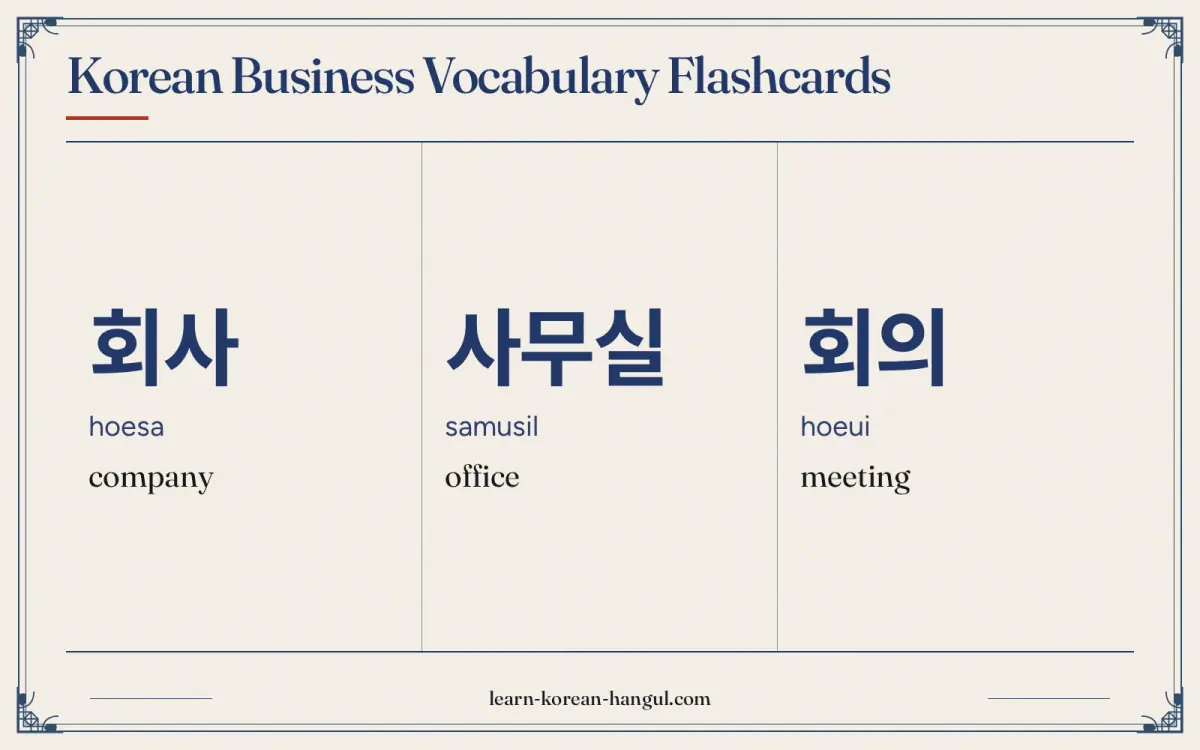
The cards start with the workplace (cards 1 to 7: 회사, 사무실, 회의, 출근, 퇴근, 업무, 일), then people and ranks (8 to 14), business cards and job-hunting (15 to 18), pay and promotion (19 to 21), life at work (22 to 26) and tools and general words (27 to 29).
How Do I Use These Flashcards?
Use the deck above in four steps. It works with tap, click or keyboard, and nothing plays until you press an audio button.
- Choose a mode. Start with recognition (Hangul to meaning). Switch to recall (meaning to Hangul) or listening (audio to meaning) once recognition feels easy.
- Show the answer. Think of the answer first, then press Show answer (or Space). Turn on the romanization toggle only if you need it; the table below always shows it.
- Grade yourself. Press Got it if you answered correctly without help, or Not yet if you hesitated or guessed.
- Finish the session. A session holds up to 20 cards (you can set 10, 20 or 40). With 29 cards, a first-time learner should expect about 3 days at the default limit of 10 new cards a day, with review sessions on top.
The Three Study Modes
Recognition shows the Hangul and asks for the meaning, so with the first card it shows 회사 and you answer "company". Recall reverses this: it shows the meaning and asks for the Hangul, and you may type the answer with your Hangul keyboard or just say it in your head. Listening plays a clip and hides the letters, which trains the ear. Listening mode only uses a card once its audio is approved, and cards without approved audio are skipped in that mode with a note. Recall mode is useful for the rank words, because you must produce 대리 or 과장 from the English title.
Got It and Not Yet
Got it moves a card up one Leitner box, so it comes back later. Not yet sends the card back to box 1, so it returns in the same session or within 10 minutes. The grades are your own judgement; the deck does not score you or claim fluency.
Deck Scope: What Is and Is Not Covered
The deck covers company, rank, meeting and job-hunting words used at work. General job names are in the jobs deck. The words and letters on these cards are explained in the business korean vocabulary lesson, so read it first if a card is new.
What This Deck Leaves Out
School words are in the school subjects flashcards and the school words flashcards. General job names such as 의사 and 요리사 are in the jobs deck, and work phrases are in the phrase decks.
All 29 Cards in One Table
All 29 cards appear below in deck order. The table is plain HTML, so you can use it as a drill without the deck: cover the Meaning column, read each word aloud, then uncover it.
| # | Hangul | Revised Romanization | Meaning | Note | Audio assetId |
|---|---|---|---|---|---|
| 1 | 회사 | hoesa | company | 회사에 다녀요 (I work at a company). | au-pg-flashcards-office-vocabulary-1 |
| 2 | 사무실 | samusil | office | 사무실은 이 층에 있어요 (The office is on this floor). | au-pg-flashcards-office-vocabulary-2 |
| 3 | 회의 | hoeui | meeting | 지금 회의 중이에요 (I'm in a meeting now). | au-pg-flashcards-office-vocabulary-3 |
| 4 | 출근 | chulgeun | going to work | 출근하다 means to go to work (start the workday). | au-pg-flashcards-office-vocabulary-4 |
| 5 | 퇴근 | toegeun | leaving work | 퇴근하다 means to leave work for the day. | au-pg-flashcards-office-vocabulary-5 |
| 6 | 업무 | eommu | duties; business tasks | Said [엄무]. | au-pg-flashcards-office-vocabulary-6; slow: au-pg-flashcards-office-vocabulary-30 |
| 7 | 일 | il | work, job | Also task or matter. | au-pg-flashcards-office-vocabulary-7 |
| 8 | 동료 | dongnyo | colleague | 동료와 점심을 먹어요 (I eat lunch with a colleague). | au-pg-flashcards-office-vocabulary-8 |
| 9 | 사장 | sajang | boss | 사장님 is the polite title for the boss. | au-pg-flashcards-office-vocabulary-9 |
| 10 | 회사원 | hoesawon | office worker | An office worker. | au-pg-flashcards-office-vocabulary-10 |
| 11 | 사원 | sawon | staff member (entry rank) | The first rank on the common ladder. | au-pg-flashcards-office-vocabulary-11 |
| 12 | 대리 | daeri | assistant manager | 김 대리님 (Assistant Manager Kim). | au-pg-flashcards-office-vocabulary-12 |
| 13 | 과장 | gwajang | section chief | 김 과장님 (Section Chief Kim). | au-pg-flashcards-office-vocabulary-13 |
| 14 | 부장 | bujang | department head | 김 부장님 (Department Head Kim). | au-pg-flashcards-office-vocabulary-14 |
| 15 | 명함 | myeongham | business card | Offer and receive it with both hands. | au-pg-flashcards-office-vocabulary-15 |
| 16 | 면접 | myeonjeop | interview (job) | 면접을 보다 means to take an interview. | au-pg-flashcards-office-vocabulary-16 |
| 17 | 이력서 | iryeokseo | resume | Said [이력써]. | au-pg-flashcards-office-vocabulary-17; slow: au-pg-flashcards-office-vocabulary-31 |
| 18 | 지원하다 | jiwonhada | to apply | 회사에 지원했어요 (I applied to the company). | au-pg-flashcards-office-vocabulary-18 |
| 19 | 승진 | seungjin | promotion | 제 친구가 승진했어요 (My friend got promoted). | au-pg-flashcards-office-vocabulary-19 |
| 20 | 월급 | wolgeup | monthly salary | Monthly pay; the annual figure is 연봉. | au-pg-flashcards-office-vocabulary-20 |
| 21 | 연봉 | yeonbong | annual salary | Used in job offers. | au-pg-flashcards-office-vocabulary-21 |
| 22 | 야근 | yageun | overtime (night work) | 야근하다 means to work overtime. | au-pg-flashcards-office-vocabulary-22 |
| 23 | 회식 | hoesik | team dinner | A company or team meal after work. | au-pg-flashcards-office-vocabulary-23 |
| 24 | 출장 | chuljang | business trip | 출장을 가요 (I go on a business trip). | au-pg-flashcards-office-vocabulary-24 |
| 25 | 휴가 | hyuga | vacation | 휴가를 내다 means to take leave. | au-pg-flashcards-office-vocabulary-25 |
| 26 | 퇴사 | toesa | leaving the company | 퇴사했어요 (I left the company). | au-pg-flashcards-office-vocabulary-26 |
| 27 | 컴퓨터 | keompyuteo | computer | 저는 컴퓨터를 매일 써요 (I use a computer every day). | au-pg-flashcards-office-vocabulary-27 |
| 28 | 이메일 | imeil | 이메일 주소가 뭐예요? (What is your email address?). | au-pg-flashcards-office-vocabulary-28 | |
| 29 | 직업 | jigeop | job | 직업이 뭐예요? (What is your job?). | au-pg-flashcards-office-vocabulary-29; slow: au-pg-flashcards-office-vocabulary-32 |
Reading the Table
Hangul is the word. Revised Romanization (RR) is a learning aid, so read the Hangul first. RR follows sound changes between letters, which is why 업무 is written eommu although it is spelled with a ㅂ. The Meaning column gives the English gloss, and the Note column gives a use or sound hint. A second ID in the last column marks a slow clip.
Usage Notes for These Cards
Rank titles follow the surname and take 님. 김 부장님 means Department Head Kim, and rank titles are often used in place of names.
The common ladder. The rank ladder runs 사원, 대리, 과장, 부장, and many companies also have 차장 between 과장 and 부장. Rank affects the speech level you use.
Employed and on leave. Say you are employed with 회사에 다녀요 (I work at a company) and take leave with 휴가를 내다.
Business cards. Exchange 명함 (business cards) by offering and receiving with both hands.
Interviews and applications. Take an interview with 면접을 보다, and apply with 지원하다: 회사에 지원했어요 (I applied to the company).
Which Sounds Do Not Match the Spelling?
업무 is said [엄무]: the ㅂ before ㅁ becomes ㅁ (nasalization). Revised Romanization writes eommu.
이력서 is said [이력써]: the ㅅ after a ㄱ final is tensified. Revised Romanization writes iryeokseo.
직업 is said [지겁]: the final ㄱ of 직 links to the empty onset of 업. Revised Romanization writes jigeop.
What Mistakes Do Learners Make with Office Words?
- Calling a boss 씨. Use title plus 님 instead.
- Using 휴가 for a public holiday. 휴가 is leave you take; a public holiday is 공휴일.
- Mixing up 월급 and 연봉. 월급 is the monthly pay and 연봉 is the annual figure.
- Using 퇴근 for leaving the company for good. That is 퇴사.
Most of these slips come from titles and from word pairs that look alike, so check the setting before you pick a word.
How Does the Review Schedule Work?
The deck uses a simplified Leitner system with five boxes. A new card starts in box 1. Each Got it moves it up one box, and each Not yet returns it to box 1. The box sets how long the card waits before it is due again.
| Box | Wait until the next review |
|---|---|
| 1 | same session or 10 minutes |
| 2 | 1 day |
| 3 | 3 days |
| 4 | 7 days |
| 5 | 21 days |
Each session shows due cards first, oldest due first, and then new cards up to the daily limit, which is 10 by default. A deck of 29 cards is introduced in about three days at the default of 10 new cards a day, and the later boxes bring each word back at longer gaps. Progress is saved only in this browser, so clearing site data deletes it. Use the export button to save a small JSON file with card IDs, boxes and due dates, and import it on another device. The file holds no personal data.
Cultural and Practical Context
Team dinners (회식) and titles used in place of names are visible parts of Korean office culture, where rank shapes how people speak to each other. Exchanging 명함 at a first meeting is normal in many offices. The customs differ between companies, so treat these notes as general guidance.
Limits of This Deck
The deck holds 29 cards, a starting set rather than a business-Korean course. The rank ladder shows the most common four ranks and the business-card note is general. Companies use different titles, and some use English titles. The Korean text on this page is generated and was reviewed and signed off by Min-ji Park on 15 October 2026.
Next Steps after This Deck
This deck is one of the korean vocabulary flashcards on the site, so browse the full list if you want a different topic. When these cards feel easy, move on to korean school subjects flashcards to keep the same routine. For a related topic, try korean school words flashcards. After a session, write the same words by hand with the korean school vocabulary worksheet. All flashcard decks, including Hangul, vocabulary, phrases, grammar and TOPIK, are listed on the Korean flashcards hub.
Frequently Asked Questions
What Does 님 Add?
님 adds respect to a title, as in 부장님 or 사장님. It is a suffix, not a separate word. Use it when you speak to or about a senior person. 선생님 (teacher) uses the same suffix.
How Do I Say Overtime?
야근 is overtime work at night or after hours, and 야근하다 means to work overtime. A short example is 오늘 야근해요 (I work overtime today). It is common to hear the word in conversations about the workday.
Is 월급 or 연봉 More Common?
월급 is the monthly salary and 연봉 is the annual figure, and each is common in its own setting. People often talk about 월급 in daily life and 연봉 in job offers and negotiations.
How Do I Say I Resigned?
퇴사했어요 means I left the company. 퇴사 covers leaving a job for any reason. In everyday speech, 회사를 그만뒀어요 (I quit my job) is just as common.
Is My Progress Saved If I Close the Page?
Yes, in the same browser on the same device. Card boxes and due dates are stored locally and nothing is sent to a server. Clearing site data, using a private window or switching browsers removes them, so use the export button to keep a backup file. No account is needed.