Korean Relationship Terms Flashcards: Study the 25 Cards
Korean has more than one word for "older brother" or "friend" because the word depends on who is speaking and how close the two people are. Read each card aloud first, then ask yourself who would say it. The lesson behind the deck is korean relationship terms, so read it first if a card is new.
How Do I Use These Flashcards?
Use the deck above in four steps. It works with tap, click or keyboard, and nothing plays until you press an audio button.
- Choose a mode. Start with recognition (Hangul to meaning). Switch to recall (meaning to Hangul) or listening (audio to meaning) once recognition feels easy.
- Show the answer. Think of the answer first, then press Show answer (or Space). Turn on the romanization toggle only if you need it; the 25-card table below always shows it.
- Grade yourself. Press Got it if you answered correctly without help, or Not yet if you hesitated or guessed.
- Finish the session. A session holds up to 20 cards (you can set 10, 20 or 40). With 25 cards, a first-time learner can split the deck over three days, using the default limit of 10 new cards a day.
The Three Study Modes
Recognition shows the Hangul and asks for the meaning, which trains reading. Recall shows the meaning and asks for the Hangul, which trains remembering; you may type the answer with your Hangul keyboard or just recall it in your head. Listening plays a clip and hides the letters, which trains the ear. Listening mode only uses a card once its audio is approved, and cards without approved audio are skipped in that mode with a note.
Got It and Not Yet
Got it moves the card up one Leitner box, so it comes back later. Not yet sends the card back to box 1, so it returns in the same session or within 10 minutes. The grades are your own judgement; the deck does not score you or claim fluency.
Deck Scope: What Is and Is Not Covered
The deck covers words for friends and partners (친구, 남자 친구, 연인), words for people above or below you in school or work (선배, 후배, 동료), the sibling-style terms that friends use (형, 누나, 오빠, 언니), polite titles (선생님, 사장님, 손님) and a few general people words (어른, 아이, 사람). Blood relatives such as 엄마, 할머니 and 삼촌 are in the family deck, and job titles are in the jobs deck.
What Is Left out of This Deck?
Family words are in the korean family words flashcards, and job names are in the korean jobs flashcards. The deck does not teach full honorific verb endings or the way to ask someone's age; those belong to the grammar lessons. It also leaves out most dating and slang vocabulary, which fills its own lesson pages.
All 25 Cards in One Table
All 25 cards appear below in deck order. The table is plain HTML, so you can use it as a drill without the deck: cover the Meaning column, read each Hangul word aloud, then uncover the meaning.
| # | Hangul | Revised Romanization | Meaning | Note | Audio assetId |
|---|---|---|---|---|---|
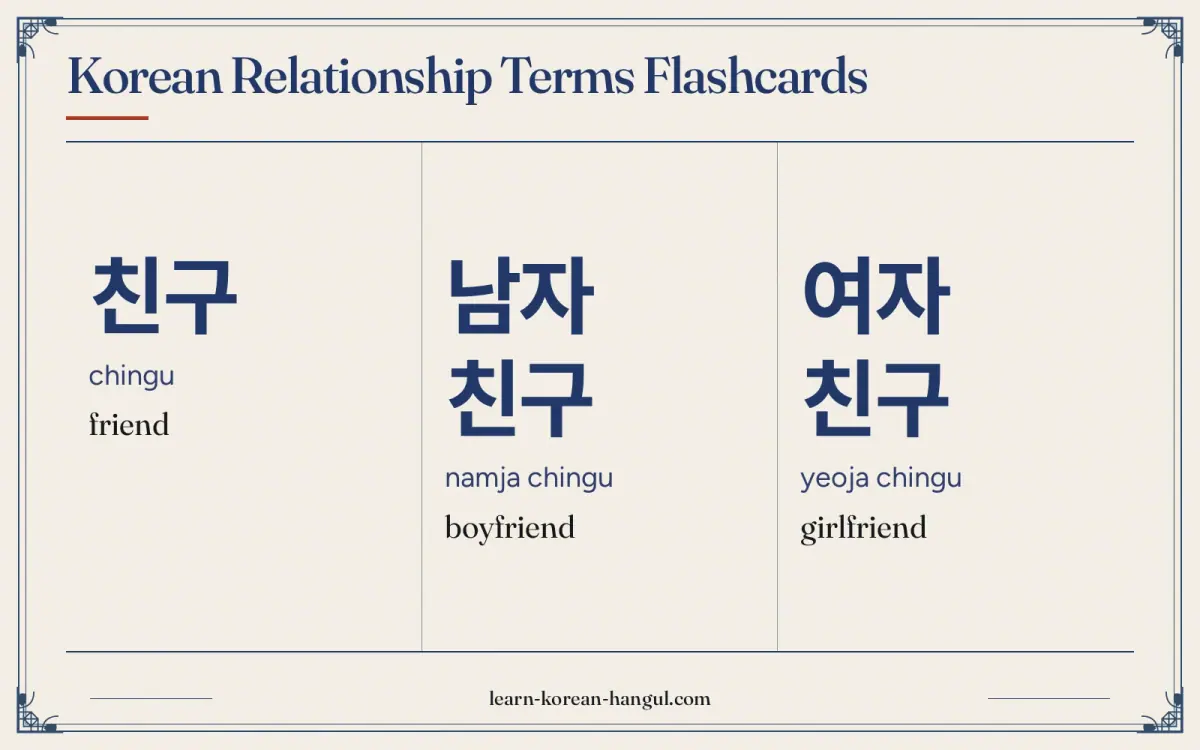
| 1 | 친구 | chingu | friend | Same age or close in age. For someone clearly older, use 선배 or 형/누나/오빠/언니 instead. | au-pg-flashcards-relationship-terms-1 |
| 2 | 남자 친구 | namja chingu | boyfriend | Written with a space; 남자친구 without one is common online. It means boyfriend. A male friend is 남자 사람 친구 or just 친구. Casual speech shortens it to 남친. | au-pg-flashcards-relationship-terms-2 |
| 3 | 여자 친구 | yeoja chingu | girlfriend | Written with a space; 여자친구 without one is common online. It means girlfriend. Casual speech shortens it to 여친. | au-pg-flashcards-relationship-terms-3 |
| 4 | 연인 | yeonin | lover | A little literary or romantic. Daily speech prefers 남자 친구 or 여자 친구. | au-pg-flashcards-relationship-terms-4 |
| 5 | 자기야 | jagiya | babe | Only for couples and close partners. Do not use it for casual friends. | au-pg-flashcards-relationship-terms-5 |
| 6 | 애교 | aegyo | aegyo (acting cute) | A noun, not an adjective. It pairs with 부리다 (애교를 부리다, to act cute) and 많다. | au-pg-flashcards-relationship-terms-6 |
| 7 | 선배 | seonbae | senior (in school/work) | Someone who entered the school, firm or field before you. It is about entry order, not age. Add 님 for extra respect. | au-pg-flashcards-relationship-terms-7; slow: au-pg-flashcards-relationship-terms-27 |
| 8 | 후배 | hubae | junior (in school/work) | Someone who entered the school, firm or field after you. It is about entry order, not age. | au-pg-flashcards-relationship-terms-8 |
| 9 | 동료 | dongnyo | colleague | Said [동뇨]: the ㄹ after ㅇ is read as ㄴ. A neutral word for a co-worker. | au-pg-flashcards-relationship-terms-9; slow: au-pg-flashcards-relationship-terms-26 |
| 10 | 형 | hyeong | older brother (said by a male) | Said by a man to an older brother or a close older man. A woman says 오빠 instead. | au-pg-flashcards-relationship-terms-10 |
| 11 | 누나 | nuna | older sister (said by a male) | Said by a man to an older sister or a close older woman. A woman says 언니 instead. | au-pg-flashcards-relationship-terms-11 |
| 12 | 오빠 | oppa | older brother (said by a female) | Said by a woman to an older brother or a close older man. With people you are not close to, use a title instead. | au-pg-flashcards-relationship-terms-12 |
| 13 | 언니 | eonni | older sister (said by a female) | Said by a woman to an older sister or a close older woman. The double ㄴ is said [언니]. | au-pg-flashcards-relationship-terms-13; slow: au-pg-flashcards-relationship-terms-28 |
| 14 | 선생님 | seonsaengnim | teacher | Also a respectful title for other professionals. Keep the 님; 선생 alone is not polite. | au-pg-flashcards-relationship-terms-14 |
| 15 | 사장님 | sajangnim | boss (title) | Customers also use it politely for a shop owner. Keep the 님 in direct address. | au-pg-flashcards-relationship-terms-15 |
| 16 | 손님 | sonnim | guest | Guest at home, and the normal word for a customer in a shop or restaurant. | au-pg-flashcards-relationship-terms-16 |
| 17 | 아줌마 | ajumma | middle-aged woman | Casual and risky with strangers. 아주머니 is more polite. Learners should not use it for any adult woman. | au-pg-flashcards-relationship-terms-17 |
| 18 | 아저씨 | ajeossi | middle-aged man | Casual and can sound rude to strangers. Do not call any adult man 아저씨. | au-pg-flashcards-relationship-terms-18 |
| 19 | 어른 | eoreun | adult | Also an elder who deserves respect. Forms and signs use 성인 for the legal adult. | au-pg-flashcards-relationship-terms-19 |
| 20 | 아이 | ai | child | Use 자녀 or 아드님/따님 when you refer politely to someone else's child. | au-pg-flashcards-relationship-terms-20 |
| 21 | 이웃 | iut | neighbor | The final ㅅ is a closed [t] sound by itself, and becomes [이우시] before a vowel particle. | au-pg-flashcards-relationship-terms-21; slow: au-pg-flashcards-relationship-terms-29 |
| 22 | 외국인 | oegugin | foreigner | Linking makes it [외구긴]. Some speakers prefer the softer 외국 사람. | au-pg-flashcards-relationship-terms-22 |
| 23 | 사람 | saram | person | The respectful word for a person is 분, as in 이분 and 그분. | au-pg-flashcards-relationship-terms-23 |
| 24 | 남자 | namja | man | A male person. Not the same as 남자 친구 (boyfriend). | au-pg-flashcards-relationship-terms-24 |
| 25 | 여자 | yeoja | woman | A female person. Not the same as 여자 친구 (girlfriend). | au-pg-flashcards-relationship-terms-25 |
Reading the Table
Hangul is the word. Revised Romanization (RR) is a learning aid, so try to read the Hangul before you look at it. RR follows the sound of the word, which is why some spellings change. The Meaning column gives the English gloss, and the Note column explains who says the word and when. For the sibling terms, the note names the speaker, because the same older brother is 형 for a man and 오빠 for a woman. The last column lists the audio assetId; a second ID marks a slow clip.
Usage Notes for These Cards
Titles carry 님. 님 attaches to titles and roles to add respect: 사장님, 선생님, 손님. When you speak directly to the person, the 님 stays. Saying 선생 alone sounds blunt, so learners should always say 선생님 to a teacher.
씨 follows a name. The suffix 씨 attaches after a given name or a full name, as in 김민수 씨. After a surname alone, as in 김 씨, it can sound rude. 씨 is for people of the same level or below you, so use a title plus 님 for someone above you at work.
선배 and 후배 work as titles and as nouns. In speech they work as plain nouns (저는 선배예요, I am a senior) and as address terms with 님 (선배님, 도와주세요, Senior, please help me). Both depend on who entered the school or company first, not on age.
분 replaces 사람 for respect. Use 분 when you talk about a person with respect: 이분은 선생님이세요 (This person is a teacher). 사람 is neutral and can sound blunt about someone older.
Same age opens casual speech. Friends of the same age are 친구, and being the same age (동갑) is what usually allows casual speech between people. A person who is only a little older is not called 친구 by most speakers; they are called 형, 누나, 오빠 or 언니 once the two people are close.
Which Sounds Do Not Match the Spelling?
A few words on this deck do not sound the way they are spelled. Revised Romanization follows the sound, so the table shows the pronounced form.
- 동료 is said [동뇨]. A ㄹ after ㅇ is read as ㄴ, so the second syllable begins with ㄴ. The card shows dongnyo.
- 이웃 ends in ㅅ. By itself the ㅅ sounds like a closed [t], and before a vowel particle the ㅅ moves forward: 이웃이 is said [이우시].
- 외국인 is said [외구긴]. The final ㄱ of 국 links to the empty ㅇ of 인. Two words that are not cards here follow other common rules: 짝사랑 (one-sided love) is said [짝싸랑], with a tense ㅆ after ㄱ, and 신랑 (groom) is said [실랑], with ㄴ read as ㄹ before ㄹ.
The pronunciations follow the 국립국어원 (National Institute of Korean Language) standard pronunciation rules (표준 발음법), and the romanization follows the Revised Romanization of Korean (2000).
What Mistakes Do Learners Make with Relationship Terms?
- Using 씨 for someone above you at work. Use their title plus 님 instead.
- Calling your teacher 선생 alone. Add 님 to make 선생님.
- Using 친구 for a boyfriend. 남자 친구 means boyfriend, and 친구 alone means just a friend.
- Calling any adult woman 아줌마 or any adult man 아저씨. Both can offend strangers; use a title or 저기요 instead.
- Using 오빠 as a man or 형 as a woman. The word depends on the speaker, not the listener.
How Does the Review Schedule Work?
The deck uses a simplified Leitner system with five boxes. A new card starts in box 1. Each Got it moves it up one box, and each Not yet returns it to box 1. The box sets how long the card waits before it is due again.
| Box | Wait until the next review |
|---|---|
| 1 | same session or 10 minutes |
| 2 | 1 day |
| 3 | 3 days |
| 4 | 7 days |
| 5 | 21 days |
Each session shows due cards first, oldest due first, and then up to 10 new cards a day by default. A deck of 25 cards is introduced over three days at the default of 10 new cards a day, and the later boxes bring each card back at longer gaps. Progress is saved only in this browser, so clearing site data deletes it. Use the export button to save a small JSON file with card IDs, boxes and due dates, and import it on another device. No account is needed.
Cultural and Practical Context
Hierarchy by school year or job rank matters in Korean social life, and 선배 and 후배 relationships often decide speech level and who pays for a meal. A new student or employee is usually introduced as a 후배, and learning how to address each person is part of fitting in.
Limits of This Deck
The deck has 25 cards, so it gives one core meaning per word. It does not cover every kinship or workplace title, such as 팀장님 or 교수님, and it does not show verb endings for polite speech. Speech-level choices such as -요 and -습니다 are explained in the grammar lessons. Because the sibling terms change with the speaker, a learner who studies only the table can still pick the wrong one; the notes are there to help. All Korean text is generated and was reviewed and signed off by Min-ji Park on 15 October 2026. The audio is generated with text-to-speech and is checked by a Korean teacher before publication, and listening mode uses only cards whose clips are approved.
Next Steps after This Deck
Continue with the korean jobs flashcards, or go back to the korean family words flashcards if a word here still feels shaky. Write the same words by hand with the korean family words worksheet. The korean vocabulary flashcards page lists every other deck, and the korean flashcards hub lists all topics.
Frequently Asked Questions
Can I Use 씨 with a Boss?
Generally no. Use the boss's title plus 님, such as 사장님 or 팀장님, because 씨 is meant for peers or people below you in rank. Using 씨 with a superior can sound disrespectful, even when you add a given name. When in doubt, choose the title.
Do 선배 and 후배 Depend on Age?
No. They depend on who entered the school, company or field first, not on age. A 후배 can be older than a 선배, although the two often match in age. This is why the deck notes describe entry order and not years of life.
Is 손님 Only for Shops?
No. 손님 means a guest in a home as well as a customer in a shop or restaurant, so context decides which one is meant. Staff call customers 손님, and a host calls visitors 손님. The 님 is already part of the word, so nothing more is added.
When Do I Say 형, 누나, 오빠 or 언니?
A man says 형 to an older man and 누나 to an older woman. A woman says 오빠 to an older man and 언니 to an older woman. These words are for close people, not for strangers, so use a title or 님 form with someone you have just met.
Is My Progress Saved If I Close the Page?
Yes, in the same browser on the same device. Card boxes and due dates are stored locally and nothing is sent to a server. Clearing site data, using a private window or switching browsers removes them, so use the export button to keep a backup file. No account is needed.