Key facts
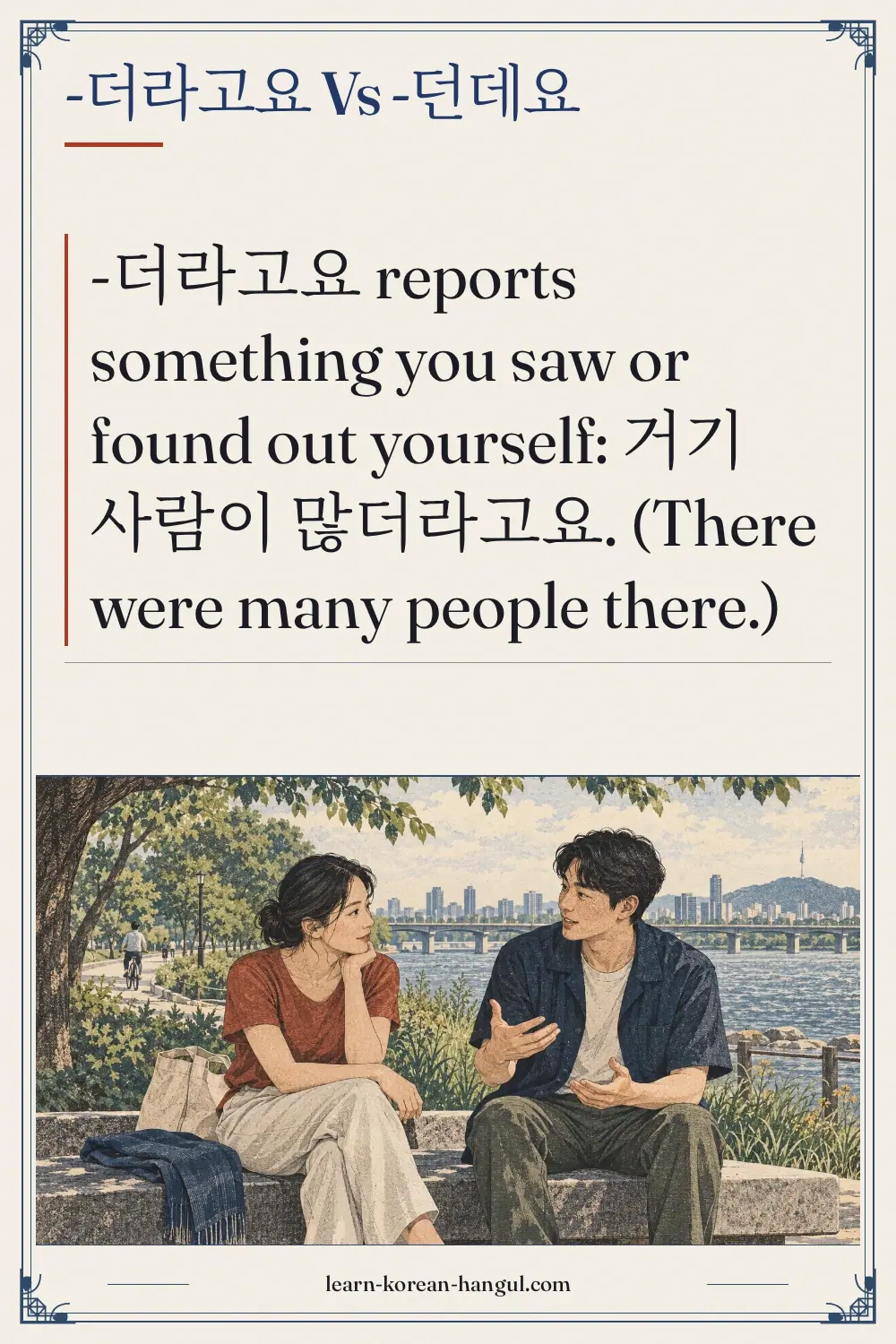
- -더라고요 reports something you saw or found out yourself, often with a sense of discovery.
- -던데요 reports it as background and invites a reaction. It often hints at advice, a contrast or a request.
What you'll learn
- Say which ending shares an observation and which one leaves a hint.
- Build both endings for verbs, adjectives and 이다, including the past form.
- Choose the right ending for five sentences and give the reason.
- Avoid the most common mistakes, such as using them for your own deliberate actions.
Before you start: you should know the polite ending -아요/어요 and the past marker -았/었-. The full rules for each ending are on their own lesson pages, linked below. Audio plays only when you press a button.
What Is the Difference between -더라고요 and -던데요?
The difference is what the speaker wants to do with the news. Both endings carry the marker -더-. This marker says "I saw this myself at some earlier time". With -더라고요, the speaker shares what they saw, as a story or a discovery. With -던데요, the speaker gives what they saw as background, and the listener is expected to draw a conclusion or to react.
Here is the contrast in two sentences about the same place.
거기 사람이 많더라고요. (geogi sarami manteoragoyo) "There were many people there." Pronunciation: [거기 사라미 만터라고요]. The speaker went there, saw the crowd, and reports it.
거기 사람이 많던데요. (geogi sarami manteondeyo) "There were many people there (so be ready)." Pronunciation: [거기 사라미 만턴데요]. The facts are the same, but the sentence stops in the air. The listener may hear "so you should go early" or "so it may not be quiet".
Both sentences are polite and both come from a personal visit. The second sentence leaves room for the listener's answer. The next section puts the two endings side by side.
-더라고요 vs -던데요: Side-by-Side Table
The table compares the two endings on the points that decide the choice.
| Point | -더라고요 | -던데요 |
|---|---|---|
| Core meaning | "I saw/found that..." | "I saw that... (and so...)" |
| Purpose | share an experience or a discovery | lead in to advice, a contrast or a request |
| Sentence feeling | complete | open, with something left unsaid |
| Built from | -더- + -라고 + 요 | -더- + -ㄴ데 + 요 |
| Typical subject | other people, places, things; the speaker's own feelings | other people, places, things |
| Past version | -았/었더라고요 | -았/었던데요 |
| Casual form | -더라고 or -더라 | -던데 |
| More formal form | -더군요 | -더군요 or a plain past form |
| Example | 먹어 보니까 맛있더라고요. | 저는 그 영화 재미있던데요. |
Two notes sit behind the table. First, the shared marker -더- is a "retrospective" marker: it takes the speaker back to a moment in the past when they saw the thing. Second, both endings sound natural in polite speech (해요체). In careful writing, a plain past form such as 많았습니다 is the usual choice.
When Do You Use -더라고요?
Use -더라고요 when you want to tell someone what you saw, heard or found out yourself, and you want to share it without a hidden message. Add it to the plain stem of a verb or adjective, and use 이더라고요 after a noun. The stem does not change for irregular verbs, because the ending starts with a consonant.
| Dictionary form | Meaning | -더라고요 form | Spoken |
|---|---|---|---|
| 가다 | to go | 가더라고요 | [가더라고요] |
| 먹다 | to eat | 먹더라고요 | [먹떠라고요] |
| 많다 | to be many | 많더라고요 | [만터라고요] |
| 맛있다 | to be tasty | 맛있더라고요 | [마싣떠라고요] |
| 춥다 | to be cold | 춥더라고요 | [춥떠라고요] |
| 학생 (noun) | a student | 학생이더라고요 | [학쌩이더라고요] |
The irregular verbs 춥다 and 듣다 (to listen) keep their stems before -더라고요: 춥더라고요, 듣더라고요. A ㄹ stem keeps its ㄹ as well: 살더라고요 ("he was living..."). For the past, add -았/었: 갔더라고요 [갇떠라고요] ("he had gone").
Here are four common scenes.
- A discovery from your own trial. 직접 먹어 보니까 맛있더라고요. (jikjeop meogeo bonikka masitdeoragoyo) "When I tried it myself, it was tasty." Pronunciation: [직쩝 머거 보니까 마싣떠라고요]. The pattern -아/어 보니까 + -더라고요 is a very common way to report a discovery.
- A scene from a trip. 서울은 겨울에 정말 춥더라고요. (seoureun gyeure jeongmal chupdeoragoyo) "Seoul was really cold in winter (as I found)."
- A surprise about a person. 선생님이 아주 젊으시더라고요. (seonsaengnimi aju jeolmeusideoragoyo) "The teacher was very young." The honorific -(으)시- goes before -더라고요 when the subject deserves respect.
- The speaker's own state. 어제는 정말 피곤하더라고요. (eojeneun jeongmal pigonhadeoragoyo) "I was really tired yesterday (I noticed)." The speaker uses -더라고요 for a feeling that they noticed, not for a decision.
The casual forms are -더라고 and -더라, as in 맛있더라 ("It was tasty"). For the full rules, read the lesson on -더라고요.
When Do You Use -던데요?
Use -던데요 when you report what you saw as background for a hint, a contrast or a request. The ending is built from the same retrospective marker -더-, the connector -ㄴ데 (which sets the scene) and the polite 요. The sentence sounds unfinished on purpose, and the listener supplies the rest.
Here are four typical uses.
- A soft disagreement. 저는 그 영화 재미있던데요. (jeoneun geu yeonghwa jaemiitdeondeyo) "I found that movie fun (though you say it wasn't)." Pronunciation: [재미읻떤데요]. The speaker contrasts their own experience with someone else's.
- A hint to go somewhere. 그 식당 맛있던데요. (geu sikdang masitdeondeyo) "That restaurant was tasty (so you might try it)." Pronunciation: [마싣떤데요].
- A tip about where someone is. 민수 씨가 회사에 있던데요. (minsu ssiga hoesae itdeondeyo) "Minsu was at the office (so you can find him there)." Pronunciation: [읻떤데요].
- A warning. 밖에 비가 오던데요. 우산 가져가세요. (bakke biga odeondeyo. usan gajyeogaseyo.) "It was raining outside. Take an umbrella."
The sentences show that -던데요 works well when there is a next step. In sentence 4 the second sentence says it aloud, but the first one already hints at it. For the full rules, read the lesson on -던데요.
Can You Use Both in the Same Sentence?
Many sentences accept either ending, and the difference lies in what the listener hears. Compare two ways to praise a cafe.
- 그 카페 커피가 맛있더라고요. "The coffee at that cafe was good (I found)." The speaker shares a discovery.
- 그 카페 커피가 맛있던데요. "The coffee at that cafe was good (so maybe go)." The speaker also recommends.
You can chain the two in a short talk: 가 보니까 사람이 많더라고요. 줄이 길던데요. (ga bonikka sarami manteoragoyo. juri gildeondeyo.) The first sentence tells what happened, and the second adds a detail that warns the listener. A speaker often uses -더라고요 for the story and -던데요 for the warning.
If you are unsure, use -더라고요. It does not suggest a hidden message, so it is hard to misread. Use -던데요 when you really want the hint.
How Does a Conversation Use Both Endings?
A short dialogue shows how the two endings split the work. Two friends talk about a new bakery.
A: 어제 새로 생긴 빵집에 갔어요? (eoje saero saenggin ppangjibe gasseoyo?) "Did you go to the new bakery yesterday?"
B: 네, 빵이 정말 맛있더라고요. (ne, ppangi jeongmal masitdeoragoyo.) "Yes, the bread was really tasty."
A: 사람은 많았어요? (sarameun manasseoyo?) "Were there many people?"
B: 줄이 길던데요. 일찍 가세요. (juri gildeondeyo. iljjik gaseyo.) "The line was long, you know. Go early."
In the first answer, speaker B shares a discovery, so -더라고요 fits. In the second answer, speaker B gives a fact that leads to advice, and the advice follows in the next sentence. Notice that -던데요 does not need the advice to be spoken. If B had stopped after 줄이 길던데요, speaker A would still have understood the warning. This is the real power of the ending: it lets the listener complete the thought, and that makes it sound polite and indirect.
How Do the Speech Levels Change These Endings?
Both endings sit in the polite style (해요체) when they end in 요. You can drop 요 to speak casually, and you can change the ending for formal situations.
| Style | -더라고요 family | -던데요 family |
|---|---|---|
| Casual (반말) | 맛있더라고, 맛있더라 | 맛있던데 |
| Polite (해요체) | 맛있더라고요 | 맛있던데요 |
| More formal | 맛있더군요 | 맛있더군요, 맛있었습니다 |
The more formal -더군요 (-deogunyo) is a way to comment on something you have noticed, and it sounds careful or a little old-fashioned in conversation. The casual forms are for friends. The choice between the two endings stays the same at every level: share (-더라고) or hint (-던데).
Which One Should You Pick? a Simple Rule of Thumb
Ask three questions in order.
- Did you see or experience it yourself? If not, neither ending fits. Use -대요 for hearsay. Example: 내일 비가 온대요. "I heard it will rain tomorrow."
- Do you only want to tell the story? If yes, use -더라고요. Example: 가 보니까 예쁘더라고요.
- Do you want the listener to take a hint, to compare, or to answer? If yes, use -던데요. Example: 그 길은 막히던데요. ("That road was jammed, you know.")
If you want to say what is true now, and you see it now, use the present -(으)ㄴ데요 instead: 비가 오는데요 means "It is raining (right now)". The -던데요 form points back to what you saw earlier.
What Mistakes Do Learners Make with These Two?
The mistakes come from forgetting that -더- belongs to what the speaker saw. Five of them appear again and again.
- Using them for your own deliberate action. 어제 제가 학교에 가더라고요 sounds like you watched yourself from outside. Say 어제 학교에 갔어요.
- Using them for hearsay. If you only heard it, use -대요, not 많더라고요.
- Using them for plans. A plan or a future event cannot be observed. Say 내일 갈 거예요, not 내일 가더라고요.
- Changing the stem of an irregular verb. The form 추워더라고요 is wrong. Say 춥더라고요, because -더- starts with a consonant.
- Mixing -던데요 with -(으)ㄴ데요. 비가 오던데요 reports what you saw earlier. 비가 오는데요 reports what you see now.
A quick self-check: ask "Did I see this myself, and was it before now?" If both answers are yes, one of the two endings can work.
Practice: Choose the Right Ending
Try the five questions, then read the answers below.
Practice · 5
You visited a shop and want to tell a friend what you found, with no hint. Which sentence fits? 그 가게는 물건이 정말 ___.
Show answer
많더라고요
You saw it yourself and you simply share the news, so -더라고요 fits.
You want to hint that your friend should try a restaurant. Which sentence fits? 그 식당 ___.
Show answer
맛있던데요
Reporting your own experience as background with an open end suits -던데요.
You only heard from a friend that it will be cold tomorrow. Which ending is right?
Show answer
내일은 춥대요.
Neither -더라고요 nor -던데요 fits hearsay or the future. -대요 reports what you heard.
Which form of 춥다 is correct before -더라고요?
Show answer
춥더라고요
The ㅂ irregular change happens only before a vowel. -더- starts with a consonant.
You see rain right now. Which sentence fits?
Show answer
비가 오는데요.
For what you see now, use the present -(으)ㄴ데요. -던데요 and -더라고요 look back at an earlier moment.
Answer key
- 많더라고요. The sentence is 그 가게는 물건이 정말 많더라고요.
- 맛있던데요. The sentence is 그 식당 맛있던데요.
- 내일은 춥대요.
- 춥더라고요.
- 비가 오는데요.
Now write your own pair: one sentence that shares something you found on a trip with -더라고요, and one sentence that hints at a tip with -던데요.
What Should You Learn Next?
After this comparison, study each ending on its own lesson page, then look at the other pairs on the list.
- Learn the full rules for -더라고요, including the casual forms.
- Learn the full rules for -던데요, including its use as a connector.
- Compare other confusable pairs on Confusing Grammar Compared.
- See where both endings sit on the Intermediate Grammar list.
Frequently Asked Questions
What Is the Difference between -더라고요 and -던데요?
Both report something the speaker saw or experienced. -더라고요 states the observation, often with a note of discovery, as in "I found that...". -던데요 states it as background and leaves the next step to the listener, so it often hints at advice, a contrast or a request.
Can I Always Replace -더라고요 with -던데요?
Often you can, but the feeling changes. 맛있더라고요 shares your experience. 맛있던데요 also suggests that the listener may want to try it, or that you disagree with someone. If you only want to state what you saw, -더라고요 is the safer choice.
Which One Sounds More Natural in Speech?
Both are natural in everyday polite speech. -더라고요 suits stories and reports about your own experiences. -던데요 is common when you give a soft opinion or a hint. Neither is a good fit for formal writing, where -더군요 or a plain past form is usual.
Which One Appears More Often on TOPIK?
This site does not publish exam statistics. Both endings are taught at the intermediate stage and are common in dialogue. For current exam content, check the level descriptions and past papers on the official TOPIK site, topik.go.kr.
What Is the Quickest Rule to Remember?
Ask what you want the listener to do with your news. If you only want to share it, use -더라고요. If you want to hint at a conclusion, a contrast or advice without saying it, use -던데요.