What you'll learn
- Attach -더라고요 to any verb or adjective stem, with no stem changes.
- Share a personal discovery, review or surprise in polite Korean.
- Tell -더라고요 from the plain past -았/었어요 and from -던데요 and -네요.
- Use -았/었더라고요 for something that had already happened when you noticed.
- Spell the ending correctly and avoid using it for your own deliberate actions.
Before you start: you should know how to find a stem (drop 다 from the dictionary form) and the polite ending -아요/어요. If you have read the page on -던데요, the retrospective idea will already be familiar. Audio plays only when you press a button.
What Does -더라고요 Grammar Mean?

-더라고요 grammar means "I noticed that..." or "I found that..." and reports a discovery from your own experience. It has two working parts. The syllable 더 is a retrospective marker, which means "I look back at something I saw, heard or felt at that time." The rest, 라고요, closes the sentence politely, as if you were telling the listener, "That is what I found."
Here are the first two examples. The first shares an opinion based on experience. The second reports what the speaker saw.
- 그 식당 음식이 맛있더라고요. (geu sikdang eumsigi masitdeoragoyo.) [그 식땅 음시기 마싣떠라고요] = "The food at that restaurant was tasty (I found)."
- 어제 비가 많이 오더라고요. (eoje biga mani odeoragoyo.) [어제 비가 마니 오더라고요] = "It was raining a lot yesterday (I saw)."
Compare 맛있었어요 and 맛있더라고요. The plain past 맛있었어요 states that the food was tasty. The ending 맛있더라고요 adds who found out and how: "I tried it and discovered that it was tasty." That personal view is the core of the pattern, and the reason it is so popular for reviews, recommendations and small talk. Next comes the mechanism that builds the pattern.
How Do You Form -더라고요?
-더라고요 is formed by dropping 다 from the dictionary form and adding -더라고요. Nothing else changes. The same rule works for vowel stems, consonant stems, adjectives and irregular verbs, because 더 starts with a consonant and never triggers a stem change.
| Dictionary form | Stem | Add -더라고요 | Meaning |
|---|---|---|---|
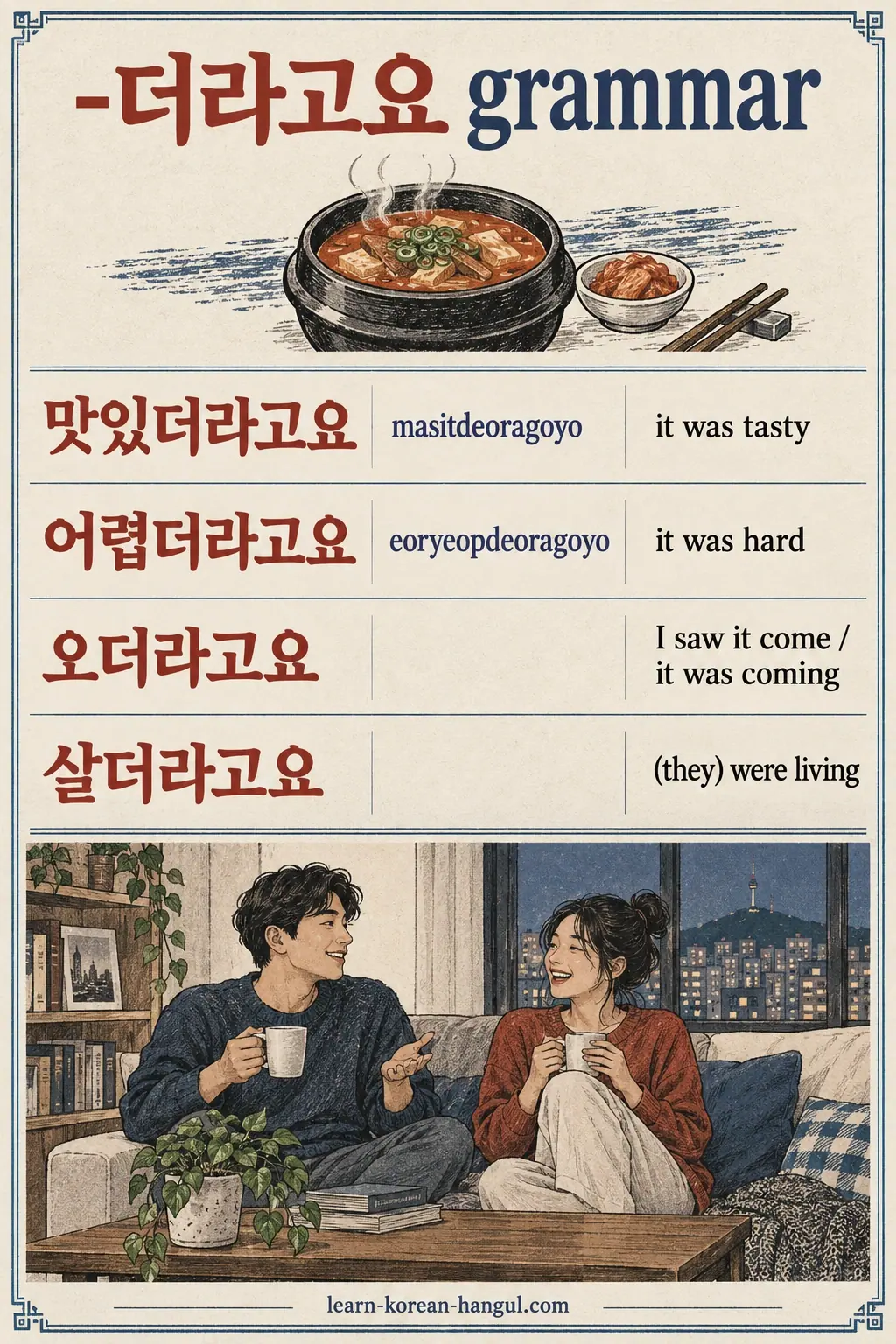
| 오다 | 오 | 오더라고요 | I saw it come / it was coming |
| 잘하다 | 잘하 | 잘하더라고요 | (they) were good at it |
| 맛있다 | 맛있 | 맛있더라고요 | it was tasty |
| 어렵다 | 어렵 | 어렵더라고요 | it was hard |
| 살다 | 살 | 살더라고요 | (they) were living |
| 듣다 | 듣 | 듣더라고요 | (they) were listening |
The table shows one rule applied to six words. The next three parts look at the groups of stems one at a time.
Stems Ending in a Vowel
A vowel stem takes -더라고요 directly. 오다 becomes 오더라고요, 세다 ("to be strong") becomes 세더라고요, and 잘하다 becomes 잘하더라고요. Examples:
- 제주도는 바람이 정말 세더라고요. (jejudoneun barami jeongmal sedeoragoyo.) [제주도는 바라미 정말 세더라고요] = "The wind on Jeju was really strong."
- 그 사람 한국어를 정말 잘하더라고요. (geu saram hangugeoreul jeongmal jalhadeoragoyo.) [그 사람 한구거를 정말 잘하더라고요] = "That person speaks Korean really well."
Vowel stems are the simplest case. A stem with a final consonant looks different on the page but follows the same rule.
Stems Ending in a Consonant
A consonant stem also takes -더라고요 directly, with no linking vowel. Compare this with endings such as -으세요, which need 으 after a consonant. For -더라고요, 맛있다 becomes 맛있더라고요, and 어렵다 becomes 어렵더라고요.
The spelling stays 맛있더 and 어렵더, but the sound changes. After a final ㅆ, ㅂ or ㄱ sound, the ㄷ of 더 is pronounced tense, so you hear [마싣떠라고요] and [어렵떠라고요]. This follows the standard pronunciation rules (표준 발음법) of the 국립국어원 (National Institute of Korean Language). Revised Romanization does not show this kind of tensing, so the two words are masitdeoragoyo and eoryeopdeoragoyo.
- 생각보다 어렵더라고요. (saenggakboda eoryeopdeoragoyo.) [생각뽀다 어렵떠라고요] = "It was harder than I thought."
Two more groups need a short note, because learners expect trouble with them.
Irregular Stems and Nouns
Irregular stems do not change before -더라고요. ㄷ-, ㅂ- and 르-irregular stems change only before an ending that starts with a vowel, and ㄹ-stems lose ㄹ only before ㄴ, ㅂ or ㅅ. The syllable 더 starts with a consonant, so the dictionary stem stays whole:
- ㄷ-irregular: 듣다 stays 듣더라고요 (not 들더라고요).
- ㅂ-irregular: 춥다 stays 춥더라고요 [춥떠라고요], and 돕다 stays 돕더라고요.
- ㄹ-stems: 살다 stays 살더라고요, and 만들다 stays 만들더라고요.
- 르-verbs: 모르다 stays 모르더라고요.
The copula 이다 gives 이더라고요 after a noun: 그분이 선생님이더라고요 ("It turned out that person was a teacher"). In speech, the 이 after a vowel often disappears (의사더라고요). With the formation clear, one full sentence can be built step by step.
Worked Example: Building a Sentence with -더라고요

-더라고요 grammar works by turning a plain statement into a personal finding. Follow the steps with the sentence "My younger sibling sings well."
- Start with the plain sentence. 동생이 노래를 잘 불러요. (dongsaengi noraereul jal bulleoyo.) = "My younger sibling sings well." The verb is 불러요.
- Find the dictionary form. 불러요 comes from 부르다 (to sing, to call). It is a 르-irregular verb. The dictionary stem is 부르.
- Go back to the whole stem. The ending 더라고요 begins with a consonant, so the 르 does not split: 부르 stays 부르.
- Add -더라고요 to the stem. 부르 + 더라고요 = 부르더라고요.
- Rebuild the sentence. Keep everything before the verb: 동생이 노래를 잘 부르더라고요. (dongsaengi noraereul jal bureudeoragoyo.) = "My younger sibling sings well (I found)."
Sentence
You will know it worked when the subject, object and adverb stay in place and only the last word changes from 불러요 to 부르더라고요. The most common slip at this step is to keep the changed stem 불러 (불러더라고요). Always work from the dictionary stem. The sentence now reports a finding, and the next question is how it behaves across tenses and sentence types.
Which Tenses and Sentence Types Work with -더라고요?
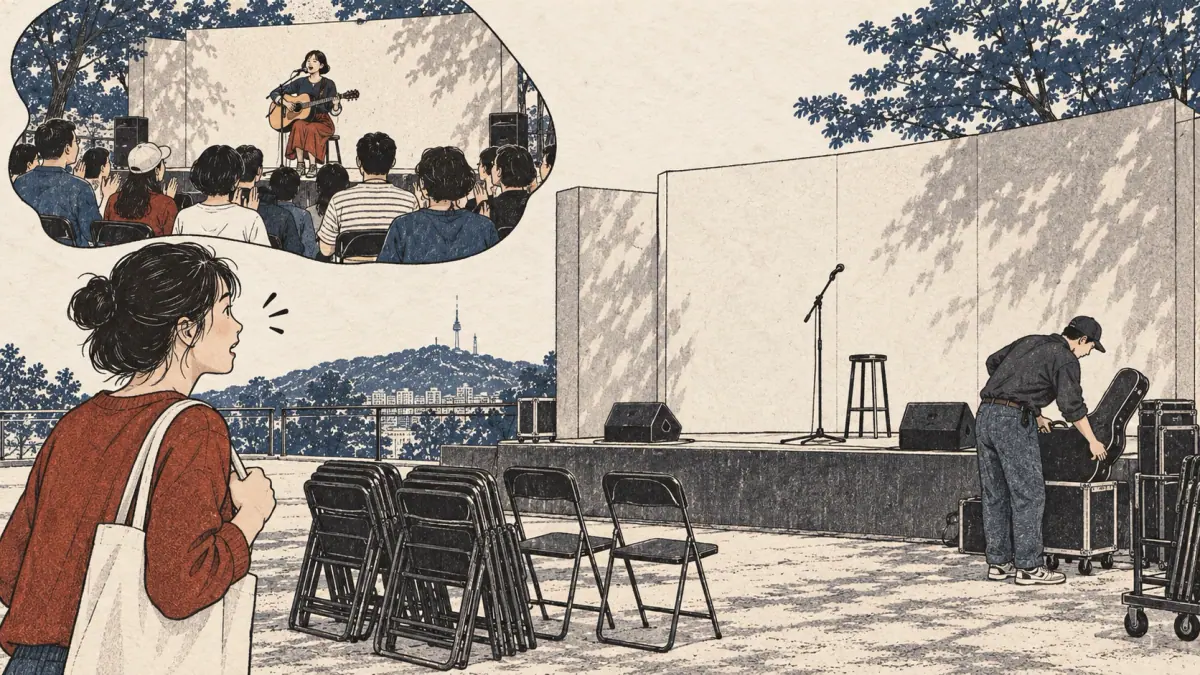
-더라고요 works for things observed at the time and things already finished, in statements, with polite and honorific forms. The change happens before 더라고요. The table shows the forms for 오다.
| Type | Form | Meaning |
|---|---|---|
| Observed in progress or as a state | 오더라고요 | I saw it come / it was coming. |
| Seen as already finished | 왔더라고요 | I found that it had come. |
| Negative | 안 오더라고요 | I found that it wasn't coming. |
| Honorific | 오시더라고요 | I saw that (respected person) came. |
| Reported speech | 온다고 하더라고요 | (They) said they were coming. |
| Casual (banmal) | 오더라고 | I saw it come (to a friend). |
| More formal | 오더군요 | I noticed that it came (a more composed tone). |
The ending already points to the past, because the speaker is remembering. You need -았/었 only when the event was complete when you noticed it: 가 보니까 벌써 끝났더라고요 (ga bonikka beolsseo kkeunnatdeoragoyo.) [가 보니까 벌써 끈낟떠라고요] = "When I went, it had already ended." Without -았/었, 끝나더라고요 would say that it was ending as you watched.
The subject is usually someone or something other than your own plan. A special case is your own state, which you discover as if from outside: 알고 보니 제가 많이 피곤했더라고요 (algo boni jega mani pigonhaetdeoragoyo.) [알고 보니 제가 마니 피곤핻떠라고요] = "It turned out that I was very tired." This is natural because you did not choose the tiredness. It does not fit deliberate actions.
Questions and commands do not fit this ending. The most useful contrast for a learner is next to the neighbouring ending that also reports an observation.
How Is -더라고요 Different from -던데요?

-더라고요 reports an observation as a finished finding, while -던데요 reports an observation that points toward the listener's situation. Both use the retrospective -더-, so both are first-hand. The difference is the feel of the ending. 더라고요 is closed: it says "that is what I found." 던데요 is open: it hints "so...". The full rules for the second pattern are on the page for -던데요, and the side-by-side lesson is -더라고요 vs -던데요.
| Point | -더라고요 | -던데요 |
|---|---|---|
| Meaning | I noticed that... (a finding) | I saw that... (and you may want to know) |
| Feel | closed, a discovery or a story | open, implies a link to the listener |
| Typical sense | surprise, personal experience | advice, contrast, background |
| Example | 그 식당 음식이 맛있더라고요. | 그 가게 문 닫았던데요. |
| Meaning of example | The food there was tasty (I found). | That shop was closed (so don't go). |
A second neighbour is -네요, which marks a discovery happening now: 맛있네요 means "Oh, this is tasty!" while you are eating. 맛있더라고요 reports the discovery afterwards. A third neighbour is the plain past 맛있었어요, which states the fact without showing how you know. These contrasts lead to the smaller variations of the pattern itself.
Variations and Edge Cases of -더라고요
-더라고요 has four common variations: a casual shape, a reported-speech shape, an honorific shape and a formal counterpart. Each is short, and each appears in real conversation.
- Casual -더라고 and -더라. With friends, 요 drops: 맛있더라고 or 맛있더라. The shorter -더라 has its own page, -더라.
- Reported speech with 하더라고요. To report what someone said in front of you, put -다고 before 하더라고요: 친구가 내일 온다고 하더라고요. (chinguga naeil ondago hadeoragoyo.) [친구가 내일 온다고 하더라고요] = "My friend said he is coming tomorrow." You heard the words yourself.
- The honorific -시-. For a respected subject, add -시- before 더: 선생님도 일찍 오시더라고요. (seonsaengnimdo iljjik osideoragoyo.) = "The teacher also came early."
- The formal counterpart -더군요. In more formal talk and in writing, speakers use 더군요. The meaning is close, but the tone is more composed and less chatty.
This lesson covers the polite ending used in daily life, not every use of the retrospective -더-. The mistakes below show where the boundary with other patterns causes real errors.
What Mistakes Do Learners Make with -더라고요?

Learners most often use the ending for the wrong kind of knowledge, use it for their own deliberate acts, or misspell it. Four mistakes appear again and again.
- Using it for things you did not experience. 서울은 한국의 수도더라고요 is odd, because you did not discover a general fact by seeing it. Use -예요/이에요 for facts and -대요 for hearsay.
- Using it for your own deliberate acts. 저는 어제 도서관에 가더라고요 is wrong, because you chose to go. Use 갔어요 or 갔는데요. Only unplanned states work, as in 제가 피곤했더라고요.
- Spelling it -더라구요. Many people say and text -더라구요, but the standard spelling is -더라고요.
- Mixing it up with the present discovery -네요. If the discovery is happening now, use -네요. 맛있더라고요 looks back on the experience.
A quick check for any sentence: Did you see, hear or feel it yourself? Is it a finding, not a plan? Is the ending spelled -더라고요? If all three answers are yes, the sentence is sound.
The practice set below tests these points directly.
Practice and Answers
Try the four items before you read the answer key. Cover the answers with your hand.
- Choose the form. Complete: 어제 그 카페에 가 봤는데 커피가 정말 ___. (맛있더라고요 / 맛있네요)
- Fix the error. A learner texts 그 영화 재미있더라구요. Correct the spelling.
- Translate. "I found that the weather was very hot." Use 덥다 and the polite style.
- Write your own. Write one sentence about a place you visited, using -더라고요. Then change it to "When I got there, it had already closed" with -았/었더라고요.
Practice · 6
Which sentence is spelled correctly?
Show answer
재미있더라고요.
The standard spelling of the ending is 더라고요. 더라구요 is a common spoken spelling but non-standard.
Which sentence is NOT natural with -더라고요?
Show answer
저는 어제 학교에 가더라고요.
Your own deliberate action cannot be reported as a discovery. Use 갔어요.
How do you say "When I got there, it had already ended"?
Show answer
가 보니까 벌써 끝났더라고요.
-았/었더라고요 shows that the event was complete when you noticed it.
Which form of 부르다 (to sing) is correct? 동생이 노래를 잘 ___.
Show answer
부르더라고요
-더라고요 starts with a consonant, so the 르 stem stays whole: 부르 + 더라고요.
You ate at a restaurant last week and recommend it now. Which ending fits? 그 식당 음식이 ___.
Show answer
맛있더라고요
-더라고요 looks back on your own experience. -네요 is for a taste you notice right now, and -(으)ㄹ 거예요 is a guess.
A friend told you in person that he is coming tomorrow. Report it: 친구가 내일 ___.
Show answer
온다고 하더라고요
To report words you heard yourself, put -다고 before 하더라고요.
Answer key
- 맛있더라고요. You tried the coffee earlier and are reporting your finding: 어제 그 카페에 가 봤는데 커피가 정말 맛있더라고요. 맛있네요 is for a taste you notice right now.
- 그 영화 재미있더라고요. The standard spelling is 더라고요, with 고.
- 날씨가 정말 덥더라고요. (nalssiga jeongmal deopdeoragoyo.) [날씨가 정말 덥떠라고요] = "I found that the weather was really hot." The stem 덥 stays whole before 더라고요.
- Answers vary. Check that the stem comes before 더라고요 and the finished version uses -았/었더라고요. An example: 그 카페는 사람이 많더라고요 → 가 보니까 그 카페는 벌써 문을 닫았더라고요. (The café was crowded → When I got there, the café had already closed.)
If you can complete items 1 to 3 without the key, you can use the ending in conversation. Next, the lesson hands off to related patterns.
What Should You Learn Next after -더라고요 Grammar?
After -더라고요 grammar, learn the open observation ending, then the immediate discovery ending. This lesson teaches the personal finding and does not cover hearsay forms, discoveries happening right now or the casual -더라 in depth. Those live on their own pages.
- Start with -던데요, which reports an observation with an open hint for the listener.
- Continue with -네요, which marks a discovery happening right now.
- Compare the pair side by side in -더라고요 vs -던데요.
- See banmal for the casual endings, then return to Exclamations and Realization to see every lesson in this set, or to the Intermediate Grammar list for other B1 patterns.
With these steps, -더라고요 becomes automatic: take the plain stem, add 더라고요, and share only what you found yourself.
Frequently Asked Questions
What does -더라고요 mean?
-더라고요 means "I noticed that..." or "I found that..." It reports a discovery you made yourself. 그 식당 음식이 맛있더라고요 means "I found the food at that restaurant tasty." The ending adds a feeling of fresh experience, often with mild surprise, and invites the listener to share your view.
How do I attach -더라고요 to a verb or adjective?
Drop 다 and add -더라고요 to the stem with no change: 오다 becomes 오더라고요, 맛있다 becomes 맛있더라고요, and 춥다 becomes 춥더라고요. Verbs and adjectives behave the same way, and irregular stems stay whole. For a finished event, use -았/었더라고요: 끝났더라고요 means "it had ended."
Can -더라고요 be used in the past tense?
The ending already points to a past observation, so it needs no extra marker for that. Add -았/었 only when the event was complete at the time you noticed: 가 보니까 벌써 끝났더라고요 means "When I got there, it had already ended." Plain 맛있더라고요 means the food was tasty when you ate it.
Is -더라고요 used in speech or only in writing?
It belongs to speech. With friends the casual -더라고 or -더라 is common, and with others -더라고요 is polite. In more formal speech and in written narration, -더군요 appears. Spoken stories, reviews and friendly reports are where you will hear -더라고요 most often.
What is the most common mistake with -더라고요?
The most common mistake is using it for your own deliberate action, as in 저는 어제 도서관에 가더라고요, which is wrong. The ending reports something you observed or discovered. A second slip is spelling it -더라구요; the standard spelling is -더라고요.