Key facts
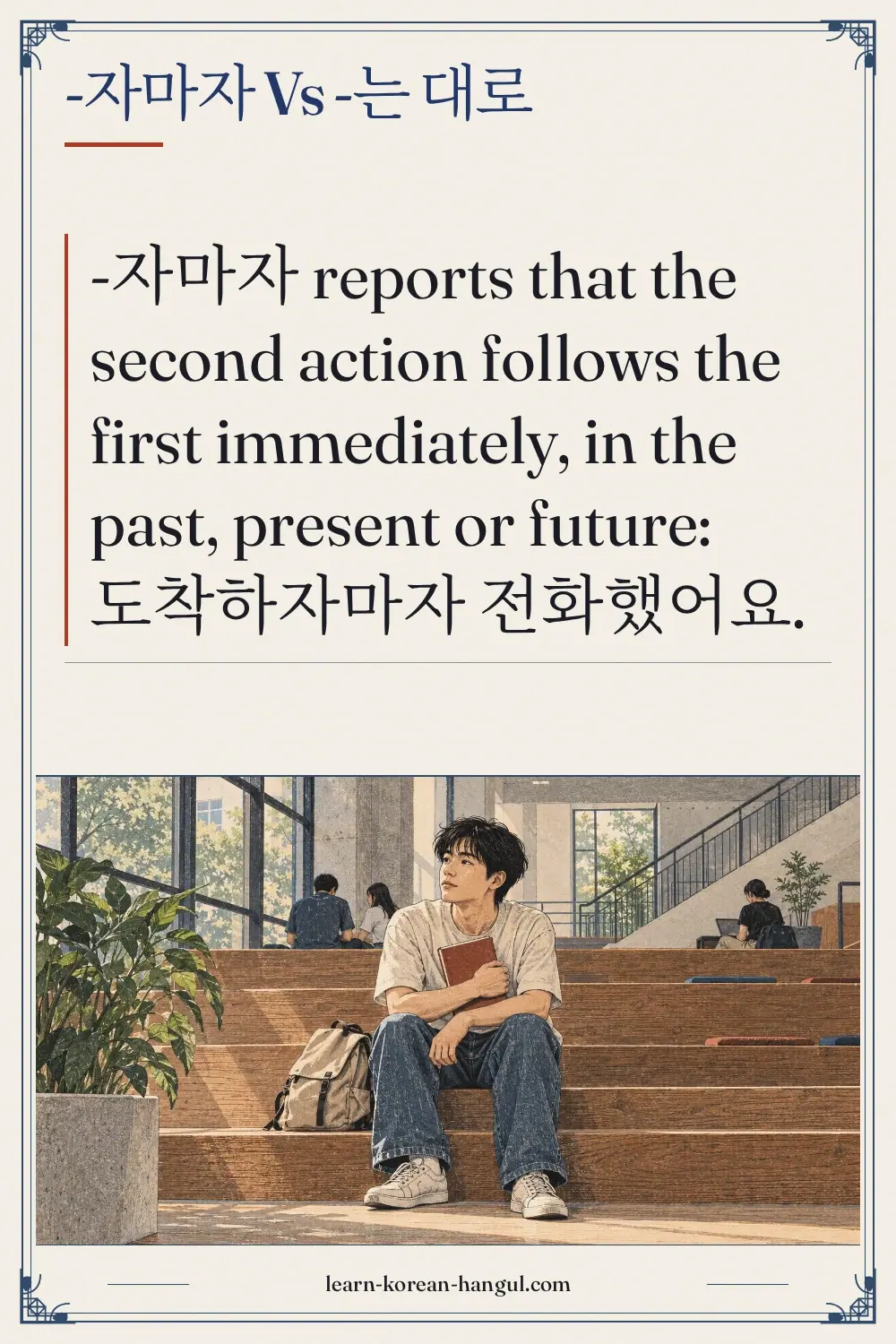
- -자마자 attaches to the bare verb stem and reports that the second action follows the first immediately. The subjects may be the same or different, and the story can be past, present or future.
- -(으)ㄴ/는 대로 has two meanings. This page compares the first, "as soon as", which usually points to the future. The second means "in the way that".
- Neither pattern takes a tense ending inside it.
What you'll learn
- Say which pattern reports an immediate sequence and which one makes a promise.
- Build both patterns from a verb, including ㄹ stems and irregular stems.
- Choose the right pattern for five sentences and give the reason.
- Avoid the main traps: past stories with -는 대로, tense endings and spacing.
Before you start: you should know the polite ending -아요/어요, the past tense and the modifier ending -는. The full rules for each pattern are on their own lesson pages, named below. Audio plays only when you press a button.
What Is the Difference between -자마자 and -는 대로?
The difference is what the sentence is for. Both patterns say that the second action comes right after the first. But -자마자 describes a sequence, and -는 대로 sets up an intention.
With -자마자 the speaker pictures two actions with almost no gap between them. The sentence can be about the past, the present or the future, and the second action can happen without anyone planning it. With -는 대로 the speaker usually has a plan, and the second action is a promise, a request or an instruction that depends on the first.
Here are two sentences about the same arrival.
도착하자마자 전화했어요.
dochakajamaja jeonhwahaesseoyo
I called as soon as I arrived.
Pronunciation: [도차카자마자 전화해써요]. The speaker tells what happened. The call came right after the arrival, and nothing was promised in advance.
도착하는 대로 전화할게요.
dochakaneun daero jeonhwahalgeyo
I will call as soon as I arrive.
Pronunciation: [도차카는 대로 전화할께요]. The speaker makes a promise about the future. The arrival is the trigger, and the call is the commitment.
The first sentence is a report. The second is a plan. The next section lines the two patterns up in a table.
-자마자 vs -는 대로: Side-by-Side Table
The table compares the two patterns on the points that decide the choice.
| Point | -자마자 | -(으)ㄴ/는 대로 ("as soon as") |
|---|---|---|
| Core meaning | the moment that | as soon as |
| What the sentence does | reports an immediate sequence | sets up a promise, a request or an instruction |
| Time of the main clause | past, present or future | usually future, a request or a command |
| Form on the verb | bare stem + 자마자 | stem + 는 + 대로 |
| Tense inside the pattern | none | none |
| Subject | same or different | same or different |
| Verbs only? | action verbs | action verbs |
| Second meaning | none | "in the way that": 시키는 대로 |
| Spacing | one word: 도착하자마자 | two words: 도착하는 대로 |
| Example | 집에 오자마자 잠들었어요. | 결과가 나오는 대로 알려 드릴게요. |
How Do You Form the Two Patterns?
-자마자 takes the bare stem of an action verb: you remove 다 and add 자마자. -는 대로 takes the modifier -는 and then the dependent noun 대로, written as a separate word.
| Dictionary form | Meaning | -자마자 | -는 대로 |
|---|---|---|---|
| 먹다 | to eat | 먹자마자 [먹짜마자] | 먹는 대로 [멍는 대로] |
| 오다 | to come | 오자마자 | 오는 대로 |
| 도착하다 | to arrive | 도착하자마자 [도차카자마자] | 도착하는 대로 [도차카는 대로] |
| 만들다 | to make | 만들자마자 | 만드는 대로 |
| 듣다 | to hear | 듣자마자 [듣짜마자] | 듣는 대로 [든는 대로] |
After a stem that ends in a stop sound such as ㄱ or ㄷ, the ㅈ of -자마자 becomes tense, so 먹자마자 sounds like 먹짜마자. After ㄹ there is no tensing: 만들자마자 [만들자마자]. A stem that ends in ㄹ, such as 만들다, keeps the ㄹ before -자마자 but drops it before -는: 만들자마자 and 만드는 대로. The irregular verb 듣다 does not change its stem in either pattern.
When Do You Use -자마자?
Use -자마자 when you describe two actions in a row, and the second one follows the first at once. It suits stories, habits and reactions. It is a neutral pattern that you can use in speech and in writing.
Here are five typical uses.
- A story. 집에 오자마자 잠들었어요. (jibe ojamaja jamdeureosseoyo) "I fell asleep as soon as I got home." Pronunciation: [지베 오자마자 잠드러써요].
- Different subjects. 비가 그치자마자 해가 나왔어요. (biga geuchijamaja haega nawasseoyo) "As soon as the rain stopped, the sun came out." Pronunciation: [비가 그치자마자 해가 나와써요].
- A habit. 눈을 뜨자마자 휴대폰을 봐요. (nuneul tteujamaja hyudaeponeul bwayo) "I look at my phone the moment I open my eyes." Pronunciation: [누늘 뜨자마자 휴대포늘 봐요].
- A reaction. 그 소식을 듣자마자 울었어요. (geu sosigeul deutjamaja ureosseoyo) "I cried the moment I heard the news." Pronunciation: [그 소시글 듣짜마자 우러써요].
- A request. 도착하자마자 연락하세요. (dochakajamaja yeollakaseyo) "Please get in touch the moment you arrive." Pronunciation: [도차카자마자 열라카세요]. A request is possible because the main clause can take any ending.
집에 오자마자 잠들었어요.
jibe ojamaja jamdeureosseoyo
I fell asleep as soon as I got home.
비가 그치자마자 해가 나왔어요.
biga geuchijamaja haega nawasseoyo
As soon as the rain stopped, the sun came out.
눈을 뜨자마자 휴대폰을 봐요.
nuneul tteujamaja hyudaeponeul bwayo
I look at my phone the moment I open my eyes.
Notice that the first verb carries no tense. The tense of the whole sentence sits on the last verb: 잠들었어요, 나왔어요, 봐요. For the full rules, read the lesson on -자마자.
When Do You Use -(으)ㄴ/는 대로?
Use -(으)ㄴ/는 대로 for "as soon as" when you make a promise, ask someone to do something or give an instruction. The main clause is usually in the future or is a request. The pattern says "when the first thing happens, the second thing follows by plan".
Here are four typical uses.
- A promise. 결과가 나오는 대로 알려 드릴게요. (gyeolgwaga naoneun daero allyeo deurilgeyo) "I will let you know as soon as the results come out." Pronunciation: [결과가 나오는 대로 알려 드릴께요].
- A request. 집에 도착하는 대로 연락 주세요. (jibe dochakaneun daero yeollak juseyo) "Please contact me as soon as you get home." Pronunciation: [지베 도차카는 대로 열락 주세요].
- A plan. 시간이 나는 대로 청소할 거예요. (sigani naneun daero cheongsohal geoyeyo) "I will clean as soon as I have time." Pronunciation: [시가니 나는 대로 청소할꺼예요].
- The second meaning. 제가 시키는 대로 하세요. (jega sikineun daero haseyo) "Do as I tell you." Here 대로 means "in the way that", and the sentence has nothing to do with time.
결과가 나오는 대로 알려 드릴게요.
gyeolgwaga naoneun daero allyeo deurilgeyo
I will let you know as soon as the results come out.
시간이 나는 대로 청소할 거예요.
sigani naneun daero cheongsohal geoyeyo
I will clean as soon as I have time.
제가 시키는 대로 하세요.
jega sikineun daero haseyo
Do as I tell you.
The two meanings of 대로 are easy to mix up, so read the context. 들은 대로 말했어요 (deureun daero malhaesseoyo) means "I told it just as I heard it", and it has nothing to do with speed. Pronunciation: [드른 대로 말해써요]. After a noun, 대로 is attached and means "as" or "according to": 예정대로 진행됐어요 (yejeongdaero jinhaengdwaesseoyo), "It went ahead as planned". Only after a verb modifier is 대로 written as a separate word. For the full rules, read the lesson on -(으)ㄴ/는 대로.
Can You Use Both in the Same Sentence?
In a request, both patterns fit and the meaning is almost the same. Compare these two.
- 도착하자마자 연락하세요. "Contact me the moment you arrive."
- 도착하는 대로 연락하세요. "Contact me as soon as you arrive."
Both ask for a contact right after arrival. The first stresses that the contact should be immediate. The second stresses that the contact is the next step on your plan. In practice, speakers choose either and are understood the same way.
The overlap ends in two places. First, for a past story, only -자마자 works: 도착하자마자 샤워했어요 is natural, while 도착하는 대로 샤워했어요 sounds wrong because -는 대로 points ahead. Second, for the meaning "in the way that", only -는 대로 works: 시키는 대로 하세요 has no -자마자 version.
How Does a Conversation Use Both?
A short dialogue shows how the two patterns work in real talk. Two friends talk about a trip.
A: 지난번에는 도착하자마자 전화해 줬어요. 고마워요. (jinabeoneneun dochakajamaja jeonhwahae jwosseoyo. gomawoyo.) "Last time you called the moment you arrived. Thank you."
B: 이번에도 도착하는 대로 전화할게요. (ibeonedo dochakaneun daero jeonhwahalgeyo.) "This time too I will call as soon as I arrive."
지난번에는 도착하자마자 전화해 줬어요. 고마워요.
jinabeoneneun dochakajamaja jeonhwahae jwosseoyo. gomawoyo.
Last time you called the moment you arrived. Thank you.
Speaker A looks back at something that already happened, so A uses -자마자. Speaker B makes a promise about the next trip, so B uses -는 대로. The conversation would sound odd if A said 지난번에는 도착하는 대로 전화해 줬어요, because the call is already in the past.
Which One Should You Pick? a Simple Rule of Thumb
Ask three questions in order.
- Are you telling what happened, in the past or as a habit? If yes, use -자마자. Example: 집에 오자마자 잠들었어요.
- Are you promising, asking or planning what comes next? If yes, use -는 대로, although -자마자 is also possible in a request. Example: 도착하는 대로 전화할게요.
- Do you mean "in the way that", not "as soon as"? If yes, use -는 대로 only. Example: 제가 시키는 대로 하세요.
When you are not sure, choose -자마자 for events you can see and -는 대로 for future plans. If the sentence is a past story, -자마자 is the safe choice.
What Mistakes Do Learners Make with These Two?
Most mistakes come from treating the two patterns as identical. Five of them appear again and again.
- Using -는 대로 for a past story. 집에 오는 대로 잠들었어요 sounds wrong, because -는 대로 points ahead. Say 집에 오자마자 잠들었어요.
- Putting a tense inside -자마자. 도착했자마자 is wrong. The tense goes only on the final verb: 도착하자마자 전화했어요.
- Using -자마자 with an adjective or 이다. 날씨가 좋자마자 산책했어요 is wrong, because the first part must be an action. Say 날씨가 좋아지자마자 산책했어요 ("as soon as the weather got better").
- Writing 대로 without a space after a verb. Write 도착하는 대로, not 도착하는대로. After a noun, write 대로 attached: 예정대로.
- Using -자마자 for "as soon as possible". 오자마자 오세요 is wrong. Say 가능한 한 빨리 오세요 or 최대한 빨리 오세요.
A quick self-check: ask whether the first part is a finished fact or a coming event. If it is a fact, -자마자 fits. If it is an event you expect, -는 대로 fits.
Practice: Choose the Right Pattern
Try the five questions, then read the answers below.
Practice · 5
Which sentence is correct? (I called as soon as I arrived.)
Show answer
도착하자마자 전화했어요.
-자마자 joins the bare stem. The past tense goes only on the final verb, 전화했어요.
Which sentence best says "I fell asleep as soon as I got home"?
Show answer
집에 오자마자 잠들었어요.
A past story takes -자마자. -는 대로 points to the future.
Which sentence means "Do it the way I tell you"?
Show answer
제가 시키는 대로 하세요.
"In the way that" is the second meaning of -는 대로. -자마자 would mean "the moment I tell you".
Which spacing is correct?
Show answer
도착하는 대로 연락 주세요.
After a verb modifier, 대로 is a separate word. 연락 주세요 is also written with a space.
Which sentence is wrong?
Show answer
날씨가 좋자마자 산책했어요.
좋다 is an adjective. -자마자 needs an action verb, such as 좋아지다 (to get better).
Answer key
- 도착하자마자 전화했어요. The tense belongs only on the final verb.
- 집에 오자마자 잠들었어요. A past story takes -자마자.
- 제가 시키는 대로 하세요. The meaning is "in the way that", so only -는 대로 fits.
- 도착하는 대로 연락 주세요. After a verb, 대로 is a separate word.
- 날씨가 좋자마자 산책했어요. 좋다 is an adjective, so -자마자 cannot follow it.
Now write your own pair: one sentence about what you did the moment something happened, with -자마자, and one promise with -는 대로.
What Should You Learn Next?
After this comparison, study each pattern on its own lesson page, then look at the other pairs on the list.
- Learn the full rules for -자마자, including how it differs from -고 나서.
- Learn the full rules for -(으)ㄴ/는 대로, including its second meaning.
- Compare other confusable pairs on Confusing Grammar Compared.
- See where both patterns sit on the Advanced Grammar list.
Frequently Asked Questions
What Is the Difference between -자마자 and -(으)ㄴ/는 대로?
Both can mean "as soon as". -자마자 reports that a second action follows the first immediately, in a story, a habit or a request: 도착하자마자 전화했어요. -(으)ㄴ/는 대로 usually looks ahead and sets up a promise or a request: 도착하는 대로 전화할게요. -는 대로 also has a second meaning, "in the way that".
Can I Always Replace -자마자 with -(으)ㄴ/는 대로?
No. For a past story, -자마자 is the right pattern, and 집에 오는 대로 잠들었어요 sounds wrong. In a request such as 도착하자마자 연락하세요 the two are close to interchangeable, but the second meaning of -는 대로 ("as", "in the way that") has no -자마자 version.
Which One Sounds More Natural in Speech?
Both are natural. -자마자 is a neutral pattern for stories and habits in speech and in writing. -(으)ㄴ/는 대로 is very common in promises and polite requests, such as 알게 되는 대로 알려 드리겠습니다 in business Korean.
Which One Appears More Often on TOPIK?
This site does not publish exam statistics. Both patterns are taught at the upper-intermediate stage. For current exam content, check the level descriptions and past papers on the official TOPIK site, topik.go.kr.
What Is the Quickest Rule to Remember?
Ask whether the sentence reports or promises. If it tells what happened, use -자마자. If it promises, asks or plans what comes next, use -는 대로.