Before you start: you should know how to find a verb stem (the dictionary form without its final 다, such as 도착하 in 도착하다) and how the three noun-modifying endings -는, -(으)ㄴ and -(으)ㄹ work. If they are new, read Noun-Modifying Forms first. The lesson on -자마자 is also useful, because it shares one meaning. Estimated time: 15 minutes.
What Does -(으)ㄴ/는 대로 Grammar Mean?
-(으)ㄴ/는 대로 grammar means "as soon as" or "exactly as, in the way that". It is one written pattern with two readings, and the sentence tells you which one you have. In 도착하는 대로 전화할게요, the call will follow the arrival at once. In 제가 말한 대로 하세요, the action must match the way something was said.
The word 대로 (daero) is a dependent noun, a noun that cannot stand alone and needs a describing phrase in front of it. The phrase in front is a modifier: a verb or adjective ending that lets it describe a noun. So 말한 대로 literally means "the way that was said". The modifier ending decides the time:
- -는 describes what happens now, habitually or at the moment (말하는 대로, "the way one says it").
- -(으)ㄴ describes what has already happened (말한 대로, "the way one said it").
- -(으)ㄹ describes what has not happened yet. It is rare with this word and appears mostly in set phrases.
For the meaning "as soon as", only -는 대로 is used, and the sentence usually looks to the future. The speaker promises, plans or asks for something that follows the first event.
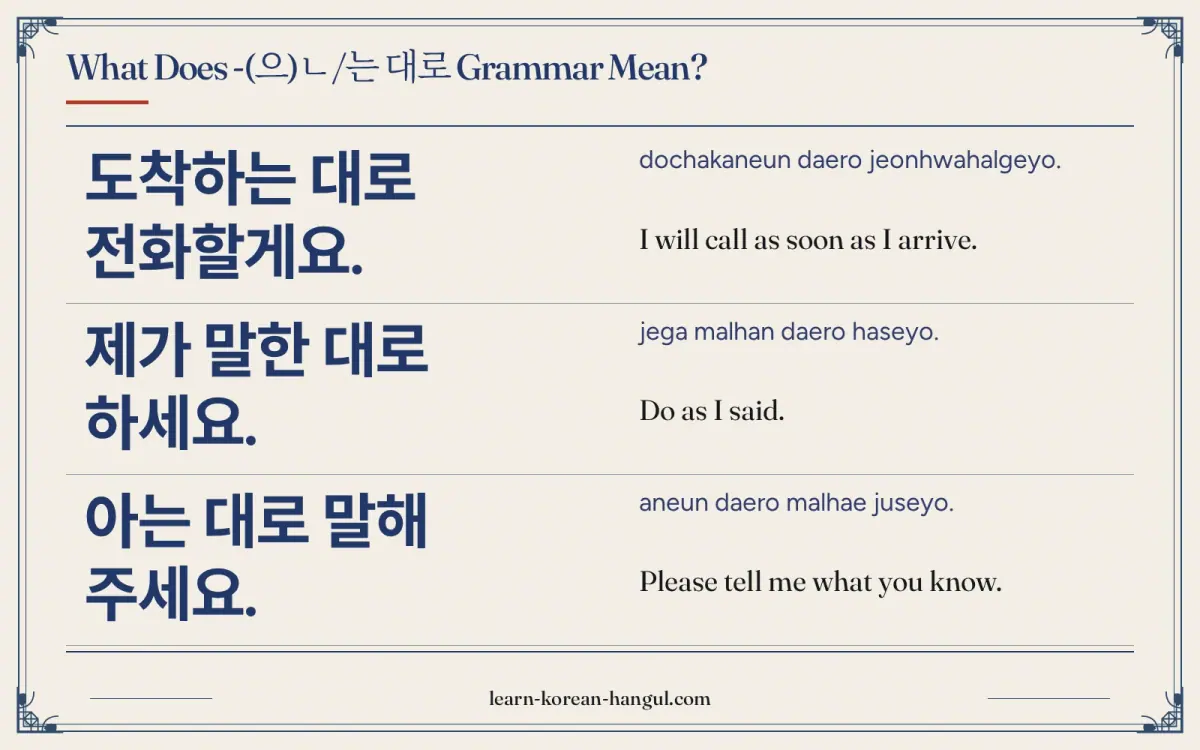
도착하는 대로 전화할게요.
dochakaneun daero jeonhwahalgeyo.
I will call as soon as I arrive.
제가 말한 대로 하세요.
jega malhan daero haseyo.
Do as I said.
아는 대로 말해 주세요.
aneun daero malhae juseyo.
Please tell me what you know.
The first example is "as soon as". The second and third are "exactly as". The next section shows how to build the forms on every kind of word.
How Do You Form -(으)ㄴ/는 대로?
You form -(으)ㄴ/는 대로 by putting the right modifier ending on the stem and then writing 대로 as a separate word. The ending is -는 for the present and for "as soon as", and -(으)ㄴ for the past. The (으) shows up only after a consonant stem.
| Stem | Dictionary form | Present / "as soon as" | Past "as it was" | Revised Romanization |
|---|---|---|---|---|
| Vowel | 가다 | 가는 대로 | 간 대로 | ganeun daero / gan daero |
| Vowel | 말하다 | 말하는 대로 | 말한 대로 | malhaneun daero / malhan daero |
| Consonant | 먹다 | 먹는 대로 [멍는 대로] | 먹은 대로 [머근 대로] | meongneun daero / meogeun daero |
| Consonant | 읽다 | 읽는 대로 [잉는 대로] | 읽은 대로 [일근 대로] | ingneun daero / ilgeun daero |
| ㄹ stem | 놀다 | 노는 대로 | 논 대로 | noneun daero / non daero |
| ㄷ stem | 듣다 | 듣는 대로 [든는 대로] | 들은 대로 [드른 대로] | deunneun daero / deureun daero |
| ㅂ stem | 돕다 | 돕는 대로 [돔는 대로] | 도운 대로 | domneun daero / doun daero |
| Adjective | 좋다 | (not used) | 좋은 대로 [조은 대로] | joeun daero |
| 있다 / 없다 | 있다 | 있는 대로 [인는 대로] | (not used) | inneun daero |
Revised Romanization (RR, the official Latin spelling) follows the sounds of the words and writes the sound changes between letters, such as meongneun for 먹는. It does not show tensing caused by a neighbouring sound. Words separated by a space are romanized separately, so 대로 is always daero.
Stems Ending in a Vowel
Add ㄴ to the stem to make the past form, and 는 to make the present form: 말하 + ㄴ = 말한, 말하 + 는 = 말하는. Then write 대로 after a space. The standard pronunciation keeps the ㅎ: 제가 말한 대로 is [제가 말한 대로]. In fast everyday speech the ㅎ after ㄹ often weakens, so you will also hear [마란 대로].
Stems Ending in a Consonant
Use 는 for the present and 은 for the past. The final consonant of the stem and the ㄴ of 는 meet, and the stem consonant changes to match, as in 먹는 [멍는] and 읽는 [잉는]. The Standard Pronunciation Rules (표준 발음법, Article 18) call this nasalization: ㄱ, ㄷ and ㅂ become ㅇ, ㄴ and ㅁ before ㄴ or ㅁ. That is why 듣는 is said [든는] and 돕는 is said [돔는].
After a modifier ending such as -는 or -(으)ㄴ, the ㄷ of 대로 stays plain. Only -(으)ㄹ makes the following consonant tense, so 대로 sounds like [대로] here.
Irregular Stems, Adjectives and Nouns
Irregular verbs follow the usual rules of the modifier. ㄹ stems drop the ㄹ before ㄴ: 놀다 gives 노는 대로, not 놀는 대로. ㄷ stems turn ㄷ into ㄹ before a vowel: 듣다 gives 들은 대로. ㅂ stems change ㅂ to 우: 돕다 gives 도운 대로.
Adjectives take only -(으)ㄴ, and they never take "as soon as". 편한 대로 하세요 (pyeonhan daero haseyo) means "Do it whichever way is comfortable for you". The words 있다 and 없다 take -는, as in 있는 대로 ("everything there is") and 없는 대로 ("making do without").
After a noun, 대로 changes from a dependent noun to a particle (조사, josa), and then it is written without a space: 계획대로 (according to plan), 규칙대로 (by the rules). The word 계획 ends in ㄱ, so the next ㄷ becomes tense and the phrase is said [계획때로].
계획대로 됐어요.
gyehoekdaero dwaesseoyo.
It went according to plan.
Next, here is one full sentence built step by step.
Worked Example: Building a Sentence with -(으)ㄴ/는 대로
You build the sentence in five steps, working from the two events you want to connect. This example makes "I will go as soon as class ends".
- Write both actions with their dictionary verbs. 수업이 끝나다 and 가다.
- Decide which action must happen first. Class ends first, so it goes into the 대로 clause.
- Find the stem of the first verb. Remove 다 from 끝나다. The stem is 끝나.
- Add -는 대로. 끝나 + 는 대로 = 끝나는 대로, said [끈나는 대로]. The subject marker comes before it: 수업이 끝나는 대로.
- Give the last verb its tense and politeness. A promise uses -ㄹ게요: 갈게요. Put the clause first: 수업이 끝나는 대로 갈게요.
Sentence
I will go as soon as class ends.
Show answer
수업이 끝나는 대로 갈게요
Checkpoint. You have it when you can change the promise into a plan without touching 끝나는 대로. The answer is 수업이 끝나는 대로 갈 거예요 [수어비 끈나는 대로 갈꺼예요]. Only the last verb changes.
The sentence built here is a promise. The next section shows which tenses and sentence types can follow each reading.
Which Tenses and Sentence Types Work with -(으)ㄴ/는 대로?
For "as soon as", the last verb is usually future, a promise or a request, and the verb before 대로 stays in the plain -는 form. For "exactly as", any tense can follow. The past ending -았/었- cannot go straight before -는 or -(으)ㄴ; the modifier -(으)ㄴ already shows the past. The retrospective form -았/었던 대로 (말했던 대로, "as I had said") is a separate, correct option for "exactly as".
| Feature | "As soon as" -는 대로 | "Exactly as" -(으)ㄴ/는 대로 |
|---|---|---|
| Promise or plan | natural: 도착하는 대로 전화할게요. | possible |
| Request or command | natural: 도착하는 대로 연락 주세요. | natural: 시킨 대로 하세요. |
| Plain past statement | awkward | natural: 시킨 대로 했어요. |
| Question | possible | possible |
| Past ending inside the clause | not allowed: 도착했는 대로 | not allowed: 말했은 대로 |
| Different subjects | allowed | allowed |
The "as soon as" reading looks forward: it names something that is expected to happen and what will follow it. For a finished event in a story, Korean prefers -자마자. The "exactly as" reading has no such limit, because it compares an action with a model: what was said, what was planned or what was expected.
Next comes the pattern that learners confuse with the "as soon as" reading most often.
How Is -(으)ㄴ/는 대로 Different from -자마자?
-(으)ㄴ/는 대로 mostly looks forward, while -자마자 can report events that have already happened. Both can mean "as soon as", but -자마자 puts the stress on how fast the second event followed. The lesson on -자마자 gives its full rules, and the side-by-side page -자마자 vs -는 대로 compares the two in detail.
Compare two sentences. 도착하는 대로 전화할게요 is a promise about the future: "I will call the moment I arrive". 수업이 끝나자마자 뛰어나갔어요 reports a finished event: "He ran out the moment class ended". Swapping them is awkward. Turning the second into 수업이 끝나는 대로 뛰어나갔어요 sounds odd, because a past story does not fit the forward-looking pattern.
-(으)ㄴ/는 대로
as soon as (future); exactly as
-자마자
as soon as: the gap is very small
| Comparison | -(으)ㄴ/는 대로 | -자마자 |
|---|---|---|
| Main idea | promise, plan or match | speed |
| Example | 도착하는 대로 전화할게요. | 도착하자마자 전화했어요. |
| Past events | awkward | natural |
| Second meaning | exactly as | none |
Use -는 대로 for promises, plans and requests; use -자마자 for events that already happened or when speed is the point.
The second difference is the extra meaning. -자마자 has only one meaning, while 대로 also means "exactly as". A quick test: if "right after" fits and the sentence is about the future, -는 대로 works. If "right after" fits and the sentence is about the past, use -자마자. Next are the useful variations of the pattern.
Variations and Edge Cases of -(으)ㄴ/는 대로
-(으)ㄴ/는 대로 has four useful variations: the "whatever you like" use, the set phrase for "as soon as possible", the noun use and the shorter spoken versions.
- Whatever or as much as. With a wanting or knowing verb, 대로 means "whatever": 먹고 싶은 대로 시키세요 ("Order whatever you want to eat"). 마음 가는 대로 하세요 means "Do what your heart tells you".
- Set phrase: 될 수 있는 대로. This phrase means "as ... as possible": 될 수 있는 대로 빨리 오세요 ("Please come as soon as you can"). The ending -(으)ㄹ makes the ㅅ of 수 tense, so 될 수 is said [될쑤]. A common alternative is 가능한 한 빨리.
- Noun + 대로. After a noun, 대로 is a particle and is attached: 계획대로 됐어요 ("It went according to plan"). A noun in front of a spaced 대로, as in 계획 대로, is a spacing error.
- Both readings in speech. In everyday talk, many speakers simply say -자마자 for "as soon as" and keep 대로 for "exactly as". Hearing 도착하는 대로 in an email or a request, however, is perfectly normal.
시킨 대로 했어요.
sikin daero haesseoyo.
I did as I was told.
예상한 대로 결과가 나왔어요.
yesanghan daero gyeolgwaga nawasseoyo.
The result came out as I expected.
For more neighbours of this pattern, see Time and Sequence. A related, stronger pattern is -기가 무섭게. Next are the errors that appear most often.
What Mistakes Do Learners Make with -(으)ㄴ/는 대로?
Learners make five common mistakes with -(으)ㄴ/는 대로.
- Attaching 대로 to a verb without a space. Learners write 말한대로 or 도착하는대로. Actually after a modifier ending, 대로 is a separate word, so write 말한 대로 and 도착하는 대로.
- Spacing a noun + 대로. Learners write 계획 대로. Actually after a noun, 대로 is a particle and is attached: 계획대로.
- Putting a past ending before 대로. Learners write 도착했는 대로 or 말했은 대로. Actually the modifier already carries the time. Use 도착하는 대로 for "as soon as" and 말한 대로 for "as I said".
- Using "as soon as" for a story in the past. Learners write 어제 집에 도착하는 대로 잤어요. Actually this reading looks forward. For a finished event, use 집에 도착하자마자 잤어요.
- Mixing up the modifier endings. Learners say 제가 말하는 대로 when they mean "as I said". Actually -는 describes what is said now or always ("as I say"), and -(으)ㄴ describes what was said before ("as I said").
Whenever you reach for 대로, check which reading you want and what comes right before it. Now test yourself.
Practice and Answers
These four exercises check the main skills: joining events, repairing a mistake and choosing the right word. Try each one before you read the answers.
Practice · 5
How do you say "as soon as I arrive" with 도착하다?
Show answer
도착하는 대로
The "as soon as" reading takes the present modifier -는 on an action verb. No past ending is added.
Which spacing is correct for "as I said"?
Show answer
말한 대로
After a modifier ending, 대로 is a separate word: 말한 대로.
How is 먹는 대로 pronounced?
Show answer
[멍는 대로]
The final ㄱ of 먹 becomes ㅇ before the ㄴ of 는, so the phrase is said [멍는 대로].
Which sentence is written correctly for "It went according to plan"?
Show answer
계획대로 됐어요.
After a noun, 대로 is a particle and is attached without a space.
Which sentence is wrong?
Show answer
도착했는 대로 전화할게요.
A past ending cannot come before 대로. The correct form is 도착하는 대로.
Exercise 1: Join the events. Make one sentence with -는 대로: 비행기에서 내리다 + 전화하다. ("I get off the plane" then "I call".) Use -ㄹ게요.
Exercise 2: Fix the error. A learner writes 제가 말한대로 하세요. Correct it.
Exercise 3: Choose the right word. You want to report that a child ran out of the classroom the moment class ended, as a past story. Is -(으)ㄴ/는 대로 right, or -자마자?
Exercise 4: Translate. "Please do it just as I taught you." (teach = 가르치다, a modifier of 주다 is 준)
Answer Key
- Exercise 1: 비행기에서 내리는 대로 전화할게요. [비행기에서 내리는 대로 전화할께요] The stem 내리 takes -는 대로, and 전화할게요 gives the promise.
- Exercise 2: 제가 말한 대로 하세요. [제가 말한 대로 하세요] 대로 is a separate word after the modifier 말한.
- Exercise 3: -자마자. The sentence is 수업이 끝나자마자 뛰어나갔어요 [수어비 끈나자마자 뛰어나가써요]. It reports a finished event.
- Exercise 4: 제가 가르쳐 준 대로 하세요. [제가 가르처 준 대로 하세요] The past modifier -ㄴ on 주 shows that the teaching is already done.
If you missed Exercise 1 or 2, return to the five building steps. If you missed Exercise 3, reread the section on -자마자. Next, plan where to go from here.
What Should You Learn Next after -(으)ㄴ/는 대로 Grammar?
The best next lesson is -기가 무섭게, a stronger, more literary way to say "the moment that". Then review -자마자 to keep "speed" and "promise" apart. The full set of timing patterns is on Time and Sequence. To see where -(으)ㄴ/는 대로 sits in a study plan, use the Advanced Grammar list. The modifier forms used here are explained in Noun-Modifying Forms.
What this lesson does not cover. It does not cover -(으)ㄹ 대로 in set phrases such as 할 대로 하다, the particle 대로 in every noun phrase, or the written style of formal notices. The level given here, B2, is an editorial estimate based on common textbook order and TOPIK II, not an official grading.
In short, -(으)ㄴ/는 대로 grammar uses -는 for "as soon as" and -(으)ㄴ for "exactly as", and it writes 대로 as a separate word after a verb.
Frequently Asked Questions
What does -(으)ㄴ/는 대로 mean? -(으)ㄴ/는 대로 has two meanings. With an action verb in the -는 form it means "as soon as", as in 도착하는 대로 전화할게요, "I will call as soon as I arrive". With -(으)ㄴ or -는 it also means "exactly as" or "in the way that", as in 제가 말한 대로 하세요, "Do as I said".
How do I attach -(으)ㄴ/는 대로 to a verb? Remove 다 and add the modifier ending, then write 대로 as a separate word. For "as soon as" use -는 on an action verb: 가다 gives 가는 대로. For the past use -(으)ㄴ: 말하다 gives 말한 대로, and 먹다 gives 먹은 대로. Stems ending in ㄹ drop it before ㄴ: 놀다 gives 노는 대로.
Can -(으)ㄴ/는 대로 be used in the past tense? The past ending -았/었- cannot go straight before -는 or -(으)ㄴ (도착했는 대로 is wrong), although -았/었던 대로 is common for "as I had said" (말했던 대로). For "exactly as" the past modifier -(으)ㄴ shows the past, as in 시킨 대로 했어요, "I did as I was told". For "as soon as", the pattern looks forward, so a finished event in a story is better told with -자마자.
Is -(으)ㄴ/는 대로 used in speech or in writing? Both. "Exactly as" is everyday speech and writing, as in 마음 가는 대로 하세요. "As soon as" is common in promises, messages and emails, as in 도착하는 대로 연락 주세요. In speech, many people use -자마자 for finished events. Say the sound carefully: 먹는 대로 is [멍는 대로].
What is the most common mistake with -(으)ㄴ/는 대로? The most common mistake is spacing. After a verb ending, 대로 is a separate word (말한 대로), and after a noun it is attached (계획대로). A second mistake is putting a past ending before 대로, as in 도착했는 대로. The time belongs to the modifier, so use 도착하는 대로 for "as soon as".
What is the difference between -(으)ㄴ/는 대로 and -자마자? Both can mean "as soon as". -는 대로 usually looks forward to a promise, plan or request, as in 도착하는 대로 전화할게요. -자마자 stresses how fast the second event followed and also works for finished events, as in 수업이 끝나자마자 뛰어나갔어요. Only 대로 also means "exactly as".