Key facts
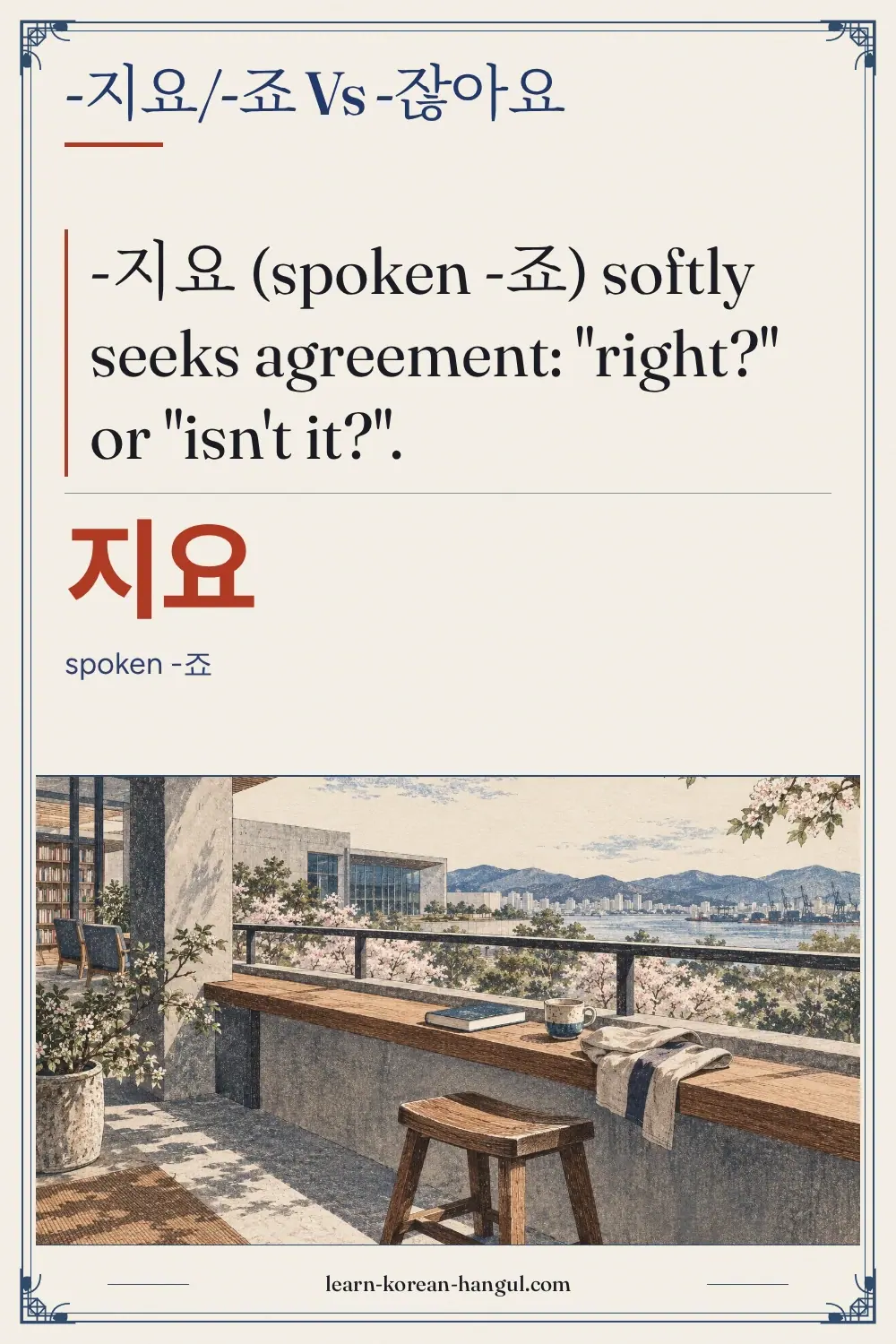
- -지요 is a soft confirmation: "right?" or "isn't it?" With a rising tone it seeks agreement, and with a falling tone it states something obvious.
- -죠 is the normal spoken contraction of -지요. It is not slang.
- -잖아요 reminds the listener of shared knowledge and carries some insistence. It is not used to ask a real question.
- Only -지요 can also soften a question (이름이 뭐죠?) or make a polite suggestion (이제 가시죠).
What you'll learn
- Choose -지요/-죠 or -잖아요 for five test sentences and state the deciding rule in one sentence.
- Build both endings from verbs, adjectives and 이다, in the present and the past.
- Use the right tone: rising for confirmation, falling for statements.
- Avoid the most common error: using -잖아요 when you really want to ask.
Before you start: you should know the polite ending -아요/-어요 and how to form the verb stem. If you want the full rules for each pattern first, read -지요/-죠 and -잖아요.
What Is the Difference between -지요/-죠 and -잖아요?
The difference is the attitude toward the listener's knowledge. With -지요/-죠, the speaker thinks the listener probably agrees, and invites them to say so. With -잖아요, the speaker thinks the listener already knows, and reminds them, sometimes with a small push. English has similar tools: "..., right?" (-지요) versus "..., you know." (-잖아요).
Two sentences built on the same adjective show the contrast:
- 날씨 좋죠? (nalssi jochyo?) [날씨 조쵸] = "Nice weather, right?" The speaker asks for a friendly yes.
- 날씨 좋잖아요. (nalssi jochanayo.) [날씨 조차나요] = "The weather's nice, you know." The speaker states it as a fact the listener can see, perhaps to explain why they want to go out.
Both sentences are polite, and both say that the weather is nice. The first leaves room for the listener to answer. The second does not expect an answer. The next section lists all the differences in a table.
-지요/-죠 vs -잖아요: Side-by-Side Table
The table lists the points learners need most. Each row gives one answer for each pattern.
| Point | -지요 / -죠 | -잖아요 |
|---|---|---|
| Core meaning | "right?" / "isn't it?" / "of course" | "you know" / "as you know" |
| Attitude | seeks agreement softly | reminds, with some insistence |
| Asks a question | yes (rising tone) | no |
| Can state the obvious | yes, falling tone | yes, this is its main job |
| Also softens a wh-question | yes: 이름이 뭐죠? | no |
| Also makes a suggestion | yes: 이제 가시죠 | no |
| Origin | -지 + 요 (죠 is the contraction) | contraction of -지 않아요 |
| Risk | can sound too sure if you do not know | can sound impatient or blaming |
| Example | 이 영화 재미있죠? | 저 사람 유명하잖아요. |
-지요/-죠
right?: a soft request for agreement
-잖아요
you know: a reminder with some insistence
Use -지요/-죠 for friendly confirmation; use -잖아요 to remind.
The table shows that the two endings share the polite level and the "shared knowledge" idea, but split on question use and on tone. Each one gets a close look next.
When Do You Use -지요/-죠?
Use -지요/-죠 when you want to confirm something softly, state the obvious in a gentle way, or soften a question. In speech the contraction -죠 is the normal form, and -지요 is the longer form that you see more in careful speech and writing.
To seek agreement. With a rising tone, the ending asks for a yes: 이 영화 재미있죠? (i yeonghwa jaemiitjyo?) = "This movie is interesting, isn't it?" The speaker expects agreement.
To state something obvious, gently. With a falling tone, the ending says "of course": 네, 그렇죠 (ne, geureochyo) = "Yes, that's right."
To soften a question. In a wh-question, -죠 sounds less blunt and often means "may I ask ...?": 이름이 뭐죠? (ireumi mwojyo?) = "What is your name, may I ask?" A wh-question usually falls or rises and falls at the end, not a sharp rise.
To make a polite suggestion. With the honorific -시-, -지요 can mean "shall we ...?": 이제 가시죠 (ije gasijyo) = "Shall we go now?"
To check something politely. 내일 시간 있으시죠? (naeil sigan isseusijyo?) = "You have time tomorrow, right?"
To build the ending, remove 다 from the dictionary form and add 지요 (or 죠 in speech). The stem never changes:
| Dictionary form | Meaning | -지요 | -죠 |
|---|---|---|---|
| 좋다 | to be good | 좋지요 | 좋죠 |
| 가다 | to go | 가지요 | 가죠 |
| 하다 | to do | 하지요 | 하죠 |
| 있다 | to be / have | 있지요 | 있죠 |
| 이다 | to be | 학생이지요 | 학생이죠 |
| 가다 (past) | went | 갔지요 | 갔죠 |
The form is easy to build, so the question is about tone. First, look at the second ending.
When Do You Use -잖아요?
Use -잖아요 when you remind the listener of something they know or should know. It is a contraction of -지 않아요, and it carries a small push: "You know this, don't you?" It does not ask a question.
- 저 사람 유명하잖아요. (jeo saram yumyeonghajanayo.) = "That person is famous, you know."
- 어제 말했잖아요. (eoje malhaetjanayo.) = "I told you yesterday, you know."
- 오늘 쉬는 날이잖아요. (oneul swineun narijanayo.) = "Today is a day off, you know."
To build the ending, remove 다 and add 잖아요:
| Dictionary form | Meaning | -잖아요 form |
|---|---|---|
| 좋다 | to be good | 좋잖아요 |
| 가다 | to go | 가잖아요 |
| 하다 | to do | 하잖아요 |
| 있다 | to be / have | 있잖아요 [읻짜나요] |
| 이다 | to be | 학생이잖아요 |
| 가다 (past) | went | 갔잖아요 |
The form is easy to build, and the ending is strong, so the next section shows how the two work together.
Can You Use Both in the Same Sentence?
You can use both in one conversation, and they often appear in a pair. A natural dialogue:
- A: 오늘 날씨 좋죠? = "The weather is nice today, isn't it?"
- B: 네, 그래서 산책하고 싶어요. 어제도 말했잖아요. = "Yes, so I want to go for a walk. I said so yesterday, you know."
A seeks agreement softly. B agrees, and then reminds A of an earlier remark.
The same fact can use either ending, and the tone changes with it. 이 식당 유명하죠? asks the listener to agree. 이 식당 유명하잖아요 says that the listener already knows it, so there is no need to ask. Because both rely on shared knowledge, many sentences work in both forms with a small change in tone.
The overlap ends at questions and suggestions, where only -지요/-죠 works, so a single rule helps.
Which One Should You Pick? a Simple Rule of Thumb
Pick by what you want from the listener. Use this four-step check.
- Find the fact. Say it in English: "The weather is nice."
- Decide what you want. Do you want the listener to agree, or do you want to remind them?
- Choose the ending. To invite agreement, use -지요/-죠. To remind, use -잖아요.
- Check the sentence type. If you want to ask a real question or make a suggestion, use -지요/-죠, because -잖아요 cannot do that.
Apply the check to "That restaurant is good, right?" You want agreement, so use 그 식당 맛있죠? Apply it to "Let's go to that restaurant. It's good, you know." You want to remind, so use 그 식당 맛있잖아요.
If you cannot decide, -지요/-죠 is the safer choice with an older person or a new acquaintance, because it sounds gentler. The next section looks at the places where learners slip.
What Mistakes Do Learners Make with These Two?
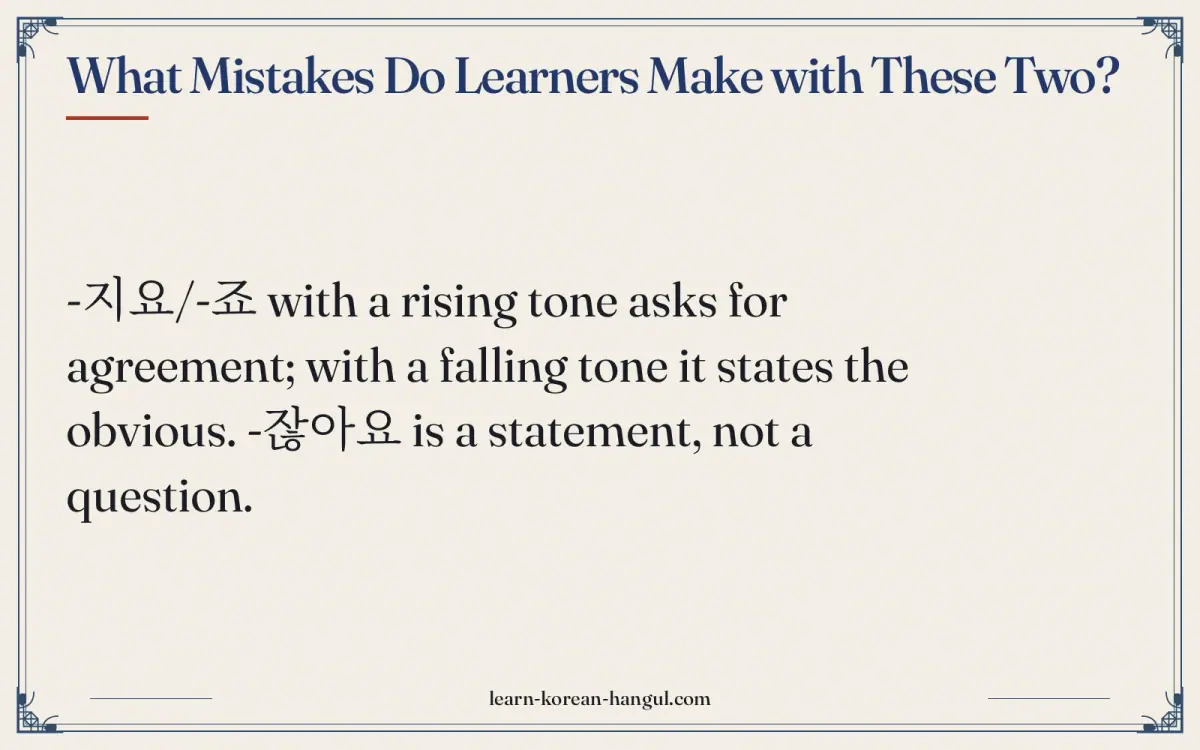
Learners most often use -잖아요 where they want a question, or ignore the tone. Four mistakes appear again and again.
- Using -잖아요 as a question. 이 영화 재미있잖아요? with a rising tone is not the usual way to ask. Use 이 영화 재미있죠?
- Using -지요 when you really do not know. -지요 shows that you expect agreement. If you do not know, ask a plain question: 이 영화 재미있어요?
- Spelling 죠 as 조. The contraction of 지요 is 죠, with ㅛ: 좋죠, 가죠, 학생이죠. Do not write *좋조.
- Using -잖아요 with elders or in a new relationship. It can sound impatient. -지요/-죠 is gentler: 날씨 좋죠?
Use this checklist when a sentence feels wrong: Do I want an answer? Do I know the fact? Is the listener older than me? The remaining differences are edge cases.
When Do the Two Endings Work Differently?
The two endings work differently with pitch, with person and with what they imply.
- Pitch. -지요/-죠 changes meaning with the tone: a rise for confirmation and a fall for a statement. -잖아요 stays a statement, and its feeling comes from the voice: friendly, firm or impatient.
- Person. In a question, -지요 can ask the listener for something they know (내일 시간 있으시죠?). -잖아요 can never ask.
- Implication. -잖아요 implies "you should know this." -지요 implies "I think you agree." The first can feel like a small criticism, and the second feels like an offer to chat.
- One honest limit. This page covers the polite spoken endings. The casual forms -지 and -잖아 follow the same pattern, and formal speech uses other endings.
Since the difference is mostly about tone and attitude, a short practice set helps you feel it.
Practice: Choose the Right Pattern
Try the five items before you read the answer key.
- Choose. You want a friend to agree that a cafe is nice. Which fits: 카페 좋죠? or 카페 좋잖아요?
- Choose. You remind a friend that you told them already. Complete: 어제 말했___. (죠 / 잖아요)
- Fix the error. A learner writes 날씨 좋조?. What is the error?
- Build. Make both endings for 하다 (present).
- Choose. You ask a stranger politely for a name. Which is gentler: 이름이 뭐죠? or 이름이 뭐잖아요?
Practice · 5
You want a friend to agree that a cafe is nice. Which fits?
Show answer
카페 좋죠?
-지요/-죠 with a rising tone softly asks for agreement.
You remind a friend that you told them already. Which fits?
Show answer
어제 말했잖아요.
-잖아요 reminds the listener of something they know. The past marker goes before it: 말했잖아요.
Which is the correct spelling of the contraction of 좋지요?
Show answer
좋죠
The contraction of 지요 is 죠, with the vowel ㅛ.
Which pair shows both endings correctly for 하다 in the present?
Show answer
하죠 / 하잖아요
Both endings attach to the stem 하- without any change.
You politely ask a stranger for their name. Which is natural?
Show answer
이름이 뭐죠?
-잖아요 cannot form a real question. -죠 softens a wh-question.
Answer key
- 카페 좋죠? You want agreement.
- 잖아요. You are reminding the friend.
- The contraction is 죠, not 조: 날씨 좋죠?
- 하죠 (or 하지요) and 하잖아요.
- 이름이 뭐죠? -잖아요 does not work in a wh-question.
A final test: if you could add "right?" in English, use -지요/-죠. If you could add "you know," use -잖아요.
What Should You Learn Next?
After this comparison, study each ending on its own and then compare -잖아요 with -거든요. This page compares the two endings but does not teach every use of either one.
- Read the full lesson on -지요/-죠, which covers the suggestion use and the pitch patterns.
- Read the full lesson on -잖아요, which covers the casual form and tone.
- See how a reminder differs from a new explanation in -잖아요 vs -거든요.
- Check the intermediate list at Intermediate Grammar to see where both endings sit among the B1 lessons.
- Compare other confusing pairs at Confusing Grammar Compared.
With these steps, the choice between -지요/-죠 and -잖아요 becomes automatic: decide whether you invite agreement or remind, then add the matching ending.
Frequently Asked Questions
What is the difference between -지요/-죠 and -잖아요?
-지요/-죠 softly asks for agreement: 날씨 좋죠? means "nice weather, right?" -잖아요 reminds the listener of something they should know: 날씨 좋잖아요 means "the weather's nice, you know." The first leaves room for an answer, and the second carries some insistence and is not a question.
Can I always replace -지요/-죠 with -잖아요?
No. -잖아요 cannot ask a real question or make a suggestion, so 이름이 뭐죠? and 이제 가시죠 cannot become -잖아요 forms. In a plain statement of a shared fact the two are close, but the tone changes from a soft invitation to agree into a reminder.
Which one sounds more natural in speech?
Both are very common in spoken Korean. -죠 appears constantly in small talk, confirmations and polite questions. -잖아요 appears when speakers share context and want to remind or persuade. With older listeners and in new relationships, -죠 is usually the gentler and safer choice.
Which one appears more often on TOPIK?
No reliable count is available, so this site makes no claim. Both endings appear in intermediate dialogues, and test items often depend on tone and on whether the speaker expects agreement or is reminding. Reading for the speaker's attitude is the most useful habit.
What is the quickest rule to remember?
Ask what you want from the listener. If you want agreement or a gentle question, use -지요/-죠 and think "right?". If you want to remind them of something they already know, use -잖아요 and think "you know." If you want to ask or suggest, use -지요/-죠.