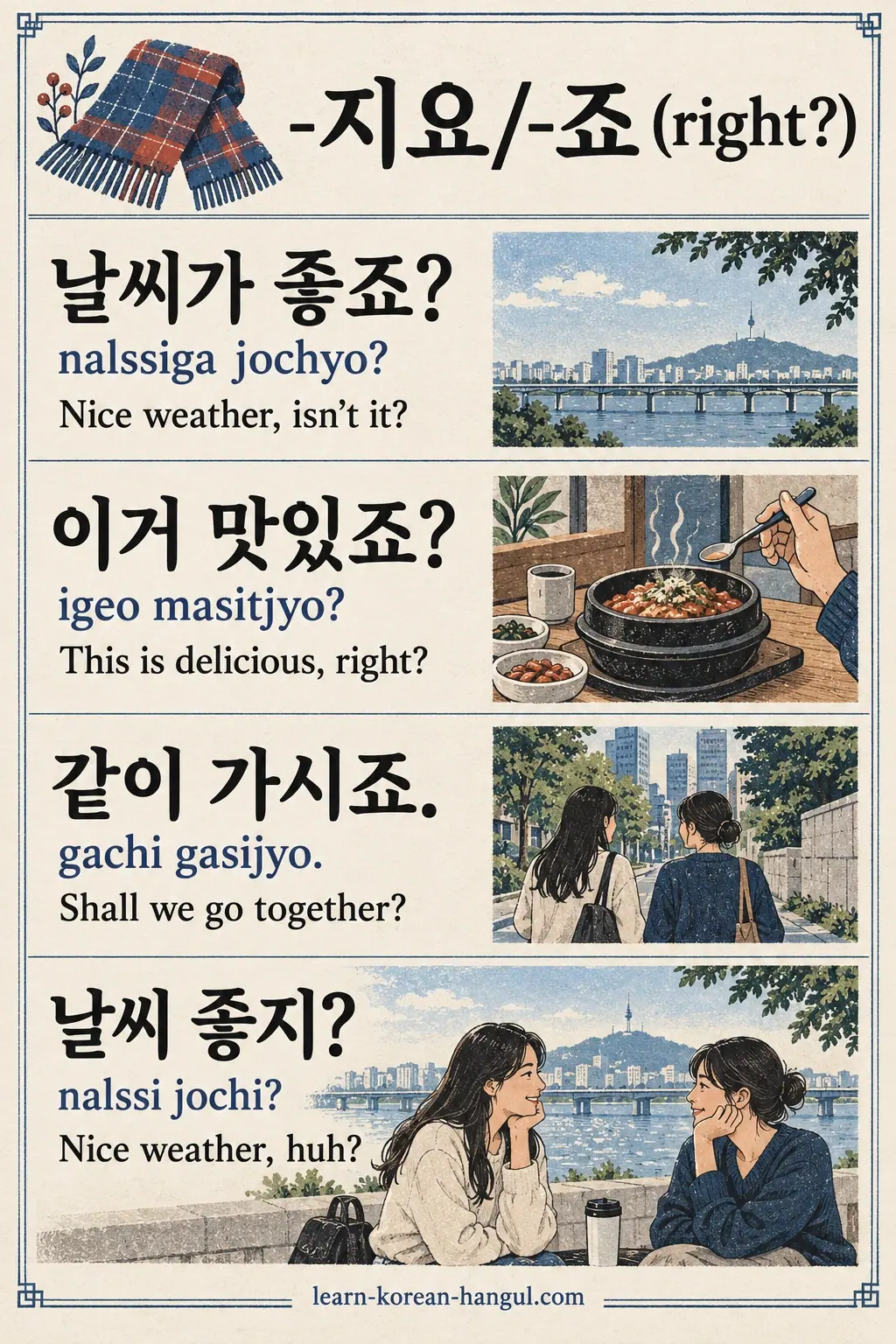
What you'll learn
- Attach -지요 and -죠 to any verb, adjective or noun and pronounce the tense ㅈ correctly.
- Ask for agreement with a rising tone, and make a soft statement with a falling tone.
- Use -(으)시죠 for a polite suggestion and -죠 for a friendly one.
- Choose between -지요/-죠 and -잖아요 when the listener may or may not agree.
- Fix the four most common learner mistakes with -지요/-죠.
Before you start: you should know how to find a verb stem (see verb stem) and the polite 요 style (polite 요 style). Audio plays only when you press a button.
What Does -지요/-죠 Grammar Mean?

-지요/-죠 grammar means "right?" when the speaker checks a fact, and "of course" or "that's right" when the speaker states something softly. In both uses the speaker expects the listener to agree, or already knows the answer. The ending is gentler than a flat statement, because it leaves a small opening for the listener to respond.
Here are two first examples. The pattern is the same in both, and the tone of voice decides whether it sounds like a question.
- 날씨가 좋죠? (nalssiga jochyo?) [날씨가 조초] = "Nice weather, isn't it?"
- 이거 맛있죠? (igeo masitjyo?) [이거 마싣쪼] = "This is delicious, right?"
In 좋죠, 좋 is the stem of 좋다 (to be good) and 죠 is the short form of 지요. In 맛있죠, 맛있 is the stem of 맛있다 (to be tasty). The full form 좋지요 and the short form 좋죠 mean the same thing. Next comes the rule that builds the pattern.
How Do You Form -지요/-죠?
-지요/-죠 is formed by dropping 다 from the dictionary form and adding -지요, or the contraction -죠, to the stem. Nothing else changes. The ending starts with ㅈ, so it needs no linking vowel, and irregular stems stay whole.
| Dictionary form | Stem | Add -지요 / -죠 | Spoken | Meaning |
|---|---|---|---|---|
| 가다 | 가 | 가지요 / 가죠 | [가지요] / [가조] | you go, right? |
| 먹다 | 먹 | 먹지요 / 먹죠 | [먹찌요] / [먹쪼] | you eat, right? |
| 앉다 | 앉 | 앉지요 / 앉죠 | [안찌요] / [안쪼] | you sit, right? |
| 좋다 | 좋 | 좋지요 / 좋죠 | [조치요] / [조초] | it's good, isn't it? |
| 알다 | 알 | 알지요 / 알죠 | [알지요] / [알조] | you know, right? |
| 학생 (noun) | 학생 | 학생이지요 / 학생이죠 | [학쌩이지요] / [학쌩이조] | you're a student, right? |
The table shows one rule on six words. The next three parts look at the groups of stems.
Stems Ending in a Vowel
A vowel stem takes -지요 or -죠 directly. 가다 becomes 가지요 or 가죠, 보다 becomes 보지요 or 보죠, and 예쁘다 becomes 예쁘지요 or 예쁘죠. The ㅈ stays plain after a vowel.
- 서울은 한국의 수도지요. (seoureun hangugui sudojiyo.) [서우른 한구긔 수도지요] = "Seoul is the capital of Korea."
- 이 가방 예쁘죠? (i gabang yeppeujyo?) [이 가방 예쁘조] = "This bag is pretty, isn't it?"
Vowel stems are the simplest case. A stem with a final consonant looks the same on the page, but it sounds different.
Stems Ending in a Consonant
A consonant stem also takes the ending directly, and the spelling stays whole. The sound follows the standard pronunciation rules (표준 발음법) of the 국립국어원 (National Institute of Korean Language). Three rules matter here:
- Tensing: a plain ㅈ is spoken tense after a final ㄱ, ㄷ or ㅂ, so 먹지요 is [먹찌요] and 먹죠 is [먹쪼]. After a verb stem that ends in ㄴ or ㅁ (including ㄵ and ㄻ), the standard also tenses the ending: 앉죠 is [안쪼].
- Aspiration: ㅎ plus ㅈ makes a [ㅊ] sound, so 좋지요 is [조치요] and 좋죠 is [조초].
- Past ㅆ: the final ㅆ of -았/었- is spoken [ㄷ], so 갔죠 is [갇쪼] and 왔죠 is [왇쪼].
A ㄹ-stem is the exception to tensing: 알죠 is [알조], not [알쪼]. In every form, 죠 itself sounds like [조], because the y-glide of ㅛ is not heard after ㅈ, ㅉ or ㅊ.
- 어제 비가 많이 왔죠? (eoje biga mani watjyo?) [어제 비가 마니 왇쪼] = "It rained a lot yesterday, didn't it?"
- 오늘 날씨가 춥죠? (oneul nalssiga chupjyo?) [오늘 날씨가 춥쪼] = "It's cold today, isn't it?"
Write the plain spelling and say the tense sound. Irregular stems and nouns need a short note, because learners expect trouble with them.
Irregular Stems and Nouns
Irregular stems stay whole before -지요, because the ending starts with a consonant.
- ㄹ-stems: 알다 stays 알지요, 살다 stays 살지요, 멀다 stays 멀지요, and 만들다 stays 만들지요. The ㄹ drops only before ㄴ, ㅂ and ㅅ.
- ㅂ-irregular: 춥다 stays 춥지요 [춥찌요], and 어렵다 stays 어렵지요. The ㅂ turns into 우 only before a vowel.
- ㄷ-irregular: 듣다 stays 듣지요 [듣찌요].
- 르 and ㅡ stems: 모르다 stays 모르지요, and 바쁘다 stays 바쁘지요.
- Nouns: 이다 gives (이)지요. After a consonant you say 이지요 or 이죠: 학생이죠. After a vowel, 이 is often dropped: 의사죠. In the polite check 김 선생님이시죠? ("You are Mr. Kim, aren't you?"), 이시 combines the honorific -시- with 이다.
With the formation clear, one full sentence can be built step by step.
Worked Example: Building a Sentence with -지요/-죠
-지요/-죠 grammar turns a plain statement into a friendly check. Follow the steps with the sentence "This is delicious."
- Start with the plain sentence. 이거 맛있어요. (igeo masisseoyo.) = "This is delicious." The predicate is 맛있어요.
- Find the dictionary form. 맛있어요 comes from 맛있다 (to be tasty). The stem is 맛있.
- Add -지요 to the stem. 맛있 + 지요 = 맛있지요, spoken [마싣찌요].
- Contract it in speech. 지요 shortens to 죠: 맛있죠, spoken [마싣쪼].
- Add a rising tone for a question. 이거 맛있죠? (igeo masitjyo?) [이거 마싣쪼] = "This is delicious, right?"
Sentence
This is delicious, right?
Show answer
이거 맛있죠
You will know it worked when the sentence invites the listener to agree. The same words with a falling tone mean "This is delicious, of course." The most common slip is keeping the 아/어 form and adding the ending to it (맛있어죠). Always work from the stem. The ending can appear in more than one tense, and each form has limits.
Which Tenses and Sentence Types Work with -지요/-죠?

-지요/-죠 works in the present, the past, the future and the honorific form, in statements, questions and suggestions. The tone of voice decides which job it does. The tense marker goes between the stem and the ending.
| Form | Pattern | Example | Meaning |
|---|---|---|---|
| Present | stem + 죠 | 날씨가 좋죠? | Nice weather, isn't it? |
| Past | stem + 았/었죠 | 어제 비가 많이 왔죠? [왇쪼] | It rained a lot yesterday, didn't it? |
| Future or guess | stem + 겠죠 | 맛있겠죠? | It will be delicious, won't it? |
| Honorific question | stem + 시죠 | 매운 음식을 좋아하시죠? | You like spicy food, right? |
| Honorific suggestion | stem + (으)시죠 | 같이 가시죠. | Shall we go together? |
| Friendly suggestion | stem + 죠 | 이제 그만 가죠. | Let's go now. |
| Casual | stem + 지 | 날씨 좋지? | Nice weather, huh? |
Intonation matters more than the grammar. A rising tone at the end asks for agreement: 날씨가 좋죠? A falling tone makes a soft statement: 날씨가 좋죠. ("The weather sure is nice.") A question word such as 뭐 or 어디 stays prominent and does not end with a sharp rise: 이름이 뭐지요? is a polite, gentle way to ask a name.
- 이름이 뭐지요? (ireumi mwojiyo?) [이르미 뭐지요] = "What is your name, may I ask?"
- 같이 가시죠. (gachi gasijyo.) [가치 가시조] = "Shall we go together?"
With the honorific -(으)시-, -죠 becomes a polite invitation: 이쪽으로 앉으시죠 means "Please sit this way." Commands in the strict sense (a flat order) do not use -지요. These limits make the closest neighbour, -잖아요, the most useful comparison.
How Is -지요/-죠 Different from -잖아요?

-지요/-죠 asks the listener to agree, while -잖아요 reminds the listener of something they already know. The first is gentle and open. The second can sound impatient, because it suggests the listener should have remembered.
-지요/-죠
right?: agreement or a soft statement
-잖아요
you know: a reminder of shared knowledge
-네요
oh, how ...: a fresh perception
| Comparison | -지요/-죠 | -잖아요 | -네요 |
|---|---|---|---|
| Main job | ask for agreement, soften | remind | react to a discovery |
| Does it suggest the listener forgot? | no | often | no |
| Works as a suggestion | yes: 가시죠 | no | no |
| Level | A2 | B1 | A2 |
Use -지요/-죠 to check or share a view gently; use -잖아요 to remind a listener of shared knowledge; use -네요 to react to what you notice right now.
Here is one situation with each ending. You and a colleague sit in a café. 여기 커피가 맛있죠? ("The coffee here is good, isn't it?") invites agreement. 여기 커피가 맛있잖아요 ("The coffee here is good, you know") assumes that the colleague already knows it, often as a reason: 그래서 자주 와요. 커피가 맛있네요 ("The coffee is good!") reacts to the first sip. The full lesson on -잖아요 has the details, and the side-by-side page is -지요 vs -잖아요. A lesson on -네요 covers the third ending. These contrasts lead to the smaller variations of the pattern.
Variations and Edge Cases of -지요/-죠

-지요/-죠 has four common variations: a reply of agreement, a friendly suggestion, a casual form and a full form for careful speech. Each one is short, and each appears in real conversation.
- Agreeing. 그렇죠 means "That's right." It is the standard reply when someone states something you agree with: 날씨가 좋죠? / 그렇죠.
- Friendly suggestion. Among equals, -죠 can mean "let's": 이제 그만 가죠 ("Let's go now"). With respect, use 가시죠.
- Casual -지. Drop the 요 with friends: 날씨 좋지? The meaning is the same.
- Careful -지요. The full form -지요 appears in careful speech, announcements and writing: 서울은 한국의 수도지요. The short form -죠 is the everyday choice.
이제 그만 가죠.
ije geuman gajyo.
Let's go now.
날씨 좋지?
nalssi jochi?
Nice weather, huh?
A last pattern is the polite check about a person: 김 선생님이시죠? ("You are Mr. Kim, aren't you?"). Receptionists use it to confirm an identity before going on.
This lesson covers the present, past and honorific forms used in daily conversation, not the full range of Korean confirmation endings. Endings such as -(으)ㄴ/는데요 ("but ...") and -나요 ("do you ...?") belong to their own lessons. The mistakes below show where the boundary with other patterns causes real errors.
What Mistakes Do Learners Make with -지요/-죠?

Learners most often get the tone, the meaning or the politeness wrong. Four mistakes appear again and again.
- Hearing every -죠 as a question. Learners often assume that -죠 always asks something. Actually the tone decides. With a falling tone, 그렇죠 is a statement: "That's right." With a rising tone, 그렇죠? asks "Isn't that so?"
- Using it for brand-new facts. 저는 학생이죠 sounds like "Obviously I'm a student", as if you were pointing out something visible. For a first introduction, say 저는 학생이에요.
- Keeping the 아/어 form. 좋아죠 and 맛있어죠 are wrong. The ending attaches to the bare stem: 좋죠 and 맛있죠.
- Pressing a superior for agreement. A question such as 이 일은 어렵죠? to a boss can sound like you are asking them to agree with you. Use the honorific form, which asks about the boss's own experience (어려우시죠? "You must find it hard, don't you?"), or a softer request.
A quick check for any -죠 sentence: Is the tone rising for a check and falling for a statement? Is the stem bare? Is the listener someone I can ask to agree? If all three answers are yes, the sentence is sound.
The practice set below tests these points directly.
Practice and Answers
Try the four items before you read the answer key. Cover the answers with your hand.
- Choose the form. You ask a friend to agree that it is cold today: 오늘 날씨가 ___? (춥죠 / 추워죠)
- Say it aloud. Write the sound of 먹죠 in Hangul.
- Translate. "Shall we go together?" Use 가다 and the honorific -(으)시죠.
- Write your own. Write one -죠 sentence that asks for agreement about food. Then change it to the casual form.
Practice · 7
You ask a colleague to agree that the weather is nice. Which question fits? 날씨가 ___?
Show answer
좋죠
-죠 with rising intonation asks for agreement.
How is 먹죠 pronounced?
Show answer
[먹쪼]
After a final ㄱ, the ㅈ is spoken tense: [먹쪼]. Nasalization does not apply because ㅈ is not a nasal.
You are a host leading guests to a table. Which sentence is a polite suggestion?
Show answer
이쪽으로 앉으시죠.
The honorific -(으)시죠 works as a polite suggestion: "Please sit this way."
What is the casual (banmal) form of 날씨가 좋죠?
Show answer
날씨 좋지?
Drop the 요 and use -지 for the casual form.
Said with a falling tone, what does 그렇죠 mean?
Show answer
That's right.
With a falling tone, -죠 makes a soft statement. Only a rising tone turns it into a question.
Complete: 이거 ___? ("This is delicious, right?")
Show answer
맛있죠
-죠 attaches to the bare stem 맛있, not to the 아/어 form.
How is 알죠 pronounced?
Show answer
[알조]
A ㄹ-stem does not tense the ㅈ, and the ㄹ stays because the ending starts with ㅈ.
Answer key
- 춥죠. The ending attaches to the bare stem 춥, which keeps its ㅂ before a consonant. It is pronounced [춥쪼].
- [먹쪼]. The ㅈ is tense after the final ㄱ of 먹.
- 같이 가시죠. (gachi gasijyo.) [가치 가시조] = "Shall we go together?"
- Answers vary. Check that the stem is bare and that the casual form drops 요. An example: 이 김치찌개 맛있죠? becomes 이 김치찌개 맛있지? ("This kimchi stew is tasty, right?").
If you can complete items 1 to 3 without the key, you can use the pattern in conversation. The lesson now hands off to related patterns.
What Should You Learn Next after -지요/-죠 Grammar?
After -지요/-죠 grammar, learn the ending that reminds, then the endings that give reasons. This lesson teaches the agreement-seeking ending and does not cover reminders, background reasons or retrospective endings in depth. Those live on their own pages.
- Start with -잖아요, which reminds a listener of something they already know.
- Compare the pair side by side in -지요 vs -잖아요.
- Continue with -네요, which reacts to what your senses show.
- Return to Exclamations and Realization to see every lesson in this set, or to the Beginner Grammar list for other A2 patterns.
With these steps, -지요/-죠 becomes automatic: take the bare stem, add 죠, and let your tone decide between a question and a soft statement.
Frequently Asked Questions
What does -지요/-죠 mean in one sentence?
-지요/-죠 means "right?" or "isn't it?" when the tone rises, and it makes a soft, confident statement when the tone falls. 날씨가 좋죠? asks "Nice weather, isn't it?" while 그렇죠 says "That's right." The speaker expects the listener to agree or already knows the answer.
How do I attach -지요/-죠 to a verb or adjective?
Drop 다 and add -지요, or the short -죠: 가다 becomes 가지요 or 가죠, 맛있다 becomes 맛있지요 or 맛있죠, and 이다 becomes (이)지요 or (이)죠. No linking vowel is needed. A stem that ends in ㄹ keeps it, so 알다 becomes 알지요. The same rule works for verbs, adjectives and nouns.
Can -지요/-죠 be used in the past tense?
Yes. Put -았/었- before it: 갔죠 means "you went, right?" or "they went, of course," and 왔죠 means "it came, didn't it?" The past form checks a past fact: 어제 비가 많이 왔죠? means "It rained a lot yesterday, didn't it?" The future marker -겠- also works: 맛있겠죠.
Is -지요/-죠 polite or casual?
-지요 is polite, and -죠 is its everyday short form. Both suit teachers, colleagues and strangers. -죠 is more common in speech, and -지요 appears in careful speech and writing. With close friends, drop 요 to get the casual -지: 날씨 좋지? The honorific -(으)시죠 is a polite suggestion.
What is the most common mistake with -지요/-죠?
The most common mistake is hearing every -죠 as a question. With falling intonation, 그렇죠 is a statement: "That's right." A second mistake is using it for brand-new facts, as in 저는 학생이죠, which sounds like "obviously I am a student." Use the plain 저는 학생이에요 for a new fact.