Key facts
- -느라고 attaches to verbs only. Both clauses have the same subject, and the result is usually a problem.
- -는 바람에 attaches to verbs. The cause is a sudden or unexpected event, the subjects can differ, and the result is unwanted.
- Neither pattern can be followed by a command or a suggestion, and neither takes a tense ending inside it.
What you'll learn
- Say which pattern names your own busy activity and which one names an unexpected event.
- Build both patterns from a verb and spot the same-subject rule for -느라고.
- Choose the right pattern for five sentences and give the reason.
- Avoid the main traps: different subjects, tense endings and good results.
Before you start: you should know the polite ending -아요/어요, the past tense -았/었어요 and the negative 못. The full rules for each pattern are on their own lesson pages, named below. Audio plays only when you press a button.
What Is the Difference between -느라고 and -는 바람에?
The difference is the kind of cause. Both patterns explain why something went wrong, and both are usually translated as "because". But they paint different pictures.
-느라고 pictures a person who was occupied. The time and energy went into one activity, and there was nothing left for something else. The speaker's own doing is the cause, so the speaker does not blame anyone.
-는 바람에 pictures an event that struck. Something happened that nobody planned, such as a traffic jam, a breakdown or a sudden rain, and the result was unwelcome. The word 바람 means wind, and the image is a gust that blows you off course.
Here are two sentences, one for each pattern.
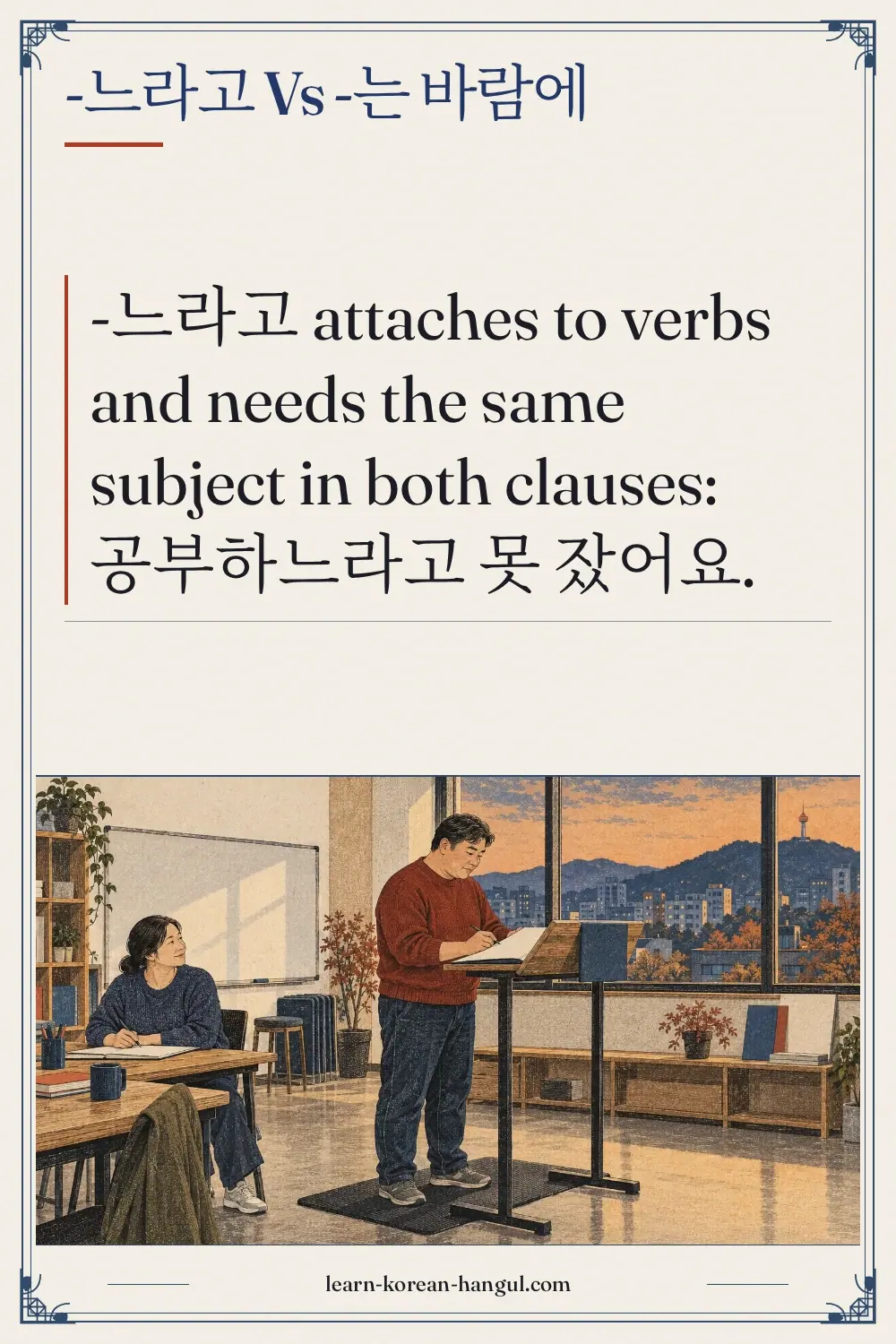
공부하느라고 못 잤어요.
gongbuhaneurago mot jasseoyo
I was busy studying, so I could not sleep.
Pronunciation: [공부하느라고 몯짜써요]. The speaker spent the night studying, and the studying took all the time.
길이 막히는 바람에 늦었어요.
giri makineun barame neujeosseoyo
The road was jammed, so I was late.
Pronunciation: [기리 마키는 바라메 느저써요]. The speaker did not choose the traffic jam. It was an unplanned event that caused the lateness.
In the first sentence the speaker is both the cause and the person affected. In the second, the cause is outside the speaker. The next section lines the two patterns up in a table.
-느라고 vs -는 바람에: Side-by-Side Table
The table compares the two patterns on the points that decide the choice.
| Point | -느라고 | -는 바람에 |
|---|---|---|
| Core meaning | being busy with X, so Y | X happened suddenly, so Y |
| Kind of cause | your own ongoing activity | an unexpected event or someone's action |
| Subject | must be the same in both clauses | can differ |
| Word class | verbs only | verbs |
| Result | usually a problem, sometimes neutral | an unwanted result |
| Tense inside the pattern | none: no -았/었- or -겠- | none: the tense goes on the final verb |
| Command or suggestion after it | not allowed | not allowed |
| Short form | -느라 (공부하느라) | none |
| Spacing | one word: 공부하느라고 | two words: 공부하는 바람에 |
| Example | 숙제를 하느라고 늦게 잤어요. | 비가 오는 바람에 소풍이 취소됐어요. |
How Do You Form the Two Patterns?
Both patterns attach to the verb stem, and neither changes with the tense of the sentence. A verb stem takes -느라고 whether it ends in a vowel or a consonant. For -는 바람에, the modifier -는 goes on the stem, followed by the dependent noun 바람 and the particle 에.
| Dictionary form | Meaning | -느라고 | -는 바람에 |
|---|---|---|---|
| 공부하다 | to study | 공부하느라고 | 공부하는 바람에 |
| 받다 | to receive, to answer | 받느라고 [반느라고] | 받는 바람에 [반는 바라메] |
| 만들다 | to make | 만드느라고 | 만드는 바람에 |
| 막히다 | to be blocked | (not natural: not your own activity) | 막히는 바람에 [마키는 바라메] |
| 넘어지다 | to fall over | (not natural: not your own activity) | 넘어지는 바람에 |
A stem that ends in ㄹ, such as 만들다, drops the ㄹ before -느라고 and before -는: 만드느라고 and 만드는 바람에. Verbs of events that happen to you, such as 막히다 and 넘어지다, fit -는 바람에 and do not fit -느라고, because they are not activities you carry out.
When Do You Use -느라고?
Use -느라고 when your own activity took your time and energy, and as a result something else did not get done. The two clauses share one subject. You do not need to write the subject twice, which is why the sentence is short.
Here are four typical uses.
- No time. 아르바이트하느라고 친구를 못 만났어요. (areubaiteuhaneurago chingureul mot mannasseoyo) "I was busy with my part-time job, so I could not meet my friend." Pronunciation: [아르바이트하느라고 친구를 몬 만나써요].
- No sleep. 공부하느라고 못 잤어요. (gongbuhaneurago mot jasseoyo) "I was busy studying, so I could not sleep."
- Losing track of time. 게임하느라고 시간 가는 줄 몰랐어요. (geimhaneurago sigan ganeun jul mollasseoyo) "I was so busy playing games that I did not notice the time." Pronunciation: [게임하느라고 시간 가는 줄 몰라써요].
- Thanks for effort. 준비하느라고 고생 많았어요. (junbihaneurago gosaeng manasseoyo) "You worked hard to prepare." Pronunciation: [준비하느라고 고생 마나써요]. Here the pattern is not a complaint. It names the hard work that caused the effort. To someone older, add -시-: 준비하시느라고 고생 많으셨어요 (junbihasineurago gosaeng maneusyeosseoyo).
아르바이트하느라고 친구를 못 만났어요.
areubaiteuhaneurago chingureul mot mannasseoyo
I was busy with my part-time job, so I could not meet my friend.
게임하느라고 시간 가는 줄 몰랐어요.
geimhaneurago sigan ganeun jul mollasseoyo
I was so busy playing games that I did not notice the time.
Notice that the result is usually something you could not do or did not notice. The pattern says "because I was occupied", and that often leads to an excuse or an apology. In the spoken language -느라 (without 고) is just as common: 공부하느라 못 잤어요. For the full rules, read the lesson on -느라고.
When Do You Use -는 바람에?
Use -는 바람에 when an event, often an unexpected one, caused an unwanted result. The cause can be the speaker's own slip, an accident, the weather or another person's action. The subjects of the two clauses can differ, and the result is nearly always in the past.
Here are four typical uses.
- Traffic. 길이 막히는 바람에 늦었어요. (giri makineun barame neujeosseoyo) "The road was jammed, so I was late."
- Weather. 갑자기 비가 오는 바람에 소풍이 취소됐어요. (gapjagi biga oneun barame sopungi chwisodwaesseoyo) "It suddenly rained, so the picnic was cancelled." Pronunciation: [갑짜기 비가 오는 바라메 소풍이 취소돼써요].
- A breakdown. 컴퓨터가 고장 나는 바람에 숙제를 못 했어요. (keompyuteoga gojang naneun barame sukjereul mot haesseoyo) "My computer broke down, so I could not do my homework." Pronunciation: [컴퓨터가 고장 나는 바라메 숙쩨를 모태써요].
- An accident. 넘어지는 바람에 다리를 다쳤어요. (neomeojineun barame darireul dachyeosseoyo) "I fell over and hurt my leg." Pronunciation: [너머지는 바라메 다리를 다처써요].
갑자기 비가 오는 바람에 소풍이 취소됐어요.
gapjagi biga oneun barame sopungi chwisodwaesseoyo
It suddenly rained, so the picnic was cancelled.
컴퓨터가 고장 나는 바람에 숙제를 못 했어요.
keompyuteoga gojang naneun barame sukjereul mot haesseoyo
My computer broke down, so I could not do my homework.
In every sentence, the first clause is an event, not a plan. Even though the events are in the past, the first clause keeps -는 and the tense goes only on the final verb: 막히는 바람에 늦었어요, not 막혔는 바람에. For the full rules, read the lesson on -는 바람에.
Can You Use Both in the Same Sentence?
Often both patterns can describe the same night, and the subject decides which one is right. Compare these two sentences about not sleeping.
- 공부하느라고 못 잤어요. "I was busy studying, so I could not sleep." The speaker did the studying.
- 동생이 공부하는 바람에 못 잤어요. "My younger sibling was studying, so I could not sleep." Someone else did the studying and it disturbed the speaker.
동생이 공부하는 바람에 못 잤어요.
dongsaengi gongbuhaneun barame mot jasseoyo
My younger sibling was studying, so I could not sleep.
Pronunciation: [동생이 공부하는 바라메 몯짜써요]. The second sentence cannot use -느라고, because the subject of 공부하다 (my sibling) differs from the subject of 못 자다 (the speaker). This is the quickest test: if the two subjects differ, -는 바람에 is the right pattern.
The two patterns can also appear in one sentence, each doing its own job. 자료를 만드느라고 점심을 못 먹었는데, 갑자기 정전이 되는 바람에 자료가 다 사라졌어요. (jaryoreul mandeuneurago jeomsimeul mot meogeonneunde, gapjagi jeongjeoni doeneun barame jaryoga da sarajyeosseoyo.) means "I was busy making the material and could not eat lunch, and then a sudden power cut made the material disappear." Pronunciation: [자료를 만드느라고 점시믈 몬 머건는데 갑짜기 정저니 되는 바라메 자료가 다 사라저써요]. The first pattern explains why lunch was missed. The second explains an unexpected loss.
Which One Should You Pick? a Simple Rule of Thumb
Ask three questions in order.
- Were you busy doing something yourself, and is the subject the same in both parts? If yes, use -느라고. Example: 청소하느라고 전화를 못 받았어요.
- Did something happen suddenly, or did someone else do something, with a bad result? If yes, use -는 바람에. Example: 갑자기 눈이 오는 바람에 길이 막혔어요.
- Is the result good, or is a command coming? If yes, use neither. Use -아/어서, -(으)니까 or a pattern such as -(으)ㄴ 덕분에 for a good result.
When you are not sure, check whether the first clause names an activity you carry out. Activities like 공부하다, 일하다 and 준비하다 take -느라고. Events like 막히다, 고장 나다 and 넘어지다 take -는 바람에.
What Mistakes Do Learners Make with These Two?
Most mistakes come from treating the two patterns as plain "because". Five of them appear again and again.
- Using -느라고 with different subjects. 동생이 공부하느라고 제가 못 잤어요 is wrong, because the subjects differ. Say 동생이 공부하는 바람에 제가 못 잤어요.
- Putting a tense inside -느라고. 공부했느라고 is wrong. The tense goes only on the final verb: 공부하느라고 못 잤어요. The same goes for -겠느라고.
- Using -느라고 with an adjective or 이다. 피곤하느라고 못 갔어요 is wrong. Use -아/어서 for states: 피곤해서 못 갔어요.
- Using -는 바람에 for a good result. 친구가 도와주는 바람에 성공했어요 is not ungrammatical, but it sounds odd, because -는 바람에 normally introduces an unlucky or unplanned cause. For thanks, say 친구가 도와준 덕분에 성공했어요.
- Following either pattern with a command or a suggestion. 길이 막히는 바람에 서두르세요 is wrong. Say 길이 막히니까 서두르세요. The same holds for -느라고: do not end with -세요 or -자.
Spacing is another small trap. -느라고 attaches to the verb as one word (공부하느라고), while 바람 is a dependent noun and is written as a separate word (공부하는 바람에).
Practice: Choose the Right Pattern
Try the five questions, then read the answers below.
Practice · 5
Which sentence is correct? (I was busy studying, so I could not sleep.)
Show answer
공부하느라고 못 잤어요.
-느라고 takes no tense ending inside it. The tense goes on the final verb 못 잤어요.
Choose the best ending: 갑자기 정전이 ___ 숙제를 못 했어요. (A sudden power cut stopped me from doing my homework.)
Show answer
되는 바람에
A power cut is a sudden event with an unwanted result, so -는 바람에 fits.
Which sentence is wrong?
Show answer
동생이 공부하느라고 제가 못 잤어요.
-느라고 needs the same subject in both clauses. Here the subjects differ, so -는 바람에 is needed.
Which main clause can follow -는 바람에?
Show answer
늦었어요.
-는 바람에 is followed by a statement of the result. Commands and suggestions are not allowed.
Choose the best ending: 파티를 ___ 고생 많았어요. (You worked hard preparing the party.)
Show answer
준비하느라고
Your own effort caused the hard work, so use -느라고 with no tense inside it.
Answer key
- 공부하느라고 못 잤어요. The tense goes on 못 잤어요, not inside the pattern.
- 되는 바람에. A sudden power cut is an event, so 정전이 되는 바람에 숙제를 못 했어요.
- 동생이 공부하느라고 제가 못 잤어요. The two subjects differ, so -느라고 cannot be used.
- 늦었어요. A past result follows -는 바람에, and commands and suggestions are not allowed.
- 준비하느라고. The cause is your own work, and the effort is what you name.
Now write your own pair: one sentence about something you could not do because you were busy, with -느라고, and one about an unexpected event that spoiled your day, with -는 바람에.
What Should You Learn Next?
After this comparison, study each pattern on its own lesson page, then look at the other pairs on the list.
- Learn the full rules for -느라고, including the short form -느라.
- Learn the full rules for -는 바람에.
- Compare two other cause patterns in -(으)ㄴ/는 덕분에 vs -(으)ㄴ/는 탓에, where one thanks and the other blames.
- Compare other confusable pairs on Confusing Grammar Compared.
- See where both patterns sit on the Advanced Grammar list.
Frequently Asked Questions
What Is the Difference between -느라고 and -는 바람에?
Both explain why something went wrong. -느라고 names your own activity that kept you busy, and the two clauses share a subject: 공부하느라고 못 잤어요. -는 바람에 names a sudden or unexpected event, and the subjects can differ: 길이 막히는 바람에 늦었어요.
Can I Always Replace -느라고 with -는 바람에?
No. If the subject of both clauses is you and the first clause is your own activity, -느라고 is the natural choice. If the subjects differ, as in 동생이 공부하는 바람에 제가 못 잤어요, you must use -는 바람에. Events that happen to you, such as 막히다, cannot take -느라고 at all.
Which One Sounds More Natural in Speech?
Both are common in everyday speech. -느라고 is often shortened to -느라, as in 공부하느라 못 잤어요. -는 바람에 is the usual way to explain an unlucky event, and people often finish a sentence with it and a past-tense verb.
Which One Appears More Often on TOPIK?
This site does not publish exam statistics. Both patterns are taught at the upper-intermediate stage. For current exam content, check the level descriptions and past papers on the official TOPIK site, topik.go.kr.
What Is the Quickest Rule to Remember?
Check the subjects. If the same person is busy and then misses something, use -느라고. If the cause is a sudden event or another person's action with a bad result, use -는 바람에.