What you'll learn
- Attach -느라고 to verb stems, including ㄹ stems, and shorten it to -느라.
- Keep the subject the same in both clauses.
- Put tense only on the last verb.
- Tell -느라고 apart from -는 바람에 and -아/어서.
Prerequisites: the lesson on -아/어서 and the past tense -았/었-. Time: about 15 minutes.
Key facts
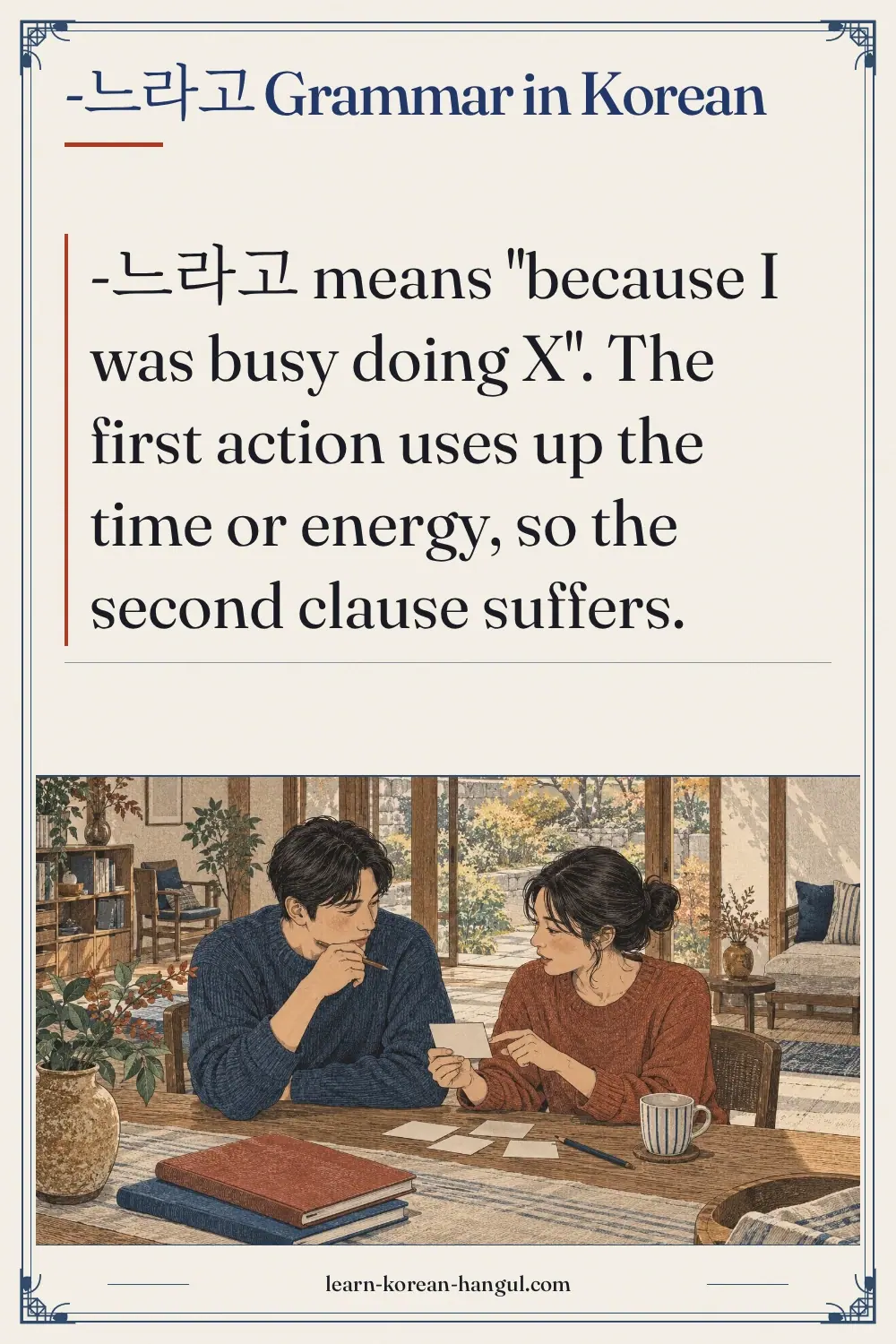
- -느라고 means "because I was busy doing X." The first action takes up the time or energy.
- It attaches only to verbs, never to adjectives or 이다.
- The subject of both clauses is the same person.
- It takes no tense inside: not -했느라고, not -겠느라고.
- The result is usually a problem: late, tired, unable to do something.
Listen to two model sentences.
The next section defines the pattern.
What Does -느라고 Grammar Mean?
-느라고 links an action that fills your time to a result that you paid for it. The speaker says, "I was busy doing the first thing, so the second thing went wrong or did not happen." The pattern points to your own effort, so the tone is often an apology or a complaint.
Three ideas follow.
- The first action is yours. It is something you were doing, such as studying, waiting or cooking.
- Time or attention is the cost. The first action uses it up, so something else suffers.
- The result is usually negative. You were late, you could not rest, you hurt yourself.
| Part | 공부하느라고 밥을 못 먹었어요. | 친구를 기다리느라고 늦었어요. |
|---|---|---|
| Busy action | 공부하느라고 (busy studying) | 친구를 기다리느라고 (busy waiting for a friend) |
| Result | 밥을 못 먹었어요 (could not eat) | 늦었어요 (was late) |
| Spoken | [공부하느라고 바블 몬 머거써요.] | [친구를 기다리느라고 느저써요.] |
| RR (aid) | gongbuhaneurago babeul mot meogeosseoyo. | chingureul gidarineurago neujeosseoyo. |
| English | I was busy studying, so I couldn't eat. | I was busy waiting for my friend, so I was late. |
Notice that 못 is written as a separate word before 먹었어요, so RR gives mot meogeosseoyo. The spoken form is [몬 머거써요]: the final ㅅ of 못 becomes a nasal ㄴ before ㅁ. The next section shows how to form the pattern.
How Do You Form -느라고?
Attach -느라고 to the verb stem, which is the dictionary form without 다. There are no changes for a final consonant, because the ending begins with 느, which is a syllable of its own.
| Stem ends in | Ending | Example | RR (aid) |
|---|---|---|---|
| a vowel | -느라고 | 공부하다 → 공부하느라고 | gongbuhaneurago |
| a consonant | -느라고 | 먹다 → 먹느라고 | meongneurago |
| ㄹ (the ㄹ drops) | -느라고 | 놀다 → 노느라고 | noneurago |
Stems Ending in a Vowel
Add 느라고 directly.
| Dictionary form | With -느라고 | Meaning | RR (aid) |
|---|---|---|---|
| 공부하다 (study) | 공부하느라고 | busy studying | gongbuhaneurago |
| 기다리다 (wait) | 기다리느라고 | busy waiting | gidarineurago |
| 돌보다 (look after) | 돌보느라고 | busy looking after | dolboneurago |
| 준비하다 (prepare) | 준비하느라고 | busy preparing | junbihaneurago |
The sentence 아이를 돌보느라고 쉬지도 못했어요 means "I was busy looking after the kids and couldn't even rest." Here 못했어요 is the attached 못하다 (cannot), which follows -지, so RR gives motaesseoyo.
Stems Ending in a Consonant
The same ending follows a final consonant: there is no 으.
| Dictionary form | With -느라고 | Meaning | RR (aid) |
|---|---|---|---|
| 먹다 (eat) | 먹느라고 | busy eating | meongneurago |
| 읽다 (read) | 읽느라고 | busy reading | ingneurago |
| 찾다 (look for) | 찾느라고 | busy looking for | channeurago |
| 입다 (wear) | 입느라고 | busy putting on | imneurago |
The final consonant meets the ㄴ of 느, so it changes sound. 먹느라고 is [멍느라고], 읽느라고 is [잉느라고], 찾느라고 is [찬느라고] and 입느라고 is [임느라고]. The sentence 영화를 보느라고 시간 가는 줄 몰랐어요 means "I was so absorbed in the film that I lost track of time."
Irregular Stems and Nouns
- ㄹ stems drop ㄹ before ㄴ. 놀다 becomes 노느라고, 만들다 becomes 만드느라고, and 살다 becomes 사느라고. The sentence 친구랑 노느라고 숙제를 못 했어요 means "I was busy playing with my friend and couldn't do my homework."
- ㅂ, ㄷ and ㅅ verbs do not change, because the ending begins with a consonant. 돕다 becomes 돕느라고, 걷다 becomes 걷느라고 and 짓다 becomes 짓느라고.
- Adjectives are not allowed. Wrong: 피곤하느라고 쉬었어요. Use -아/어서 (피곤해서 쉬었어요).
- Nouns are not allowed. If you want to say "because of a noun," use 때문에, as in 일 때문에 늦었어요.
- The shortened form is -느라, as in 청소하느라 힘들었어요. Both forms mean the same.
The next section builds a full sentence.
Worked Example: Building 공부하느라고 밥을 못 먹었어요
Say that you studied all day and skipped lunch. Follow five steps.
- Name your action. "Study" is 공부하다. You are the one doing it.
- Remove 다. The stem is 공부하.
- Add 느라고. 공부하 + 느라고 = 공부하느라고. No tense goes inside.
- Write the result. "I couldn't eat" is 밥을 못 먹었어요. The past tense belongs here, on the last verb.
- Join the parts. 공부하느라고 밥을 못 먹었어요.
You'll know it worked when the first verb ends in 느라고, you are the person doing both things, and the result is a problem or a missed chance. If the weather caused it, the sentence changes completely, as the later section shows.
Sentence
I was busy studying, so I couldn't eat.
Show answer
공부하느라고 밥을 못 먹었어요
The next section covers tense and sentence types.
Which Tenses and Sentence Types Work with -느라고?
The first clause has no tense of its own. The last verb carries the tense and the speech level.
| Slot | Form | Example | English |
|---|---|---|---|
| First clause | stem + 느라고 | 공부하느라고 | busy studying |
| Tense in the first clause | not allowed | 공부했느라고 | (wrong) |
| Result: past statement | past tense | 못 먹었어요. | I couldn't eat. |
| Result: present statement | present or state | 정신이 없어요. | I'm in a whirl. |
| Result: wh-question | past | 뭐 하느라고 전화를 안 받았어요? | What were you doing, that you didn't answer? |
| Command or suggestion | not allowed | 공부하느라고 가세요. | (does not fit) |
The most common shape is a past-tense statement, because the pattern explains something that already went wrong. Present-tense results are possible when the busy time is still going on: 이사 준비를 하느라고 정신이 없어요 ("I'm in a whirl, busy getting ready to move").
A question with -느라고 asks what someone was doing that took so long. 뭐 하느라고 전화를 안 받았어요? means "What were you busy doing that you didn't answer my call?" A wh-question puts the stress on the question word and often ends with a fall or a rise-fall, rather than a sharp rise. It can sound like gentle blame, so use it with friends.
Commands and suggestions do not fit, because the pattern describes a past cost. Use -(으)니까 if you want to give a command with a reason.
The next section compares -느라고 with -는 바람에.
How Is -느라고 Different from -는 바람에?
Both explain a bad result. The difference is who is responsible and whether the cause was expected.
-느라고
busy doing X, so Y suffered
-는 바람에
an unexpected event, bad result
-아/어서
because, so: plain cause
| Comparison | -느라고 | -는 바람에 | -아/어서 |
|---|---|---|---|
| The cause is | your own busy action | a sudden event | any reason |
| Same subject needed | yes | no | no |
| Attaches to | verbs only | verbs | verbs and adjectives |
| Result | usually a problem | a bad result | any result |
Use -느라고 when your own busy action caused the problem, -는 바람에 when a sudden, unwanted event did, and -아/어서 for a plain cause.
| Pattern | Cause | Subjects | Example |
|---|---|---|---|
| -느라고 | your own busy action | the same | 공부하느라고 밥을 못 먹었어요. |
| -는 바람에 | a sudden, unwanted event | may differ | 길이 막히는 바람에 늦었어요. |
| -아/어서 | any plain cause | may differ | 공부해서 밥을 못 먹었어요. |
Compare these sentences.
- 친구를 기다리느라고 늦었어요. "I was busy waiting for my friend, so I was late." The speaker did the waiting.
- 길이 막히는 바람에 늦었어요. "The road got jammed, so I was late." The cause is an event that the speaker did not control.
- 비가 와서 늦었어요. "It rained, so I was late." A plain cause, and the weather is not a person's action.
The key test is whether the first clause is something you were busy doing. If it is, use -느라고. If it is an unexpected event, use -는 바람에. If it is a plain reason, use -아/어서. See also -(으)니까 when you need to follow with a command.
For a full side-by-side with practice, see -느라고 vs -는 바람에.
A plain -아/어서 sentence like 공부해서 밥을 못 먹었어요 is also correct, but it says only that studying was the reason. With -느라고, the speaker adds the idea that studying took all the time.
The next section covers shortening and related uses.
Variations and Edge Cases of -느라고
The Shortened Form -느라
In speech and informal writing, 고 is often dropped: 시험 공부하느라 밤을 새웠어요 ("I stayed up all night studying for the exam"). The meaning is the same.
Results That Are Not Complaints
Most results are negative, but some are neutral descriptions of a state: 숙제하느라고 바빴어요 ("I was busy doing homework"). The result is still about the cost of time. A truly positive result does not fit. For credit, use -(으)ㄴ/는 덕분에.
Injuries and Accidents
A busy action can lead to an accident: 요리하느라고 손을 다쳤어요 ("I hurt my hand while busy cooking"). The injury is the cost of being absorbed in the action.
Apologising
-느라고 is a common way to explain a delay politely. 준비하느라고 답장이 늦었어요 ("I was busy preparing, so my reply was late") is a mild, natural excuse. Adding 죄송합니다 before it makes the apology clear.
Why Not an Adjective?
Adjectives describe states, not actions that fill time. You cannot be "busy being tired." Say 피곤해서 일찍 잤어요, not 피곤하느라고 일찍 잤어요.
The next section lists the mistakes that appear most often.
What Mistakes Do Learners Make with -느라고?
Learners make six predictable mistakes. Each has a reason and a fix.
Learners often use it with different subjects. Wrong: 제가 공부하느라고 동생이 밥을 못 먹었어요. Right: 제가 공부해서 동생이 밥을 못 먹었어요, or 제가 공부하는 동안 동생이 밥을 못 먹었어요. Fix: if the two clauses have different subjects, use -아/어서 or another connector.
Learners often use it with an adjective. Wrong: 피곤하느라고 쉬었어요. Right: 피곤해서 쉬었어요. Fix: -느라고 takes only verbs.
Learners often put a tense inside. Wrong: 공부했느라고 밥을 못 먹었어요. Right: 공부하느라고 밥을 못 먹었어요. Fix: tense goes on the last verb only.
Learners often use it with weather or events. Wrong: 비가 오느라고 늦었어요. Right: 비가 와서 늦었어요 or 비가 오는 바람에 늦었어요. Fix: weather is not an action you are busy doing.
Learners often use it for a good result. Wrong: 열심히 공부하느라고 합격했어요. Right: 열심히 공부해서 합격했어요. Fix: the result is a problem; use -아/어서 or 덕분에 for a good outcome.
Learners often add 으 for ㄹ stems. Wrong: 놀으느라고. Right: 노느라고. Fix: drop ㄹ, then add 느라고.
The next section gives you practice.
Practice and Answers
Do the four tasks, then compare with the key.
Task 1: add the ending. Write the form with -느라고.
- 공부하다
- 기다리다
- 먹다
- 놀다
- 돌보다
Task 2: fix the error. Each sentence has one mistake. Rewrite it correctly.
- 피곤하느라고 일찍 잤어요.
- 공부했느라고 밥을 못 먹었어요.
- 비가 오느라고 늦었어요.
Task 3: translate. Write in Korean: "I was busy cooking, so I didn't hear the phone." and "What were you busy doing that you didn't answer?"
Task 4: write your own. Write one sentence that says what kept you busy and what you missed, and one wh-question to a friend who did not answer.
Practice · 5
Which form is -느라고 attached to 놀다?
Show answer
노느라고
ㄹ stems drop ㄹ before ㄴ, so 놀다 becomes 노느라고.
Which sentence is correct?
Show answer
피곤해서 일찍 잤어요.
-느라고 takes only action verbs. An adjective uses -아/어서.
Which sentence has the same subject in both clauses?
Show answer
저는 청소하느라고 힘들었어요.
저는 does both the cleaning and the being tired, so the subject is the same.
Where does the past tense go?
Show answer
On the last verb
The first verb stays plain. The last verb carries the tense.
What does 뭐 하느라고 전화를 안 받았어요? ask?
Show answer
What were you busy doing that you did not answer?
It asks what kept the person busy, often with a hint of blame.
Answer key
- (1) 공부하느라고 (2) 기다리느라고 (3) 먹느라고 (4) 노느라고 (5) 돌보느라고
- (1) 피곤해서 일찍 잤어요. (2) 공부하느라고 밥을 못 먹었어요. (3) 비가 와서 늦었어요.
- 요리하느라고 전화 소리를 못 들었어요. 뭐 하느라고 안 받았어요? Other correct versions exist, for example 뭐 하느라고 전화를 안 받았어요?
- Sample answers: 과제를 하느라고 저녁을 못 먹었어요. 뭐 하느라고 연락이 없었어요? Any sentence is correct if the first verb is an action with 느라고, the subject is the same, and the result is a problem.
If task 1 was correct, you have the form rule. If task 2 was hard, review the verb-only rule and where tense goes. The next section points you to what comes after this lesson.
What Should You Learn after -느라고 Grammar?
After -느라고, learn -는 바람에, the pattern for a sudden, unwanted event, and review -아/어서, the plain "because."
For a wider view, the parent page Cause and Reason lists every pattern in this group. -느라고 sits at level B2 on the Advanced Grammar list, which is an editorial estimate. For the tense that goes on the last verb, see past tense -았/었-. TOPIK is run by the National Institute for International Education (NIIED); check topik.go.kr for what the exam covers.
This lesson covers -느라고 in everyday and written Korean. It does not cover every idiom that uses 느라. About this page. Last updated 2026-10-09. Revised Romanization follows the national rules and is shown only as a learning aid.
Frequently Asked Questions
What Does -느라고 Mean?
-느라고 means "because I was busy doing X". The first clause names an action that used up your time or attention, and the second clause tells what suffered. 공부하느라고 밥을 못 먹었어요 means "I was busy studying, so I couldn't eat." It is common in speech, and it is often an excuse or a mild complaint.
How Do I Attach -느라고 to a Verb or Adjective?
Attach it only to verbs. Remove 다 and add -느라고 with no 으: 공부하느라고, 먹느라고, 기다리느라고. ㄹ stems drop ㄹ (놀다 becomes 노느라고). Adjectives and 이다 do not take it; use -아/어서 instead, as in 피곤해서 일찍 잤어요. The shortened form is -느라.
Can -느라고 Be Used in the past Tense?
Not inside the first clause. Wrong: 공부했느라고 밥을 못 먹었어요. Put the tense on the last verb only: 공부하느라고 밥을 못 먹었어요. The first verb stays in the plain stem form, and the whole sentence reads as past because the last verb is past. A future form with 겠 is also not allowed inside.
Is -느라고 Used in Speech or Only in Writing?
It is common in everyday speech, and it also appears in informal writing and messages. People use it to explain why they were late, why they missed a call or why they could not rest. It is polite enough for coworkers when the final ending is -어요. In formal writing, other connectors are more usual.
What Is the Most Common Mistake with -느라고?
The most common mistake is using it with different subjects or with an adjective. Both clauses must have the same subject, and the first verb must be an action. 제가 공부하느라고 동생이 밥을 못 먹었어요 is wrong. Use -아/어서 there. Weather also does not fit, because rain is not an action you are busy doing.
What Is the Difference between -느라고 and -는 바람에?
-느라고 explains a problem caused by your own busy action, and both clauses share a subject. -는 바람에 explains a problem caused by a sudden, unwanted event, and the subjects may differ. 공부하느라고 늦었어요 means you were busy studying. 길이 막히는 바람에 늦었어요 means the road got jammed.