What you'll learn
- Attach -나 or -으나 to verb and adjective stems, including ㄹ stems and ㅂ-irregular stems.
- Add 았/었 inside the first clause to show the past.
- Choose between -(으)나 and -지만 by register.
- Avoid the look-alikes: the question ending -나, the guess pattern -나 보다 and the particle (이)나.
Prerequisites: the lessons on -지만 and -(으)ㄴ/는데. Time: about 15 minutes.
Key facts
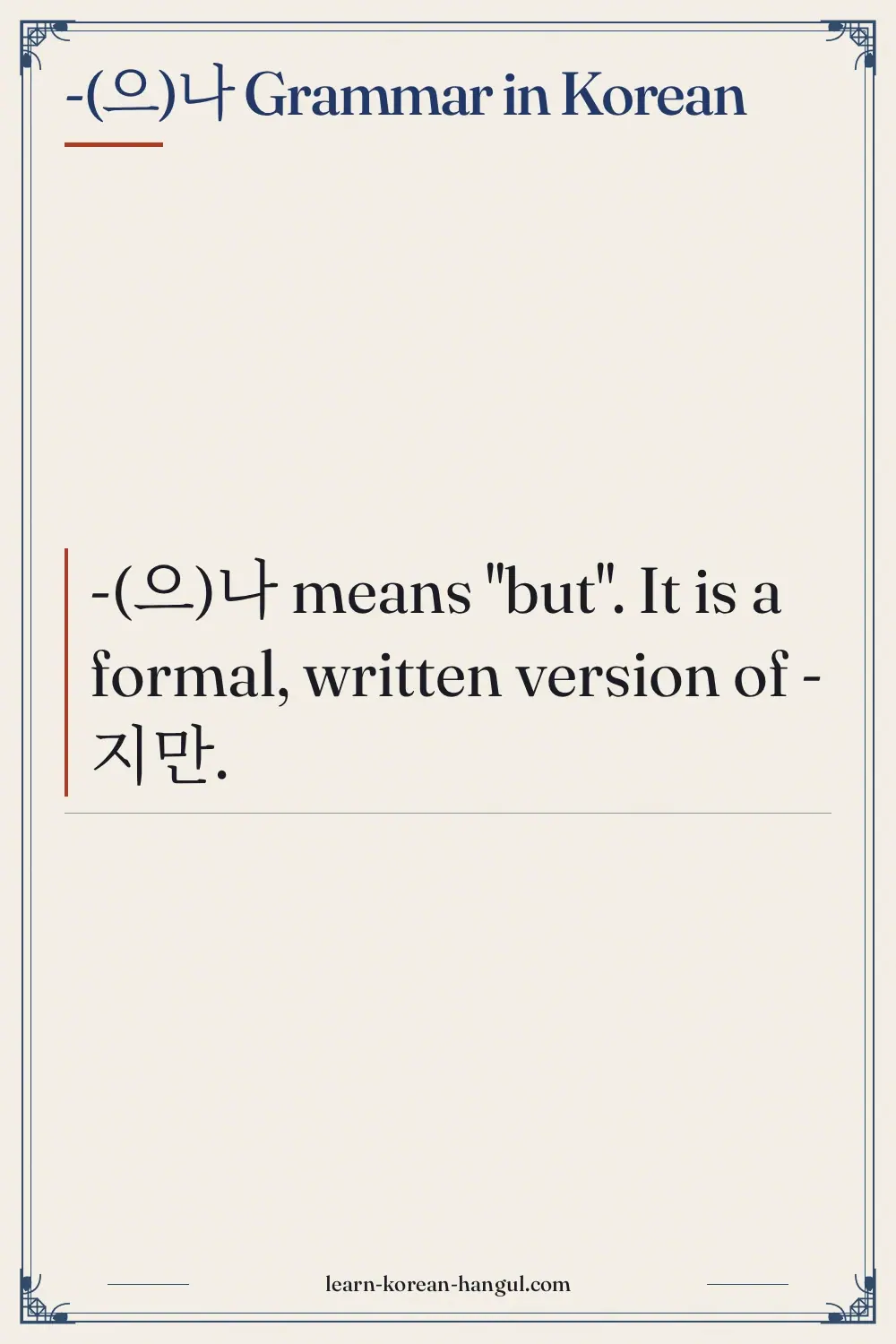
- -(으)나 means "but" and is a formal, written version of -지만.
- Form: -나 after a vowel or ㄹ; -으나 after a final consonant. ㄹ stems drop ㄹ.
- The past goes inside the first clause: 좋았으나, 노력하였으나.
- Written sentences usually end in the plain style (-다). Formal speech ends in -ㅂ니다.
Listen to two model sentences. They are in the plain written style, so they end in -다.
The next section defines the pattern.
What Does -(으)나 Grammar Mean?
-(으)나 is a connective ending that sets one fact against another. The first clause says one thing, and the second clause says something that pulls the other way. Read it as "but," "yet" or "although."
The ending belongs to formal written Korean. A newspaper writes 정부는 대책을 발표하였으나 반응은 차가웠다 ("The government announced measures, but the reaction was cold"). A person chatting with a friend says 발표했지만 반응이 차가웠어요 instead. Both are correct, but they live in different places.
| Part | 그는 열심히 노력하였으나 실패하였다. | 값은 비싸나 품질이 좋다. |
|---|---|---|
| First clause | 그는 열심히 노력하였으나 (he worked hard, but) | 값은 비싸나 (the price is high, but) |
| Second clause | 실패하였다 (he failed) | 품질이 좋다 (the quality is good) |
| Spoken | [그는 열씸히 노려카여쓰나 실패하엳따.] | [갑쓴 비싸나 품지리 조타.] |
| RR (aid) | geuneun yeolsimhi noryeokayeosseuna silpaehayeotda. | gapseun bissana pumjiri jota. |
| English | He worked hard, but he failed. | The price is high, but the quality is good. |
Two sound notes help. The standard pronunciation of 열심히 is [열씸히], with a tense ㅅ. In 노력하였으나, the ㄱ of 력 meets the ㅎ of 하 and becomes an aspirated [ㅋ]: [노려카여쓰나]. In a verb, RR writes that aspirated sound, so it reads noryeokayeosseuna. The next section shows how to form the ending.
How Do You Form -(으)나?
Attach the ending to the stem, that is, the dictionary form without 다. The ending has two shapes, and the stem's last sound picks one.
| Stem ends in | Ending | Example | RR (aid) |
|---|---|---|---|
| a vowel | -나 | 비싸다 → 비싸나 | bissana |
| ㄹ (the ㄹ drops) | -나 | 살다 → 사나 | sana |
| a consonant | -으나 | 많다 → 많으나 | maneuna |
Stems Ending in a Vowel
Add 나 directly. The same rule covers 하다 verbs and adjectives.
| Dictionary form | With -(으)나 | Meaning | RR (aid) |
|---|---|---|---|
| 비싸다 (be expensive) | 비싸나 | the price is high, but | bissana |
| 쓰다 (be bitter) | 쓰나 | it is bitter, but | sseuna |
| 가난하다 (be poor) | 가난하나 | he is poor, but | gananhana |
| 검소하다 (be frugal) | 검소하나 | he is frugal, but | geomsohana |
The ㅡ-stem 쓰다 keeps its ㅡ before 나, because 나 begins with a consonant. The sentence 약은 맛이 쓰나 몸에 좋다 means "The medicine tastes bitter, but it is good for the body."
Stems Ending in a Consonant
Add 으나. The 으 is the linking vowel that lets the ending follow a final consonant.
| Dictionary form | With -(으)나 | RR (aid) |
|---|---|---|
| 많다 (be many) | 많으나 | maneuna |
| 좋다 (be good) | 좋으나 | joeuna |
| 있다 (exist) | 있으나 | isseuna |
| 먹다 (eat) | 먹으나 | meogeuna |
Spoken, 많으나 is [마느나] because the ㅎ is silent before a vowel, and 좋으나 is [조으나]. The sentence 그는 나이가 많으나 건강하다 ("He is old, but he is healthy") is said [그는 나이가 마느나 건강하다.].
Irregular Stems and Nouns
- ㄹ stems drop ㄹ before ㄴ, and they take -나. 살다 becomes 사나, 만들다 becomes 만드나, and 길다 becomes 기나. The sentence 그는 서울에 사나 부산에서 일한다 means "He lives in Seoul, but he works in Busan."
- ㅂ-irregular stems change ㅂ to 우 before 으. 어렵다 becomes 어려우나, 차갑다 becomes 차가우나. The 으나 ending gives 어려우나, as in 일이 어려우나 포기하지 않겠습니다.
- ㅅ-irregular stems drop ㅅ before a vowel: 낫다 (be better) becomes 나으나.
- 르 stems end in a vowel, so they take -나 with no change: 다르다 becomes 다르나. The 르 change only affects 아/어 endings.
- Past tense puts 았/었 inside: 좋았으나, 부족했으나. The formal written form of 하다 is 하였-: 노력하였으나, although 했- is also correct.
- Honorific puts 시 inside: 바쁘시나 ("is busy, but," said of a respected person).
- Nouns take 이다, so the ending is 이나 (after a consonant or a vowel): 그는 부자이나 검소하다 ("He is rich, but frugal").
The next section builds a full sentence.
Worked Example: Building 값은 비싸나 품질이 좋다
Say that a product costs a lot, but it is well made. Follow five steps.
- Write the first fact. "The price is expensive" is 값이 비싸다. The topic particle 은 sets up a contrast, so write 값은 비싸다.
- Remove 다. The stem is 비싸. It ends in a vowel.
- Add 나. 비싸 + 나 = 비싸나. You do not need 으.
- Write the second fact. "The quality is good" is 품질이 좋다.
- Join the parts. 값은 비싸나 품질이 좋다. The sentence ends with the plain written -다.
You'll know it worked when the first clause ends in -나 with no 요, the clauses contrast, and the last verb ends in -다. If you wanted a spoken version, you would say 값은 비싸지만 품질이 좋아요.
Sentence
The price is high, but the quality is good.
Show answer
값은 비싸나 품질이 좋다
The next section covers tense and sentence types.
Which Tenses and Sentence Types Work with -(으)나?
The first clause can show past tense, and the last verb carries the sentence's style.
| Slot | Form | Example | English |
|---|---|---|---|
| Present state | stem + (으)나 | 비싸나 | is expensive, but |
| Past | stem + 았/었으나 | 좋았으나 | was good, but |
| Formal past of 하다 | 하였으나 | 노력하였으나 | worked hard, but |
| Honorific | stem + (으)시나 | 바쁘시나 | is busy, but (respected person) |
| Written ending | -다 | 실패하였다. | failed. |
| Formal speech ending | -ㅂ니다 | 포기하지 않겠습니다. | I will not give up. |
| Casual ending | -어요 | 비싸나 좋아요. | (sounds like reading the news) |
| Command or suggestion | not natural | 비싸나 사세요. | (does not fit) |
Most sentences end with a statement, because the pattern reports a contrast. A question is rare. Commands and suggestions do not fit.
The pairing with the ending matters. In writing, the plain -다 style is the default: 계획은 좋았으나 실행이 부족했다 ("The plan was good, but the execution was lacking"). In a formal speech, the -ㅂ니다 style matches the register: 일이 어려우나 포기하지 않겠습니다 ("The work is hard, but I will not give up"). In a chat, -나 followed by -어요 sounds like someone reading the news aloud.
The two clauses may have different subjects, as in 서울은 교통이 좋으나 집값이 비싸다 ("Seoul has good transport, but housing is expensive").
The next section compares -(으)나 with -지만 and -(으)ㄴ/는데.
How Is -(으)나 Different from -지만?
Both mean "but." The difference is register, and there are a few small grammar differences.
-(으)나
but: formal, written
-지만
but, although: everyday and formal
-(으)ㄴ/는데
background, contrast or request set-up
| Comparison | -(으)나 | -지만 | -(으)ㄴ/는데 |
|---|---|---|---|
| Register | formal, written | everyday and formal | everyday |
| Typical sentence end | -다 or -ㅂ니다 | -어요 or -다 | -어요 |
| Softens a request | no | yes | yes |
| Sets the scene | no | no | yes |
Use -(으)나 in formal writing, -지만 for an everyday "but" that can also soften a request, and -(으)ㄴ/는데 when you set the scene or invite a reply.
| Pattern | Register | Can soften a request? | Example |
|---|---|---|---|
| -(으)나 | formal, written | no | 값은 비싸나 품질이 좋다. |
| -지만 | everyday and formal | yes | 값은 비싸지만 품질이 좋아요. |
| -(으)ㄴ/는데 | everyday | yes, and it can set up a topic | 값은 비싼데 품질이 좋아요. |
Compare these three.
- 열심히 노력하였으나 실패하였다. A report about someone's attempt. It is formal and distant.
- 열심히 했지만 실패했어요. What you would say to a friend. The -지만 clause feels natural in conversation.
- 열심히 했는데 실패했어요. Also spoken, with an extra feeling of regret or surprise.
The biggest practical difference is that -지만 can soften a refusal or a request. 죄송하지만 지금은 어려워요 means "I'm sorry, but it is difficult right now." The ending -(으)나 does not do that job. Another difference is flexibility: -(으)ㄴ/는데 can set the scene, make a request or invite a reply, and -(으)나 only contrasts.
The next section covers look-alikes and set uses.
Variations and Edge Cases of -(으)나
The Pair -(으)나 -(으)나
Repeat the ending in both clauses to say "whether ... or ...": 비가 오나 눈이 오나 출근해야 합니다 ("Whether it rains or snows, I must go to work"). Here the two clauses do not contrast. They list cases that make no difference.
The Look-Alike Guess Ending -나 보다
비가 오나 봐요 looks like a -(으)나 sentence, but it is not. The ending -나 보다 means "it seems that" and describes a guess. There is no second clause and no contrast. The meaning is "It looks like it is raining."
The same -나 appears in a question, as in 지금 가나요? ("Are you going now?"). A connector -(으)나 always continues into a second clause.
The Sentence Adverb 그러나
그러나 begins a new sentence and means "However." It is the written partner of 그렇지만. Use it when the contrast is between two full sentences: 노력하였다. 그러나 실패하였다.
Nouns and the Particle (이)나
After a noun, -(으)나 appears as 이나, as in 부자이나 검소하다. That looks the same as the particle (이)나, which means "or" and appears after a noun in a different role. The difference is the job: the connector is followed by a second clause, while the particle stays inside one clause. For the particle, see (이)나. To join plain nouns, Korean uses 와/과, not -(으)나.
The next section lists the mistakes that appear most often.
What Mistakes Do Learners Make with -(으)나?
Learners make six predictable mistakes. Each has a reason and a fix.
Learners often use it in casual speech. Actually -(으)나 is a written and formal ending. Casual example: 비싸나 좋아요 sounds like a newsreader. Fix: say 비싸지만 좋아요 or 비싼데 좋아요 with a friend.
Learners often use -요 or other casual endings after it. The style should stay consistent. Fix: in writing, end the sentence with -다. In a formal talk, end with -ㅂ니다.
Learners often keep ㄹ on ㄹ stems. Wrong: 살으나, 만들으나. Right: 사나, 만드나. Fix: drop ㄹ before ㄴ.
Learners often forget 으 after a consonant. Wrong: 먹나 (as a connector). Right: 먹으나. The form 먹나 is a question form, "Does he eat?" Fix: check the last sound of the stem.
Learners often use it without a contrast. The pattern needs the second clause to pull against the first. Unnatural: 날씨가 좋으나 바람이 시원하다. Better: 날씨가 좋고 바람이 시원하다. Fix: use -고 for plain "and."
Learners often mix it up with the guess ending -나 보다. Fix: if there is no second clause and the meaning is "it seems," it is not -(으)나 the connector.
The next section gives you practice.
Practice and Answers
Do the four tasks, then compare with the key.
Task 1: add the ending. Write the form with -(으)나.
- 비싸다
- 많다
- 살다
- 어렵다
- 부자 (noun, with 이다)
Task 2: fix the error. Each sentence has one mistake or one style clash. Rewrite it correctly.
- 그는 서울에 살으나 부산에서 일한다.
- 약은 맛이 쓰나 몸에 좋아요.
- 그는 나이가 많나 건강하다.
Task 3: translate. Write in Korean: "The plan was good, but the execution was lacking." and "He worked hard, but he failed."
Task 4: write your own. Write one written-style sentence that sets a good fact against a bad fact, and rewrite it as an everyday sentence with -지만.
Practice · 5
Which form is the connector -(으)나 attached to 살다?
Show answer
사나
ㄹ stems drop ㄹ before ㄴ, so 살다 becomes 사나.
Where is -(으)나 most natural?
Show answer
A news report
-(으)나 is a formal written ending, so a news report fits it best.
Which sentence has the correct ending for 많다?
Show answer
나이가 많으나 건강하다.
After a final consonant the ending is -으나.
What does 비가 오나 봐요 mean?
Show answer
It seems to be raining.
-나 보다 is a guess ending. It is not the connector -(으)나.
How do you say "He is rich, but frugal" in written Korean?
Show answer
그는 부자이나 검소하다.
A noun takes 이다 first, and the ending then becomes 이나.
Answer key
- (1) 비싸나 (2) 많으나 (3) 사나 (4) 어려우나 (5) 부자이나
- (1) 그는 서울에 사나 부산에서 일한다. (2) 약은 맛이 쓰나 몸에 좋다. (3) 그는 나이가 많으나 건강하다.
- 계획은 좋았으나 실행이 부족했다. 그는 열심히 노력하였으나 실패하였다. Other correct versions exist, for example 노력했으나 실패했다.
- Sample answers: 월급은 적으나 일은 재미있다. → 월급은 적지만 일은 재미있어요. Any pair is correct if the written sentence ends in -다 and the spoken one uses -지만 with -어요.
If task 1 was correct, you have the form rule. If task 2 was hard, review the ㄹ stems and the consonant ending 으나. The next section points you to what comes after this lesson.
What Should You Learn after -(으)나 Grammar?
After -(으)나, review -지만, the everyday "but," and then -(으)ㄴ/는데, which also sets the scene and invites a reply.
For a wider view, the parent page And / But Connectors lists every pattern in this group. -(으)나 sits at level B2 on the Advanced Grammar list, which is an editorial estimate. TOPIK is run by the National Institute for International Education (NIIED); check topik.go.kr for what the exam covers. Because -(으)나 is a formal written ending, you are most likely to meet it in news and reading practice.
This lesson covers -(으)나 in written and formal Korean. It does not cover every literary variation. About this page. Last updated 2026-10-09. Revised Romanization follows the national rules and is shown only as a learning aid.
Frequently Asked Questions
What Does -(으)나 Mean?
-(으)나 means "but" or "yet". It joins two clauses and sets the second fact against the first. 값은 비싸나 품질이 좋다 means "The price is high, but the quality is good." It is a formal, written ending that carries the same meaning as -지만, and it appears in reports, news and formal speeches.
How Do I Attach -(으)나 to a Verb or Adjective?
Remove 다 from the dictionary form. After a vowel add -나 (비싸나). After a final consonant add -으나 (많으나). ㄹ stems drop ㄹ and take -나 (사나, 만드나). ㅂ-irregular stems become 우 before 으나 (어려우나). After a noun use 이나, as in 부자이나 검소하다.
Can -(으)나 Be Used in the past Tense?
Yes. Put 았/었 inside the first clause: 계획은 좋았으나 실행이 부족했다. For 하다 verbs, formal writing often uses 하였으나, as in 노력하였으나, and 노력했으나 is also correct. The last verb of the sentence also carries the past tense. Future meaning uses 겠 or -(으)ㄹ 것이다 in the last clause.
Is -(으)나 Used in Speech or Only in Writing?
It is mainly written and formal. You will meet it in news, reports, essays and prepared formal speeches, usually with -다 or -ㅂ니다 endings. In everyday conversation people say -지만 or -(으)ㄴ/는데. Using -(으)나 with a friend, plus -어요, sounds like someone reading the news aloud.
What Is the Most Common Mistake with -(으)나?
The most common mistake is using it in casual speech, where -지만 is the natural form. A close second is the ㄹ stem: write 사나, not 살으나. Learners also write 먹나 for 먹으나, but 먹나 is a question form, and the connector after a consonant needs 으나.
What Is the Difference between -(으)나 and -지만?
Both mean "but" and connect two contrasting clauses. -(으)나 is formal and written, and it only contrasts. -지만 works in speech and writing, and it can also soften a request or a refusal, as in 죄송하지만 지금은 어려워요. When in doubt, -지만 is the safer choice.