What you'll learn
- Attach -(으)ㄴ/는데 to verbs, adjectives, 있다/없다 and nouns.
- Tell its three jobs apart: background, mild contrast and a lead-in to a request.
- Choose between -(으)ㄴ/는데 and -지만.
- Use -는데요 at the end of a sentence to soften what you say.
Prerequisites: the polite ending -아요/어요 and the past tense -았/었-. Time: about 15 minutes.
Key facts
- -(으)ㄴ/는데 joins two clauses. The first clause prepares the listener for the second.
- There is no single English word for it. It can be "and", "but", "so" or nothing at all.
- The ending changes with the word class: 는데 for verbs, ㄴ데/은데 for adjectives, 인데 for nouns.
- Any sentence type can follow it: statement, question, command or suggestion.
- At the end of a sentence it makes a remark sound softer, more hesitant or a little surprised.
Listen to two model sentences.
The next section defines the pattern.
What Does -(으)ㄴ/는데 Grammar Mean?

-(으)ㄴ/는데 is a connective ending, an ending that joins one clause to the next. Its job is to prepare the ground. The speaker gives some background, and the listener expects something to follow. The listener does not know yet whether the next clause will agree, disagree or ask for something. That is why the ending has no fixed English match.
It has three main uses.
| Use | What it does | Example | English |
|---|---|---|---|
| Background | sets the scene for the main point | 제가 어제 시장에 갔는데 사람이 많았어요. | I went to the market yesterday, and there were many people. |
| Mild contrast | the second clause goes against the first | 한국어는 어려운데 재미있어요. | Korean is hard, but it is fun. |
| Lead-in | prepares a question, request or suggestion | 배가 고픈데 같이 먹을래요? | I'm hungry. Do you want to eat together? |
Here are the two glossed examples from the model sentences.
| Part | 제가 어제 시장에 갔는데 사람이 많았어요. | 비싼데 사실래요? |
|---|---|---|
| First clause | 제가 어제 시장에 갔는데 (I went to the market yesterday, and) | 비싼데 (it is expensive, but) |
| Second clause | 사람이 많았어요 (there were many people) | 사실래요? (do you want to buy it?) |
| Spoken | [제가 어제 시장에 간는데 사라미 마나써요] | [비싼데 사실래요] |
| RR (aid) | jega eoje sijange ganneunde sarami manasseoyo | bissande sasillaeyo |
| English | I went to the market yesterday, and there were many people. | It is expensive, but do you want to buy it? |
In the second example, the speaker admits the price and then asks. The ending prepares a question, not a pure contrast. The next section shows how to build the form.
How Do You Form -(으)ㄴ/는데?
The form depends on the word class. A word class is the type of word: verb, adjective or noun. Start by finding the stem, which is the dictionary form without 다. For 먹다 the stem is 먹.
Stems Ending in a Vowel
Verbs add 는데 to the stem, and adjectives add ㄴ데 directly to the vowel.
| Dictionary form | Class | Stem + ending | RR (aid) |
|---|---|---|---|
| 가다 (go) | verb | 가는데 | ganeunde |
| 오다 (come) | verb | 오는데 | oneunde |
| 공부하다 (study) | verb | 공부하는데 | gongbuhaneunde |
| 비싸다 (be expensive) | adjective | 비싼데 | bissande |
| 크다 (be big) | adjective | 큰데 | keunde |
| 바쁘다 (be busy) | adjective | 바쁜데 | bappeunde |
The adjective ending ㄴ is added to the last syllable as a final consonant: 비싸 + ㄴ becomes 비싼. This is the same ending you see in the modifier form, as in 비싼 옷 ("expensive clothes").
Stems Ending in a Consonant
After a final consonant, verbs still take 는데. Adjectives take 은데.
| Dictionary form | Class | Stem + ending | Spoken | RR (aid) |
|---|---|---|---|---|
| 먹다 (eat) | verb | 먹는데 | [멍는데] | meongneunde |
| 읽다 (read) | verb | 읽는데 | [잉는데] | ingneunde |
| 듣다 (listen) | verb | 듣는데 | [든는데] | deunneunde |
| 좋다 (be good) | adjective | 좋은데 | [조은데] | joeunde |
| 많다 (be many) | adjective | 많은데 | [마는데] | maneunde |
| 작다 (be small) | adjective | 작은데 | [자근데] | jageunde |
The words 있다 ("exist, have") and 없다 ("not exist") behave like verbs here, even though they describe states. They take 는데: 있는데 [인는데] and 없는데 [엄는데]. The same is true for words built on them, such as 맛있다, 재미있다 and 맛없다: 맛있는데, 재미있는데, 맛없는데.
For verbs, a final consonant plus ㄴ sounds like a nasal. In 먹는데, the ㄱ of 먹 becomes ㅇ before ㄴ, so the word sounds like [멍는데]. This is a spoken change, and the spelling stays the same.
Irregular Stems and Nouns
Irregular stems change only before an ending that starts with a vowel. Verbs take 는데, which starts with a consonant, so verb stems stay whole. Adjectives can take 은데, which starts with a vowel, so ㅂ-irregular adjectives change.
| Type | Dictionary form | With the ending | Note |
|---|---|---|---|
| ㄹ stem (verb) | 살다 (live) | 사는데 | ㄹ drops before ㄴ |
| ㄹ stem (verb) | 만들다 (make) | 만드는데 | ㄹ drops before ㄴ |
| ㄹ stem (verb) | 알다 (know) | 아는데 | ㄹ drops before ㄴ |
| ㄹ stem (adjective) | 길다 (be long) | 긴데 | ㄹ drops before ㄴ |
| ㅂ-irregular | 춥다 (be cold) | 추운데 | ㅂ becomes 우 before 은 |
| ㅂ-irregular | 어렵다 (be hard) | 어려운데 | ㅂ becomes 우 before 은 |
| ㄷ-irregular (verb) | 듣다 (listen) | 듣는데 | no change; 는데 starts with a consonant |
| 르 (verb) | 모르다 (not know) | 모르는데 | no change before 는 |
| ㅡ stem | 아프다 (be sick) | 아픈데 | no change before ㄴ |
Only ㅂ-irregular adjectives change shape here. Verb stems like 듣 and 모르 stay whole, because 는데 starts with a consonant.
For nouns, use 인데, the 이다 form. 학생인데 ("I am a student, and") is said [학쌩인데]. After a vowel the 이 stays: 의사인데. The negative noun form is 아닌데.
| Noun | Ending | Meaning |
|---|---|---|
| 학생 (student) | 학생인데 | I'm a student, and... |
| 의사 (doctor) | 의사인데 | I'm a doctor, and... |
| 아니다 (is not) | 아닌데 | it isn't, and... |
The next section builds a full sentence.
Worked Example: Building 배가 고픈데 같이 먹을래요?

Say that you are hungry and want to ask a friend to eat together. Follow five steps.
- Say the background. "I am hungry" is 배가 고파요. The adjective is 고프다, and its stem is 고프.
- Pick the adjective ending. 고프 ends in a vowel, so add ㄴ. The result is 고픈데.
- Use the bare stem. Attach ㄴ데 to 고프, not to the polite form 고파요.
- Write the request. "Do you want to eat together?" is 같이 먹을래요?
- Join the two parts. 배가 고픈데 같이 먹을래요?
You'll know it worked when the first clause ends in 데 without 요, and the request comes second. If your first clause has a verb, use 는데 instead: 지금 먹는데 같이 먹을래요? ("I'm eating now, do you want to join?").
Sentence
I went to the market yesterday, and there were many people.
Show answer
제가 어제 시장에 갔는데 사람이 많았어요
The next section covers tense and sentence types.
Which Tenses and Sentence Types Work with -(으)ㄴ/는데?

The past marker goes before the ending. The present form depends on the word class, as the formation tables showed. The speech level goes on the last verb.
| Slot | Form | Example | English |
|---|---|---|---|
| Present, verb | stem + 는데 | 지금 비가 오는데 | it is raining now, and |
| Present, adjective | stem + (으)ㄴ데 | 날씨가 좋은데 | the weather is good, and |
| Past | stem + 았/었 + 는데 | 갔는데 [간는데] | I went, and |
| Past, 하다 | 했 + 는데 | 공부했는데 | I studied, and |
| Honorific | stem + (으)시 + ㄴ데 (adjective) or 는데 (verb) | 선생님이 바쁘신데 | the teacher is busy, and |
| Statement after | any style | 사람이 많았어요. | There were many people. |
| Question after | rising for yes/no | 비가 오는데 우산 있어요? | It is raining. Do you have an umbrella? |
| Command after | 세요 | 비가 오는데 우산을 가져가세요. | It's raining, so take an umbrella. |
| Suggestion after | 요, ㄹ까요 | 날씨가 좋은데 산책할까요? | The weather is nice. Shall we take a walk? |
Notice that -(으)ㄴ/는데 allows commands and suggestions after it. This is a big difference from -아/어서. A listener hears the first clause as the reason or the situation, and the command as the response to it. The ending itself does not say "because". The listener infers the link from the content.
The past form is common when you tell a story. 어제 서점에 갔는데 문이 닫혀 있었어요 means "I went to the bookshop yesterday, and the door was shut." The past clause tells what you did. The second clause tells what you found. Often the second clause is unexpected, so the ending sounds a bit like "but" in English.
Yes/no questions end with a rise: 비가 오는데 우산 있어요? A wh-question puts the stress on the question word and often ends with a fall or a rise-fall, rather than a sharp rise, as in 날씨가 좋은데 어디 갈까요?
The next section compares -(으)ㄴ/는데 with its neighbours.
How Is -(으)ㄴ/는데 Different from -지만?

Both can mean "but", and that is why learners use them as if they were the same. The difference is in strength and purpose.
| Feature | -지만 | -(으)ㄴ/는데 |
|---|---|---|
| Main purpose | a clear contrast | background, soft contrast or lead-in |
| Meaning of "but" | always present | sometimes present, sometimes absent |
| Form changes with word class | no | yes (는데, ㄴ데, 인데) |
| Followed by a request or a question | possible, but unusual | very common |
| Example | 비싸지만 맛있어요. | 비싼데 맛있어요. |
| Feeling | The two ideas oppose each other. | The speaker talks it over. |
Compare these.
- 비싸지만 맛있어요. "It's expensive, but it's tasty." The speaker is making a point about price versus taste.
- 비싼데 맛있어요. "It's expensive, and yet it's tasty." The same facts, said more softly.
- 비싼데 사실래요? "It's expensive, so do you want to buy it?" This is the natural job of -(으)ㄴ/는데. 비싸지만 사실래요? is possible, but it pushes the contrast and sounds like an argument.
You can read more in -지만 and in the side-by-side page -는데 vs -지만.
What about 그런데? 그런데 is the sentence word that grows out of 그렇다 and -ㄴ데. It begins a new sentence and can mean "but" or "by the way": 비싸요. 그런데 맛있어요. ("It's expensive. But it's tasty.") It also changes the subject: 그런데, 내일 시간 있어요? ("By the way, are you free tomorrow?")
What about -(으)ㄴ/는데도? This ending means "even though" and it is stronger. The result must be unexpected from the fact. Compare 비가 오는데 나갔어요 ("It was raining, and I went out") with 비가 오는데도 나갔어요 ("I went out even though it was raining"). See -(으)ㄴ/는데도 for the details.
The next section covers set phrases and edge cases.
Variations and Edge Cases of -(으)ㄴ/는데

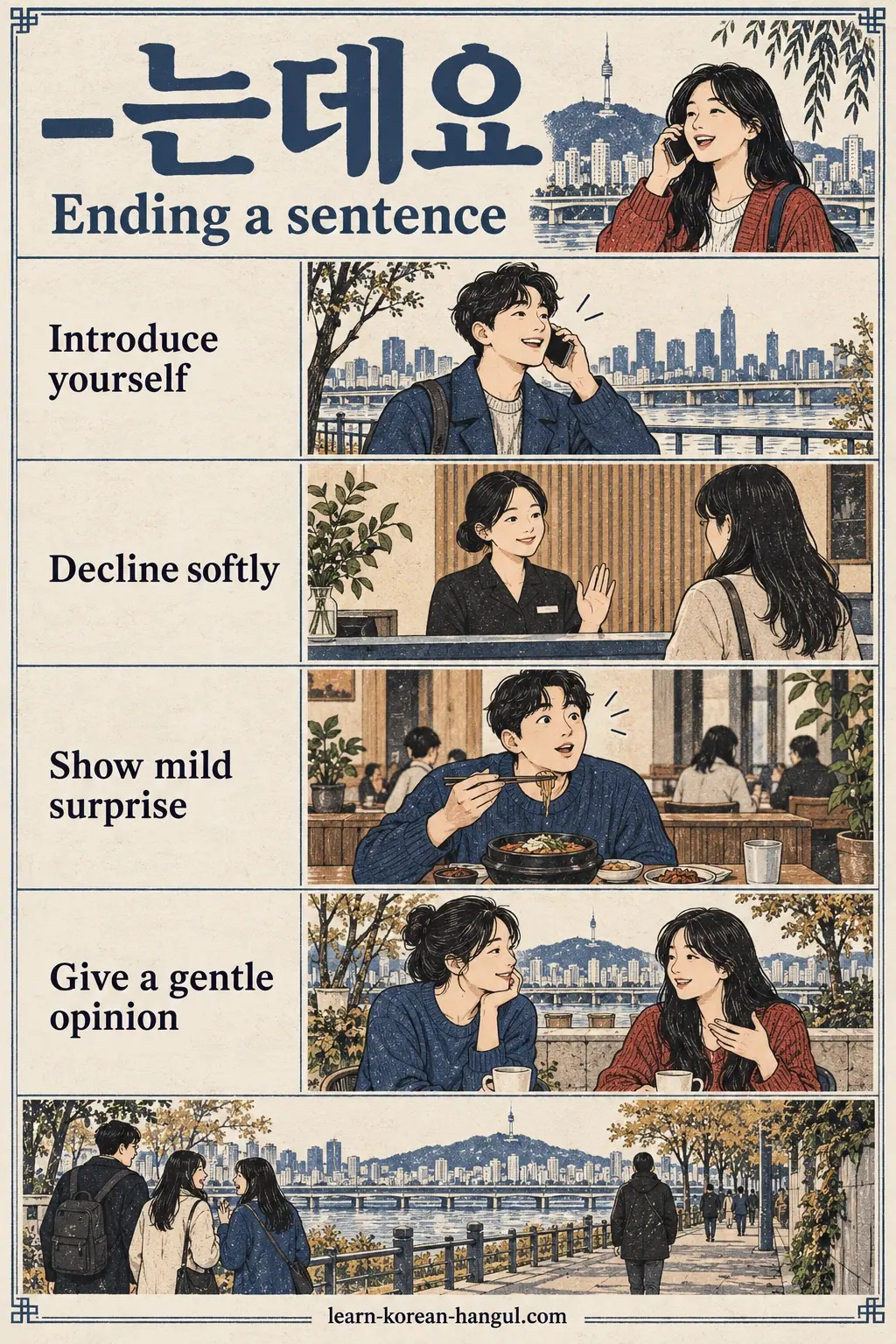
Ending a Sentence with -는데요
Speakers often stop after -(으)ㄴ/는데 and add 요. The sentence ends there, and the listener fills in the rest. This is one of the most common spoken patterns in Korean. It does four things.
| Job | Example | What it means |
|---|---|---|
| Introduce yourself | 저는 김민수인데요. | I'm Kim Minsu (and I'm calling about something). |
| Decline softly | 지금 자리에 없는데요. | They're not at their desk right now (so I can't put you through). |
| Show mild surprise | 이거 맛있는데요! | Oh, this is tasty! |
| Give a gentle opinion | 괜찮은데요. | It looks fine to me (but maybe you think otherwise). |
Because the ending leaves the sentence open, it is more polite than a flat statement. 지금 자리에 없는데요 sounds friendlier than 지금 자리에 없어요 in a phone call.
Casual Endings
In casual speech to a friend, drop 요: 이거 맛있는데. The same ending also forms questions that ask for a reaction: 괜찮은데? means "Looks fine, doesn't it?"
Spacing: the Ending Versus the Noun 데
The ending -ㄴ/는데 is attached to the stem. There is also a noun 데 ("place, point"), which is written as a separate word after a modifier. Compare 어디 가는데요? (ending) with 갈 데가 없어요 ("I have nowhere to go"). When 데 is a place, you can put a particle on it (데가, 데를). The ending cannot take a particle.
Past and Future
To talk about plans, use -(으)ㄹ 건데, a spoken short form of -(으)ㄹ 것인데: 내일 갈 건데 같이 갈래요? ("I'm going tomorrow, do you want to come?"). The spoken pattern 갈 건데 is often said [갈껀데]. This follows the -(으)ㄹ tensing rule in the standard pronunciation rules.
The next section lists the mistakes that appear most often.
What Mistakes Do Learners Make with -(으)ㄴ/는데?
Learners make seven predictable mistakes. Each has a reason and a fix.
Learners often assume the ending always means "but". Actually it often means nothing more than "and" or "so". Wrong thinking: 배가 고픈데 같이 먹을래요? = "I'm hungry but..." Right: "I'm hungry, so do you want to eat?" Fix: ask what the speaker will do next. If it is a question, a request or news, the ending is probably a lead-in.
Learners often put 는데 on an adjective. Actually adjectives take ㄴ/은. Wrong: 비싸는데 and 좋는데. Right: 비싼데 and 좋은데. Fix: ask whether the word describes a state (adjective) or an action (verb).
Learners often put 은데 or ㄴ데 on a verb. Actually verbs take 는데. Wrong: 가ㄴ데 and 먹은데. Right: 가는데 and 먹는데. A form like 먹은 데 with a space is something else: it is "the place where I ate".
Learners often treat 있다 and 없다 as adjectives. Actually they take 는데. Wrong: 있은데 and 맛있은데. Right: 있는데 and 맛있는데.
Learners often forget to drop ㄹ. Actually ㄹ drops before ㄴ. Wrong: 살는데 and 만들는데. Right: 사는데 and 만드는데.
Learners often forget 이 with nouns. Actually a noun needs 인데. Wrong: 학생는데. Right: 학생인데.
Learners often put the polite ending inside. Wrong: 비싸요는데 맛있어요. Right: 비싼데 맛있어요. Fix: attach to the bare stem and keep 요 for the last verb.
The next section gives you practice.
Practice and Answers
Do the four tasks, then compare with the key.
Task 1: attach the ending. Write the form with -(으)ㄴ/는데.
- 가다
- 비싸다
- 좋다
- 살다
- 학생
Task 2: fix the error. Each sentence has one mistake. Rewrite it correctly.
- 날씨가 좋는데 산책할까요?
- 저는 서울에 살는데 친구는 부산에 살아요.
- 저는 학생는데 일도 해요.
Task 3: translate. Write in Korean: "It is raining, so take an umbrella." and "I'm hungry. Do you want to eat?"
Task 4: write your own. Write one sentence that gives background and then makes a request, and one that has a mild contrast.
Practice · 5
Which form of the adjective 좋다 (be good) is correct before "and" or "but"?
Show answer
좋은데
Adjectives take ㄴ after a vowel and 은 after a consonant. 좋 ends in a consonant, so the form is 좋은데.
Which form of the verb 살다 (live) is correct?
Show answer
사는데
ㄹ drops before ㄴ, so 살다 becomes 사는데.
Which sentence uses the ending as a lead-in to a request?
Show answer
비싼데 사실래요?
The ending prepares the listener for a question. -지만 states a contrast, -아/어서 gives a reason, and -고 lists.
How do you say "I am a student, and..." with this ending?
Show answer
학생인데
Nouns take 인데, the 이다 form of the ending.
What does 지금 자리에 없는데요 do in a phone call?
Show answer
It softly says the person is not there.
The sentence-final -는데요 leaves the sentence open, which makes the refusal gentle.
Answer key
- (1) 가는데 (2) 비싼데 (3) 좋은데 (4) 사는데 (5) 학생인데
- (1) 날씨가 좋은데 산책할까요? (2) 저는 서울에 사는데 친구는 부산에 살아요. (3) 저는 학생인데 일도 해요.
- 비가 오는데 우산을 가져가세요. 배가 고픈데 먹을래요? Other correct versions exist, for example 비가 오는데 우산 있어요?
- Sample answers: 오늘 시간이 있는데 같이 영화 볼래요? 이 가방은 작은데 가벼워요. Any pair is correct if the first clause ends in the right form of the ending and the second clause fits.
If task 1 was correct, you have the formation rule. If task 2 was hard, go back to the word-class tables. The next section points you to what comes after this lesson.
What Should You Learn after -(으)ㄴ/는데 Grammar?
After -(으)ㄴ/는데, learn -지만 for the direct "but", and -(으)ㄴ/는데도 for "even though". To choose between them, read -는데 vs -지만.
For a wider view, the parent page And / But Connectors lists every connector in this group. To plan by level, use Beginner Grammar. Two particles often meet this ending when you list nouns: 와/과 and with particle for "and", and (이)나 or particle for "or".
This lesson covers -(으)ㄴ/는데 in the polite and casual styles. It does not cover every spoken shortening. About this page. Last updated 2026-10-09. Revised Romanization follows the national rules and is shown only as a learning aid.
Frequently Asked Questions
What Does -(으)ㄴ/는데 Mean?
-(으)ㄴ/는데 sets up the next clause. It can mean "and" when it gives background, "but" when it gives a mild contrast, or "so" when it leads into a question or request. 비가 오는데 우산 있어요? means "It is raining, do you have an umbrella?" Often it has no direct English word.
How Do I Attach -(으)ㄴ/는데 to a Verb or Adjective?
Verbs take 는데: 가는데, 먹는데. Adjectives take ㄴ데 after a vowel and 은데 after a consonant: 비싼데, 좋은데. 있다 and 없다 take 는데. Nouns take 인데: 학생인데. ㄹ stems drop ㄹ: 사는데, 만드는데. For the past, add 았/었 first: 갔는데, 비쌌는데.
Can -(으)ㄴ/는데 Be Used in the past Tense?
Yes. Add 았/었 before 는데: 갔는데, 먹었는데, 비쌌는데. Use it to tell what happened first and what you found next: 어제 서점에 갔는데 문이 닫혀 있었어요. The past form often sets up a surprise or a new event, rather than a simple reason.
Is -(으)ㄴ/는데 Used in Speech or Only in Writing?
It is used mostly in speech and informal writing. It is one of the most common endings in conversation. In formal writing, -(으)나 and -지만 are more usual. Speakers also end a sentence with -(으)ㄴ/는데요 to soften a statement, decline politely or show mild surprise.
What Is the Difference between -(으)ㄴ/는데 and -지만?
-지만 is a direct "but" that puts two ideas against each other. -(으)ㄴ/는데 is softer and wider. It can give background or lead into a question. 비싸지만 맛있어요 stresses the contrast. 비싼데 맛있어요 sounds more like the speaker is thinking aloud and telling you about it.