Quick verdict by situation
- Two facts that clearly pull against each other: -지만 (비싸지만 맛있어요).
- A scene-setting fact before a question or request: -(으)ㄴ/는데 (시간이 있는데 커피 마실래요?).
- A polite "sorry, but" before a refusal: -지만 or -(으)ㄴ/는데 (죄송하지만, 죄송한데).
- A mild contrast that sounds like "and yet": -(으)ㄴ/는데 (비싼데 맛있어요).
- A sentence that trails off and invites a reply: -(으)ㄴ/는데요 (비가 오는데요).
Before you start: you can read the two lessons on -(으)ㄴ/는데 and -지만, or at least you know that both link two clauses. Estimated time: 15 minutes.
What Is the Difference between -는데 and -지만?

-지만 says a clear "but" or "although", and -(으)ㄴ/는데 gives background that may or may not contrast with the next clause. Both are connective endings (연결 어미): endings that link one clause to the next. A clause is a group of words built around one verb or adjective. The difference is not in the grammar of the clauses but in what the speaker wants the listener to do with the first one.
- With -지만, the listener is told to expect a turn: the second clause pushes against the first.
- With -(으)ㄴ/는데, the listener is told "here is the situation": the second clause may add, contrast, ask or request.
The name -(으)ㄴ/는데 shows its changing form: -는데 after a verb and -(으)ㄴ데 after an adjective. The title uses the short name -는데 for both forms.
The One-Line Rule
If you mean a clear "but", use -지만. If you are setting the scene for a question, a request or a comment, use -(으)ㄴ/는데.
That rule covers most beginner sentences. The rest of this page breaks it into five criteria, each with an example, so you can check harder cases one at a time.
Side-by-Side Comparison Table
The table compares the two endings across the criteria that decide most choices. The bold cell in each row marks the ending that the criterion favours.
| Criterion | -지만 | -(으)ㄴ/는데 |
|---|---|---|
| Core meaning | clear "but, although" | background, mild contrast, "and", "so" |
| Strength of contrast | strong | weak or none |
| Lead-in to a question or request | not as a scene-setter (only prefaces such as 실례지만) | possible: 배고픈데 같이 먹을래요? |
| Form | one form for all stems: 먹지만, 크지만 | changes: 먹는데, 큰데, 학생인데 |
| Sound after a consonant stem | [먹찌만] | [멍는데] |
| After -았/었- | 비쌌지만 | 비쌌는데 |
| Sentence-final use | uncommon | common: 비가 오는데요. |
| Polite preface to a refusal | 죄송하지만 | 죄송한데 (softer) |
The criteria are explained one by one below. The next section shows the first two rows in one worked exchange.
A Worked Example: One Restaurant, Three Endings

Check what the second clause does, and the ending follows. This worked example follows one speaker who talks about the same restaurant three times.
-지만
clear but: expensive, but delicious
-(으)ㄴ/는데
background: expensive, and yet delicious / delicious, shall we go?
| Comparison | -지만 | -(으)ㄴ/는데 |
|---|---|---|
| Meaning | clear but | background or mild contrast |
| Scene-setter before a request | no (only fixed prefaces such as 죄송하지만) | yes |
| Form | never changes | verb -는데, adjective -(으)ㄴ데 |
Use -지만 for a direct contrast; use -(으)ㄴ/는데 to set the scene or lead into a request.
Step 1: A clear "but". The speaker warns that the restaurant costs a lot, and the good food outweighs it. 이 식당은 비싸지만 맛있어요 (i sikdangeun bissajiman masisseoyo) [이 식땅은 비싸지만 마시써요] = "This restaurant is expensive, but the food is good."
Step 2: A mild contrast. The same two facts, said as a comment. 이 식당은 비싼데 맛있어요 (i sikdangeun bissande masisseoyo) = "This restaurant is expensive, and yet the food is good." The speaker is pointing out something interesting, not arguing against the price.
Step 3: A lead-in. The speaker sets the scene and invites the friend. 이 식당은 맛있는데 같이 갈래요? (i sikdangeun masinneunde gachi gallaeyo?) [이 식땅은 마신는데 가치 갈래요] = "This restaurant is good; do you want to go together?" There is no "but" in this sentence, and -지만 cannot replace -는데 here.
Checkpoint. You'll know you have it when you can explain why Step 3 would sound strange with -지만. The ending -지만 announces a contrast, but there is nothing in "tasty" to contrast with the invitation. The five criteria below test the same idea in other situations.
Criterion 1: How Strong Is the Contrast?

Use -지만 when the contrast is the point, and use -(으)ㄴ/는데 when it is only a side note. The strength of the contrast is the most visible difference between the two endings.
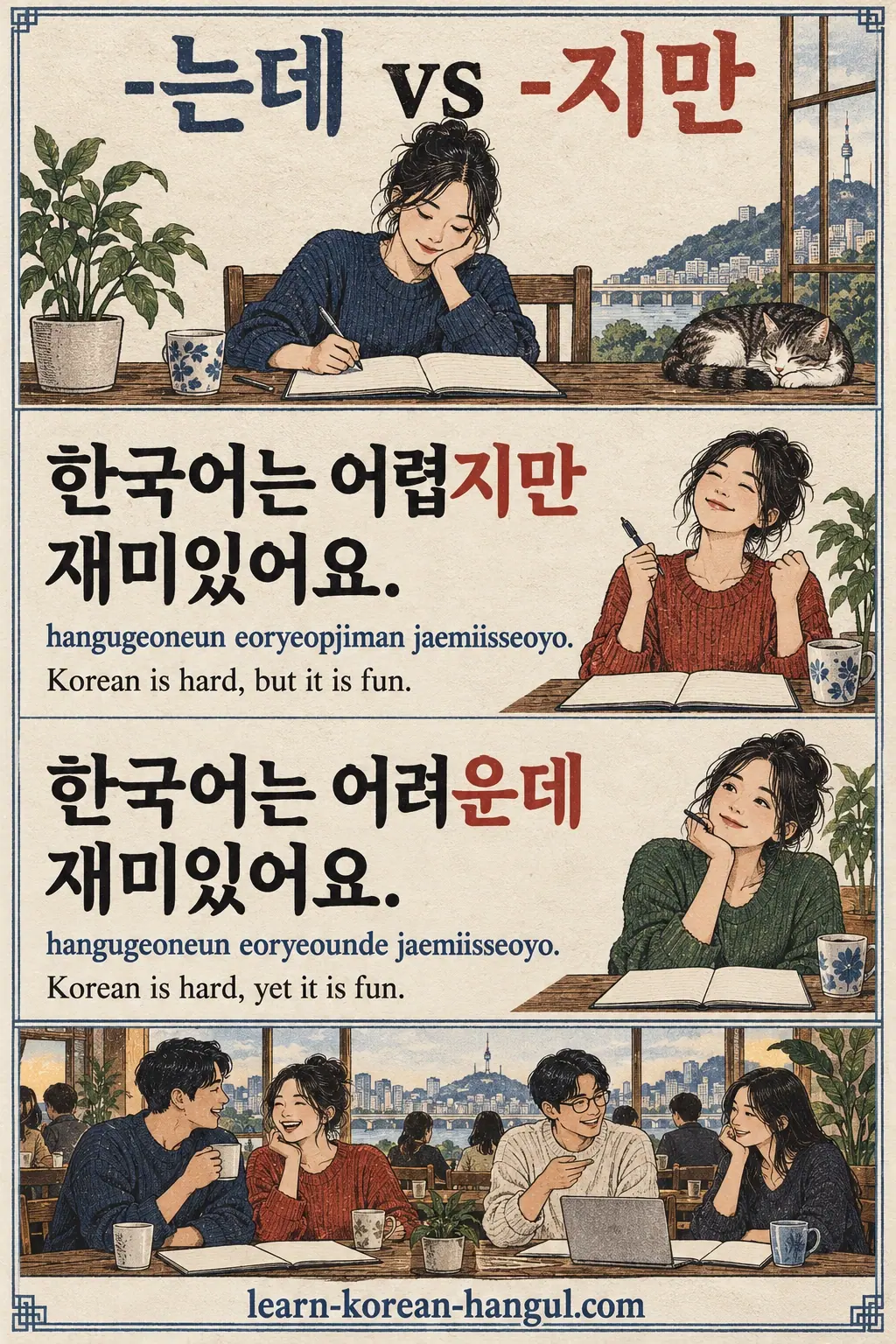
- 한국어는 어렵지만 재미있어요. (hangugeoneun eoryeopjiman jaemiisseoyo.) [한구거는 어렵찌만 재미이써요] = "Korean is hard, but it is fun." The second clause is the speaker's conclusion.
- 한국어는 어려운데 재미있어요. (hangugeoneun eoryeounde jaemiisseoyo.) = "Korean is hard, yet it is fun." The contrast is softer: the speaker reports two facts and lets the listener weigh them.
Winner for a strong contrast: -지만. Winner for a mild contrast: -(으)ㄴ/는데.
Criterion 2: Does the Sentence Lead into a Question or Request?

Use -(으)ㄴ/는데 when the next clause is a question, an invitation or a request. The first clause gives the reason the listener needs to hear the second.
- 지금 시간이 있는데 같이 커피 마실래요? (jigeum sigani inneunde gachi keopi masillaeyo?) [지금 시가니 인는데 가치 커피 마실래요] = "I have time now; do you want to have coffee together?"
- 길을 모르는데 도와주세요. (gireul moreuneunde dowajuseyo.) = "I don't know the way; please help me."
Replacing -는데 with -지만 in these sentences would mean "I have time, but ..." and the invitation would no longer follow. Winner for a lead-in: -(으)ㄴ/는데. Winner for a clear statement: -지만.
Criterion 3: Which Form Does Each Ending Take?
-지만 has one form, while -(으)ㄴ/는데 changes with the word type. This is the biggest practical difference for learners.
| Word type | -지만 | -(으)ㄴ/는데 |
|---|---|---|
| Verb 먹다 | 먹지만 [먹찌만] | 먹는데 [멍는데] |
| Verb 가다 | 가지만 | 가는데 |
| Verb 살다 (ㄹ drops) | 살지만 | 사는데 |
| Adjective 크다 | 크지만 | 큰데 |
| Adjective 좋다 | 좋지만 [조치만] | 좋은데 [조은데] |
| Adjective 춥다 (ㅂ-irregular) | 춥지만 [춥찌만] | 추운데 |
| 있다 / 없다 | 있지만 [읻찌만] / 없지만 [업찌만] | 있는데 [인는데] / 없는데 [엄는데] |
| Noun + 이다 | 학생이지만 | 학생인데 |
| Past stem | 먹었지만 [머걷찌만] | 먹었는데 [머건는데] |
Three points sit behind the table. First, -지만 attaches to the bare stem. The irregular classes do not change, because -지만 starts with a consonant. Second, -(으)ㄴ/는데 uses the same shape as the noun-modifying ending: -는 for verbs and 있다/없다, -(으)ㄴ for adjectives. Third, any tense marker (-았/었-, -겠-) is followed by -는데, whatever the word type.
Pronunciation: 먹는데 is said [멍는데], because the ㄱ before ㄴ sounds like ㅇ (nasalization, Standard Pronunciation Rules Article 18). 먹지만 is said [먹찌만], with a tense ㅈ after the ㄱ (Article 23).
Winner for easy formation: -지만. Winner for flexibility: -(으)ㄴ/는데. The lessons on -지만 and -(으)ㄴ/는데 give all the forms in detail.
Criterion 4: How Do They Behave with Tense?
Both endings take a past marker inside the first clause, and the sentence type comes from the final verb. The one difference is the shape of -(으)ㄴ/는데 after the marker.
- 어제는 비쌌지만 오늘은 싸요. (eojeneun bissatjiman oneureun ssayo.) [어제는 비싿찌만 오느른 싸요] = "It was expensive yesterday, but it is cheap today."
- 어제는 비쌌는데 오늘은 싸요. (eojeneun bissanneunde oneureun ssayo.) [어제는 비싼는데 오느른 싸요] = "It was expensive yesterday, and today it is cheap." The contrast is still there, but it is reported rather than stressed.
Notice that the adjective 비싸다 takes -(으)ㄴ데 in the present (비싼데) but -는데 in the past (비쌌는데), because -는데 follows every tense marker. The past 비쌌지만 is said with the final ㅆ as ㄷ before the tense ㅈ. The past tense itself is explained in the lesson on past tense -았/었-.
Winner for a simple past form: -지만. Winner for tense plus a lead-in: -(으)ㄴ/는데.
Criterion 5: How Soft or Polite Does the Sentence Sound?

Both endings can soften a refusal, and -(으)ㄴ/는데 is the softer of the two. A speaker uses them before a "no" or a request to show respect for the listener.
- 죄송하지만 지금은 못 가요. (joesonghajiman jigeumeun mot gayo.) [죄송하지만 지그믄 몯 까요] = "I'm sorry, but I can't go now."
- 죄송한데 지금은 못 가요. (joesonghande jigeumeun mot gayo.) = "Sorry, but I can't go now." More casual and softer in tone.
- 비가 오는데요. (biga oneundeyo.) = "Well, it's raining..." The -(으)ㄴ/는데요 ending leaves the rest unsaid and invites the listener to react.
For a written, formal "but", Korean has a third choice: the ending -(으)나, taught in the lesson on -(으)나. Winner for a polite hint: -(으)ㄴ/는데. Winner for a clean, formal "but": -지만.
Which Should You Choose in Each Situation?
Choose by the job the first clause does. Four common situations each get a firm recommendation.
Giving Two Opposing Facts
Use -지만. 작지만 예뻐요 means "It is small, but pretty", and the contrast is the whole sentence.
Inviting or Asking
Use -(으)ㄴ/는데. 시간이 있는데 커피 마실래요? sets up the question with a fact.
Making a Request Politely
Use -(으)ㄴ/는데. 길을 모르는데 도와주세요 gives the reason before the request.
Refusing Politely
Use 죄송하지만 for a clean "sorry, but" and 죄송한데 for a softer, more spoken tone. The next section shows what happens when both endings share one sentence.
Can You Use Both in the Same Sentence?
Yes, they fit together when the sentence has both a contrast and a lead-in. 비싸지만 맛있는데 같이 갈래요? (bissajiman masinneunde gachi gallaeyo?) [비싸지만 마신는데 가치 갈래요] means "It's expensive but tasty; do you want to go together?" The -지만 clause holds the contrast, and the -는데 clause leads into the invitation.
This pattern also shows why the two are not rivals: one marks a turn, and the other opens a topic. The next section lists the mistakes that come from mixing them up.
What Mistakes Do Learners Make with These Two?
Learners make five common mistakes with -는데 vs -지만. Each one follows the pattern "learners often assume X; actually Y, because Z".
- Translating -는데 as "but" every time. Learners see 맛있는데 한번 먹어 보세요 and expect a contrast. Actually it means "It's tasty; try it once", with no "but" at all. The ending only opens the topic.
- Using -지만 to lead into a request. Learners write 시간이 있지만 커피 마실래요?. Actually -지만 announces a turn, so the listener expects something against having time. Use 시간이 있는데.
- Using the verb shape on an adjective. Learners write 날씨가 좋는데. Actually adjectives take -(으)ㄴ데: 날씨가 좋은데.
- Forgetting 인데 for nouns. Learners write 학생는데. Actually a noun needs the copula first: 학생인데.
- Saying 먹는데 with a plain ㄱ. Learners follow the spelling. Actually the ㄱ sounds like ㅇ before ㄴ, so say [멍는데].
A practical rule of thumb: if you cannot find a contrast in the sentence, the ending is -(으)ㄴ/는데 doing its scene-setting job. The next section explains where even this rule is not simple.
Edge Cases and Exceptions
The rule "contrast means -지만, scene-setting means -(으)ㄴ/는데" is a teaching simplification, and it has honest limits. Native speakers make some choices for style or tone.
- Both can fit. In a sentence such as 한국어는 어렵지만 재미있어요, either ending is grammatical. The difference is how strongly the speaker argues the point.
- -(으)ㄴ/는데 also has its own contrast meaning. It can mean "although" in sentences such as 어제 전화했는데 안 받았어요 ("I called yesterday, but you didn't pick up"; said [어제 전화핸는데 안 바다써요]). In that sentence the speaker reports an unexpected result and does not argue a case.
- -지만 does not set the scene. A plain fact plus -지만 cannot introduce a request (시간이 있지만 커피 마실래요? sounds odd). Fixed polite prefaces are the exception: 죄송하지만 and 실례지만 ("excuse me, but") go before requests and questions all the time, as does the softer 죄송한데.
- Related endings. The pattern -(으)ㄴ/는데도 means "even though", and -(으)나 is the written "but". Both are separate lessons.
If a sentence does not fit any criterion, choose by what the second clause does and move on. The practice below checks the core cases.
Practice and Answers
These four exercises check the core outcome: choosing -(으)ㄴ/는데 or -지만 in a new sentence and explaining why. Try each one before you read the answers.
Practice · 5
Which ending fits? 배고프__ 같이 먹을래요? (I'm hungry; shall we eat together?)
Show answer
배고픈데
The second clause is an invitation, so the first clause sets the scene with -(으)ㄴ데. 고프다 is an adjective, so it takes -(으)ㄴ데.
Which is the correct form of 날씨가 좋다 before 산책할까요?
Show answer
날씨가 좋은데
좋다 is an adjective, so it takes -(으)ㄴ데: 좋은데. The verb shape 좋는데 is a common error.
How do you say "It is small, but pretty"?
Show answer
작지만 예뻐요.
The two descriptions pull against each other, so the clear "but" -지만 fits. -지만 attaches to the bare stem.
Why does 시간이 있지만 같이 커피 마실래요? sound odd?
Show answer
-지만 announces a contrast, but having time does not pull against an invitation.
-지만 tells the listener to expect a turn. Use 시간이 있는데 to set the scene for the invitation.
How is 먹는데 pronounced?
Show answer
[멍는데]
Final ㄱ before ㄴ becomes ㅇ (nasalization, Standard Pronunciation Rules Article 18).
Exercise 1: Choose the ending. Fill in the blank with -지만 or -(으)ㄴ/는데: 배고프__ 같이 먹을래요? (I'm hungry; shall we eat together?)
Exercise 2: Fix the error. A learner writes 날씨가 좋는데 산책할까요?. Give the correct form.
Exercise 3: Translate. "It is small, but pretty." (small = 작다, pretty = 예쁘다)
Exercise 4: Explain. Why is 시간이 있지만 같이 커피 마실래요? a poor sentence?
Answer Key
- Exercise 1: 배고픈데 같이 먹을래요? [배고픈데 가치 머글래요] The second clause is an invitation, so -(으)ㄴ/는데 fits.
- Exercise 2: 날씨가 좋은데 산책할까요? [날씨가 조은데 산채칼까요] 좋다 is an adjective, so it takes -(으)ㄴ데.
- Exercise 3: 작지만 예뻐요. [작찌만 예뻐요] The two descriptions pull against each other, so -지만 fits.
- Exercise 4: -지만 announces a contrast, but "I have time" does not pull against an invitation. Use 시간이 있는데 같이 커피 마실래요?
If you missed Exercise 1 or 4, reread Criterion 2. If you missed Exercise 2, reread Criterion 3. The next section shows where to go from here.
What Should You Learn Next?
The next step is the full lesson on whichever ending felt weaker: -(으)ㄴ/는데 or -지만. Then review -고 for a plain "and", and the written "but" in -(으)나. Both endings are listed with their neighbours on And / But Connectors, and the level plan is on the Beginner Grammar list.
What this lesson does not cover. It does not cover -(으)ㄴ/는데도 ("even though"), -기는 하지만 or the formal written -(으)나 in depth. Other confusable pairs are collected under Confusing Grammar Compared. The level given here, A2, is an editorial estimate, not an official grading.
In short, -는데 vs -지만 comes down to one question: is the second clause a clear turn, or does the first clause set the scene? For a clear turn, use -지만. For a scene, a question or a request, use -(으)ㄴ/는데.
Frequently Asked Questions
Can I always replace -(으)ㄴ/는데 with -지만? No. -지만 works only where the speaker means a clear "but". It cannot simply set the scene for a question or request, so 배고픈데 같이 먹을래요? cannot become 배고프지만 같이 먹을래요?. Fixed prefaces such as 죄송하지만 and 실례지만 are the exception. The reverse swap often works when the contrast is mild, and the sentence gets softer.
Which one sounds more natural in speech? Both are everyday speech. -(으)ㄴ/는데 is the more conversational of the two, and it often ends a sentence as -(으)ㄴ/는데요 to leave room for the listener. -지만 is neutral and also common in writing. For a strong, explicit "but" in a report or an essay, -지만 or the more formal -(으)나 is the usual choice.
Do both endings take a past tense marker? Yes. Put -았/었- before either ending: 비쌌지만 and 비쌌는데. After a tense marker, -는데 is always the form used, even for adjectives. Without a tense marker, adjectives take -(으)ㄴ데 (비싼데) and verbs take -는데 (가는데). The sentence type still comes from the final verb, so both endings can lead into a statement, a question or a request.
Which one appears more often on the TOPIK? No official pattern-by-pattern frequency list is published, so no honest ranking exists. This site places both endings at A2, which matches the beginner level of TOPIK I as an editorial estimate. Learn both: -지만 for explicit contrast, and -는데 because it appears in questions, requests and sentence-final speech.
What is the quickest rule to remember? Ask what the second clause does. If it contradicts what the first clause leads you to expect, use -지만. If the first clause only sets the scene for a question, a request, a comment or a mild contrast, use -(으)ㄴ/는데. When in doubt between the two, -(으)ㄴ/는데 gives a softer sentence.