What you'll learn
- Attach -(으)ㄴ/는 만큼 to verbs, adjectives and nouns.
- Tell the three senses apart: proportion, equal amount and reason.
- Space 만큼 correctly as a word or as a particle.
- Choose between -(으)ㄴ/는 만큼, -(으)ㄴ/는 이상 and -(으)ㄹ수록.
Prerequisites: modifier endings for verbs and adjectives, and the past tense -았/었-. Time: about 15 minutes.
Key facts
- -(으)ㄴ/는 만큼 links a result to a degree: "as much as".
- The word before 만큼 is a modifier: 는 for a present verb, (으)ㄴ for a past verb or adjective, (으)ㄹ for a limit, 인 for a noun.
- After a modifier, 만큼 is a separate word. After a plain noun it is a particle and attaches: 동생만큼.
- It can also give a reason ("since"), mostly in writing and speeches.
- It is not a plain "because": the clause must name a degree.
Listen to two model sentences.
The next section defines the pattern.
What Does -(으)ㄴ/는 만큼 Grammar Mean?
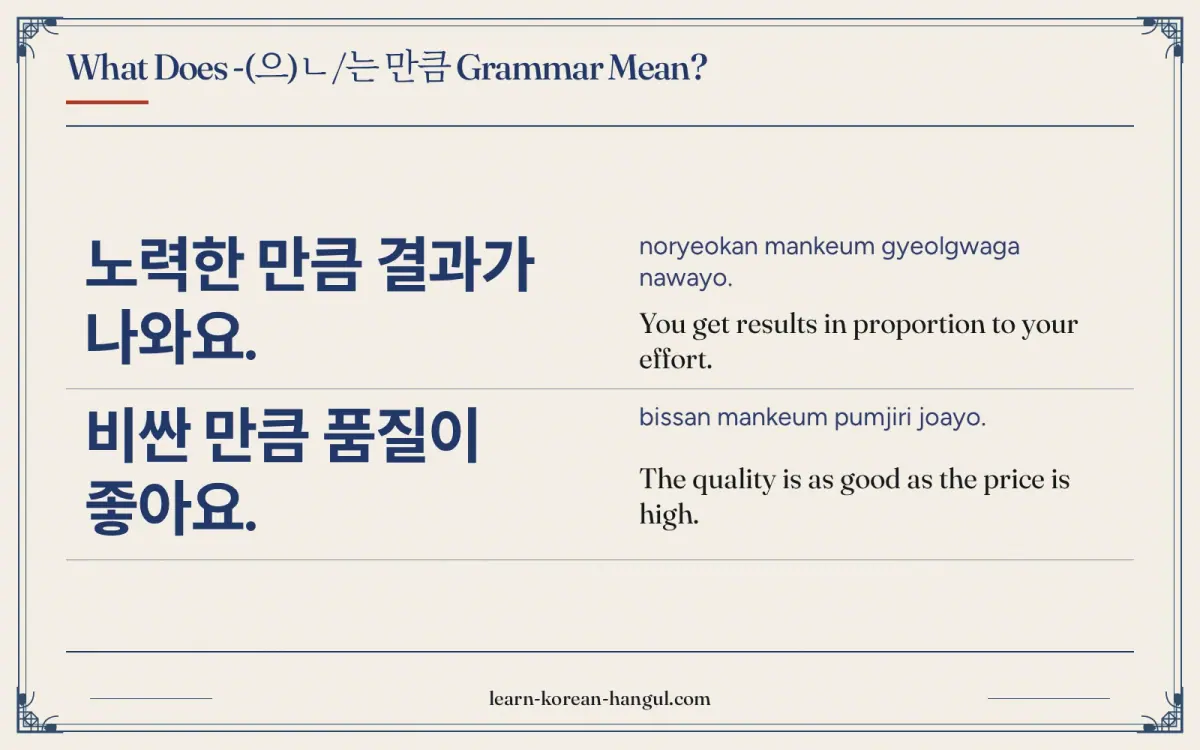
-(으)ㄴ/는 만큼 means "as much as" or "to the extent that". A connective ending is a word or ending that joins one clause to the next. 만큼 is a bound noun, which means a noun that cannot stand alone and always needs a modifier in front of it. Its basic meaning is "the amount" or "the degree".
The pattern has three senses. They overlap, so use the clause that follows to tell them apart.
- Proportion. The result grows or shrinks with the basis: 노력한 만큼 결과가 나와요. More effort gives more result.
- Equal amount. The amount matches what is named: 원하는 만큼 가져가세요 ("Take as much as you want").
- Reason and degree. The first clause is both a cause and a measure: 기대가 큰 만큼 실망도 컸어요 ("Since expectations were high, the disappointment was big too").
Here are two glossed examples.
노력한 만큼 결과가 나와요.
noryeokan mankeum gyeolgwaga nawayo.
You get results in proportion to your effort.
비싼 만큼 품질이 좋아요.
bissan mankeum pumjiri joayo.
The quality is as good as the price is high.
| Part | 노력한 만큼 결과가 나와요. | 비싼 만큼 품질이 좋아요. |
|---|---|---|
| First clause | 노력한 만큼 (as much as you tried) | 비싼 만큼 (as much as it is expensive) |
| Result clause | 결과가 나와요 (results come out) | 품질이 좋아요 (the quality is good) |
| Spoken | [노려칸 만큼 결과가 나와요] | [비싼 만큼 품지리 조아요] |
| RR (aid) | noryeokan mankeum gyeolgwaga nawayo | bissan mankeum pumjiri joayo |
| English | You get results in proportion to your effort. | The quality is as good as the price is high. |
In both sentences, the second clause matches the first in size. That is the signal of this pattern: the speaker puts two things on the same scale.
The next section shows how to build the form.
How Do You Form -(으)ㄴ/는 만큼?
Put a modifier in front of 만큼. A modifier is a verb or adjective changed so that it describes a noun. Take the stem, which is the dictionary form without 다, and add the modifier ending.
| Type | Rule | Example | Spoken | RR (aid) |
|---|---|---|---|---|
| Verb, present | stem + 는 만큼 | 원하는 만큼 (as much as you want) | [원하는 만큼] | wonhaneun mankeum |
| Verb, past | stem + (으)ㄴ 만큼 | 준비한 만큼 (as much as you prepared) | [준비한 만큼] | junbihan mankeum |
| Adjective | stem + (으)ㄴ 만큼 | 큰 만큼 (as big as, since it is big) | [큰 만큼] | keun mankeum |
| Prospective / limit | stem + (으)ㄹ 만큼 | 찰 만큼 (to the point of being full) | [찰 만큼] | chal mankeum |
| Past adjective | stem + 았/었던 만큼 | 컸던 만큼 (as big as it was) | [컫떤 만큼] | keotdeon mankeum |
| Noun + 이다 | noun + 인 만큼 | 어른인 만큼 (since one is an adult) | [어르닌 만큼] | eoreunin mankeum |
| Plain noun | noun + 만큼 (particle) | 동생만큼 (as much as my sibling) | [동생만큼] | dongsaengmankeum |
The word 만큼 has no sound change. The only change to watch is in the modifier: 컸던 만큼 sounds like [컫떤 만큼], because ㅆ is said as ㄷ and the ㄷ of 던 becomes a tense ㄸ. Revised Romanization (RR) is a spelling system that writes sounds in Latin letters. It does not mark tensing that comes from a neighbouring sound, so it writes keotdeon.
Stems Ending in a Vowel
Vowel stems take 는 in the present and ㄴ in the past: 가다 gives 가는 만큼 and 간 만큼. The adjective 크다 gives 큰 만큼, and 비싸다 gives 비싼 만큼.
Stems Ending in a Consonant
Consonant stems take 는 in the present and 은 in the past: 먹다 gives 먹는 만큼 and 먹은 만큼. Adjectives take 은: 많다 gives 많은 만큼.
For a limit, use (으)ㄹ: 먹다 gives 먹을 만큼 ("enough to eat"), and 달리다 gives 달릴 만큼 ("enough to run"). This (으)ㄹ form means "to the point that", as in 숨이 찰 만큼 달렸어요 ("I ran until I was out of breath").
Irregular Stems and Nouns
The ㄹ stems drop ㄹ before ㄴ: 알다 gives 아는 만큼 in the present and 안 만큼 in the past. This is why the saying 아는 만큼 보여요 ("You see as much as you know") has 아는 and not 알는.
For nouns, use 이다 when you mean "since one is": 어른인 만큼 책임이 있어요. When 만큼 follows a plain noun and means "as much as that noun", it is a particle and attaches without a space: 동생만큼 키가 커요 means "He is as tall as my younger sibling." Compare the spacing.
| Spacing | Why | Example |
|---|---|---|
| space before 만큼 | a bound noun after a modifier | 노력한 만큼 |
| no space before 만큼 | a particle after a noun | 노력만큼 결과가 나와요 |
| one word | the demonstrative forms | 이만큼, 그만큼, 저만큼 |
The next section builds a full sentence.
Worked Example: Building 기대가 큰 만큼 실망도 컸어요
Say "Since expectations were high, the disappointment was big too." Follow five steps.
- Write the first clause. "Expectations are high" is 기대가 커요. The word 기대 means "expectation".
- Find the stem. The dictionary form is 크다, so the stem is 크.
- Make the modifier. Add ㄴ to the stem: 큰. Remove the polite ending 어요, because the ending belongs to the last verb only.
- Add 만큼. 기대가 큰 만큼 means "as much as expectations are high".
- Write the matching result. "The disappointment was big too" is 실망도 컸어요. The particle 도 means "also", and it signals the match. Join the two parts: 기대가 큰 만큼 실망도 컸어요.
You'll know it worked when the first clause ends in 만큼 with nothing after it, and the polite ending 요 appears only once, at the end. The particle 도 in the second clause is a good sign: the sentence puts two things on the same scale. Try the same steps with "As much as you studied, your score went up": 공부한 만큼 점수가 올랐어요.
Sentence
Since expectations were high, the disappointment was big too.
Show answer
기대가 큰 만큼 실망도 컸어요
The next section covers tense and sentence types.
Which Tenses and Sentence Types Work with -(으)ㄴ/는 만큼?
Tense lives in the modifier. The present modifier 는 describes a degree that is true now or in general: 원하는 만큼. The past modifier (으)ㄴ describes a finished act: 준비한 만큼. For a past state of an adjective, use 았/었던: 기대가 컸던 만큼. Past tense -았/었- is explained in full on its own page, so this page does not repeat it.
| Slot | Form | Example | English |
|---|---|---|---|
| General or present | 는 / (으)ㄴ + 만큼 | 아는 만큼 보여요. | You see as much as you know. |
| Finished act | (으)ㄴ + 만큼 | 준비한 만큼 자신이 있어요. | I am as confident as I prepared. |
| Past state | 았/었던 + 만큼 | 기대가 컸던 만큼 실망도 컸어요. | The disappointment matched the big hopes. |
| Limit or degree | (으)ㄹ + 만큼 | 숨이 찰 만큼 달렸어요. | I ran until I was out of breath. |
| Noun | 인 + 만큼 | 어른인 만큼 책임이 있어요. | Since you are an adult, you have responsibility. |
| Command after | -(으)세요 | 먹고 싶은 만큼 드세요. | Eat as much as you like. |
The result clause can be a statement, a question or a polite command. A command is common with the "equal amount" sense: 원하는 만큼 가져가세요. A yes/no question ends with a rise: 먹고 싶은 만큼 먹어도 돼요? A wh-question, for example 얼마만큼 드릴까요? ("How much shall I give you?"), does not end with a sharp rise.
The sense of "reason" appears when the first clause is a state and the second clause is a matching state or a duty: 어른인 만큼 책임이 있어요. If the result is only a cause-and-effect event and not a matching degree, use -아/어서 or -기 때문에 instead.
The next section compares -(으)ㄴ/는 만큼 with its neighbours.
How Is -(으)ㄴ/는 만큼 Different from -(으)ㄴ/는 이상?
All three patterns below link a first clause to a second clause, and that is why learners mix them up. The difference is what they measure. The same effort idea is told three ways.
| Pattern | Core idea | Example | Feeling |
|---|---|---|---|
| -(으)ㄴ/는 만큼 | same degree, in proportion | 노력한 만큼 결과가 나와요. | "As much as you try, so much you get." |
| -(으)ㄹ수록 | rising degree, step by step | 노력할수록 결과가 좋아져요. | "The more you try, the better it gets." |
| -(으)ㄴ/는 이상 | fixed basis, so a duty | 도전한 이상 결과를 받아들여야 해요. | "You took the challenge, so accept the result." |
Spoken forms: 노력할수록 결과가 좋아져요 is [노려칼쑤록 결과가 조아져요] (RR noryeokalsurok gyeolgwaga joajyeoyo), and 도전한 이상 결과를 받아들여야 해요 is [도전하니상 결과를 바다드려야 해요] (RR dojeonhan isang gyeolgwareul badadeuryeoya haeyo).
The key test is what you are comparing. If you match one amount against another amount, use 만큼. If you describe a change that keeps rising, use -(으)ㄹ수록. If you describe a fixed fact and a duty, use 이상. Compare these two.
- 많이 연습한 만큼 잘해요. ("You do well in proportion to how much you practised.") Two amounts match.
- 많이 연습할수록 잘해요. ("The more you practise, the better you do.") A change in step.
-(으)ㄴ/는 만큼
as much as: matched degree
-(으)ㄹ수록
the more, the more: rising change
-(으)ㄴ/는 이상
now that, since: fixed basis
| Comparison | -(으)ㄴ/는 만큼 | -(으)ㄹ수록 | -(으)ㄴ/는 이상 |
|---|---|---|---|
| Core idea | same degree | change in step | fixed situation |
| Typical result | matching amount or state | matching change | duty or decision |
| Second clause often has | 도 (also) | 더 (more) | 아/어야 하다 |
| Reason sense | sometimes | no | yes |
Use -(으)ㄴ/는 만큼 to match a result to a degree; use -(으)ㄹ수록 for a rising change; use -(으)ㄴ/는 이상 for a fixed basis that leads to a duty.
The next section covers set phrases and edge cases.
Variations and Edge Cases of -(으)ㄴ/는 만큼
Set Phrases
| Phrase | Use | RR (aid) |
|---|---|---|
| 아는 만큼 보인다 | "you see as much as you know" | aneun mankeum boinda |
| 노력한 만큼 얻는다 | "you gain as much as you try" | noryeokan mankeum eonneunda |
| 그만큼 | "that much, to that degree" | geumankeum |
| 얼마만큼 | "how much" | eolmamankeum |
The words 이만큼, 그만큼 and 저만큼 mean "this much", "that much" and "that much over there". They are written as one word: 그만큼 노력했어요 means "I tried that hard."
Adding 도 for the Matching Feeling
A particle 도 in the second clause underlines the match: 기대가 큰 만큼 실망도 컸어요. The sentence says that two things are the same size, not that one caused the other.
The Look-Alike 을 만하다
Do not mix up 만큼 with the ending -(으)ㄹ 만하다, which means "to be worth doing". 이 영화는 볼 만해요 means "This film is worth watching." The word 만하다 is a separate verb: it follows -(으)ㄹ and ends the sentence. It has no 큼.
Written Style
In essays and speeches, the reason sense is common: 중요한 만큼 신중하게 결정해야 합니다 ("Since it is important, we must decide carefully"). It sounds measured and formal. In speech, the "as much as" sense is more natural.
The next section lists the mistakes that appear most often.
What Mistakes Do Learners Make with -(으)ㄴ/는 만큼?
Learners make six predictable mistakes. Each has a reason and a fix.
Learners often use 만큼 as a plain "because". The clause must name a degree. Unnatural: 비가 오는 만큼 못 갔어요. Right: 비가 와서 못 갔어요. Fix: use -아/어서 or -기 때문에 for a simple cause.
Learners often attach 만큼 to a bare stem. A modifier must come first. Wrong: 노력하 만큼 and 노력해요 만큼. Right: 노력한 만큼. Fix: add 는, (으)ㄴ or (으)ㄹ before 만큼 and never put the polite ending 요 inside.
Learners often write the modifier and 만큼 together. 만큼 is a separate word after a modifier. Wrong: 노력한만큼. Right: 노력한 만큼. Fix: leave a space.
Learners often space the particle. 만큼 after a plain noun is a particle. Wrong: 동생 만큼 키가 커요. Right: 동생만큼 키가 커요. Fix: attach it with no space.
Learners often drop 인 when they mean "since one is". The sentence 어른만큼 책임이 있어요 is correct Korean, but it means "He has as much responsibility as an adult." Right for "Since you are an adult, you have responsibility": 어른인 만큼 책임이 있어요. Fix: add 인 when the noun is the reason.
Learners often confuse 만큼 with 처럼. 만큼 compares an amount or a degree, and 처럼 compares a manner. 동생만큼 노래해요 means "I sing as much as my sibling." 동생처럼 노래해요 means "I sing like my sibling." Fix: ask whether you compare "how much" or "how".
The next section gives you practice.
Practice and Answers
Do the four tasks, then compare with the key.
Task 1: join the sentences with -(으)ㄴ/는 만큼. Write one sentence for each pair.
- 노력했어요. / 결과가 나와요.
- 원해요. / 가져가세요.
- 비싸요. / 품질이 좋아요.
- 기대가 컸어요. / 실망도 컸어요.
Task 2: fix the error. Each sentence has one mistake. Rewrite it correctly.
- 노력하 만큼 결과가 나와요.
- 동생 만큼 키가 커요.
- 비가 오는 만큼 못 갔어요.
Task 3: translate. Write in Korean: "You see as much as you know." and "I tried that hard."
Task 4: write your own. Write one sentence with 준비한 만큼, and one with 어른인 만큼.
Practice · 5
Which sentence means "You get results in proportion to your effort"?
Show answer
노력한 만큼 결과가 나와요.
A modifier comes first, and 만큼 is a separate word after it.
How do you say "He is as tall as my younger sibling"?
Show answer
동생만큼 키가 커요.
After a plain noun, 만큼 is a particle and attaches directly.
What does 기대가 큰 만큼 실망도 컸어요 mean?
Show answer
Expectations were high, and so the disappointment was just as big.
만큼 sets the two things on the same scale, and 도 marks the match.
Which modifier of the adjective 비싸다 fits before 만큼 in "as much as it is expensive"?
Show answer
비싼
An adjective takes the modifier ending (으)ㄴ: 비싼.
Which sentence uses 만큼 wrongly, as a plain "because"?
Show answer
비가 오는 만큼 못 갔어요.
Rain is a cause, not a degree. Use 비가 와서 못 갔어요.
Answer key
- (1) 노력한 만큼 결과가 나와요. (2) 원하는 만큼 가져가세요. (3) 비싼 만큼 품질이 좋아요. (4) 기대가 컸던 만큼 실망도 컸어요.
- (1) 노력한 만큼 결과가 나와요. (2) 동생만큼 키가 커요. (3) 비가 와서 못 갔어요.
- 아는 만큼 보여요. 그만큼 노력했어요. Other correct versions exist, for example 그만큼 열심히 했어요.
- Sample answers: 준비한 만큼 자신이 있어요. 어른인 만큼 책임이 있어요. Any pair is correct if the modifier comes first, 만큼 is spaced, and the result matches the degree.
If task 1 was correct, you have the formation rule. If task 2 was hard, check whether you skipped the modifier, spaced the particle, or used 만큼 for a plain cause. The next section points you to what comes after this lesson.
What Should You Learn after -(으)ㄴ/는 만큼 Grammar?
After -(으)ㄴ/는 만큼, learn -(으)ㄹ수록 for "the more ..., the more ...". If you have not yet studied the fixed-basis partner, go to -(으)ㄴ/는 이상.
For a wider view, the parent page Cause and Reason lists every connector in this group. To plan by level, use Advanced Grammar.
This lesson covers -(으)ㄴ/는 만큼 in the polite, casual and formal styles. It does not cover every written variation. About this page. Last updated 2026-10-09. Revised Romanization follows the national rules and is shown only as a learning aid.
Frequently Asked Questions
What Does -(으)ㄴ/는 만큼 Mean?
-(으)ㄴ/는 만큼 means "as much as" or "to the extent that". It matches a result to a degree: 노력한 만큼 결과가 나와요 means "You get results in proportion to your effort." In writing it can also give a reason, as in "since expectations were high, the disappointment was big too".
How Do I Attach -(으)ㄴ/는 만큼 to a Verb or Adjective?
Make a modifier, then add the separate word 만큼. A present verb takes 는 (하는 만큼), a past verb takes (으)ㄴ (한 만큼), and an adjective takes (으)ㄴ (큰 만큼). A guess or limit takes (으)ㄹ (할 만큼). After a plain noun, 만큼 is a particle and attaches directly: 동생만큼.
Can -(으)ㄴ/는 만큼 Be Used in the past Tense?
Yes. A past verb uses (으)ㄴ, as in 준비한 만큼 자신이 있어요. A past adjective or a remembered state uses 았/었던, as in 기대가 컸던 만큼 실망도 컸어요. The result clause can be present or past, and its tense depends on what the speaker wants to report.
Is -(으)ㄴ/는 만큼 Used in Speech or Only in Writing?
The "as much as" meaning is common in speech: 원하는 만큼 가져가세요. The "since" meaning is more common in writing, speeches and news, where a reason and a degree are linked. Both senses are polite and neutral in tone, so they work in any speech level.
What Is the Most Common Mistake with -(으)ㄴ/는 만큼?
Using 만큼 as a plain "because". 비가 오는 만큼 못 갔어요 sounds wrong, because rain is not a degree. Use 비가 와서 못 갔어요. Other frequent mistakes are attaching 만큼 to a bare stem, writing 노력한만큼 without a space, and spacing the particle in 동생 만큼.
What Is the Difference between -(으)ㄴ/는 만큼 and -(으)ㄴ/는 이상?
-(으)ㄴ/는 만큼 sets one thing in proportion to another: the result grows or shrinks with the basis. -(으)ㄴ/는 이상 treats the first clause as a fixed situation that cannot be undone and leads to a duty. 약속한 이상 지켜야 해요 is a duty. 노력한 만큼 결과가 나와요 is proportion.