What you'll learn
- Choose 았, 었 or 했 by the last vowel of the stem.
- Merge vowel-final stems correctly, as in 가+았 to 갔 and 보+았 to 봤.
- Attach the same infix to polite, formal, casual and plain endings.
- Tell -았/었- from -았었- and -고 있었다.
Before you start: you should know the polite ending -아요/어요 and the verb-last sentence pattern. Time: about 30 minutes.
What Does the past Tense -았/었- Mean?

The past tense -았/었- marks an action or state that is finished at the moment of speaking. It is an infix (선어말어미), a small piece placed inside a word between the stem and the final ending. The stem carries the meaning, the infix carries the tense, and the ending carries the politeness.
Compare the present with the past:
| Tense | Form | Meaning |
|---|---|---|
| Present | 먹어요 | I eat. / I am eating. |
| Past | 먹었어요 | I ate. / I have eaten. |
The only difference is the infix 었 inserted before 어요. Korean past forms cover both the English simple past ("I ate") and the present perfect ("I have eaten"), so 점심 먹었어요? can mean "Did you eat lunch?" or "Have you had lunch?"
A First Example
Listen to each sentence at normal speed, then slowly.
1. 어제 영화를 봤어요. (eoje yeonghwareul bwasseoyo) "I watched a movie yesterday."
Pronunciation: [어제 영화를 봐써요]. The stem 보 plus the infix 았 merges into 봤, and the double ㅆ is spoken as a doubled s sound.
2. 밥을 먹었어요. (babeul meogeosseoyo) "I ate a meal."
Pronunciation: [바블 머거써요]. The final ㅂ of 밥 moves onto the next syllable, and the final ㄱ of 먹 moves onto 었.
One sentence merges the stem with the infix, and the other keeps them apart. The next section explains when each happens.
How Does the past Tense -았/었- Work?
The infix is chosen by the last vowel of the stem, using the same vowel harmony as the polite ending. 았 follows ㅏ or ㅗ, 었 follows every other vowel, and 하다 verbs use 했. After the infix, any ending can follow.
Pattern Table
| Dictionary form | Stem | Last vowel | Past stem | Polite past | Spoken |
|---|---|---|---|---|---|
| 좋다 (to be good) | 좋 | ㅗ | 좋았 | 좋았어요 | [조아써요] |
| 살다 (to live) | 살 | ㅏ | 살았 | 살았어요 | [사라써요] |
| 앉다 (to sit) | 앉 | ㅏ | 앉았 | 앉았어요 | [안자써요] |
| 먹다 (to eat) | 먹 | ㅓ | 먹었 | 먹었어요 | [머거써요] |
| 읽다 (to read) | 읽 | ㅣ | 읽었 | 읽었어요 | [일거써요] |
| 있다 (to exist) | 있 | ㅣ | 있었 | 있었어요 | [이써써요] |
| 없다 (not to exist) | 없 | ㅓ | 없었 | 없었어요 | [업써써요] |
| 공부하다 (to study) | 공부하 | 하 | 공부했 | 공부했어요 | [공부해써요] |
Three details make the table easy to apply.
- Look at the last vowel of the stem only. 먹 ends in ㅓ, so the infix is 었. The same logic gives 좋았 for 좋, with ㅗ.
- Spell the infix with ㅆ. The double consonant is part of the infix: 았, 었, 했. A single ㅅ, as in 갓어요, is a spelling error.
- Use 했 for every 하다 verb. 했 is the contracted form of 하였. The long form 하였- survives in formal writing (공부하였다), but 하었어요 and 하았어요 are never used.
Vowel-Final Stems Merge with the Infix
When a stem ends in a vowel, the stem vowel and the infix merge into one syllable that carries the ㅆ.
| Dictionary form | Merge | Past stem | Polite past | Spoken |
|---|---|---|---|---|
| 가다 (to go) | 가 + 았 | 갔 | 갔어요 | [가써요] |
| 사다 (to buy) | 사 + 았 | 샀 | 샀어요 | [사써요] |
| 만나다 (to meet) | 만나 + 았 | 만났 | 만났어요 | [만나써요] |
| 오다 (to come) | 오 + 았 | 왔 | 왔어요 | [와써요] |
| 보다 (to see) | 보 + 았 | 봤 | 봤어요 | [봐써요] |
| 서다 (to stand) | 서 + 었 | 섰 | 섰어요 | [서써요] |
| 마시다 (to drink) | 마시 + 었 | 마셨 | 마셨어요 | [마셔써요] |
| 주다 (to give) | 주 + 었 | 줬 | 줬어요 | [줘써요] |
| 배우다 (to learn) | 배우 + 었 | 배웠 | 배웠어요 | [배워써요] |
| 기다리다 (to wait) | 기다리 + 었 | 기다렸 | 기다렸어요 | [기다려써요] |
The pattern is the same as in the polite present: ㅏ plus 았 keeps one ㅏ, ㅗ plus 았 becomes ㅘ, ㅜ plus 었 becomes ㅝ, and ㅣ plus 었 becomes ㅕ. The only new detail is the ㅆ at the bottom of the merged syllable.
Adjectives and Irregular Stems
Adjectives (descriptive verbs) take the same infix. A few stems also change before the infix, so the irregular change comes first and the vowel rule second.
| Dictionary form | What happens | Polite past | Spoken |
|---|---|---|---|
| 크다 (to be big) | ㅡ drops, no vowel before | 컸어요 | [커써요] |
| 바쁘다 (to be busy) | ㅡ drops, vowel before is ㅏ | 바빴어요 | [바빠써요] |
| 예쁘다 (to be pretty) | ㅡ drops, vowel before is ㅖ | 예뻤어요 | [예뻐써요] |
| 듣다 (to listen) | ㄷ becomes ㄹ | 들었어요 | [드러써요] |
| 춥다 (to be cold) | ㅂ becomes 우 | 추웠어요 | [추워써요] |
| 모르다 (not to know) | 르 becomes ㄹ라 | 몰랐어요 | [몰라써요] |
The full set of irregular classes is in how to conjugate Korean verbs in past tense. Use the Korean verb conjugator when you are unsure.
One Infix, Every Ending
The infix stays the same at every speech level and in every connecting ending. Only the part after it changes.
| Use | Form of 먹다 | Spoken | Meaning |
|---|---|---|---|
| Polite | 먹었어요 | [머거써요] | I ate. |
| Formal | 먹었습니다 | [머걷씀니다] | I ate. |
| Casual | 먹었어 | [머거써] | I ate. |
| Plain (written) | 먹었다 | [머걷따] | I ate. |
| Connecting "and" | 먹었고 | [머걷꼬] | I ate, and... |
| Connecting "but" | 먹었지만 | [머걷찌만] | I ate, but... |
This regularity is why the infix is worth learning once. The next section builds a sentence step by step.
How Do You Make a past Tense Sentence with -았/었-?

To make a past sentence, take the dictionary form, remove 다, check the last vowel, add 았, 었 or 했, merge if needed, then add the ending. Follow these steps with 어제 영화를 봤어요.
- Start from the dictionary form. 보다 ("to see").
- Remove 다. The stem is 보.
- Check the last vowel. 보 ends in ㅗ, so the infix is 았.
- Merge the stem and the infix. 보 + 았 becomes 봤.
- Add the ending. For the polite style, add 어요: 봤어요.
- Add the other words. 어제 영화를: 어제 영화를 봤어요.
You'll know it worked when the verb ends in 요 and has the double ㅆ in the middle. Common mistake at this step: adding the infix to the whole word without removing 다, as in 보다았어요. Remove 다 first.
Repeat the steps with two more verbs. For 먹다, the stem is 먹, the last vowel is ㅓ, and the polite past is 먹었어요. For 공부하다, the stem is 공부하, the verb ends in 하, and the polite past is 공부했어요.
Reference Examples
| Tense | Form | Meaning |
|---|---|---|
| Present | 먹어요 | I eat. / I am eating. |
| Past | 먹었어요 | I ate. / I have eaten. |
| Dictionary form | Stem | Last vowel | Past stem | Polite past | Spoken |
|---|---|---|---|---|---|
| 좋다 (to be good) | 좋 | ㅗ | 좋았 | 좋았어요 | [조아써요] |
| 살다 (to live) | 살 | ㅏ | 살았 | 살았어요 | [사라써요] |
| 앉다 (to sit) | 앉 | ㅏ | 앉았 | 앉았어요 | [안자써요] |
| 먹다 (to eat) | 먹 | ㅓ | 먹었 | 먹었어요 | [머거써요] |
| 읽다 (to read) | 읽 | ㅣ | 읽었 | 읽었어요 | [일거써요] |
| 있다 (to exist) | 있 | ㅣ | 있었 | 있었어요 | [이써써요] |
| 없다 (not to exist) | 없 | ㅓ | 없었 | 없었어요 | [업써써요] |
| 공부하다 (to study) | 공부하 | 하 | 공부했 | 공부했어요 | [공부해써요] |
| Dictionary form | Merge | Past stem | Polite past | Spoken |
|---|---|---|---|---|
| 가다 (to go) | 가 + 았 | 갔 | 갔어요 | [가써요] |
| 사다 (to buy) | 사 + 았 | 샀 | 샀어요 | [사써요] |
| 만나다 (to meet) | 만나 + 았 | 만났 | 만났어요 | [만나써요] |
| 오다 (to come) | 오 + 았 | 왔 | 왔어요 | [와써요] |
| 보다 (to see) | 보 + 았 | 봤 | 봤어요 | [봐써요] |
| 서다 (to stand) | 서 + 었 | 섰 | 섰어요 | [서써요] |
| 마시다 (to drink) | 마시 + 었 | 마셨 | 마셨어요 | [마셔써요] |
| 주다 (to give) | 주 + 었 | 줬 | 줬어요 | [줘써요] |
| 배우다 (to learn) | 배우 + 었 | 배웠 | 배웠어요 | [배워써요] |
| 기다리다 (to wait) | 기다리 + 었 | 기다렸 | 기다렸어요 | [기다려써요] |
| Dictionary form | What happens | Polite past | Spoken |
|---|---|---|---|
| 크다 (to be big) | ㅡ drops, no vowel before | 컸어요 | [커써요] |
| 바쁘다 (to be busy) | ㅡ drops, vowel before is ㅏ | 바빴어요 | [바빠써요] |
| 예쁘다 (to be pretty) | ㅡ drops, vowel before is ㅖ | 예뻤어요 | [예뻐써요] |
| 듣다 (to listen) | ㄷ becomes ㄹ | 들었어요 | [드러써요] |
| 춥다 (to be cold) | ㅂ becomes 우 | 추웠어요 | [추워써요] |
| 모르다 (not to know) | 르 becomes ㄹ라 | 몰랐어요 | [몰라써요] |
| Use | Form of 먹다 | Spoken | Meaning |
|---|---|---|---|
| Polite | 먹었어요 | [머거써요] | I ate. |
| Formal | 먹었습니다 | [머걷씀니다] | I ate. |
| Casual | 먹었어 | [머거써] | I ate. |
| Plain (written) | 먹었다 | [머걷따] | I ate. |
| Connecting "and" | 먹었고 | [머걷꼬] | I ate, and... |
| Connecting "but" | 먹었지만 | [머걷찌만] | I ate, but... |
| Form | Example | Meaning |
|---|---|---|
| -았/었- | 서울에 살았어요. | I lived in Seoul. |
| -았었- | 서울에 살았었어요. | I used to live in Seoul (and no longer do). |
| -고 있었다 | 서울에 살고 있었어요. | I was living in Seoul (at that time). |
| -고 있었다 | 세 시에 공부하고 있었어요. | I was studying at three o'clock. |
| Sentence | Literal past | Actual meaning |
|---|---|---|
| 알았어요. | I understood. | OK. / I got it. |
| 다 왔어요. | We have all come. | We have arrived. |
| 결혼했어요. | I got married. | I am married. |
| 늦었어요. | It became late. | I am late. / It is late. |
| 잘 먹었습니다. | I ate well. | Thank you for the meal. |
With the sentence built, the next section compares the plain past with two similar forms.
How Is -았/었- Different from -았었- and -고 있었다?

-았/었- reports a finished event, -았었- reports a past felt as cut off from now, and -고 있었다 reports an action in progress at a past time. All three are past, but they describe different shapes of the event.
| Form | Example | Meaning |
|---|---|---|
| -았/었- | 서울에 살았어요. | I lived in Seoul. |
| -았었- | 서울에 살았었어요. | I used to live in Seoul (and no longer do). |
| -고 있었다 | 서울에 살고 있었어요. | I was living in Seoul (at that time). |
| -고 있었다 | 세 시에 공부하고 있었어요. | I was studying at three o'clock. |
Pronunciation: 살았었어요 is [사라써써요] (sarasseosseoyo), 살고 있었어요 is [살고 이써써요] (salgo isseosseoyo), and 세 시에 공부하고 있었어요 is [세 시에 공부하고 이써써요]. The plain -았/었- suits most past sentences, so beginners should use it first. The other two are taught in Korean aspect and Korean progressive tense. The wider set is in Korean past tense. The next section covers where the past form carries a present meaning.
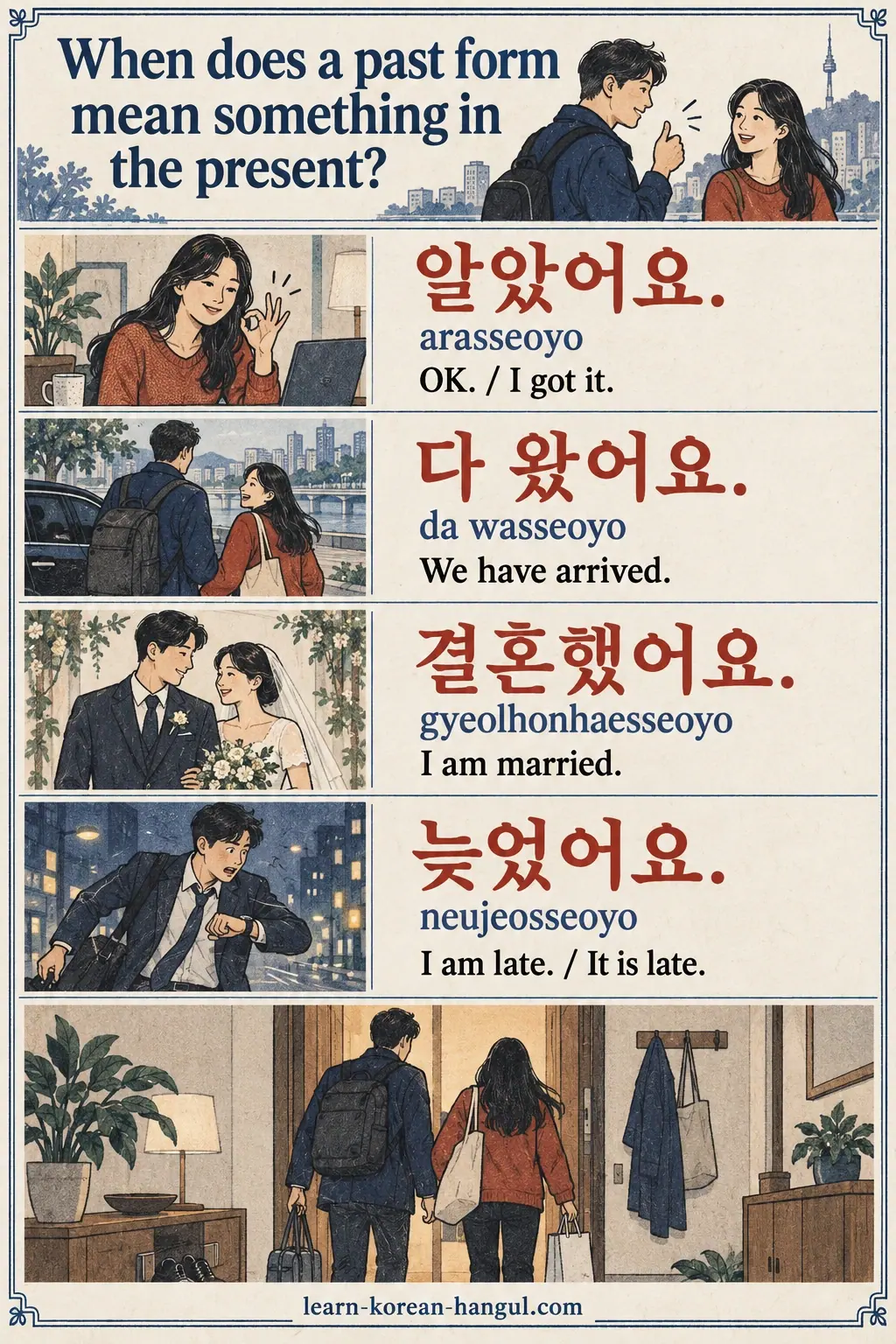
When Does a past Form Mean Something in the Present?

Some Korean past forms describe a state that is true now. The action finished, and its result remains. This is a rare feature that surprises learners, because the English translation uses the present tense.
| Sentence | Literal past | Actual meaning |
|---|---|---|
| 알았어요. | I understood. | OK. / I got it. |
| 다 왔어요. | We have all come. | We have arrived. |
| 결혼했어요. | I got married. | I am married. |
| 늦었어요. | It became late. | I am late. / It is late. |
| 잘 먹었습니다. | I ate well. | Thank you for the meal. |
Pronunciation: 알았어요 is [아라써요] (arasseoyo), 다 왔어요 is [다 와써요] (da wasseoyo), 결혼했어요 is [결혼해써요] (gyeolhonhaesseoyo), 늦었어요 is [느저써요] (neujeosseoyo), and 잘 먹었습니다 is [잘 머걷씀니다] (jal meogeotseumnida). The last phrase is said after a meal, so the finished action is the point. Questions and negatives use the same infix: 먹었어요? ("Did you eat?") and 안 먹었어요 ("I did not eat"), pronounced [안 머거써요]. See negative past tense in Korean for the negative forms.
Limitation: this lesson covers the regular and common irregular forms of -았/었-. It does not cover the past of 이다, which is taught in 이었어요/였어요 past of 이다, or the plain past in diaries and news, which is taught in plain past -았다/었다. The next section lists the errors to avoid.
What Mistakes Do Learners Make?

Six mistakes cover most wrong past forms.
- Using 았 after a stem with ㅓ. Learners match 았 with every verb that sounds "short". Actually only ㅏ and ㅗ take 았. 먹았어요 is wrong, and 먹었어요 is right.
- Writing a single ㅅ. 갓어요 is wrong. The infix has a double ㅆ: 갔어요.
- Keeping the present form with a past time word. 어제 가요 mixes "yesterday" with a present ending. Say 어제 갔어요.
- Marking the past twice. 갔었어요 is a different form, for a past cut off from now. For an ordinary past, say 갔어요.
- Adding 어 to 하다. 공부하었어요 is wrong. Every 하다 verb takes 했: 공부했어요.
- Leaving an irregular stem unchanged. 듣었어요 is wrong, because 듣 changes to 들. Say 들었어요.
The same habits carry over to korean present tense uses, and the sentence pattern behind every example is explained in the Korean SOV sentence pattern. Now test yourself.
Practice and Answers
Try all four items before you read the answers. Each answer has audio, normal and slow.
Practice · 8
What is the polite past of 읽다 (to read)?
Show answer
읽었어요
The last vowel of 읽 is ㅣ, so the infix is 었, spelled with a double ㅆ.
What is the polite past of 가다 (to go)?
Show answer
갔어요
가 + 았 merges into 갔, and the infix keeps its double ㅆ.
What is the polite past of 공부하다 (to study)?
Show answer
공부했어요
Every 하다 verb takes 했.
Which sentence correctly says "I went to school yesterday"?
Show answer
어제 학교에 갔어요.
The time word 어제 needs a past ending, and the infix is spelled with ㅆ.
What is the polite past of 듣다 (to listen)?
Show answer
들었어요
듣다 is irregular: ㄷ becomes ㄹ before a vowel, and then the vowel rule adds 었.
Which form correctly says "I watched"?
Show answer
봤어요
Remove 다 first, then merge 보 + 았 into 봤 and add 어요.
What does 알았어요 usually mean in conversation?
Show answer
OK. / I got it.
Some past forms describe a result that holds now, so 알았어요 works like "OK, I got it".
What does 서울에 살았었어요 mean?
Show answer
I used to live in Seoul (and no longer do).
-았었- reports a past felt as cut off from now. The plain past 살았어요 just means "I lived in Seoul".
- Choose the form. 읽다 ("to read"): 읽았어요 or 읽었어요?
- Fix the error. 어제 학교에 가요. (The speaker wants to say "I went to school yesterday.")
- Translate. "I studied Korean yesterday."
- Write your own. Write one past sentence about what you did this morning, using 마시다 (to drink) or 먹다 (to eat).
Answer Key
- 읽었어요 (ilgeosseoyo) Pronounced [일거써요]. The last vowel of 읽 is ㅣ, so the infix is 었.
- 어제 학교에 갔어요. (eoje hakgyoe gasseoyo) Pronounced [어제 학꾜에 가써요]. The time word 어제 needs a past ending.
- 어제 한국어를 공부했어요. (eoje hangugeoreul gongbuhaesseoyo) Pronounced [어제 한구거를 공부해써요]. Every 하다 verb takes 했.
- Sample answer: 아침에 커피를 마셨어요. (achime keopireul masyeosseoyo) "I drank coffee in the morning." Pronounced [아치메 커피를 마셔써요]. Any morning action with a correct 았/었 infix is right.
If you chose the wrong infix, check the last vowel of the stem: ㅏ or ㅗ takes 았, other vowels take 었, and 하다 takes 했. Then continue with the next lessons.
What Should You Learn Next?
After the past tense -았/었-, the natural next lesson is 이었어요/였어요 past of 이다, which adds "was" and "were" after a noun. For the written style, study plain past -았다/었다. To see the neighbouring tense that stresses a past that no longer holds, read past perfect -았었-. The set overview, Korean past tense, lists every lesson in order.
This page uses Revised Romanization only as a learning aid; the Hangul is the reference. To remember the idea in one line: the past tense -았/었- adds 았 after ㅏ or ㅗ, 었 after other vowels and 했 to 하다 verbs, between the stem and any ending.
Frequently Asked Questions
What Does -았/었- Mean in Korean?
-았/었- is the past tense infix. It marks a finished action or a past state and sits between the verb stem and the final ending, as in 먹었어요 (I ate). Korean past forms cover both the English simple past and the present perfect, so 점심 먹었어요? can mean "Did you eat lunch?" or "Have you eaten lunch?".
How Do I Choose between 았 and 었?
Look at the last vowel of the stem. Use 았 after ㅏ or ㅗ, as in 좋았어요 and 살았어요, and 었 after any other vowel, as in 먹었어요 and 읽었어요. For 하다 verbs use 했, as in 공부했어요. The vowels before the last vowel of the stem do not matter.
What Is the Most Common Mistake with -았/었-?
The most common mistake is using 았 after a stem whose last vowel is ㅓ: 먹았어요 is wrong, and 먹었어요 is right. Check the last vowel only. A second mistake is keeping the present form with a past time word, as in 어제 가요, which should be 어제 갔어요.
How Is -았/었- Different from -았었-?
-았/었- reports a finished event, and -았었- reports a past felt as cut off from now. 살았어요 means "I lived there", while 살았었어요 means "I used to live there, but not anymore". Beginners should use -았/었- for most past sentences and learn -았었- later in the aspect lessons.
Do I Use -았/었- in Speech, Writing or Both?
Both. -았/었- appears in speech and writing with the same spelling. The ending after it changes by style: 먹었어요 in polite speech, 먹었습니다 in formal speech, 먹었어 in casual speech and 먹었다 in plain writing. Only the final ending changes; the infix stays the same.