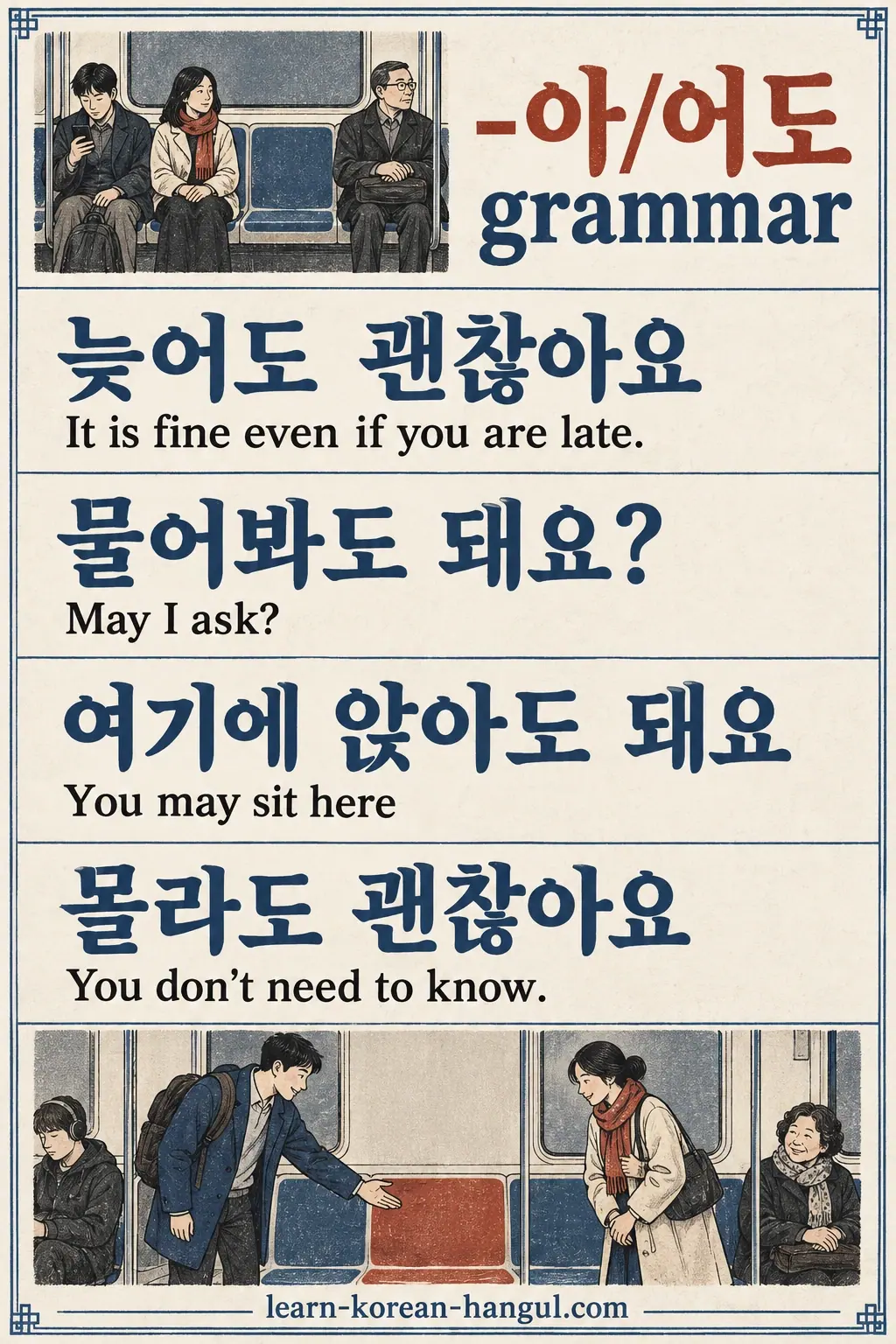
What you'll learn
- Attach -아/어도 to any verb, adjective or 이다.
- Choose between 아도, 어도 and 해도, and handle contractions and irregular stems.
- Use the frames 아무리 ... -아/어도 and -아/어도 되다.
- Choose between -아/어도, -더라도 and -(ㄴ/는)데도.
Prerequisites: the polite ending -아요/어요 and the future ending -(으)ㄹ 거예요. Time: about 15 minutes.
Key facts
- -아/어도 admits one thing and says that the result stays the same.
- The form follows the same vowel rule as -아/어서: 아도 after ㅏ or ㅗ, 어도 after other vowels, 해도 for 하다.
- It works with verbs, adjectives and 이다.
- The result clause can be a statement, a question, a command or a suggestion.
- The same ending is inside the permission frame -아/어도 되다, "you may".
Listen to two model sentences.
The next section defines the pattern.
What Does -아/어도 Grammar Mean?

-아/어도 means "even if", "even though" or "no matter". A connective ending is a word ending that joins one clause to the next. -아/어도 is a connective ending that tells the listener, "Take the first thing as true, and the result is still the same."
Think of a closed door. If someone says "Even if it rains, I will go", the rain is a possible obstacle. The speaker names the obstacle and then says that it will not change the plan. The first clause can be a possible event (비가 와도), a general fact (바빠도), or a case that is just supposed for the sake of argument.
Here are two glossed examples.
| Part | 비가 와도 갈 거예요. | 아무리 먹어도 배가 안 불러요. |
|---|---|---|
| First clause | 비가 와도 (even if it rains) | 아무리 먹어도 (no matter how much I eat) |
| Second clause | 갈 거예요 (I will go) | 배가 안 불러요 (I do not get full) |
| Spoken | [비가 와도 갈꺼예요] | [아무리 머거도 배가 안 불러요] |
| RR (aid) | biga wado gal geoyeyo | amuri meogeodo baega an bulleoyo |
| English | Even if it rains, I will go. | No matter how much I eat, I do not get full. |
The word 아무리 means "however much". It is the most common partner of -아/어도. The idiom 배가 부르다 means "to be full", and the stem 부르 is a 르-irregular stem, so 안 부르다 becomes 안 불러요.
The ending also covers real facts: 한국어가 어려워도 재미있어요 means "Korean is difficult, but it is fun." For a strong "although" about a surprising fact, however, a better choice is -(ㄴ/는)데도 (see the comparison below). The next section shows how to build the form.
How Do You Form -아/어도?
Remove 다 from the dictionary form to get the stem. The stem is the verb or adjective without its dictionary ending -다. For 먹다 the stem is 먹. Then look at the last vowel of the stem.
- If the last vowel is ㅏ or ㅗ, add 아도.
- If the last vowel is any other vowel, add 어도.
- If the verb is 하다, the form is 해도.
This is exactly the rule you learned for -아/어요 and -아/어서. After a vowel, the two vowels merge.
| Dictionary form | Stem | Stem + -아/어도 | Spoken | RR (aid) |
|---|---|---|---|---|
| 앉다 (sit) | 앉 | 앉아도 | [안자도] | anjado |
| 좋다 (be good) | 좋 | 좋아도 | [조아도] | joado |
| 많다 (be many) | 많 | 많아도 | [마나도] | manado |
| 먹다 (eat) | 먹 | 먹어도 | [머거도] | meogeodo |
| 읽다 (read) | 읽 | 읽어도 | [일거도] | ilgeodo |
| 늦다 (be late) | 늦 | 늦어도 | [느저도] | neujeodo |
| 있다 (exist) | 있 | 있어도 | [이써도] | isseodo |
| 없다 (not exist) | 없 | 없어도 | [업써도] | eopseodo |
| 가다 (go) | 가 | 가도 | [가도] | gado |
| 오다 (come) | 오 | 와도 | [와도] | wado |
| 보다 (see) | 보 | 봐도 | [봐도] | bwado |
| 마시다 (drink) | 마시 | 마셔도 | [마셔도] | masyeodo |
| 하다 (do) | 하 | 해도 | [해도] | haedo |
| 공부하다 (study) | 공부하 | 공부해도 | [공부해도] | gongbuhaedo |
One entry in this table needs a note on its sound. In 많아도 the ㅎ is silent before a vowel, so it is said [마나도], and RR writes manado.
Stems Ending in a Vowel
Vowel stems merge with the ending. The stem 가 plus 아도 would be 가아도, but two identical vowels collapse into one: 가도. The stem 오 plus 아도 becomes 와도. The stem 보 plus 아도 becomes 봐도. A stem such as 마시 plus 어도 becomes 마셔도. A stem such as 크 plus 어도 loses ㅡ and becomes 커도.
For 하다 verbs, the form is 해도: 공부해도, 피곤해도, 출근해도. Written Korean sometimes keeps the long form 하여도, which means the same.
Stems Ending in a Consonant
Consonant stems add 아도 or 어도 directly, and the final consonant moves to the next syllable: 앉아도 [안자도], 먹어도 [머거도]. Say the sentence 여기에 앉아도 돼요? ("May I sit here?") slowly. You will hear that the ending 아도 sounds like [안자도].
Irregular Stems and Nouns
Irregular stems change before -아/어도 in the same way they change before -아/어서. An irregular stem is one that changes its shape before an ending that begins with a vowel.
| Type | Dictionary form | With -아/어도 | Note |
|---|---|---|---|
| ㅂ-irregular | 덥다 (be hot) | 더워도 | ㅂ becomes 우 plus 어 |
| ㅂ-irregular | 돕다 (help) | 도와도 | ㅂ becomes 오 plus 아 |
| ㄷ-irregular | 듣다 (listen) | 들어도 [드러도] | ㄷ becomes ㄹ |
| ㅅ-irregular | 낫다 (get better) | 나아도 | ㅅ drops |
| 르-irregular | 모르다 (not know) | 몰라도 | 르 becomes ㄹ라 |
| ㅡ stem | 바쁘다 (be busy) | 바빠도 | ㅡ drops |
| ㄹ stem | 살다 (live) | 살아도 [사라도] | ㄹ stays |
For nouns, use 이다, which means "to be". After a consonant use 이어도, and after a vowel use 여도: 학생이어도 ("even if he is a student"), 의사여도 ("even if he is a doctor"). The negative 아니다 becomes 아니어도, which means "even if it is not".
The next section builds a full sentence.
Worked Example: Building 아무리 바빠도 밥은 먹어야 해요

Say "No matter how busy I am, I must eat." Follow five steps.
- Write the first fact. "I am busy" is 바빠요 in the polite style.
- Find the stem. The dictionary form is 바쁘다, so the stem is 바쁘. The stem ends in ㅡ.
- Add the ending. The ㅡ drops and the stem becomes 바빠. Add 도: 바빠도. Remove the polite ending 요, because the ending belongs to the last verb only.
- Add the partner word. Put 아무리 at the start for "however much": 아무리 바빠도.
- Write the result and join. "I must eat" is 밥은 먹어야 해요. The full sentence is 아무리 바빠도 밥은 먹어야 해요.
You'll know it worked when the first verb ends in 도 with nothing after it, and the polite ending 요 appears only once, at the end. Try the same steps with "No matter how hard it is, I will not give up": 어렵다 gives 어려워도, and 포기하지 않을 거예요 follows.
Sentence
No matter how busy I am, I must eat.
Show answer
아무리 바빠도 밥은 먹어야 해요
The next section covers tense and sentence types.
Which Tenses and Sentence Types Work with -아/어도?

Tense in Korean is shown on the verb before the ending. For -아/어도, you may put the past marker between the stem and the ending. You do not use -겠- here. The last verb of the sentence carries the speech level.
| Slot | Form | Example | English |
|---|---|---|---|
| Present or future case | stem + 아/어도 | 비가 와도 | even if it rains |
| Finished case | stem + 았/었 + 어도 | 밥을 먹었어도 [머거써도] | even though I ate |
| Honorific | stem + (으)시 + 어도 | 바쁘셔도 | even if you are busy |
| Statement after | any style | 갈 거예요. | I will go. |
| Question after | rising for yes/no | 비가 와도 갈 거예요? | Even if it rains, will you go? |
| Command after | 세요, 주세요 | 늦어도 오세요. | Even if you are late, come. |
| Suggestion after | 요, 아요/어요 | 멀어도 같이 가요. | Even if it is far, let's go together. |
Like -(으)면, -아/어도 allows every sentence type after it. You can follow it with a statement, a question, a command or a suggestion. That is because it only concedes a point and does not give a reason.
The past form -았/었어도 says that the first event is finished: 밥을 먹었어도 또 배가 고파요 means "Even though I ate, I am hungry again." In this sentence the past form states a real, finished fact. It can also imagine a different past: 일찍 갔어도 늦었을 거예요 means "Even if I had left early, I would have been late."
Yes/no questions end with a rise: 비가 와도 갈 거예요? A wh-question puts the stress on the question word and often ends with a fall or a rise-fall, rather than a sharp rise: 늦어도 몇 시까지 와야 해요? means "At the latest, by what time must I come?"
The next section compares -아/어도 with its neighbours.
How Is -아/어도 Different from -더라도 and -(ㄴ/는)데도?

All three can be translated as "even if" or "even though", and that is why learners mix them up. The difference is how real the first clause is.
| Pattern | Core idea | Example | Feeling |
|---|---|---|---|
| -아/어도 | admit a point, result unchanged | 비가 와도 갈 거예요. | A plain, neutral plan. |
| -더라도 | a firm, imagined case | 비가 오더라도 갈 거예요. | "Whatever happens." Sounds determined. |
| -(ㄴ/는)데도 | a real fact, unexpected result | 비가 오는데도 갔어요. | "Although it was raining, he went." Both facts are true. |
| -(으)면 | a plain condition | 비가 오면 안 갈 거예요. | "If it rains, I will not go." The result changes. |
The key test is whether the result changes. With -(으)면, the result depends on the condition: 비가 오면 안 가요. With -아/어도, the result stays the same: 비가 와도 가요. Compare these two.
- 비가 오는데도 사람들이 많이 왔어요. ("Although it was raining, many people came.") The rain is a real fact and the crowd is a surprise, so -(ㄴ/는)데도 is best.
- 비가 와도 사람들이 많이 올 거예요. ("Even if it rains, many people will come.") The rain is only possible, so -아/어도 fits.
-아/어도
even if, even though: neutral
-더라도
even if: firm and imagined
-(ㄴ/는)데도
even though: a real fact
| Comparison | -아/어도 | -더라도 | -(ㄴ/는)데도 |
|---|---|---|---|
| First clause is | a possible or general case | an imagined case | a real, known fact |
| Feels | neutral | firm, determined | surprised |
| Past tense before the ending | possible | possible | possible |
| Command or suggestion after it | possible | very common | not used |
Use -아/어도 for a neutral even if, -더라도 for a firm imagined case, and -(ㄴ/는)데도 for a real fact with a surprising result.
For a detailed side-by-side with practice, see -아/어도 vs -더라도. The next section covers set phrases and edge cases.
Variations and Edge Cases of -아/어도

Permission: -아/어도 되다
Add 되다 after -아/어도 and the meaning becomes "you may". 여기에 앉아도 돼요 means "You may sit here", and 물어봐도 돼요? means "May I ask?" Add 괜찮다 or 좋다 for the same meaning: 늦어도 괜찮아요 means "It is fine even if you are late." The full lesson is -아/어도 되다. Do not mix it up with -(으)면 되다, which means "it is enough if". That one has its own comparison page: -아/어도 되다 vs -(으)면 되다.
Repetition for Emphasis
Repeat the first clause for "however much". 먹어도 먹어도 배가 고파요 means "No matter how much I eat, I am still hungry." The repeated form is very common in speech, and 아무리 is optional.
Negatives and Nouns
The negative 안 goes before the verb as usual: 안 먹어도 돼요 means "You don't have to eat." The long negative is -지 않아도: 먹지 않아도 돼요. With a noun, use 이어도 or 여도: 어른이어도 이 규칙은 지켜야 해요 means "Even adults must follow this rule." The negative of a noun is 아니어도: 학생이 아니어도 괜찮아요 means "Even if you are not a student, it is fine."
The Look-Alike (이)라도
Do not confuse -아/어도 with the particle (이)라도. The particle (이)라도 means "even a ..." or "at least a ...", as in 물이라도 마셔요 ("Have some water, at least"). The two share the sound 도, but the particle attaches to a noun and does not join two clauses.
The Particle 도 inside the Ending
The ending 아도/어도 is built from the connective 아/어 plus the particle 도, which means "also" or "even". That is why the ending feels like "even if". To learn the particle itself, see also particle 도.
Fixed Phrases
A few frames are worth learning whole. 몰라도 means "even if you don't know", and 몰라도 괜찮아요 means "You don't need to know." The phrase 없어도 means "even without", as in 돈이 없어도 행복해요 ("I am happy even without money").
The next section lists the mistakes that appear most often.
What Mistakes Do Learners Make with -아/어도?
Learners make six predictable mistakes. Each has a reason and a fix.
Learners often use -아/어도 as a plain "although" about a surprising fact. Actually -아/어도 sounds general. Less natural: 열심히 공부했어도 시험에 떨어졌어요 (as a statement of a surprising fact). Better: 열심히 공부했는데도 시험에 떨어졌어요. Fix: if the fact is real and the result is a surprise, use -(ㄴ/는)데도.
Learners often choose the wrong vowel. Actually the last vowel of the stem decides. Wrong: 먹아도 and 앉어도. Right: 먹어도 and 앉아도. Fix: ㅏ and ㅗ take 아도, and all other vowels take 어도.
Learners often forget to contract. Actually vowel stems merge. Wrong: 가아도 and 오아도. Right: 가도 and 와도. Fix: say the vowels together, and write one syllable.
Learners often add 으. Actually the ending does not use 으. Wrong: 먹으도 and 좋으도. Right: 먹어도 and 좋아도. Fix: this is -아/어, not -(으).
Learners often put -겠- inside. Actually the first clause keeps the plain stem. Wrong: 비가 오겠어도 갈 거예요. Right: 비가 와도 갈 거예요. Fix: put the future on the last verb.
Learners often mix up permission and sufficiency. Actually -아/어도 되다 means "may", and -(으)면 되다 means "it is enough if". Wrong: 이 버튼을 눌러도 돼요 (when you mean "just press this button"). Right: 이 버튼을 누르면 돼요. Fix: ask whether you are giving permission or naming the one step needed.
The next section gives you practice.
Practice and Answers
Do the four tasks, then compare with the key.
Task 1: join the sentences with -아/어도. Write one sentence for each pair.
- 비싸요. / 살 거예요.
- 피곤해요. / 운동해야 해요.
- 많이 먹어요. / 배가 고파요.
- 한국어가 어려워요. / 포기하지 않을 거예요.
Task 2: fix the error. Each sentence has one mistake. Rewrite it correctly.
- 날씨가 덥아도 밖에 나가요.
- 늦겠어도 꼭 오세요.
- 가아도 돼요?
Task 3: translate. Write in Korean: "Even if you don't know, it's okay." and "May I sit here?"
Task 4: write your own. Write one sentence with 아무리 about food, and one that gives permission.
Practice · 5
Which form of 앉다 means "even if you sit"?
Show answer
앉아도
The last vowel of 앉 is ㅏ, so the ending is 아도. The ending never takes 으.
How do you say "even if it is hot" with the adjective 덥다?
Show answer
더워도
덥다 is a ㅂ-irregular stem. Before 아/어 the ㅂ becomes 우, and 우 plus 어 merges into 워.
Which sentence is correct for "Even if I go, I will not know anyone"?
Show answer
가도 아는 사람이 없을 거예요.
Vowel stems merge with the ending, so 가 plus 아도 becomes 가도.
Which pattern fits "Although it was raining, many people came", where the rain is a real fact?
Show answer
-(ㄴ/는)데도
A real fact with a surprising result is the job of -(ㄴ/는)데도. -아/어도 fits a possible or general case.
Which sentence means "May I ask?"
Show answer
물어봐도 돼요?
-아/어도 되다 gives permission. The stem 물어보 plus 아도 contracts to 물어봐도.
Answer key
- (1) 비싸도 살 거예요. (2) 피곤해도 운동해야 해요. (3) 많이 먹어도 배가 고파요. (4) 한국어가 어려워도 포기하지 않을 거예요.
- (1) 날씨가 더워도 밖에 나가요. (2) 늦어도 꼭 오세요. (3) 가도 돼요?
- 몰라도 괜찮아요. 여기에 앉아도 돼요? Other correct versions exist, for example 몰라도 돼요.
- Sample answers: 아무리 매워도 김치는 맛있어요. 여기에서 사진을 찍어도 돼요. Any pair is correct if the first verb ends in the right form of -아/어도.
If task 1 was correct, you have the formation rule. If task 2 was hard, check whether you used the wrong vowel, forgot to contract, or put -겠- inside. The next section points you to what comes after this lesson.
What Should You Learn after -아/어도 Grammar?
After -아/어도, learn -더라도, the firmer way to say "even if". Then read -(ㄴ/는)데도 for real facts with surprising results. The permission frame -아/어도 되다 is the most useful everyday use of this ending.
For a wider view, the parent page Contrast and Concession lists every connector in this group. To plan by level, use Beginner Grammar.
This lesson covers -아/어도 in the polite, casual and formal styles. It does not cover every written variation. About this page. Last updated 2026-10-09. Revised Romanization follows the national rules and is shown only as a learning aid.
Frequently Asked Questions
What Does -아/어도 Mean?
-아/어도 means "even if" or "even though". It admits a fact or an assumption and says that the result stays the same. 비가 와도 갈 거예요 means "Even if it rains, I will go." It is also the base of the common permission frame -아/어도 되다, which means "you may".
How Do I Attach -아/어도 to a Verb or Adjective?
Take the stem and look at its last vowel. After ㅏ or ㅗ add 아도: 앉아도, 좋아도. After other vowels add 어도: 먹어도, 늦어도. For 하다 use 해도. Vowel stems contract: 가도, 와도, 봐도, 커도. Irregular stems change as before -아/어서: 더워도, 들어도, 몰라도.
Can -아/어도 Be Used in the past Tense?
Yes, with 았/었 before it: 먹었어도, 갔어도. The past form says that the action is finished or imagined as finished. 밥을 먹었어도 또 배가 고파요 means "Even though I ate, I am hungry again." Do not put -겠- before -아/어도. Use the plain present form for the future.
Is -아/어도 Used in Speech or Only in Writing?
Both. It is one of the first concession endings that learners meet, and it is natural in polite, casual and formal speech. In very formal writing you may also see the older form 하여도 for 해도. In everyday speech, -아/어도 and the permission frame -아/어도 되다 are among the most common patterns.
What Is the Difference between -아/어도 and -더라도?
-아/어도 is neutral. It works for real facts, general rules and plain assumptions. -더라도 is a stronger hypothetical and often sounds firm or determined. 비가 와도 갈 거예요 simply states the plan. 비가 오더라도 갈 거예요 sounds like a promise to go whatever happens.