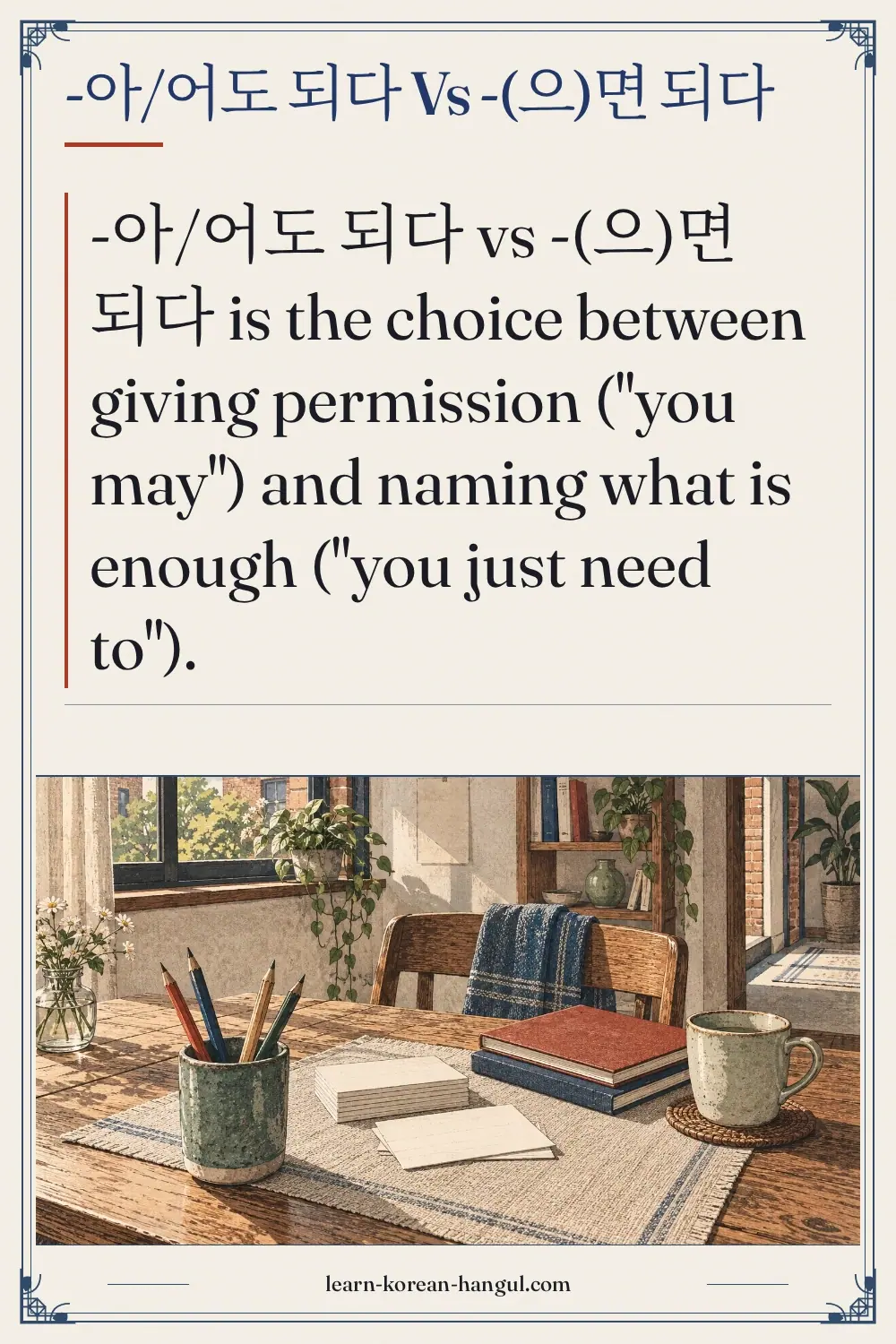
-아/어도 되다 vs -(으)면 되다 is the choice between giving permission and naming what is enough. -아/어도 되다 gives permission, as in "you may". -(으)면 되다 says what is enough, as in "you just need to". Both end in 되다, which is why learners often mix them up.
Key facts
- Both patterns end in 되다 ("to be okay"), but the part before it changes the meaning completely.
- The negatives are different patterns: "must not" is -(으)면 안 되다, and "do not have to" is -지 않아도 되다.
- Level: A2. This is an editorial estimate based on common textbook order, not an official list.
What you'll learn
- Say in one sentence how the two patterns differ.
- Choose the right pattern by asking whether you give permission or name what is enough.
- Make the correct negative for each pattern.
- Ask permission and ask "what should I do?" in the right form.
Before you start, it helps to know how each pattern is built. The full rules are in the lessons on -아/어도 되다 and -(으)면 되다. Estimated time: 15 minutes.
What Is the Difference between -아/어도 되다 and -(으)면 되다?
The difference is the question each pattern answers. -아/어도 되다 answers "Is it allowed?" and -(으)면 되다 answers "What do I need to do?" The word 되다 means "to be okay" in both, but the first part sets the meaning.
Here is the smallest pair. Both sentences are about sitting, and both are correct.
Permission: 여기에 앉아도 돼요. (yeogie anjado dwaeyo.) means "You may sit here." Sitting here is allowed. Say 앉아도 as [안자도].
What is enough: 여기에 앉으면 돼요. (yeogie anjeumyeon dwaeyo.) means "You just sit here." Someone is telling you where to sit, and sitting here is all you need to do. Say 앉으면 as [안즈면].
The key point: the first sentence removes a limit, and the second one gives a simple instruction. Think of -아/어도 as "even if you do it" and -(으)면 as "if you do it". Each one carries its own meaning into 되다.
-아/어도 되다 vs -(으)면 되다: Side-by-Side Table
The table compares the two patterns on the points that decide most choices. Each row is a test for your own sentence.
-아/어도 되다
permission: you may, it is okay to
-(으)면 되다
what is enough: all you need to do is
Use -아/어도 되다 for permission (may) and -(으)면 되다 for what is enough (just do).
| Test | -아/어도 되다 | -(으)면 되다 |
|---|---|---|
| Core meaning | permission: "may", "it is okay to" | what is enough: "just", "all you need to do" |
| Question it answers | "Is it allowed?" | "What should I do?" |
| Typical question | 사진을 찍어도 돼요? | 몇 시까지 오면 돼요? |
| Typical answer | 네, 돼요. / 아니요, 안 돼요. | 열 시까지 오면 돼요. |
| Negative form | -지 않아도 되다: "do not have to" | -(으)면 안 되다 is a separate pattern: "must not" |
| Form of the verb | stem plus 아도/어도 (vowel harmony): 앉아도, 먹어도, 와도 | stem plus (으)면: 앉으면, 먹으면, 오면 |
| Often paired with | 언제든지 ("any time"): 언제든지 와도 돼요 | 만 ("only"): 이름만 쓰면 돼요 |
One row is easy to miss. The negative of -아/어도 되다 is not "-아/어도 안 되다". That would not mean "must not". The next sections show the right negatives.
When Do You Use -아/어도 되다?
You use -아/어도 되다 when you give permission, ask for permission, or say that a limit does not apply. It has three main jobs.
- Asking permission. 사진을 찍어도 돼요? (sajineul jjigeodo dwaeyo?) means "May I take a photo?" It is a yes/no question, so it rises at the end. Say 찍어도 as [찌거도].
- Giving permission. 숙제는 내일 내도 돼요. (sukjeneun naeil naedo dwaeyo.) means "You may hand in the homework tomorrow." The deadline is relaxed. Say 숙제는 as [숙쩨는].
- Saying that a limit does not apply. 일찍 와도 되고 늦게 와도 돼요. (iljjik wado doego neutge wado dwaeyo.) means "You may come early or late." Both options are fine.
How the form is built: take the stem and add 아도 if the last vowel is ㅏ or ㅗ, and 어도 for every other vowel. 앉다 gives 앉아도, 먹다 gives 먹어도, 오다 gives 와도, 내다 gives 내도, and 하다 gives 해도. Then add 되다 in the polite form 돼요.
Two negatives belong to this pattern. For "do not have to", use -지 않아도 되다: 오지 않아도 돼요 (oji anado dwaeyo) means "You do not have to come." Say it as [오지 아나도 돼요]. For "must not", use the separate pattern -(으)면 안 되다: 여기에 앉으면 안 돼요 means "You must not sit here."
When Do You Use -(으)면 되다?
You use -(으)면 되다 when you name the one thing that is enough to reach a goal. It has three main jobs.
- Giving a simple instruction. 이름만 쓰면 돼요. (ireumman sseumyeon dwaeyo.) means "Writing only your name is enough." The speaker tells you the whole task.
- Asking what to do. 몇 시까지 오면 돼요? (myeot sikkaji omyeon dwaeyo?) means "By what time should I come?" It is a question with a question word, so the pitch usually falls or rises and falls, and it does not end in a sharp rise. Say 몇 시까지 as [멷씨까지].
- Checking that one thing is enough. 이 서류만 내면 돼요? (i seoryuman naemyeon dwaeyo?) means "Is it enough to hand in only this document?" This is a yes/no question, so it rises.
How the form is built: add 면 to a stem that ends in a vowel, and 으면 to a stem that ends in a consonant. 오다 gives 오면, 쓰다 gives 쓰면, 내다 gives 내면, and 앉다 gives 앉으면. No vowel harmony applies. Then add 되다: 오면 돼요.
The pattern often comes with 만 ("only") before it, as in 이름만 쓰면 돼요. The 만 makes the "that is all" meaning clear.
Can You Use Both in the Same Sentence?
Yes. The two patterns do not compete, so a speaker can use both in one answer, one for each job. Imagine a teacher explaining homework: 숙제는 내일 내도 돼요. 제 책상 위에 놓으면 돼요. (sukjeneun naeil naedo dwaeyo. je chaeksang wie noeumyeon dwaeyo.) means "You may hand the homework in tomorrow. Just leave it on my desk." The first sentence gives permission about the date, and the second names the one thing you need to do. Say 놓으면 as [노으면].
A second pair shows the same verb with both patterns.
- 숙제는 내일 내도 돼요. means "You may hand it in tomorrow." The deadline is relaxed.
- 숙제는 내일까지 내면 돼요. means "Handing it in by tomorrow is enough." The deadline is tomorrow.
The sentences look almost the same, but the second one adds 까지 ("by", "until") and sets a deadline, while the first one only removes the limit. The point: 까지 plus -(으)면 되다 sets a deadline, while -아/어도 되다 relaxes one.
A limit of this page: some sentences accept both patterns with only a small shift in meaning. 여기서 기다려도 돼요 ("You may wait here") and 여기서 기다리면 돼요 ("You can just wait here") are close in practice. When both fit, choose by the question: permission or instruction.
Which One Should You Pick? a Simple Rule of Thumb
Pick the pattern by asking what the listener wants to know, using these questions in order.
- Is the listener asking, or are you telling them, whether something is allowed? Use -아/어도 되다.
- Is the listener asking what to do, or are you telling them the one thing they need to do? Use -(으)면 되다.
- Do you want to say "must not"? Use -(으)면 안 되다, which is a separate pattern.
- Do you want to say "do not have to"? Use -지 않아도 되다.
You'll know the rule works when you can say why 어디에서 내려도 돼요? and 어디에서 내리면 돼요? ask different questions. The first asks where getting off is allowed. The second asks where you should get off. Both are wh-questions, so neither ends in a sharp rise.
The rule is a teaching tool, and it is not a law of Korean. Context can blur the two, as in the waiting example above. When in doubt, ask whether a sign on the wall would say "allowed" or "do this".
What Mistakes Do Learners Make with These Two?

Learners make four mistakes with this pair, and each has a one-line fix.
- Using the wrong negative for "must not". Learners often say 앉아도 안 돼요 to mean "You must not sit". Actually the prohibition is 앉으면 안 돼요. Use -(으)면 안 되다 for "must not".
- Using -(으)면 되다 to ask permission. Learners often ask 사진을 찍으면 돼요? Actually it asks "Is it right to take a photo?" and not "Am I allowed?" For permission, use 찍어도 돼요?
- Using -아/어도 되다 for an instruction. Learners often say 여기에 앉아도 돼요 when they mean "You just sit here". Actually it sounds like "You may sit here, if you like". Use 앉으면 돼요 for an instruction.
- Writing 되요. Learners often write 되요. Actually the polite form is 돼요, the contraction of 되어요. The past form contracts the same way: 됐어요.
Practice: Choose the Right Pattern
These exercises check the outcome of this page: choosing the right pattern for a new sentence and explaining the rule. Try each one before reading the answers.
Practice · 5
A visitor asks if photos are allowed: 사진을 찍___ 돼요?
Show answer
어도
Asking whether something is allowed uses -아/어도 되다: 찍어도 돼요?
A clerk says that writing your name is all you need: 이름만 쓰___ 돼요.
Show answer
면
Naming the one enough thing uses -(으)면 되다: 쓰면 돼요.
How do you say "You must not sit here"?
Show answer
여기에 앉으면 안 돼요.
The prohibition is -(으)면 안 되다. 앉아도 안 돼요 does not mean "must not".
How do you say "You do not have to come"?
Show answer
오지 않아도 돼요.
"Do not have to" is -지 않아도 되다. 오면 안 돼요 means "You must not come".
Which spelling is correct?
Show answer
돼요
돼요 is the contraction of 되어요. The spelling 되요 is a common error.
Exercise 1: Choose the pattern. A visitor asks if photos are allowed: 사진을 찍__ 돼요?
Exercise 2: Choose the pattern. A clerk says that writing your name is all you need: 이름만 쓰__ 돼요.
Exercise 3: Fix the error. 여기에 앉아도 안 돼요. (The speaker means "You must not sit here.")
Exercise 4: Translate. "You do not have to come." (come = 오다)
Exercise 5: Translate. "Arriving by ten is enough." (ten o'clock = 열 시)
Answer Key
- Exercise 1: 사진을 찍어도 돼요? The visitor asks whether photos are allowed, so use -아/어도 되다.
- Exercise 2: 이름만 쓰면 돼요. The clerk names the one thing that is enough, so use -(으)면 되다.
- Exercise 3: 여기에 앉으면 안 돼요. Use -(으)면 안 되다 for "must not".
- Exercise 4: 오지 않아도 돼요. This is the pattern -지 않아도 되다.
- Exercise 5: 열 시까지 오면 돼요. The time limit with 까지 and the "that is enough" meaning point to -(으)면 되다.
If you missed Exercise 3 or 4, reread the table row on negatives. The next section shows where to go from here.
What Should You Learn Next?
The fastest way to firm up this pair is to read the two lessons it compares: -아/어도 되다 and -(으)면 되다. Then learn the two negatives that sit beside them: -(으)면 안 되다 for "must not" and -지 않아도 되다 for "do not have to".
If you also want to say "must", the lesson on -아/어야 하다/되다 is the next piece, and -아/어야 하다 vs -(으)ㄹ 필요가 있다 compares two ways of saying "need to". Both patterns on this page sit around level A2 on the beginner grammar list, and this pair is one of many in the confusing grammar compared hub.
What this page does not cover. It does not cover the full list of irregular verbs, the polite and formal versions of 되다, or the use of -(으)면 as a plain "if". Each of those has its own lesson.
In short, -아/어도 되다 vs -(으)면 되다 comes down to one question: are you giving permission, or naming what is enough?
Frequently Asked Questions
What is the difference between -아/어도 되다 and -(으)면 되다? -아/어도 되다 gives or asks for permission: "may I" or "you may". -(으)면 되다 names the one thing that is enough: "you just need to" or "all you have to do is". The first answers "Is it allowed?" and the second answers "What should I do?".
Can I always replace -아/어도 되다 with -(으)면 되다? No. They answer different questions. 사진을 찍어도 돼요? asks whether photos are allowed, while 사진을 찍으면 돼요? asks whether taking a photo is the right way to proceed. A swap keeps the grammar correct but changes the meaning, so check which question you are answering.
Which one sounds more natural in speech? Both are very common in everyday speech, in the polite form 돼요. Shop staff, teachers and guides use -(으)면 돼요 to give simple instructions, such as 여기에 이름을 쓰면 돼요. Visitors and students use -아/어도 돼요? to ask permission. Which one fits depends on the situation, not on the style.
Which one appears more often on TOPIK? This site has no official frequency count to cite. Both are beginner-level patterns of the kind TOPIK I tests. A typical test item gives a short dialogue and asks which pattern fits, so the permission-or-enough question in this page is the skill to practise.
What is the quickest rule to remember? Ask yourself whether you are giving permission or naming the one thing that is enough. Permission is -아/어도 되다 ("may"). The one enough thing is -(으)면 되다 ("just do"). For "must not", do not use -아/어도 되다 with a negative; use -(으)면 안 되다.