
What you'll learn
- Attach -(으)ㄹ 걸 그랬다 to any verb stem, including ㄹ-stems and irregular verbs.
- Say "I should have..." and "I shouldn't have..." in polite Korean.
- Place the tense correctly: on 그랬다, not on the verb.
- Tell this pattern apart from the guess -(으)ㄹ걸요.
- Choose between regret (걸 그랬다) and duty (-았/었어야 했다).
Before you start: you should know how to find a verb stem (drop 다 from the dictionary form) and the polite ending -아요/어요. It also helps to know that 걸 is a short form of 것을, where 것 is the "thing" noun used in patterns such as 할 거예요. Audio plays only when you press a button.
What Does -(으)ㄹ 걸 그랬다 Grammar Mean?
-(으)ㄹ 걸 그랬다 grammar means "I should have (done)" or "I wish I had (done)." It looks back at a choice and says that the other choice would have been better. The pattern is not an order or a rule. It is a feeling: the speaker is sorry, disappointed or annoyed with themselves.
Here are the first two examples. The pattern is the same in both, and only the verb changes.
- 일찍 올 걸 그랬어요. (iljjik ol geol geuraesseoyo.) [일찍 올껄 그래써요] = "I should have come early."
- 우산을 가져올 걸 그랬어요. (usaneul gajyeool geol geuraesseoyo.) [우사늘 가저올껄 그래써요] = "I should have brought an umbrella."
The pattern has three pieces. The first is a verb in its future-form shape (올, 가져올). The second is 걸, a short form of 것을 ("the thing" plus the object particle). The third is 그랬다, the past form of 그러다 ("to be so", "to do so"). Put together, the sentence says, "As for coming early, it would have been so (better)." That is why the verb stays plain and the past sits on the last word. Next comes the mechanism that builds the pattern.
How Do You Form -(으)ㄹ 걸 그랬다?
-(으)ㄹ 걸 그랬다 is formed by adding -ㄹ 걸 그랬다 to a vowel stem and -을 걸 그랬다 to a consonant stem. A simple trick for every case: take the "future-form" modifier of the verb (갈, 먹을, 놀, 들을) and add 걸 그랬다. The same modifier appears in -(으)ㄹ 거예요 ("will"), so it is worth learning once.
| Dictionary form | Stem type | Future-form modifier | Add 걸 그랬다 | Polite form |
|---|---|---|---|---|
| 가다 | vowel | 갈 | 갈 걸 그랬다 | 갈 걸 그랬어요 |
| 사다 | vowel | 살 | 살 걸 그랬다 | 살 걸 그랬어요 |
| 먹다 | consonant | 먹을 | 먹을 걸 그랬다 | 먹을 걸 그랬어요 |
| 놀다 | ㄹ-stem | 놀 | 놀 걸 그랬다 | 놀 걸 그랬어요 |
| 듣다 | ㄷ-irregular | 들을 | 들을 걸 그랬다 | 들을 걸 그랬어요 |
| 돕다 | ㅂ-irregular | 도울 | 도울 걸 그랬다 | 도울 걸 그랬어요 |
The table applies one rule to six verbs. The next three parts look at each type of stem.
Stems Ending in a Vowel
A vowel stem adds ㄹ to its last syllable and then 걸 그랬다. 가다 becomes 갈 걸 그랬다, 사다 becomes 살 걸 그랬다, and 하다 becomes 할 걸 그랬다. The ㄹ sits under the vowel as a final consonant. Examples:
- 그 옷을 살 걸 그랬어요. (geu oseul sal geol geuraesseoyo.) [그 오슬 살껄 그래써요] = "I should have bought that outfit."
- 어제 좀 더 공부할 걸 그랬어요. (eoje jom deo gongbuhal geol geuraesseoyo.) [어제 좀 더 공부할껄 그래써요] = "I should have studied a bit more yesterday."
Vowel stems are the simplest case. A stem with a final consonant needs one extra syllable.
Stems Ending in a Consonant
A consonant stem takes the linking vowel 을 before 걸: 먹다 becomes 먹을 걸 그랬다, and 읽다 becomes 읽을 걸 그랬다. Compare this with 가다 (갈 걸), which needs no 으. The final consonant of the stem moves to the next syllable in speech, so 먹을 걸 is pronounced [머글껄].
Notice also the sound of 걸. After the future-form modifier -(으)ㄹ, a plain consonant becomes tense, so 걸 is pronounced as a tense [껄] in the regret examples on this page. This follows the standard pronunciation rules (표준 발음법, Article 27) of the 국립국어원 (National Institute of Korean Language). Revised Romanization does not show this kind of tensing, so 올 걸 is written ol geol.
- 친구 말을 들을 걸 그랬어요. (chingu mareul deureul geol geuraesseoyo.) [친구 마를 드를껄 그래써요] = "I should have listened to my friend."
Two more groups need a short note, because learners expect trouble with them.
Irregular Stems and Nouns
Irregular verbs follow the future-form modifier, so check that form first. ㄹ-stems keep their ㄹ and add no 으: 놀다 becomes 놀 걸 그랬다, and 만들다 becomes 만들 걸 그랬다. ㄷ-irregular stems change ㄷ to ㄹ before 을: 듣다 becomes 들을 걸 그랬다. ㅂ-irregular stems turn ㅂ into 우: 돕다 becomes 도울 걸 그랬다. 르-verbs keep 르: 모르다 becomes 모를 걸 그랬다 (this one is rare).
Nouns and the copula 이다 do not take this pattern directly. To regret not becoming something, use 되다: 의사가 될 걸 그랬어요 ("I should have become a doctor"). Adjectives are rare, because you cannot decide to be tall. When a regret is about a manner, speakers use a verb: 더 친절하게 대할 걸 그랬어요 ("I should have treated them more kindly"). With the formation clear, one full sentence can be built step by step.
Worked Example: Building a Sentence with -(으)ㄹ 걸 그랬다
-(으)ㄹ 걸 그랬다 grammar works by turning a plain missed action into regret. Follow the steps with the idea "I didn't buy that outfit, and now I wish I had."
- Start with the action you skipped. 그 옷을 안 샀어요. (geu oseul an sasseoyo.) [그 오슬 안 사써요] = "I didn't buy that outfit." The action is 사다 (to buy).
- Find the dictionary form and stem. 사다 has the stem 사. It ends in a vowel.
- Make the future-form modifier. 사 + ㄹ = 살.
- Add 걸 그랬다. 살 + 걸 그랬다 = 살 걸 그랬다.
- Put the sentence in the polite style and rebuild it. Replace 그랬다 with 그랬어요: 그 옷을 살 걸 그랬어요. (geu oseul sal geol geuraesseoyo.) [그 오슬 살껄 그래써요] = "I should have bought that outfit."
Sentence
You will know it worked when the object stays in place and the negative from step 1 is gone: the regret itself says you did not buy it. The most common slip at this step is to put the past on the first verb (샀을 걸 그랬어요). Always work from the plain stem. The sentence now voices regret, and the next question is how it behaves across tenses and sentence types.
Which Tenses and Sentence Types Work with -(으)ㄹ 걸 그랬다?
-(으)ㄹ 걸 그랬다 works in statements about the past, in several speech levels. The change always happens on 그랬다, the last word. The table shows the forms for 가다.
| Sentence type | Form | Meaning |
|---|---|---|
| Polite statement | 갈 걸 그랬어요 | I should have gone. |
| Regret about doing | 가지 말 걸 그랬어요 | I shouldn't have gone. |
| Noticed just now | 갈 걸 그랬네요 | I should have gone (I see now). |
| Formal statement | 갈 걸 그랬습니다 | I should have gone (formal). |
| Casual (banmal) | 갈 걸 그랬어 | I should have gone (to a friend). |
| Short, to oneself | 갈걸 | I should have gone... |
| Written plain style | 갈 걸 그랬다 | I should have gone (diary, essay). |
The pattern has two halves. For a missed action, use the positive: 우산을 가져올 걸 그랬어요. For regret about something you did, use -지 말 걸 그랬다, built on the verb 말다 ("to stop, to refrain"): 그 말은 하지 말 걸 그랬어요 (geu mareun haji mal geol geuraesseoyo.) [그 마른 하지 말껄 그래써요] = "I shouldn't have said that." Do not add a past marker to the first verb, because 그랬다 already carries the past.
The ending -네요 adds a sense of noticing right now: 택시를 탈 걸 그랬네요 (taeksireul tal geol geuraenneyo.) [택씨를 탈껄 그랜네요] = "I should have taken a taxi (I see that now)." Speakers say this while stuck in traffic. The short form 갈걸 on its own is a sigh to oneself.
Questions and commands do not fit this pattern: a regret belongs to the speaker, and you cannot order a past choice. The most useful contrast for a learner is next to the neighbouring ending that sounds almost the same.
How Is -(으)ㄹ 걸 그랬다 Different from -(으)ㄹ걸요?
-(으)ㄹ 걸 그랬다 voices regret about a past choice, while -(으)ㄹ걸요 gives a soft guess. The two share 걸, so they look alike, but they work differently. In the regret pattern, 걸 is the word "thing" and 그랬다 follows after a space. In the guess, -(으)ㄹ걸요 is one ending and nothing follows. The full rules for the guess are on the page for -(으)ㄹ걸요.
| Point | -(으)ㄹ 걸 그랬다 | -(으)ㄹ걸요 |
|---|---|---|
| Meaning | I should have; I wish I had | I think; probably |
| Function | regret about a past choice | a soft guess, or a gentle correction |
| Spacing | 올 걸 그랬어요 (two words, then 그랬어요) | 올걸요 (one ending) |
| Example | 일찍 올 걸 그랬어요. | 오늘은 비가 올걸요. |
| Meaning of example | I should have come early. | It will probably rain today. |
A second neighbour is -았/었어야 했다, which means "should have" with a stronger sense of duty or blame: 일찍 왔어야 했어요 (iljjik wasseoya haesseoyo.) [일찍 와써야 해써요] = "I should have come early (it was my duty)." The regret pattern is lighter and more personal. It says you wish it had gone differently. The duty pattern says there was an obligation. A third neighbour is the advice pattern -는 게 좋겠어요, which looks forward, not back.
These contrasts lead to the smaller variations of the pattern itself.
Variations and Edge Cases of -(으)ㄹ 걸 그랬다
-(으)ㄹ 걸 그랬다 has four points worth knowing: a "noticing" shape, a shortened shape, an added result and the spacing. Each is short, and each appears in real use.
- With -네요. 그랬네요 adds a sense of "I realise it now": 우산을 가져올 걸 그랬네요 means "I should have brought an umbrella" as the rain begins.
- The shortened -(으)ㄹ걸. In speech and messages, 걸 그랬다 shrinks to 걸 alone: 아, 일찍 올걸. [일찍 올껄] = "Ah, I should have come early." It is written without a space, like an ending. Intonation and context tell it apart from the guess 올걸요.
- Adding a result. A regret is often followed by the cause: 늦게 일어났어요. 일찍 잘 걸 그랬어요 ("I woke up late. I should have slept early").
- Spacing and writing. In the full form, 걸 is a separate word, so write 올 걸 그랬어요 with spaces. In the short form, it is written as an ending without a space (올걸).
This lesson covers regret in daily life, not the full range of "should" expressions. Obligations and advice belong to different patterns. The mistakes below show where the boundary with those patterns causes real errors.
What Mistakes Do Learners Make with -(으)ㄹ 걸 그랬다?
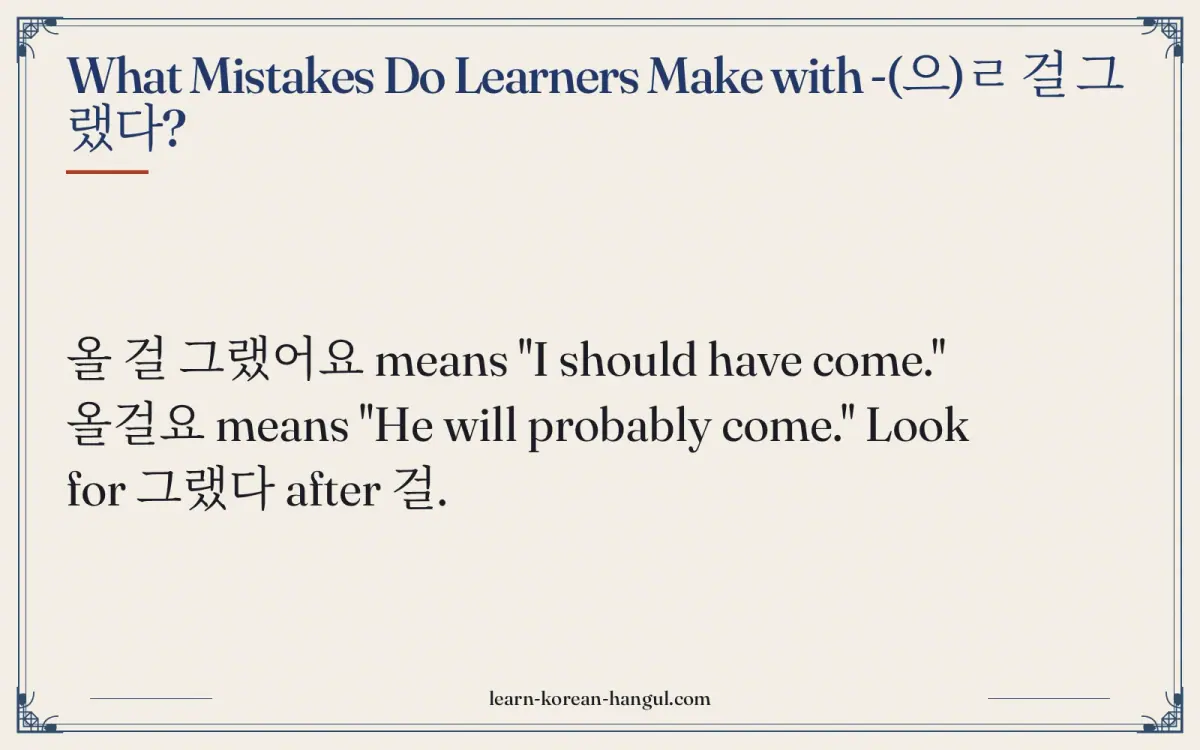
Learners most often confuse the pattern with the guess, put the tense in the wrong place, or use it for advice. Four mistakes appear again and again.
- Confusing it with the guess -(으)ㄹ걸요. 올 걸 그랬어요 is regret, and 올걸요 is a guess. Check whether 그랬다 follows.
- Putting the past on the first verb. 갔을 걸 그랬어요 is wrong. The past marker sits on 그랬다, and the verb stays plain: 갈 걸 그랬어요.
- Using it for advice. 지금 가 볼 걸 그랬어요 cannot mean "you should go now." The pattern looks back. For advice, use 가 보세요 or -는 게 좋겠어요.
- Using the wrong negative. For "I shouldn't have", use -지 말 걸 그랬다: 하지 말 걸 그랬어요. A form such as 안 할 걸 그랬어요 is heard in casual speech, but -지 말 걸 is the shape textbooks teach and the safe choice.
A quick check for any sentence: Does it look back at a past choice? Is the verb in its plain future-form shape? Is 그랬다 the word that carries the past? If all three answers are yes, the sentence is sound.
The practice set below tests these points directly.
Practice and Answers
Try the four items before you read the answer key. Cover the answers with your hand.
- Choose the form. Complete: 비가 너무 많이 와요. 우산을 ___. (가져올 걸 그랬어요 / 가져올걸요)
- Fix the error. A learner says 어제 일찍 잤을 걸 그랬어요 to mean "I should have slept early yesterday." Correct it.
- Translate. "I shouldn't have eaten so much." Use 먹다 and 말다.
- Write your own. Write one sentence about something you should have done last week, using -(으)ㄹ 걸 그랬어요. Then write one about something you shouldn't have done.
Practice · 6
Which sentence means "I should have gone"?
Show answer
갈 걸 그랬어요.
The verb stays in its plain future-form shape (갈), and 그랬어요 carries the past. 갈걸요 is a guess.
Which sentence means "It will probably rain today"?
Show answer
오늘은 비가 올걸요.
-(으)ㄹ걸요 is a single ending that gives a soft guess. The other choices are regret patterns.
How do you say "I shouldn't have said that"?
Show answer
그 말은 하지 말 걸 그랬어요.
Regret about doing something uses -지 말 걸 그랬다.
Choose the correct form of 듣다: 친구 말을 ___ 걸 그랬어요.
Show answer
들을
듣다 is ㄷ-irregular, so ㄷ becomes ㄹ before 을: 들을.
Which sentence means "I should have slept early yesterday"?
Show answer
어제 일찍 잘 걸 그랬어요.
The verb stays in its plain future-form shape (잘), and 그랬어요 carries the past. 잘걸요 is a guess.
Which form of 돕다 (to help) is correct?
Show answer
도울 걸 그랬어요
돕다 is ㅂ-irregular, so ㅂ turns into 우 before the modifier: 도울.
Answer key
- 가져올 걸 그랬어요. The sentence looks back at a missed action, so the regret pattern fits: 비가 너무 많이 와요. 우산을 가져올 걸 그랬어요. 가져올걸요 would be a guess about someone else.
- 어제 일찍 잘 걸 그랬어요. The verb keeps its plain stem (잘) and the past sits on 그랬어요.
- 너무 많이 먹지 말 걸 그랬어요. (neomu mani meokji mal geol geuraesseoyo.) [너무 마니 먹찌 말껄 그래써요] = "I shouldn't have eaten so much." The negative uses -지 말 걸 그랬다.
- Answers vary. Check that the verb stem takes ㄹ/을 before 걸 그랬어요 and that the negative sentence uses 말. An example: 지난주에 운동할 걸 그랬어요. 밤늦게 커피를 마시지 말 걸 그랬어요. (Last week I should have exercised. I shouldn't have drunk coffee late at night.)
If you can complete items 1 to 3 without the key, you can use the pattern in conversation. Next, the lesson hands off to related patterns.
What Should You Learn Next after -(으)ㄹ 걸 그랬다 Grammar?
After -(으)ㄹ 걸 그랬다 grammar, learn the guess it is often confused with, then the other endings in this set. This lesson teaches regret about past choices and does not cover guesses, duty or advice in depth. Those live on their own pages.
- Start with -(으)ㄹ걸요, which gives a soft guess or a gentle correction.
- Continue with banmal, to see how the casual endings sound with friends.
- Return to Exclamations and Realization to see every lesson in this set, or to the Intermediate Grammar list for other B1 patterns.
With these steps, -(으)ㄹ 걸 그랬다 becomes automatic: take the future-form modifier, add 걸 그랬어요, and let the regret sit on the last word.
Frequently Asked Questions
What does -(으)ㄹ 걸 그랬다 mean?
-(으)ㄹ 걸 그랬다 means "I should have (done)" or "I wish I had (done)." 일찍 올 걸 그랬어요 means "I should have come early." It voices a personal regret about an action you did not take, and it carries a feeling of disappointment more than a duty.
How do I attach -(으)ㄹ 걸 그랬다 to a verb or adjective?
Use the future-form modifier of the verb and add 걸 그랬다: 가다 becomes 갈 걸 그랬다, 먹다 becomes 먹을 걸 그랬다, and 듣다 becomes 들을 걸 그랬다. It is used with verbs. For a regret about something you did, use -지 말 걸 그랬다, as in 그 말은 하지 말 걸 그랬어요.
Can -(으)ㄹ 걸 그랬다 be used in the past tense?
The pattern is already about the past, because 그랬다 is a past form. Do not add -았/었 to the verb: 갔을 걸 그랬어요 is wrong. Use 갈 걸 그랬어요 for "I should have gone." A present form such as 갈 걸 그래요 is not used for regret.
Is -(으)ㄹ 걸 그랬다 used in speech or only in writing?
Both, but speech is far more common. People say 갈 걸 그랬어요 (polite) and 갈 걸 그랬어 (casual), or only 갈걸 on its own. In diaries and essays the plain form 갈 걸 그랬다 appears. The meaning stays the same, and only the speech level changes.
What is the most common mistake with -(으)ㄹ 걸 그랬다?
The most common mistake is mixing it up with -(으)ㄹ걸요, which means "I guess" or "probably." 올 걸 그랬어요 means "I should have come," while 올걸요 means "He will probably come." The first has 걸 followed by 그랬다, and the second is a single ending.