
What you'll learn
- Attach -(으)ㄹ걸요 to vowel stems, consonant stems, ㄹ stems and common irregular stems.
- Say a guess about the past with 갔을걸요 and a guess about a state with 바쁠걸요.
- Hear the difference between a guess (-(으)ㄹ걸요) and regret (-(으)ㄹ 걸 그랬다).
- Choose between -(으)ㄹ걸요 and -(으)ㄹ 것 같다 for the right tone.
Before you start: you should know how to find a stem (drop 다 from the dictionary form) and the polite ending 요. Audio plays only when you press a button.
What Does -(으)ㄹ걸요 Grammar Mean?
-(으)ㄹ걸요 grammar means "I think so" or "probably," with a small extra message: "and you may be expecting something different." Take a short exchange. A friend asks whether a shop is cheap. You answer 비쌀걸요. You are not just guessing. You are quietly saying, "I expect you will find it is not cheap."
The ending comes from a modifier, the future form -(으)ㄹ, plus the dependent noun 걸, which is a short form of 것을 ("the thing"). Grammar books describe this as a guess based on the speaker's own knowledge or reasoning, not on something they can see. A dependent noun is a noun that cannot stand alone and always follows a modifier.
Here are the first two examples. Both show a guess, and the second also shows the gentle correction.
- 그 사람은 벌써 갔을걸요. (geu sarameun beolsseo gasseulgeoryo.) [그 사라믄 벌써 가쓸껄료] = "He has probably already left."
- 지금은 비쌀걸요. (jigeumeun bissalgeoryo.) [지그믄 비쌀껄료] = "It is probably expensive now."
Notice the sound at the end. After the ending ㄹ, the ㄱ of 걸 becomes tense, so you hear [껄], and the 요 after the ㄹ is usually heard as [료], so the whole ending sounds like [껄료]. This follows the tensing rule of the standard pronunciation rules (표준 발음법, Article 27) of the 국립국어원 (National Institute of Korean Language). You still write 걸요. Now for the mechanism that builds the ending.
How Do You Form -(으)ㄹ걸요?
-(으)ㄹ걸요 is formed by dropping 다 from the dictionary form and adding -ㄹ걸요 after a vowel or ㄹ, or -을걸요 after any other final consonant. The (으) in brackets is a linking vowel that appears only when it is needed.
| Dictionary form | Stem | Add the ending | Polite form | Meaning |
|---|---|---|---|---|
| 가다 | 가 | 갈걸요 | 갈걸요 | He probably goes |
| 비싸다 | 비싸 | 비쌀걸요 | 비쌀걸요 | It is probably expensive |
| 먹다 | 먹 | 먹을걸요 | 먹을걸요 | He probably eats |
| 많다 | 많 | 많을걸요 | 많을걸요 | There are probably many |
| 살다 | 살 | 살걸요 | 살걸요 | He probably lives |
| 춥다 | 추우 | 추울걸요 | 추울걸요 | It is probably cold |
The table shows one idea: a vowel stem gets a final ㄹ, and a consonant stem gets 을. The next three parts take the groups one at a time.
Stems Ending in a Vowel
A vowel stem takes the ending by adding ㄹ to the last syllable. 가 becomes 갈, 비싸 becomes 비쌀, and 바쁘 becomes 바쁠. Then you add 걸요.
- 오늘은 바쁠걸요. (oneureun bappeulgeoryo.) [오느른 바쁠껄료] = "He is probably busy today."
- 많이 피곤할걸요. (mani pigonhalgeoryo.) [마니 피곤할껄료] = "He is probably very tired."
In 피곤하다, the stem 피곤하 ends in the vowel 하, so it becomes 피곤할. Vowel stems are the simplest case. Stems with a final consonant need the extra 을.
Stems Ending in a Consonant
A stem with a final consonant takes 을걸요. The 을 keeps the consonant from clashing with ㄹ. 먹다 becomes 먹을걸요, 많다 becomes 많을걸요, and 닫다 becomes 닫을걸요.
- 주말에는 사람이 많을걸요. (jumareneun sarami maneulgeoryo.) [주마레는 사라미 마늘껄료] = "There are probably many people on the weekend."
- 그 가게는 문을 닫았을걸요. (geu gageneun muneul dadasseulgeoryo.) [그 가게는 무늘 다다쓸껄료] = "That shop has probably closed." (literally "closed the door")
In speech, the final consonant of the stem links to 을, so 많을걸요 is pronounced [마늘껄료]. The ㅎ of 많 is silent before a vowel. The second example already shows a past guess: 닫았을걸요 is 닫- plus -았- plus -을걸요. Now for stems that change shape.
Irregular Stems and Nouns
Irregular stems change as usual before the vowel of 을걸요, and the ㄹ-stem rule applies:
- ㅂ-irregular: 춥다 becomes 추울걸요 (not 춥을걸요). 어렵다 becomes 어려울걸요: 시험이 어려울걸요 ("The exam is probably hard").
- ㄷ-irregular: 듣다 becomes 들을걸요: 그 노래는 들을걸요 ("He probably listens to that song").
- 르-irregular: 모르다 becomes 모를걸요: 민수 씨는 모를걸요 ("Min-su probably doesn't know").
- ㄹ stems: 살다 becomes 살걸요 and 만들다 becomes 만들걸요. The ㄹ is already there, so 을 is not added.
- Nouns with 이다: add 일걸요. 학생일걸요 means "He is probably a student."
Each of these irregular stems follows the same logic as before a vowel such as -아요/어요, so a learner who knows the polite present can rebuild them quickly. With the formation clear, one sentence can be built step by step.
Worked Example: Building a Sentence with -(으)ㄹ걸요
-(으)ㄹ걸요 grammar turns a plain statement into a confident guess. Follow the steps with "This bag is expensive."
- Start with the plain sentence. 이 가방은 비싸요. (i gabangeun bissayo.) = "This bag is expensive." The predicate is 비싸요.
- Find the dictionary form. 비싸요 comes from 비싸다. The stem is 비싸.
- Look at the end of the stem. 비싸 ends in a vowel, so you add a final ㄹ to the last syllable: 싸 becomes 쌀.
- Add 걸요. 비쌀 + 걸요 = 비쌀걸요.
- Rebuild the sentence. 이 가방은 지금 비쌀걸요. (i gabangeun jigeum bissalgeoryo.) = "This bag is probably expensive now."
Sentence
You will know it worked when the sentence ends in a single word that carries both the stem and the guess. The most common slip at this step is writing the polite ending after the dictionary form (비싸요걸요) or forgetting the final ㄹ (비싸걸요). Build from the stem, add ㄹ or 을, then 걸요. The sentence is now a guess, and a guess has limits in tense and sentence type.
Which Tenses and Sentence Types Work with -(으)ㄹ걸요?
-(으)ㄹ걸요 works for statements about the past, the present state or the future, but it has no tense marker of its own. The only tense you can show is the past, with -았/었- placed before the ending. It does not combine with -겠-, because 가겠을걸요 would pile up two guesses.
| What you mean | Form | Meaning |
|---|---|---|
| A state now | 바쁠걸요 | He is probably busy. |
| Something that will happen | 올걸요 | He will probably come. |
| Something that already happened | 갔을걸요 | He has probably gone. |
| A negative guess | 안 올걸요 | He probably won't come. |
| Casual, no 요 | 갈걸 | He probably goes (to a friend). |
| Formal | not available | Use -(으)ㄹ 것 같습니다. |
The negative uses 안 before the verb or -지 않을걸요: 아직 안 왔을걸요 means "He probably hasn't come yet." Both are common.
This ending is for statements only. You cannot make a question with -(으)ㄹ걸요, and you cannot give a command or a suggestion with it. If you want to ask for a guess, use a different pattern, such as -(으)ㄹ까요? ("Do you think it will...?"). The conversation below shows the usual use, a reply to a question.
- A: 이 식당은 지금 사람이 없을까요? ("Do you think this restaurant has no people now?")
- B: 점심시간이라 사람이 많을걸요. ("It is lunchtime, so there are probably many.")
The speaker B guesses from knowledge of how lunchtime works, not from a view of the room. The next section compares this ending with the pattern most learners meet first.
How Is -(으)ㄹ걸요 Different from -(으)ㄹ 것 같다?
-(으)ㄹ걸요 sounds more confident and more casual than -(으)ㄹ 것 같다, which is a neutral, softer guess. Both mean "I think." The difference is in tone and where you can use them.
| Point | -(으)ㄹ걸요 | -(으)ㄹ 것 같다 |
|---|---|---|
| Certainty | fairly sure | uncertain or hedged |
| Message to the listener | "you may be wrong" | none, just an impression |
| Style | spoken, casual or polite casual | any level, spoken or written |
| Formal form | none | -(으)ㄹ 것 같습니다 |
| Example | 갈걸요. | 갈 것 같아요. |
| Meaning of example | He probably goes (and I doubt your idea). | I think he will go. |
If a friend says, "The meeting is at five, right?", the answer 세 시일걸요 ("I think it's three") quietly corrects, while 세 시인 것 같아요 sounds like a mild guess. Full rules are on the page for -(으)ㄹ 것 같다, which is also the pattern to use in writing.
A second neighbour looks almost the same but means something else: -(으)ㄹ 걸 그랬다 expresses regret. 일찍 올 걸 그랬어요 means "I should have come early." The difference is the final 그랬어요 and the speaker's feeling: guess versus regret.
-(으)ㄹ걸요
I think / probably: a casual guess
-(으)ㄹ 것 같다
it seems it will: a neutral guess
-(으)ㄹ 걸 그랬다
I should have: regret
| Comparison | -(으)ㄹ걸요 | -(으)ㄹ 것 같다 | -(으)ㄹ 걸 그랬다 |
|---|---|---|---|
| Meaning | a guess I am fairly sure of | an impression or soft guess | regret about something not done |
| Formal speech or writing | no | yes (같습니다) | no |
| Typical feeling | gentle disagreement | neutral hedge | wishing I had acted |
| Example | 갈걸요 | 갈 것 같아요 | 갈 걸 그랬어요 |
Use -(으)ㄹ걸요 for a confident, casual guess or a gentle correction; use -(으)ㄹ 것 같다 for a neutral guess in any speech level; use -(으)ㄹ 걸 그랬다 only for regret.
Two other forms are often mentioned beside these. Future events can also be stated with future guess -겠- or with the plain future tense -(으)ㄹ 거예요. Those are covered on their own pages, so this lesson does not repeat them. Now for variations you will hear in real talk.
Variations and Edge Cases of -(으)ㄹ걸요
-(으)ㄹ걸요 has a few common variations. They differ mostly in register and in what comes before the ending.
- Casual -(으)ㄹ걸. Drop 요 and you get a casual guess for friends and family: 그 사람은 벌써 갔을걸 ("He's probably gone already"). The same shape in a monologue can also express regret (일찍 올걸), so the situation tells you which one is meant.
- With 아마. The adverb 아마 ("perhaps") often comes first and adds to the guess: 아마 비쌀걸요. It is natural but not required.
- With a subject marker. A subject is usually the third person or a thing. Speakers rarely guess about themselves, because they know their own plans. Say 갈 거예요, not 제가 갈걸요, when the plan is yours.
- Honorific -(으)시-. Put it before the ending when the subject deserves respect: 선생님은 바쁘실걸요 ("The teacher is probably busy"). See the full rule on the honorific pages of this site.
- A look-alike, -(ㄴ/는)걸요. With -(ㄴ/는), the ending changes meaning. 비가 오는걸요 [비가 오는걸료] means "But it is raining, you know," a gentle objection or surprise about a fact, not a guess about something uncertain.
The lesson covers the spoken guess and its main variants. It does not cover the written equivalents, which belong to the pages on -(으)ㄹ 것 같다 and -(으)ㄹ 것이다. The mistakes below show where learners go wrong.
What Mistakes Do Learners Make with -(으)ㄹ걸요?
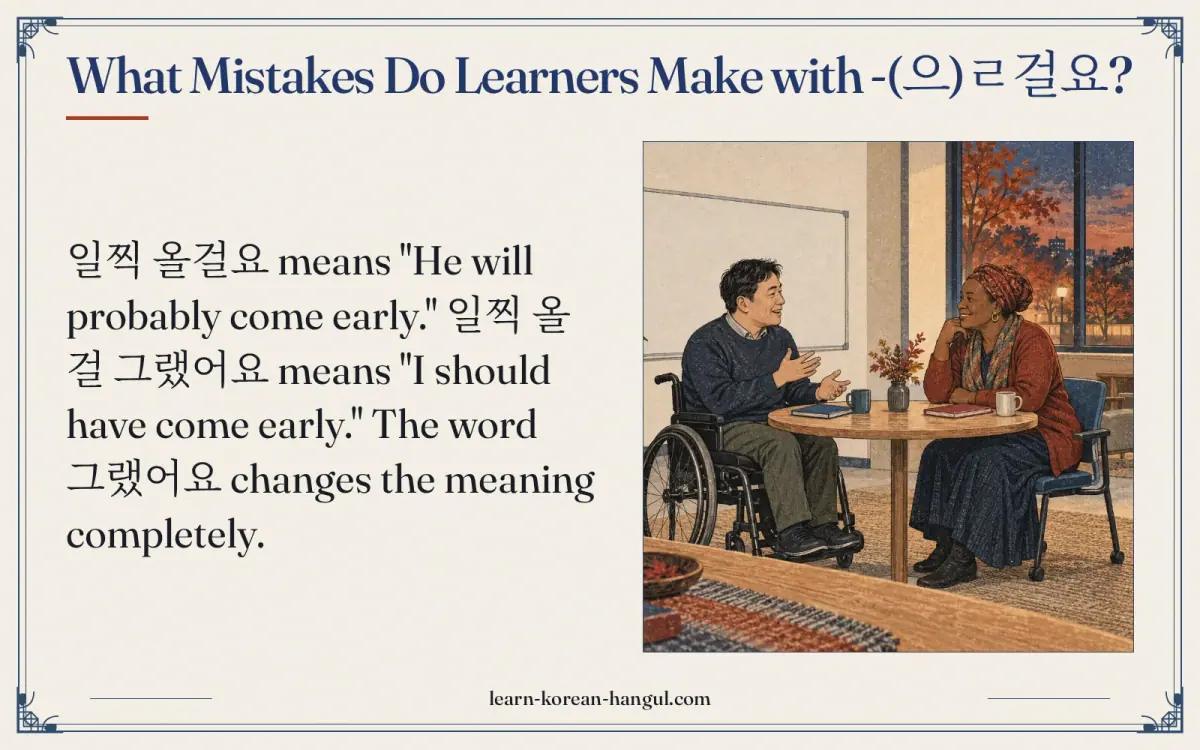
Learners most often confuse the ending with regret, put it in a formal setting or add the wrong tense. Four slips come up again and again.
- Mixing it with regret. -(으)ㄹ 걸 그랬다 means "I should have." 일찍 올걸요 is a guess about someone else, and 일찍 올 걸 그랬어요 is a regret about yourself. Check for 그랬다.
- Using it in formal speech. There is no 갈걸습니다. In a presentation or interview, say 갈 것 같습니다.
- Adding the wrong tense. 가겠을걸요 and 왔걸요 are both wrong. The only tense marker is the past -았/었- before the ending: 갔을걸요.
- Using it as a question. 갈걸요? asks nothing. Use 갈까요? for "Do you think it will go?"
A quick check for any guess you plan to say: Is the listener likely to expect something different? Is the setting casual? Is the ending a statement? If all three are yes, -(으)ㄹ걸요 is a good fit.
The practice set below tests these points directly.
Practice and Answers
Try the items before you read the answer key.
- Build the form. Write the polite -(으)ㄹ걸요 form of 크다 ("to be big").
- Fix the error. A learner says 어제 친구가 왔걸요 for "My friend probably came yesterday." Correct it.
- Choose the tone. Which fits a polite correction of a friend's guess: 갈 것 같습니다 or 갈걸요?
- Write your own. Write one sentence about a restaurant on a Saturday night, using -(으)ㄹ걸요.
Practice · 5
Which form means "He has probably already left" (갔다 = went)?
Show answer
갔을걸요
A guess about something already done puts the past marker 았/었 before the ending: 갔 + 을걸요.
How do you say "It is probably cold" with 춥다 (ㅂ-irregular)?
Show answer
추울걸요
The ㅂ changes to 우 before a vowel-starting ending, so 춥 becomes 추우, and ㄹ걸요 attaches to it.
Which form is right for 살다 (to live) with the meaning "He probably lives there"?
Show answer
살걸요
A stem that already ends in ㄹ takes -ㄹ걸요 without adding 을, so the ㄹ is shared.
Which sentence ends in regret, not a guess?
Show answer
일찍 올 걸 그랬어요.
The extra 그랬어요 turns the sentence into the regret pattern -(으)ㄹ 걸 그랬다, "I should have come early."
Where would -(으)ㄹ걸요 sound out of place?
Show answer
A formal news report
It is a spoken, casual ending with no formal version, so a news report uses -(으)ㄹ 것으로 보입니다 or a similar written form.
Answer key
- 클걸요. 크다 has the stem 크, which ends in a vowel, so ㄹ is added to make 클, and 걸요 follows.
- 어제 친구가 왔을걸요. The past marker 았 must be followed by 을걸요, so you get 왔 + 을걸요.
- 갈걸요. It is casual, confident and gently correcting, while 갈 것 같습니다 is formal and neutral.
- Answers vary. Check that the stem comes before ㄹ걸요 or 을걸요 and that the sentence is a statement. An example: 토요일 밤에는 사람이 많을걸요. ("There are probably many people on a Saturday night.")
If you can answer items 1 to 3 without the key, you can use the ending in conversation. Next, the lesson points to related patterns.
What Should You Learn Next after -(으)ㄹ걸요 Grammar?
After -(으)ㄹ걸요 grammar, learn the neutral guess, then the regret pattern, then the future forms. This lesson teaches one casual spoken ending. It does not cover written guesses, evidence-based guesses or plans.
- Start with -(으)ㄹ 것 같다, the neutral guess that works at every speech level.
- Continue with -(으)ㄹ 걸 그랬다, the regret pattern that sounds almost the same.
- Review the future with future guess -겠- and future tense -(으)ㄹ 거예요.
- Return to Guessing and Conjecture to see every lesson in this set, or to the Intermediate Grammar list for other B1 patterns.
With these steps, the ending becomes automatic: take the stem, add ㄹ or 을, then 걸요, and keep the tone casual.
Frequently Asked Questions
What does -(으)ㄹ걸요 mean?
-(으)ㄹ걸요 means "I think" or "probably" and marks a guess that the speaker is fairly sure about. 지금은 비쌀걸요 means "It is probably expensive now." The speaker often adds a gentle correction, as if saying "I think you will find that it is different from what you expect."
How do I attach -(으)ㄹ걸요 to a verb or adjective?
Drop 다 from the dictionary form. After a vowel or ㄹ, add -ㄹ걸요: 가다 becomes 갈걸요, and 살다 becomes 살걸요. After any other final consonant, add -을걸요: 먹다 becomes 먹을걸요. For nouns, use 이다: 학생일걸요. ㅂ, ㄷ and 르 stems change first, as in 추울걸요.
Can -(으)ㄹ걸요 be used in the past tense?
Yes, but the past marker goes before the ending. 그 사람은 갔을걸요 means "He has probably gone," built from 갔- plus -을걸요. The ending itself already points forward or leaves time open, so it needs no present-tense marker. For a present state, the stem alone does the work: 바쁠걸요 means "probably busy."
Is -(으)ㄹ걸요 used in speech or only in writing?
It belongs to speech. Friends and colleagues use 갈걸요 in the polite style and 갈걸 in casual talk. There is no formal -습니다 version and it does not suit essays, news or reports, which use -(으)ㄹ 것 같다 or -(으)ㄹ 것이다 instead. Dropping the 요 gives a casual register.
What is the most common mistake with -(으)ㄹ걸요?
The most common mistake is mixing it up with -(으)ㄹ 걸 그랬다, which expresses regret. 일찍 올 걸 그랬어요 means "I should have come early," while 일찍 올걸요 means "He will probably come early." The sound is nearly the same, so check for 그랬다 at the end.
Can I use -(으)ㄹ걸요 to talk about my own plans?
Usually not. The ending expresses a guess, and people rarely guess about what they decide themselves. For your own plan, say 갈 거예요 ("I will go"). You can use it about yourself only for something outside your control, such as 저는 늦을걸요, meaning "I will probably be late."