What you'll learn
- Attach -(으)ㄹ 것 같다 to vowel stems, consonant stems, ㄹ stems and common irregular stems.
- Give a soft guess about tomorrow, next week or a place you have not been.
- Tell apart a guess about the future (올 것 같아요) from an impression about the past (온 것 같아요).
- Use the pattern for yourself when a plan is not fixed, as in 못 갈 것 같아요.
Before you start: you should know how to find a stem (drop 다 from the dictionary form) and the polite ending -아요/어요. Audio plays only when you press a button.
What Does -(으)ㄹ 것 같다 Grammar Mean?

-(으)ㄹ 것 같다 grammar means "it seems it will" or "I think it will." It joins the future modifier -(으)ㄹ to the dependent noun 것 ("thing") and the adjective 같다 ("to be like"). Put together, the pattern says "it is like a thing that will happen." A dependent noun is a noun that cannot stand alone and always follows a describing word. In plain English, you are saying that the future event looks like it is coming, but you cannot be sure.
The key condition is that the speaker has no direct evidence. You cannot see the rain, taste the dish or check the schedule. You are judging from feeling, experience or reasoning. Here are the first two examples.
- 내일은 비가 올 것 같아요. (naeireun biga ol geot gatayo.) [내이른 비가 올껃까타요] = "I think it will rain tomorrow."
- 그 영화는 재미있을 것 같아요. (geu yeonghwaneun jaemiisseul geot gatayo.) [그 영화는 재미이쓸껃까타요] = "That movie seems like it will be fun."
Notice the sound. After the ending ㄹ, the ㄱ of 것 becomes tense, so you hear [껃], and the ㄱ of 같 is tense as well because it follows the stop sound of 것. This follows the standard pronunciation rules (표준 발음법, Articles 23 and 27) of the 국립국어원 (National Institute of Korean Language). You write 것 같아요 and say [껃까타요]. In everyday speech, 것 is often shortened to 거, so 올 거 같아요 [올꺼가타요] is just as common. Next comes the mechanism that builds the pattern.
How Do You Form -(으)ㄹ 것 같다?
-(으)ㄹ 것 같다 is formed by dropping 다 from the dictionary form and adding -ㄹ 것 같다 after a vowel or ㄹ, or -을 것 같다 after any other final consonant. The (으) in brackets is a linking vowel that appears only when it is needed.
| Dictionary form | Stem | Add the ending | Polite form | Meaning |
|---|---|---|---|---|
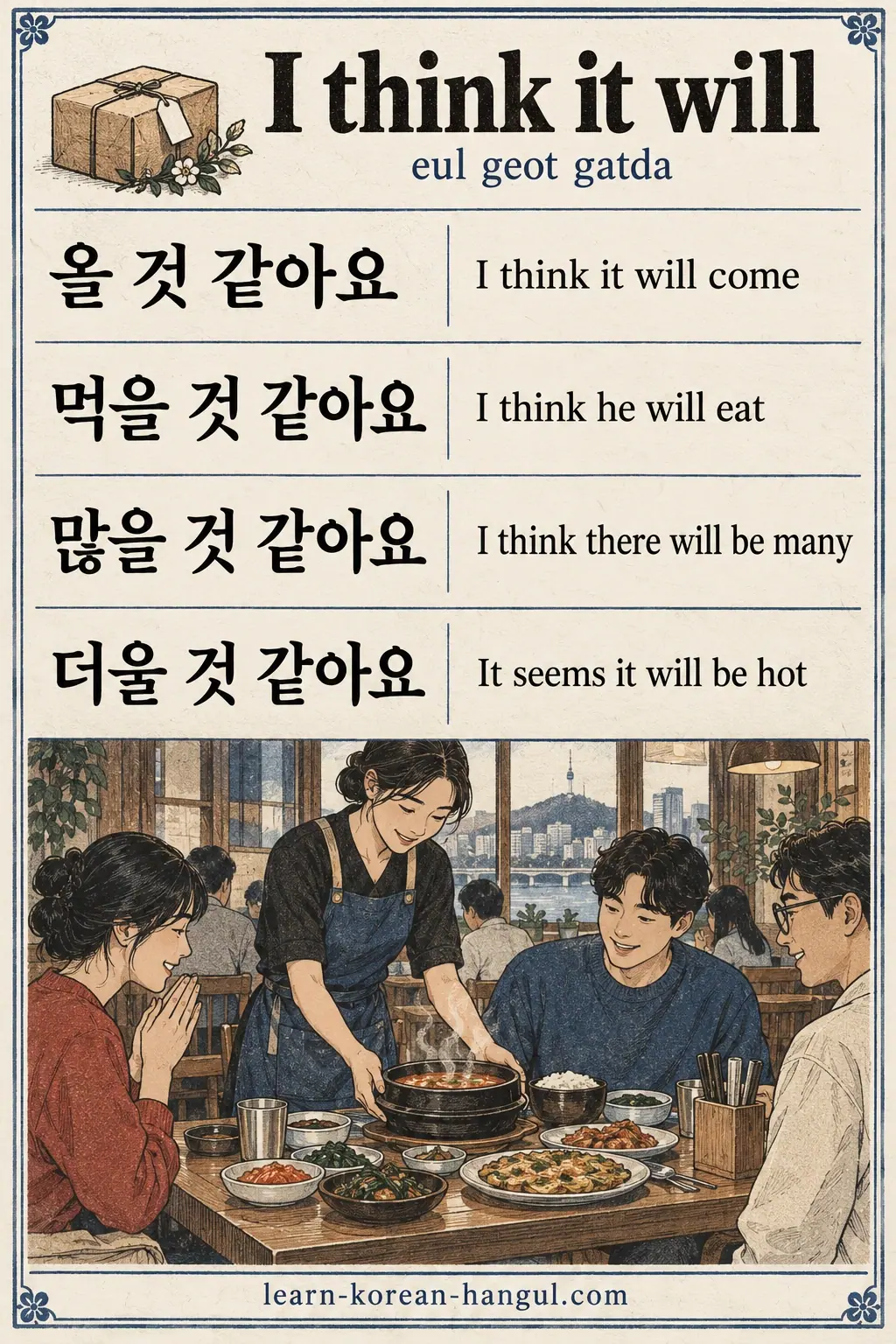
| 오다 | 오 | 올 것 같다 | 올 것 같아요 | I think it will come |
| 비싸다 | 비싸 | 비쌀 것 같다 | 비쌀 것 같아요 | It seems it will be expensive |
| 먹다 | 먹 | 먹을 것 같다 | 먹을 것 같아요 | I think he will eat |
| 많다 | 많 | 많을 것 같다 | 많을 것 같아요 | I think there will be many |
| 만들다 | 만들 | 만들 것 같다 | 만들 것 같아요 | I think he will make it |
| 덥다 | 더우 | 더울 것 같다 | 더울 것 같아요 | It seems it will be hot |
The table shows one idea: a vowel stem gets a final ㄹ, and a consonant stem gets 을. The next three parts take the groups one at a time.
Stems Ending in a Vowel
A vowel stem takes the ending by adding ㄹ to the last syllable. 오 becomes 올, 가 becomes 갈, and 바쁘 becomes 바쁠. Then you add 것 같다.
- 눈이 올 것 같아요. (nuni ol geot gatayo.) [누니 올껃까타요] = "I think it will snow."
- 요즘 바쁠 것 같아요. (yojeum bappeul geot gatayo.) [요즘 바쁠껃까타요] = "I think you will be busy these days."
Vowel stems are the simplest case. A stem with a final consonant needs one extra vowel.
Stems Ending in a Consonant
A stem with a final consonant takes 을 before 것 같다. 먹다 becomes 먹을 것 같다, 늦다 becomes 늦을 것 같다, and 많다 becomes 많을 것 같다.
- 오늘은 늦을 것 같아요. (oneureun neujeul geot gatayo.) [오느른 느즐껃까타요] = "I think I will be late today."
- 사람이 많을 것 같아요. (sarami maneul geot gatayo.) [사라미 마늘껃까타요] = "I think there will be a lot of people."
The final consonant of the stem links to 을, so 늦을 is pronounced [느즐] and 많을 is pronounced [마늘]. The ㅎ of 많 is silent before a vowel.
Now for stems that change shape.
Irregular Stems and Nouns
Irregular stems change as usual before a vowel, and ㄹ stems keep their ㄹ:
- ㅂ-irregular: 덥다 becomes 더울 것 같다, and 맵다 becomes 매울 것 같다: 이 음식은 매울 것 같아요 ("This food seems spicy").
- ㄷ-irregular: 듣다 becomes 들을 것 같다: 그 노래를 들을 것 같아요 ("I think he will listen to that song").
- 르-irregular: 모르다 becomes 모를 것 같다: 아무도 모를 것 같아요 ("I think nobody will know").
- ㄹ stems: 살다 becomes 살 것 같다 and 만들다 becomes 만들 것 같다. No 을 is added.
- Nouns with 이다: add 일 것 같다. 다음 주는 방학일 것 같아요 means "Next week is probably vacation."
A noun in the present tense usually takes -인 것 같다 instead, which is covered on the page for the present and past form. With the formation clear, one sentence can be built step by step.
Worked Example: Building a Sentence with -(으)ㄹ 것 같다

-(으)ㄹ 것 같다 grammar turns a plain future statement into a soft guess. Follow the steps with "It rains tomorrow."
- Start with the plain sentence. 내일은 비가 와요. (naeireun biga wayo.) = "It rains tomorrow." The predicate is 와요.
- Find the dictionary form. 와요 comes from 오다 (to come, here "to fall"). The stem is 오.
- Look at the end of the stem. 오 ends in a vowel, so you add a final ㄹ: 오 becomes 올.
- Add 것 같아요. 올 + 것 같아요 = 올 것 같아요. Keep the space after 올 and after 것.
- Rebuild the sentence. 내일은 비가 올 것 같아요. (naeireun biga ol geot gatayo.) = "I think it will rain tomorrow."
Sentence
You will know it worked when the subject (비가) and the time word (내일은) stay in place and only the predicate changes from 와요 to 올 것 같아요. The most common slip at this step is adding the polite ending to the stem (와요 것 같아요). Always work from the stem. A guess can appear in several tenses and sentence types, and each has limits.
Which Tenses and Sentence Types Work with -(으)ㄹ 것 같다?

-(으)ㄹ 것 같다 works in statements and questions, in the present and future sense, and in the negative. The speech level changes only on 같다, the last word. The table shows the forms for 오다 in the polite style.
| What you mean | Form | Meaning |
|---|---|---|
| Polite statement | 올 것 같아요 | I think it will come. |
| Formal statement | 올 것 같습니다 | I think it will come (formal). |
| Casual (banmal) | 올 것 같아 | I think it will come (to a friend). |
| Written plain style | 올 것 같다 | It seems it will come (diary, essay). |
| Negative | 안 올 것 같아요 | I think it will not come. |
| Question | 올 것 같아요? | Do you think it will come? |
| Past guess | 왔을 것 같아요 | I think it has probably come. |
The present statement and the question have the same shape. Rising tone turns 올 것 같아요 into a yes/no question, and a written question mark marks it in text. A question with a question word, such as 언제 올 것 같아요?, puts the stress on the question word and often falls or rise-falls at the end.
For the past, the pattern does not simply change tense. 왔을 것 같아요 is a guess that something probably happened ("it has probably come"), and it is built with -았/었- before the ending. If you actually see or hear signs that something already happened, say 온 것 같아요 instead. That is a different pattern and is explained on its own page.
- 저는 내일 못 갈 것 같아요. (jeoneun naeil mot gal geot gatayo.) [저는 내일 몯깔껃까타요] = "I do not think I can go tomorrow."
- 그 사람은 벌써 집에 갔을 것 같아요. (geu sarameun beolsseo jibe gasseul geot gatayo.) [그 사라믄 벌써 지베 가쓸껃까타요] = "I think he has already gone home."
The compatibility pattern is simple: the only tense you can add is the past, directly before the ending. The most useful contrast for a learner is next to the pattern that looks back instead of ahead.
How Is -(으)ㄹ 것 같다 Different from -(으)ㄴ/는 것 같다 and -나 보다?

-(으)ㄹ 것 같다 looks ahead or at an unseen state, while -(으)ㄴ/는 것 같다 describes what you see or heard about now or before. The point is the time and the basis of the guess.
| Point | -(으)ㄹ 것 같다 | -(으)ㄴ/는 것 같다 | -나 보다 |
|---|---|---|---|
| Time | future or unseen state | present or past | present or past |
| Basis | feeling, reasoning | what I see or hear | clear evidence |
| Typical example | 비가 올 것 같아요. | 비가 오는 것 같아요. | 비가 오나 봐요. |
| Meaning of example | I think it will rain. | It seems it is raining. | It looks like it is raining. |
With the weather, you might say 비가 올 것 같아요 while looking at dark clouds, and 비가 오는 것 같아요 when you hear drops on the window. The form of the word shows the time. Full rules are on the page for -(으)ㄴ/는 것 같다, and for -나 보다, which has the sound of thinking aloud. The side-by-side lesson for the second pair is -(으)ㄹ 것 같다 vs -나 보다.
-(으)ㄹ 것 같다
it seems it will: a guess about the future or an unseen state
-(으)ㄴ/는 것 같다
it seems that: an inference about now or the past
-나 보다
it seems that: an inference from evidence
| Comparison | -(으)ㄹ 것 같다 | -(으)ㄴ/는 것 같다 | -나 보다 |
|---|---|---|---|
| Time | future or unseen state | present or past | present or past |
| Basis | feeling or reasoning | what I see or hear | clear evidence |
| Style | any level | any level | mostly spoken |
| Example | 올 것 같아요 | 온 것 같아요 | 비가 오나 봐요 |
Use -(으)ㄹ 것 같다 for the future or an unseen state, -(으)ㄴ/는 것 같다 for what you see now or saw before, and -나 보다 when you point to clear evidence.
A fourth neighbour is -(으)ㄹ 텐데, which states a probability and then adds a worry or request: the lesson is -(으)ㄹ 텐데 vs -(으)ㄹ 것 같다. The firm future forms are separate again. Future guess -겠- sounds like a stronger prediction, and future tense -(으)ㄹ 거예요 states a plan or a firm expectation. For example, 비가 올 거예요 sounds like a forecast, while 비가 올 것 같아요 sounds like a hunch. These contrasts lead to the smaller variations.
Variations and Edge Cases of -(으)ㄹ 것 같다

-(으)ㄹ 것 같다 has four common variations. Each one is short, and each appears in real conversation.
- Spoken 거 for 것. In speech, 것 shrinks to 거: 올 거 같아요. It is a pronunciation habit, not a different pattern. Writing keeps 것 in careful text.
- Adjectives before experience. With an adjective, the ㄹ form judges something you have not yet experienced: 이 케이크는 맛있을 것 같아요 ("This cake looks like it will taste good") before you eat it. After tasting, say 맛있는 것 같아요 ("It seems tasty").
- Softening your own plan. Speakers often use the pattern to avoid sounding too certain: 아마 늦을 것 같아요 ("I will probably be late"). The adverb 아마 ("perhaps") often comes first.
- Honorific -(으)시-. For a respected subject, place -(으)시- before the ending: 선생님도 오실 것 같아요 ("I think the teacher will come too"). See the honorific pages of this site for the full rule.
This lesson covers the common spoken and written forms, not every guess pattern in Korean. Guesses based on visible signs belong to other pages. The mistakes below show where the boundary with those patterns causes real errors.
What Mistakes Do Learners Make with -(으)ㄹ 것 같다?

Learners most often confuse the time, drop the spaces or use the pattern for facts. Four mistakes appear again and again.
- Using it for the past. 어제 비가 올 것 같아요 is wrong for "It seems it rained yesterday." Use 어제 비가 온 것 같아요, or 어제 비가 왔을 것 같아요 for a guess about what probably happened.
- Writing the words together. 올것같아요 and 올 것같아요 are both wrong. 것 is a dependent noun and 같아요 is a separate word, so write 올 것 같아요.
- Using it for what you can see. If you are looking at the wet street, 비가 올 것 같아요 sounds odd. Say 비가 오는 것 같아요 or 비가 온 것 같아요.
- Adding a second marker. 올 것 같겠어요 is wrong. The pattern is already a guess, so no extra 겠 is needed.
A quick check for any guess: Does the sentence point ahead or at something unseen? Is the stem followed by ㄹ or 을? Are both spaces in place? If all three are yes, the sentence is sound.
The practice set below tests these points directly.
Practice and Answers
Try the items before you read the answer key.
- Build the form. Write the polite -(으)ㄹ 것 같다 form of 가다 ("to go").
- Fix the error. A learner says 어제 친구가 올 것 같아요 for "My friend probably came yesterday." Correct it.
- Choose the form. The sky is dark and you have not felt a drop. Which fits: 비가 올 것 같아요 or 비가 오는 것 같아요?
- Write your own. Write one sentence about what you think will happen this weekend, using -(으)ㄹ 것 같아요.
Practice · 5
Which form means "I think it will snow" with 오다?
Show answer
눈이 올 것 같아요
오 ends in a vowel, so the future modifier is 올 (오 + ㄹ).
How do you say "It will probably be hot" with 덥다 (ㅂ-irregular)?
Show answer
더울 것 같아요
The ㅂ becomes 우 before a vowel, so 덥 becomes 더우, and then ㄹ is added: 더울.
Which sentence is correct for "It seems it rained" (the street is wet)?
Show answer
비가 온 것 같아요.
A past impression uses -(으)ㄴ 것 같다. The ㄹ form looks forward.
Which is spaced correctly?
Show answer
올 것 같아요
것 is a dependent noun and 같아요 is a separate word, so both spaces stay.
Which version fits "I think I will be late today" with 늦다?
Show answer
오늘은 늦을 것 같아요.
늦 ends in a consonant, so 을 is added: 늦을.
Answer key
- 갈 것 같아요. 가 ends in a vowel, so ㄹ is added to make 갈.
- 어제 친구가 왔을 것 같아요. The past marker 았 comes before the ending, so you get 왔 + 을 것 같아요.
- 비가 올 것 같아요. No rain is falling yet, so the guess points ahead.
- Answers vary. Check that the stem is followed by ㄹ or 을 and that the spaces are right. An example: 이번 주말에는 날씨가 좋을 것 같아요. ("I think the weather will be good this weekend.")
If you can answer items 1 to 3 without the key, you can use the pattern in conversation. Next, the lesson points to related patterns.
What Should You Learn Next after -(으)ㄹ 것 같다 Grammar?
After -(으)ㄹ 것 같다 grammar, learn the guess about now and the past, then the guess that points to evidence. This lesson teaches one pattern and does not cover evidence-based guesses or firm plans in depth. Those live on their own pages.
- Start with -(으)ㄴ/는 것 같다, which covers present and past impressions.
- Continue with -나 보다, which reports a guess based on evidence.
- Review the future with future guess -겠- and future tense -(으)ㄹ 거예요.
- Return to Guessing and Conjecture to see every lesson in this set, or to the Beginner Grammar list for other A1 and A2 patterns.
With these steps, the pattern becomes automatic: take the stem, add ㄹ or 을, then 것 같아요, and keep both spaces.
Frequently Asked Questions
What does -(으)ㄹ 것 같다 mean?
-(으)ㄹ 것 같다 means "it seems it will" or "I think it will." It gives a guess about the future or about a state you have not experienced yet. 내일은 비가 올 것 같아요 means "I think it will rain tomorrow." The speaker is not sure and is not claiming a fact, which makes it a polite, soft way to speak.
How do I attach -(으)ㄹ 것 같다 to a verb or adjective?
Drop 다 from the dictionary form. After a vowel or ㄹ, add -ㄹ 것 같다: 오다 becomes 올 것 같다, and 만들다 becomes 만들 것 같다. After another final consonant, add -을 것 같다: 먹다 becomes 먹을 것 같다. ㅂ, ㄷ and 르 stems change first, so 덥다 becomes 더울 것 같다.
Can -(으)ㄹ 것 같다 be used in the past tense?
Not directly. The ㄹ points to the future or to an unseen state, so a past impression uses -(으)ㄴ 것 같다 instead: 비가 온 것 같아요 means "It seems it rained." To guess that something probably happened, you can put -았/었- before the ending: 갔을 것 같아요 means "He probably went."
Is -(으)ㄹ 것 같다 used in speech or only in writing?
Both. In everyday speech people say 올 것 같아요, often shortening 것 to 거 as in 올 거 같아요. In news, reports and presentations they use 올 것 같습니다 or the plain written 올 것 같다. The meaning stays the same, and only the speech level changes.
What is the most common mistake with -(으)ㄹ 것 같다?
The most common mistake is using it for something you can already see or have just done. If the street is wet, say 비가 온 것 같아요, not 비가 올 것 같아요. A second mistake is writing the spacing wrongly: 것 is a dependent noun, so write 올 것 같다, not 올것같다.
Can I use -(으)ㄹ 것 같다 about myself?
Yes, when your plan is not fixed. 저는 내일 못 갈 것 같아요 means "I do not think I can go tomorrow," and it sounds less abrupt than 못 가요. If the plan is firm, use -(으)ㄹ 거예요 or the plain present. The pattern shows that even you are unsure of what will happen.