What you'll learn
- Attach -나 보다 to verb stems and to 있다/없다, with no irregular changes.
- Report what a clue suggests with 비가 오나 봐요 and 자나 봐요.
- Say a past inference with 왔나 봐요.
- Tell apart -나 보다 (evidence) from -(으)ㄹ 것 같다 (feeling or future).
Before you start: you should know how to find a stem (drop 다 from the dictionary form) and the polite ending -아요/어요. If your word is an adjective, read -(으)ㄴ가 보다 as well. Audio plays only when you press a button.
What Does -나 보다 Grammar Mean?

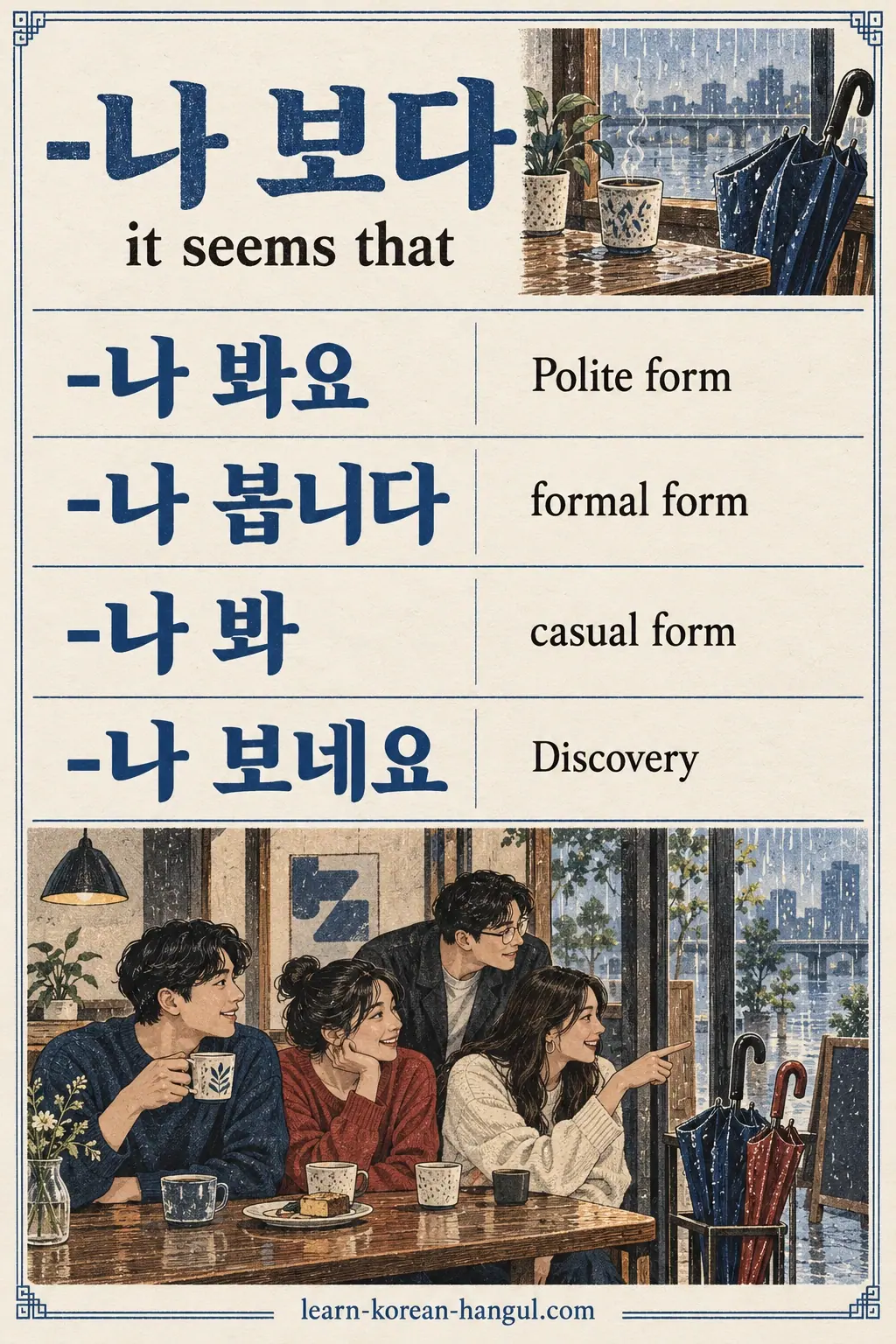
-나 보다 grammar means "it seems that" or "it looks like." The speaker saw or heard a clue and says what it suggests. Imagine you are in a cafe and see people coming in with wet umbrellas. You say to your friend 비가 오나 봐요, "It seems to be raining." You did not feel a drop. The umbrellas gave you the answer.
The pattern is made of two parts. The first is -나, an ending that carries a small question inside the sentence, roughly "is it so?" The second is the helper 보다. Normally 보다 is the verb "to see." Here it is an auxiliary, which is a helper that follows another word and adds a meaning. The words together say, roughly, "I look and it seems that." That is why the pattern sounds like thinking out loud, and why it fits a guess based on a sign.
Here are the first two examples.
- 비가 오나 봐요. (biga ona bwayo.) [비가 오나 봐요] = "It looks like it is raining."
- 친구가 아픈가 봐요. (chinguga apeunga bwayo.) [친구가 아픈가 봐요] = "It seems my friend is sick."
The first example uses the verb 오다 with -나. The second uses the adjective 아프다 with the twin form -(으)ㄴ가, which shows that the word class decides the shape. The form 봐요 comes from 보 plus 아요, which contracts to 봐요. Next comes the mechanism that builds the pattern.
How Do You Form -나 보다?
-나 보다 is formed by dropping 다 from the dictionary form of a verb and adding -나 보다. Nothing else changes. The ending begins with a consonant, so vowel stems and consonant stems both take it directly, and irregular stems do not change.
| Dictionary form | Stem | Add the ending | Polite form | Meaning |
|---|---|---|---|---|
| 오다 | 오 | 오나 보다 | 오나 봐요 | it seems he is coming |
| 자다 | 자 | 자나 보다 | 자나 봐요 | he seems to be sleeping |
| 먹다 | 먹 | 먹나 보다 | 먹나 봐요 | he seems to eat |
| 있다 | 있 | 있나 보다 | 있나 봐요 | he seems to be there |
| 없다 | 없 | 없나 보다 | 없나 봐요 | there seems to be none |
| 살다 | 살 | 사나 보다 | 사나 봐요 | he seems to live there |
The table shows one idea: the stem plus 나. The one change is a ㄹ stem, which drops its ㄹ before ㄴ. The next three parts take the groups one at a time.
Stems Ending in a Vowel
A vowel stem takes the ending directly. 오 stays 오, 자 stays 자, and 막히 stays 막히.
- 민수 씨가 지금 자나 봐요. (minsu ssiga jigeum jana bwayo.) = "Min-su seems to be sleeping now." (He does not answer.)
- 길이 막히나 봐요. (giri makina bwayo.) [기리 마키나 봐요] = "The road seems to be jammed."
Vowel stems are the simplest case. A stem with a final consonant looks different on the page but follows the same rule.
Stems Ending in a Consonant
A consonant stem also takes -나 directly, with no linking vowel. This is unlike -(으)ㄹ 것 같다, which needs 을 after a consonant. 먹다 becomes 먹나 보다, and 있다 becomes 있나 보다.
- 아이가 밥을 잘 먹나 봐요. (aiga babeul jal meongna bwayo.) [아이가 바블 잘 멍나 봐요] = "The child seems to eat well."
- 가게에 사람이 없나 봐요. (gagee sarami eomna bwayo.) [가게에 사라미 엄나 봐요] = "There seems to be nobody in the shop."
The spelling stays 먹나 and 없나, but the sound changes: the final ㄱ of 먹 and the final ㅂ of 없 become nasal before ㄴ, so you hear [멍나] and [엄나]. This follows the nasalisation rule of the standard pronunciation rules (표준 발음법) of the 국립국어원 (National Institute of Korean Language). Write the plain spelling and say the nasal sound.
Irregular Stems and the Past
Because -나 begins with a consonant, irregular stems do not change:
ㄷ-irregular: 듣다 stays 듣나 보다: 그 사람이 음악을 듣나 봐요 ("He seems to be listening to music").
ㅂ-irregular: 돕다 stays 돕나 보다 (not 도우나): 친구를 돕나 봐요 ("He seems to be helping a friend").
르-irregular: 모르다 stays 모르나 보다: 아직 모르나 봐요 ("He seems not to know yet").
ㄹ stems: 살다 becomes 사나 보다, and 만들다 becomes 만드나 보다. The ㄹ drops before ㄴ.
Past: put -았/었- before 나. 오다 becomes 왔나 보다, and 살다 becomes 살았나 보다.
친구가 벌써 왔나 봐요. (chinguga beolsseo wanna bwayo.) [친구가 벌써 완나 봐요] = "My friend seems to have arrived already."
그 사람이 한국에서 오래 살았나 봐요. (geu sarami hangugeseo orae saranna bwayo.) [그 사라미 한구게서 오래 사란나 봐요] = "He seems to have lived in Korea for a long time."
In the past, the final ㅆ of 왔 and 았 is pronounced [ㄷ] and then becomes [ㄴ] before 나, so you hear [완나] and [사란나]. With the formation clear, one full sentence can be built step by step.
Worked Example: Building a Sentence with -나 보다

-나 보다 grammar turns a plain action sentence into an inference. Follow the steps with "The child eats well."
- Start with the plain sentence. 아이가 잘 먹어요. (aiga jal meogeoyo.) = "The child eats well." The predicate is 먹어요.
- Find the dictionary form. 먹어요 comes from 먹다 (to eat). The stem is 먹.
- Add 나 보다 to the stem. 먹 + 나 보다 = 먹나 보다. There is no linking vowel and no irregular change.
- Choose the speech level. For polite speech, change 보다 into 봐요: 먹나 봐요.
- Rebuild the sentence. 아이가 잘 먹나 봐요. (aiga jal meongna bwayo.) = "The child seems to eat well."
Sentence
You will know it worked when the subject (아이가) and the adverb (잘) stay in place and only the predicate changes from 먹어요 to 먹나 봐요. The most common slip at this step is attaching the polite ending to the stem first (먹어요 나 봐요). Always work from the stem. The sentence is now an inference. An inference can appear in several tenses and sentence types, and each has limits.
Which Tenses and Sentence Types Work with -나 보다?

-나 보다 works in statements about the present and the past. The only tense you can show is the past, with -았/었- placed before 나. The last word 보다 changes only for the speech level. The table shows the forms for 오다 in the polite style.
| What you mean | Form | Meaning |
|---|---|---|
| Present | 오나 봐요 | He seems to be coming. |
| Past | 왔나 봐요 | He seems to have come. |
| Negative | 안 오나 봐요 | He doesn't seem to come. |
| Discovery | 오나 보네요 | Oh, he seems to be coming. |
| Casual (banmal) | 오나 봐 | He seems to be coming (to a friend). |
| Formal | 오나 봅니다 | He seems to be coming (formal). |
The pattern is for statements. You cannot use it for a command or a suggestion, and a question with it is unusual. It is also not used for the future: for a guess about tomorrow, use -(으)ㄹ 것 같다, future guess -겠- or future tense -(으)ㄹ 거예요.
- 요즘 한국 드라마가 인기가 있나 봐요. (yojeum hanguk deuramaga ingiga inna bwayo.) = "Korean dramas seem to be popular these days."
- 제가 잘못 들었나 봐요. (naega jalmot deureonna bwayo.) = "I must have heard it wrong."
The second example shows that you can use the pattern about yourself when you discover your own mistake. The compatibility pattern is simple: the clue is always seen or heard, and the conclusion is always open to correction. The most useful contrast for a learner is the pattern most often used for a guess.
How Is -나 보다 Different from -(으)ㄹ 것 같다 and -(으)ㄴ가 보다?

-나 보다 points to a clue you noticed, while -(으)ㄹ 것 같다 gives a guess from feeling or about the future. -(으)ㄴ가 보다 is the same idea as -나 보다 for adjectives and nouns. The point is the basis and the word class.
| Point | -나 보다 | -(으)ㄴ가 보다 | -(으)ㄹ 것 같다 |
|---|---|---|---|
| Attaches to | verb, 있다/없다 | adjective, noun + 이다 | verb, adjective, noun + 이다 |
| Basis | clue you noticed | clue you noticed | feeling or reasoning |
| Time | present or past | present or past | future or unseen |
| Example | 비가 오나 봐요. | 아픈가 봐요. | 비가 올 것 같아요. |
| Meaning of example | It looks like it is raining. | He seems sick. | I think it will rain. |
Look at the umbrellas: 비가 오나 봐요. Look at the dark sky and the weather forecast: 비가 올 것 같아요. The first reacts to a sign that rain is already falling, and the second looks forward. Full rules for the future side are on the page for -(으)ㄹ 것 같다, and the side-by-side lesson is -(으)ㄹ 것 같다 vs -나 보다.
The twin form for adjectives is explained on the page for -(으)ㄴ가 보다. The two pages share the same idea, so learners often study them together.
-나 보다
it seems that: verbs, evidence-based
-(으)ㄴ가 보다
it seems: adjectives and nouns
-(으)ㄹ 것 같다
it seems it will: feeling or future
| Comparison | -나 보다 | -(으)ㄴ가 보다 | -(으)ㄹ 것 같다 |
|---|---|---|---|
| Basis | observed clue | observed clue | feeling or reasoning |
| Time | present or past | present or past | future or unseen |
| Tone | thinking aloud | thinking aloud | neutral hedge |
| Example | 비가 오나 봐요 | 아픈가 봐요 | 비가 올 것 같아요 |
Use -나 보다 when you point to something you saw or heard, -(으)ㄴ가 보다 for adjectives and nouns, and -(으)ㄹ 것 같다 for a guess about the future or an unseen state.
Now for variations you will hear in real talk.
Variations and Edge Cases of -나 보다
-나 보다 has a few common variations. They show the pattern's thinking-aloud character.
- Discovery with 보네요. Changing 봐요 to 보네요 adds a feeling of fresh noticing: 비가 오나 보네요 ("Oh, it seems to be raining"). Speakers use it when they have just seen the clue.
- A bare -나. The ending -나 alone, without 보다, wonders aloud: 비가 오나? ("I wonder if it is raining?"). The 보다 version turns the wondering into a conclusion.
- With 아무래도. The adverb 아무래도 ("probably, on balance") often comes first: 아무래도 길이 막히나 봐요. It signals that the clue is not complete.
- Negative. Negate with 안 or -지 않다: 안 오나 봐요, or 오지 않나 봐요 ("He doesn't seem to be coming").
- Honorific -(으)시-. Place it before 나 when the subject deserves respect: 선생님이 오시나 봐요 ("The teacher seems to be coming").
The tone of this pattern is conversational. In a news report or an essay, the speaker would choose 오는 것으로 보입니다 or a similar objective form. This lesson covers the common spoken forms. The mistakes below show where learners go wrong.
What Mistakes Do Learners Make with -나 보다?

Learners most often use the wrong shape for the word class, use the pattern without a clue or look for a future meaning. Four slips come up again and again.
- Using -나 보다 with an adjective. 아프나 봐요 breaks the textbook rule. Say 아픈가 봐요.
- Using it for known facts. If you are wet and the rain is on you, say 비가 와요. The pattern needs a clue, not direct experience.
- Expecting a future meaning. 내일 비가 오나 봐요 is odd. For tomorrow, say 내일 비가 올 것 같아요.
- Adding a linking vowel. 먹으나 봐요 is wrong. The ending starts with ㄴ, so no 으 is needed: 먹나 봐요.
A quick check for any inference: Did you see or hear a clue? Is the word before the ending a verb or 있다/없다? Is the sentence about the present or the past? If all three answers are yes, the sentence is sound.
The practice set below tests these points directly.
Practice and Answers
Try the items before you read the answer key.
- Build the form. Write the polite -나 보다 form of 가다 ("to go").
- Fix the error. A learner says 날씨가 춥나 봐요. Correct it.
- Choose the pattern. The window is dark and the lights are off. Which fits: 친구가 자나 봐요 or 친구가 잘 것 같아요?
- Write your own. Write one sentence about what you think your friend is doing now, using -나 봐요.
Practice · 5
Which form means "It looks like it is raining" with 오다?
Show answer
비가 오나 봐요
A verb stem takes -나 보다 directly: 오 + 나 + 봐요.
Which is correct for "He seems to have come already"?
Show answer
벌써 왔나 봐요
The past marker 았 goes before the ending: 왔 + 나 봐요.
Which pattern fits the adjective 아프다 ("He seems to be sick")?
Show answer
아픈가 봐요
Adjectives take -(으)ㄴ가 보다: 아프 + ㄴ가 + 봐요.
How do you say "There seems to be nobody in the shop" with 없다?
Show answer
사람이 없나 봐요
없다 follows the verb pattern, so it takes -나 보다: 없 + 나 봐요.
Which situation is NOT right for -나 보다?
Show answer
You are getting wet in the rain and say it is raining.
You know it directly, so just say 비가 와요. -나 보다 needs a clue and an unsure conclusion.
Answer key
- 가나 봐요. A verb stem takes 나 directly.
- 날씨가 추운가 봐요. 춥다 is an adjective, so it takes -(으)ㄴ가 보다, and the ㅂ changes to 우.
- 친구가 자나 봐요. The dark window is a clue about now. 잘 것 같아요 looks forward.
- Answers vary. Check that the verb stem is followed by 나 봐요 and that you have a clue in mind. An example: 친구가 지금 공부하나 봐요. ("My friend seems to be studying now.")
If you can answer items 1 to 3 without the key, you can use the pattern in conversation. Next, the lesson points to related patterns.
What Should You Learn Next after -나 보다 Grammar?
After -나 보다 grammar, learn the adjective twin, then the future guess, then the future forms. This lesson teaches the verb side and does not cover adjectives or future guesses in depth.
- Start with -(으)ㄴ가 보다, the same idea for adjectives and nouns.
- Continue with -(으)ㄹ 것 같다, the guess about the future, and compare it in -(으)ㄹ 것 같다 vs -나 보다.
- Review the future with future guess -겠- and future tense -(으)ㄹ 거예요.
- Return to Guessing and Conjecture to see every lesson in this set, or to the Intermediate Grammar list for other B1 patterns.
With these steps, the pattern becomes automatic: take the verb stem, add 나 봐요, and always have a clue.
Frequently Asked Questions
What does -나 보다 mean?
-나 보다 means "it seems that" or "it looks like." The speaker saw or heard a clue and reaches a conclusion out loud. 비가 오나 봐요 means "It looks like it is raining," said after seeing people with umbrellas. It sounds like thinking aloud, not like a report of a fact.
How do I attach -나 보다 to a verb or adjective?
Drop 다 from a verb and add -나 보다: 오다 becomes 오나 보다, and 먹다 becomes 먹나 보다. 있다 and 없다 follow the same rule. No stem needs an irregular change, because -나 starts with a consonant. For adjectives and nouns, use the twin form -(으)ㄴ가 보다, as in 아픈가 봐요.
Can -나 보다 be used in the past tense?
Yes. Put -았/었- before the ending: 친구가 벌써 왔나 봐요 means "My friend seems to have arrived already." The same past form works for adjectives, so 어제 많이 아팠나 봐요 means "He seems to have been very sick yesterday." Unlike the present, the past form is the same for both word classes.
Is -나 보다 used in speech or only in writing?
It is mostly spoken. People say 오나 봐요 in conversation and 오나 봐 to friends. When they notice something new, they say 오나 보네요. The plain 오나 보다 appears in diaries and stories. News and reports prefer 오는 것으로 보입니다, which is more objective and does not sound like thinking aloud.
What is the most common mistake with -나 보다?
The most common mistake is attaching it to an adjective, as in 아프나 봐요. The textbook rule gives adjectives -(으)ㄴ가 보다, so say 아픈가 봐요. A second mistake is using the pattern for something you know directly. If you see rain falling on your own head, say 비가 와요, not 비가 오나 봐요.
Can I use -나 보다 about something I know for sure?
No. The pattern needs a clue and an unsure conclusion. If you are certain, state the fact: 민수 씨가 자요. If you only see a sign, such as a dark window, say 민수 씨가 자나 봐요. A speaker can also use it about themselves after finding a clue, as in 제가 잘못 들었나 봐요, meaning "I must have heard it wrong."