What you'll learn
- Attach -(으)ㄴ가 보다 to adjective stems, ㄹ stems, irregular stems and nouns with 이다.
- Explain what you see or hear with 아픈가 봐요 and 부자인가 봐요.
- Say a past inference with 아팠나 봐요.
- Choose between -(으)ㄴ가 보다 and -나 보다 by checking the word before it.
Before you start: you should know how to find a stem (drop 다 from the dictionary form) and the polite ending -아요/어요. If you have not met -나 보다 yet, the page for -나 보다 covers the verb version. Audio plays only when you press a button.
What Does -(으)ㄴ가 보다 Grammar Mean?

-(으)ㄴ가 보다 grammar means "it seems that" or "it looks like." The speaker saw or heard a clue and draws a conclusion. Imagine a classmate is holding her stomach and has gone pale. You turn to a friend and say 친구가 아픈가 봐요, "She seems to be sick." You did not hear a doctor say it. The clue gave you the answer.
The pattern is built from the ending -(으)ㄴ가 and the helper 보다. The ending -(으)ㄴ가 carries a question inside the sentence, roughly "is it so?" The helper 보다 is the verb "to see," used here as an auxiliary, which is a helper word that follows another word and adds a meaning. The words together say, roughly, "it looks as if it is so." That is why the sentence feels like thinking out loud.
Here are the first two examples.
- 그 사람은 부자인가 봐요. (geu sarameun bujainga bwayo.) [그 사라믄 부자인가 봐요] = "He seems to be rich."
- 이 책이 어려운가 봐요. (i chaegi eoryeounga bwayo.) [이 채기 어려운가 봐요] = "This book seems hard."
In both sentences, a clue is understood. In the first, perhaps he drives an expensive car. In the second, everyone around you is reading slowly. The listener understands that without a word. Next comes the mechanism that builds the pattern.
How Do You Form -(으)ㄴ가 보다?
-(으)ㄴ가 보다 is formed by dropping 다 from an adjective and adding -ㄴ가 보다 after a vowel, or -은가 보다 after a consonant. A noun takes 이다: 인가 보다. ㄹ stems drop the ㄹ before ㄴ. The (으) in brackets is a linking vowel that appears only when it is needed.
| Dictionary form | Stem | Add the ending | Polite form | Meaning |
|---|---|---|---|---|
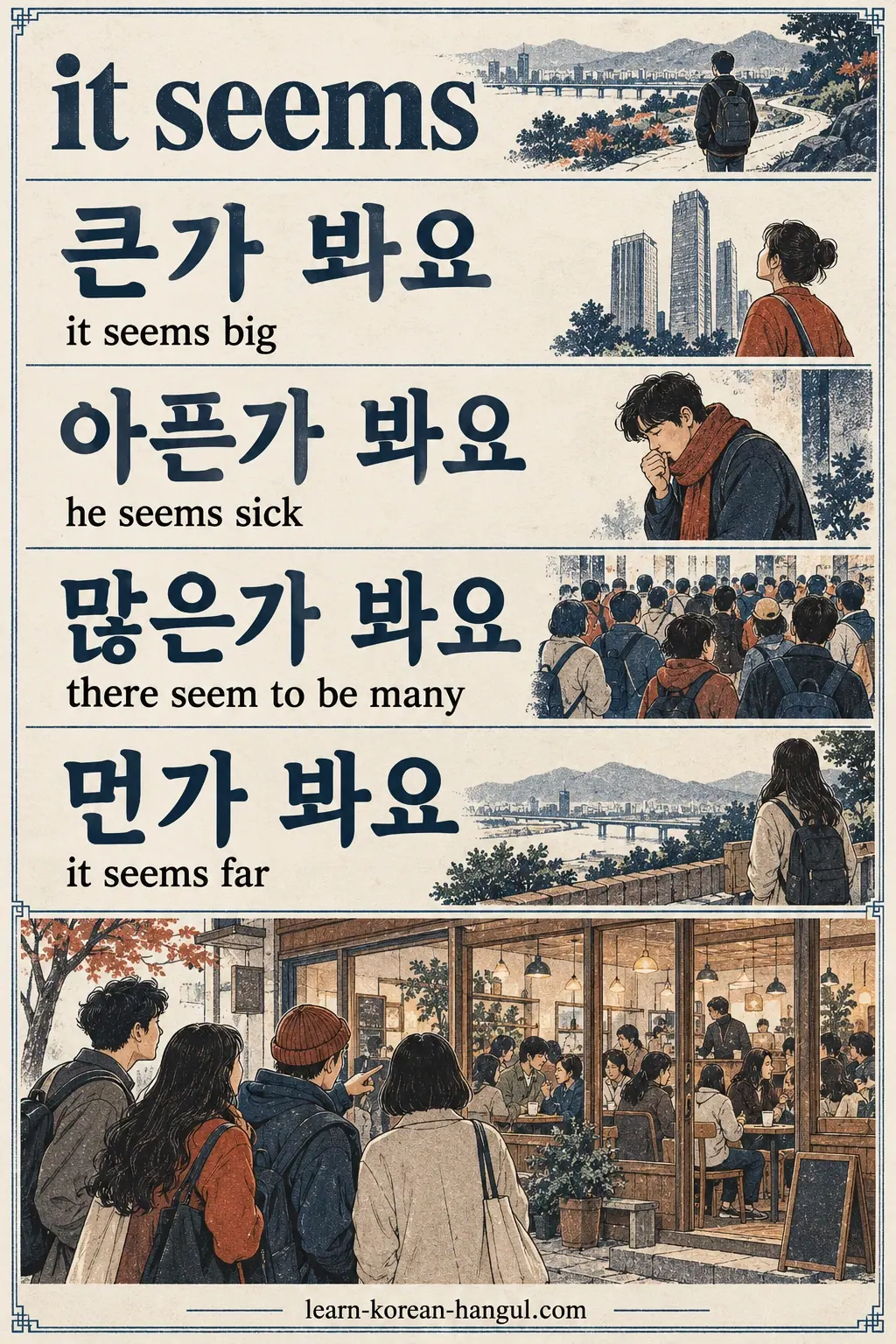
| 크다 | 크 | 큰가 보다 | 큰가 봐요 | it seems big |
| 아프다 | 아프 | 아픈가 보다 | 아픈가 봐요 | he seems sick |
| 많다 | 많 | 많은가 보다 | 많은가 봐요 | there seem to be many |
| 멀다 | 멀 | 먼가 보다 | 먼가 봐요 | it seems far |
| 어렵다 | 어려우 | 어려운가 보다 | 어려운가 봐요 | it seems hard |
| 부자 (noun) | 부자 | 부자인가 보다 | 부자인가 봐요 | he seems rich |
The table shows one idea: a vowel stem gets ㄴ, and a consonant stem gets 은. The next three parts take the groups one at a time.
Stems Ending in a Vowel
A vowel stem takes the ending by adding ㄴ to the last syllable. 크 becomes 큰, 아프 becomes 아픈, and 바쁘 becomes 바쁜. Then you add 가 봐요.
- 친구가 아픈가 봐요. (chinguga apeunga bwayo.) [친구가 아픈가 봐요] = "My friend seems to be sick."
- 아이가 키가 큰가 봐요. (aiga kiga keunga bwayo.) = "The child seems tall."
Vowel stems are the simplest case. A stem with a final consonant needs one extra vowel.
Stems Ending in a Consonant
A stem with a final consonant takes 은 before 가. 많다 becomes 많은가 보다, 좋다 becomes 좋은가 보다, and 작다 becomes 작은가 보다. The 하다 adjectives follow the vowel rule: 깨끗하다 becomes 깨끗한가 보다.
- 사람이 많은가 봐요. (sarami maneunga bwayo.) [사라미 마는가 봐요] = "There seem to be a lot of people."
- 방이 깨끗한가 봐요. (bangi kkaekkeutanga bwayo.) [방이 깨끄탄가 봐요] = "The room seems clean."
The final consonant of 많 links to 은, so you hear [마는가]. In 깨끗한가, the ㅅ is pronounced [ㄷ] and joins the ㅎ of 한, so the sound is [깨끄탄가]. The Revised Romanization shows this as kkaekkeutanga, because aspiration inside an adjective is written. Now for the stems that change shape.
Irregular Stems and Nouns
Irregular stems change as usual before a vowel, and ㄹ stems drop their ㄹ:
- ㅂ-irregular: 춥다 becomes 추운가 보다, and 어렵다 becomes 어려운가 보다: 오늘은 날씨가 추운가 봐요 ("The weather seems cold today").
- ㄹ stems: 멀다 becomes 먼가 보다, and 길다 becomes 긴가 보다. The ㄹ drops before ㄴ: 길이 먼가 봐요 ("The road seems far").
- ㅡ stems: 바쁘다 becomes 바쁜가 보다, and 슬프다 becomes 슬픈가 보다. The ㅡ stays, because the ending begins with a consonant.
- Nouns with 이다: add 인가 봐요. 선생님인가 봐요 means "He seems to be a teacher."
- Negative nouns: 아니다 becomes 아닌가 봐요: 학생이 아닌가 봐요 ("He doesn't seem to be a student").
Each of these forms follows the same logic as any ending that begins with ㄴ. With the formation clear, one full sentence can be built step by step.
Worked Example: Building a Sentence with -(으)ㄴ가 보다

-(으)ㄴ가 보다 grammar turns a plain adjective statement into an inference. Follow the steps with "This book is hard."
- Start with the plain sentence. 이 책이 어려워요. (i chaegi eoryeowoyo.) = "This book is hard." The predicate is 어려워요.
- Find the dictionary form. 어려워요 comes from 어렵다 (to be hard). The stem is 어렵.
- Fix the irregular stem. 어렵다 is ㅂ-irregular, so the ㅂ becomes 우 before a vowel: 어려우.
- Add ㄴ가 보다. 어려우 + ㄴ = 어려운, so 어려운가 보다.
- Choose the speech level. For polite speech, change 보다 into 봐요. Result: 이 책이 어려운가 봐요. (i chaegi eoryeounga bwayo.) = "This book seems hard."
Sentence
You will know it worked when the stem is followed by ㄴ or 은, then 가 봐요. The most common slip at this step is forgetting the irregular change and writing 어렵은가 봐요. The sentence now sounds like a conclusion. A conclusion can appear in several tenses and sentence types, and each has limits.
Which Tenses and Sentence Types Work with -(으)ㄴ가 보다?

-(으)ㄴ가 보다 works for statements about a present state or a past state. After the past marker -았/었-, the sentence takes the form -나 보다, because the past stem behaves like a verb. The last word 보다 changes only for the speech level. The table shows the forms for 아프다 in the polite style.
| What you mean | Form | Meaning |
|---|---|---|
| Present state | 아픈가 봐요 | He seems to be sick. |
| Past state | 아팠나 봐요 | He seems to have been sick. |
| Negative | 안 아픈가 봐요 | He doesn't seem to be sick. |
| Casual (banmal) | 아픈가 봐 | He seems sick (to a friend). |
| Formal | 아픈가 봅니다 | He seems to be sick (formal). |
| Written plain style | 아픈가 보다 | He seems to be sick (diary, story). |
The pattern is for statements. You cannot use it for a command, a suggestion or a plain question. It is also not used for the future: for a guess about tomorrow, use future guess -겠-, future tense -(으)ㄹ 거예요, or the patterns on the guessing pages.
- 어제 많이 아팠나 봐요. (eoje mani apanna bwayo.) [어제 마니 아판나 봐요] = "He seems to have been very sick yesterday."
- 집에 사람이 있나 봐요. (jibe sarami inna bwayo.) [지베 사라미 인나 봐요] = "There seems to be someone at home." (A light is on.)
The second example shows that 있다 and 없다 take -나 보다, even though 있다 looks like an adjective. The next section compares the two patterns directly.
How Is -(으)ㄴ가 보다 Different from -나 보다?
-(으)ㄴ가 보다 and -나 보다 mean the same thing, and only the word class before them is different. -(으)ㄴ가 보다 follows adjectives and nouns with 이다, while -나 보다 follows verbs and the words 있다 and 없다. Think of them as one pattern with two shapes, like a twin pair.
| Point | -(으)ㄴ가 보다 | -나 보다 |
|---|---|---|
| Attaches to | adjective, noun + 이다 | verb, 있다/없다 |
| Past form | 아팠나 봐요 | 왔나 봐요 |
| Meaning | it seems | it seems |
| Example | 아픈가 봐요. | 오나 봐요. |
| Meaning of example | He seems sick. | He seems to be coming. |
A practical rule: check the word before the ending. If you can say "to be ..." in English, such as "to be sick," use -(으)ㄴ가. The exceptions are 있다 and 없다, which take -나. If you can say "to do ...", use -나. Full rules for the verb side are on the page for -나 보다.
A second neighbour is -(으)ㄴ/는 것 같다, which also means "it seems." The difference is in how clear the clue is. 아픈 것 같아요 can be a gentle opinion, even a polite softener for something you know. 아픈가 봐요 always points to a clue and cannot soften an opinion. So you would say 이 노래 좋은 것 같아요 to be polite about your own taste, but not 이 노래 좋은가 봐요.
-(으)ㄴ가 보다
it seems: adjectives and nouns
-나 보다
it seems: verbs and 있다/없다
-(으)ㄴ/는 것 같다
it seems that: a general impression
| Comparison | -(으)ㄴ가 보다 | -나 보다 | -(으)ㄴ/는 것 같다 |
|---|---|---|---|
| Attaches to | adjectives, nouns with 이다 | verbs, 있다/없다 | verbs, adjectives, nouns |
| Evidence | clear clue | clear clue | clue or feeling |
| Can soften an opinion | no | no | yes |
| Example | 아픈가 봐요 | 자나 봐요 | 아픈 것 같아요 |
Use -(으)ㄴ가 보다 after adjectives and nouns, -나 보다 after verbs and 있다/없다, and -(으)ㄴ/는 것 같다 when you want a softer, less evidence-based opinion.
Now for variations you will hear in real talk.
Variations and Edge Cases of -(으)ㄴ가 보다

-(으)ㄴ가 보다 has a few common variations. They differ mostly in the speaker's role and the ending.
- Self-realisation. You can apply the pattern to yourself when your body gives the clue: 제가 피곤한가 봐요 ("I must be tired"), said after yawning. It cannot describe what you decide or what you know directly.
- With 아무래도. The adverb 아무래도 ("probably, on balance") often comes first: 아무래도 사람이 많은가 봐요. It adds the idea that the evidence is not complete.
- Reaction to news. When you hear something new, you can answer with the pattern: 그 사람이 부자인가 봐요 ("So he must be rich"), as a way to show you have taken it in.
- Honorific -(으)시-. Place it before ㄴ가 when the subject deserves respect: 선생님이 바쁘신가 봐요 ("The teacher seems busy").
- Noun phrases. For a noun, say 인가 봐요: 오늘이 휴일인가 봐요 ("Today seems to be a holiday"). Since the noun already has 이다, no other change is needed.
This lesson covers the common spoken forms. It does not cover the formal written equivalents, such as 아픈 것으로 보인다. The mistakes below show where learners go wrong.
What Mistakes Do Learners Make with -(으)ㄴ가 보다?

Learners most often use the wrong shape for the word class, forget the irregular change or use the pattern for facts. Four slips come up again and again.
- Using -나 보다 with an adjective. 아프나 봐요 breaks the textbook rule. Say 아픈가 봐요.
- Forgetting the irregular change. 어렵은가 봐요 is wrong. Use 어려운가 봐요. For ㄹ stems, drop the ㄹ: 먼가 봐요, not 멀은가 봐요.
- Using it for known facts. If you know it directly, say 아파요. 아픈가 봐요 needs a clue.
- Writing the words without spaces. 아픈가봐요 is common in texting, but standard writing separates 보다: 아픈가 봐요.
A quick check for any inference: Is there a clue? Is the word before the ending an adjective or a noun? Is the stem ending right? If all three answers are yes, the sentence is sound.
The practice set below tests these points directly.
Practice and Answers
Try the items before you read the answer key.
- Build the form. Write the polite -(으)ㄴ가 보다 form of 작다 ("to be small").
- Fix the error. A learner says 날씨가 춥나 봐요. Correct it.
- Choose the form. Which fits the verb 오다: 오나 봐요 or 온가 봐요?
- Write your own. Write one sentence about a classmate who looks tired, using -(으)ㄴ가 봐요.
Practice · 5
Which form is correct for "He seems to be rich" (부자 = rich person)?
Show answer
부자인가 봐요
Nouns take 이다 plus -ㄴ가 보다, which gives 부자인가 봐요.
How do you say "This book seems hard" with 어렵다 (ㅂ-irregular)?
Show answer
어려운가 봐요
The ㅂ becomes 우, so 어렵 becomes 어려우, and then ㄴ is added: 어려운가 봐요.
Which is right for "The road seems far" with 멀다?
Show answer
먼가 봐요
ㄹ stems drop the ㄹ before ㄴ: 멀 becomes 머, and then ㄴ is added: 먼.
Which means "He seems not to be a student"?
Show answer
학생이 아닌가 봐요
아니다 is an adjective-like word, so it takes -ㄴ가 보다: 아닌가 봐요.
Which pattern would you use for a verb, such as "It seems it is raining"?
Show answer
비가 오나 봐요
Verbs take -나 보다. -(으)ㄴ가 보다 is for adjectives and nouns.
Answer key
- 작은가 봐요. 작 ends in a consonant, so 은 is added.
- 날씨가 추운가 봐요. 춥다 is ㅂ-irregular, so 춥 becomes 추우, and ㄴ is added.
- 오나 봐요. Verbs take -나 보다, and -(으)ㄴ가 is for adjectives and nouns.
- Answers vary. Check that the adjective stem is followed by ㄴ or 은, then 가 봐요. An example: 민수 씨가 피곤한가 봐요. ("Min-su seems tired.")
If you can answer items 1 to 3 without the key, you can use the pattern in conversation. Next, the lesson points to related patterns.
What Should You Learn Next after -(으)ㄴ가 보다 Grammar?
After -(으)ㄴ가 보다 grammar, learn the verb twin, then the more flexible impression pattern, then the future forms. This lesson teaches the adjective and noun side and does not cover verbs in depth.
- Start with -나 보다, the verb version of the same idea.
- Continue with -(으)ㄴ/는 것 같다, which covers present and past impressions and can soften an opinion.
- Review the future with future guess -겠- and future tense -(으)ㄹ 거예요.
- Return to Guessing and Conjecture to see every lesson in this set, or to the Intermediate Grammar list for other B1 patterns.
With these steps, the pattern becomes automatic: check the word class, add ㄴ or 은, then 가 봐요, and always have a clue.
Frequently Asked Questions
What does -(으)ㄴ가 보다 mean?
-(으)ㄴ가 보다 means "it seems" or "it looks like." The speaker uses evidence, such as a look, a sound or a behaviour, to reach a conclusion about a state. 친구가 아픈가 봐요 means "My friend seems to be sick." It sounds like thinking aloud, as if the speaker has just worked something out.
How do I attach -(으)ㄴ가 보다 to a verb or adjective?
Drop 다 from an adjective. After a vowel, add -ㄴ가 보다: 크다 becomes 큰가 보다. After a consonant, add -은가 보다: 많다 becomes 많은가 보다. ㄹ stems drop ㄹ: 멀다 becomes 먼가 보다. Nouns use -인가 보다: 부자인가 봐요. Verbs and 있다/없다 take -나 보다 instead.
Can -(으)ㄴ가 보다 be used in the past tense?
Yes. Put -았/었- before the ending: 어제 많이 아팠나 봐요 means "He seems to have been very sick yesterday." After the past marker the adjective form is the same as a verb, so -나 보다 is used. The sentence also reports what the evidence suggests, not what the speaker saw happen.
Is -(으)ㄴ가 보다 used in speech or only in writing?
It is mostly spoken. People say 아픈가 봐요 in conversation and 아픈가 봐 to friends. In formal speech, 아픈가 봅니다 is possible, and in writing the plain form 아픈가 보다 appears in diaries and stories. News and reports prefer 아픈 것으로 보입니다, which is more objective.
What is the most common mistake with -(으)ㄴ가 보다?
The most common mistake is attaching -나 보다 to an adjective, as in 아프나 봐요. The textbook rule gives adjectives and nouns -(으)ㄴ가, so say 아픈가 봐요. A second mistake is using the pattern for something you know directly, such as your own name or a fact you have just seen with your own eyes.
Can I use -(으)ㄴ가 보다 about myself?
Yes, when you realise something about yourself from evidence. 제가 피곤한가 봐요 means "I must be tired," said after yawning. It cannot be used for what you directly decide or know, such as a plan. The pattern always points to a clue, and the clue can be about your own body or behaviour.